Research on the expansion and development of Ulaanbaatar City based on satellite city theory
2020-05-25 17:56:25BAT-ERDENESUVDMAA
科學(xué)與財富 2020年9期
關(guān)鍵詞:城鄉(xiāng)規(guī)劃
BAT-ERDENE SUVDMAA
Abstract:Currently, With the rapid urbanization, the problem of big cities is becoming increasingly serious. To relieve the pressure of population growth in the city center , expand the space for new urban development, optimize the urban structure and enhance the comprehensive competitiveness of the city has become? key issues in the planning and construction of the big city.
The city selected in this paper is ulaanbaatar, the capital of Mongolia. Ulaanbaatar is the economic, political, commercial and cultural center of Mongolia. Ulaanbaatar is the largest city in Mongolia and also the political, economic and transportation center of the country. Chinese and Russian railways run across ulaanbaatar to the north and to the city of erenhot in China's Inner Mongolia autonomous region to the south. There are many industries near the city, mainly coal. Most of the division of labor and enterprises are located here. The industry sector is mainly light industry and food industry. The total industrial output value of the whole city accounts for more than half of the total industrial output value of the whole country. And the national transportation center is also the capital city of ulaanbaatar. Mongolia has a social problem of uneven population distribution. The total population of ulaanbaatar is nearly half of the national total. According to the population density per square kilometer, the population of ulaanbaatar is human, while only people in the eastern region, the central region and the western region. n recent years, the urbanization level of ulaanbaatar has been developing rapidly and the urban appearance is becoming increasingly updated. However, the construction of urban supporting facilities cannot catch up with the pace of urban development. To solve this problem, it is necessary for us to conduct a detailed study on the urban expansion of ulaanbaatar.
Key words: the expansion,? development, Satellite city theory, Ulaanbaatar city,
1. Introduction
Development and research status of satellite cities at home and abroad
The term satellite city originated from Howard's theory of garden cities. Howard originally wanted to establish some "garden cities" on the edge of cities, and later Taylor in the United States formally proposed it in 1915 [1].Many foreign scholars also mentioned satellite cities in their studies, such as the "organic evacuation theory" proposed by Finnish architect ariel saarinen in order to alleviate the over-concentration of cities [2].The encyclopedia britannica defines satellite city as a planning form that aims to gradually become a relatively independent new city by resettling population on the edge of large cities, building housing and hospitals, forming local leading industries, and setting up cultural and commercial centers [3].China's satellite cities began to develop in 1950, when they only chose the suburbs of some important industrial cities to develop state-owned industries. On the basis of summarizing the predecessors, Chinese scholars put forward some relevant theories in combination with China's national conditions. For example, kong xiangzhi et al. [4] analyzed the current situation and existing problems of the development of satellite cities of Beijing, proposed to build "main industry urban area" participating in the big circulation of regional central cities, and carried out the division of functions, accelerated the cultivation of leading industries, and formed the leading model of suburban urbanization of Beijing. Taking satellite cities of Beijing as an example, qiu baoxing et al. pointed out several key points of satellite city planning, including highlighting urban design, optimizing urban traffic, regulating non-construction space, reflecting resource conservation, preventing social stratification and other important aspects [5].Satellite cities have experienced four stages of development [6] : in the first stage, satellite cities are known as sleeping cities. Residents' work and entertainments are still in the main city. Its purpose is mainly to solve the housing problem and reduce the housing burden of the population in the main city. In the second stage, satellite cities have a certain number of factories and supporting public facilities, which can solve the employment problem of some local people. When satellite cities reach the third stage of development, their public facilities are basically complete and their functions are relatively independent, which can provide a large number of employment opportunities. Satellite city developed to the fourth stage, its function is perfect, convenient transportation, can operate independently from the main city. Since the second world war, satellite cities have developed rapidly, and the number and area of satellite cities have been expanding. The rapid expansion of urban centers has brought about a series of urban diseases, and the capacity of urban centers is facing new challenges. But the question of how far a city can grow to fit a satellite city, and how far a large city can fit several satellite cities, raises new questions.
The role of the satellite cities
The issue of reducing urbanization is not only a concern in Ulaanbaatar. There are still problems associated with it in major cities around the world, and it is being solved by many ways.
The role of the satellite city is enormous in solving such problems as population concentration and construction. Because the satellite city takes on the problematic issue of the capital city, and it helps to solve the problem.
China, where concentration and regional development accelerates,? very fast focuses on the planning of its satellite cities.? If suburbs develops into satellite city, the chance of people not moving to Ulaanbaatar will be opened. On the other hand, the satellite city needs to operate specifically on this? policy that based on such? advantage as the mining industry. It plays important role in the development of the large city..
2. Current situation analysis of the research area
The foundation for creation of the satellite city
Ulaanbaatar has 9 districts, of which 3 are away from the city. We need to focus at the following issues such as these districts will be released from Ulaanbaatar, and will be developed as an independent city.
For districts of Baganuur, Bagakhangai, and Nalaikh, even Administrative Unit have separated from Ulaanbaatar. Thus it has lacked that these districts develops comparison with central 6 districts. So it is clear method , which distant districts will be developed as satellite and independent.
Today, air pollution and excessive traffic overload has become the problematic issue of Ulaanbaatar Therefore, there is a need to intensify the concentration in Baganuur.? If we can do it, we will solve the problematic issue in Ulaanbaatar.
Baganuur district is the farthest district 130 kilometers east of Ulaanbaatar. It was founded in 1980. It has 41.6 thousand hectares, 5 administrative committees, and 40000 population. The largest coal industry in Mongolia, the main basis of development, was founded in 1978 and Baganuur district is developing on this basis.
Urbanisation
The population of Ulaanbaatar has increased from 590,000 in 1990 to , 640,000 in 1995, 790,000 in 2000 to, 970,000 in 2005 and 1 130,000 in 2010. The proportion of Ulaanbaatars population in Mongolians population increased from 27% in 1990 to 41% in 2011 because in the 1990's, it moved to a market economy, and concentration of the population towards the capital due to the rapid economic growth of the 2000's. Even further, the concentration will tend to increase. Over the last 20 years, Ulaanbaatars population has grown by 3.3%, with an average population growth of 1.3%. But even population growth was 4% from 1995 to 2005, tend to decrease slightly to 3.2% since 2005, and has been increased an average of 340,000 people per year.
Population distribution in Ulaanbaatar
The total area of Ulaanbaatar has 395.42 5 hectares and 275,409 hectares of that has housing and ger areas. Housing is 11.8% of the total building area and 88.2% is ger area.? As of January 1, 2011, the total population of six central districts was 1,099,775 from it 424,219 or 38.6% are living in apartment, and 675,556 or 61.4% are living in ger areas.? The average population density is 183 people/hectare in the ger area and 26 people/hectare in the ger area.
Population perspective
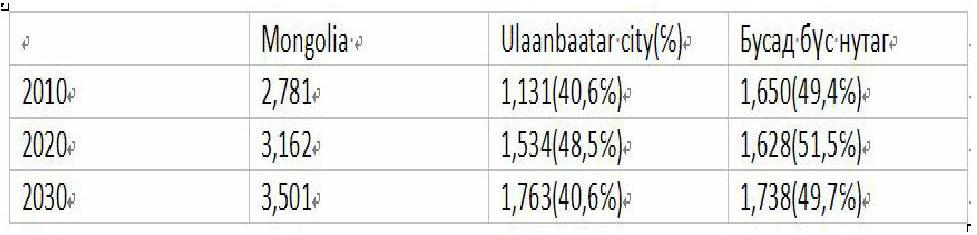
The population of Ulaanbaatar in the population of Mongolia has been shown in following 41% in 2010 will equal the half of total population by 2030.
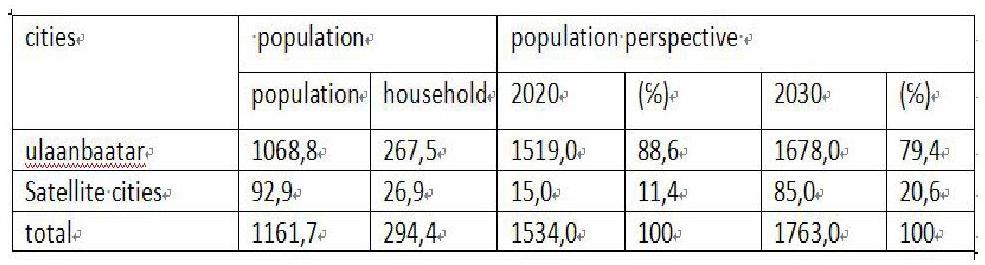
The population perspective of Ulaanbaatar has being shown in following and by 2030, the population of Ulaanbaatar will reach 1,760,000, of which 850,000 plan to move to satellite cities.
If we aim to develop Ulaanbaatar as an environmentally friendly (eco) and compact city, population density should be increased rather than chaotic expansion of the built-up area. When a subway will be commissioned, it will become an environmentally friendly city so that the population move to area near the station that was provided comfortable condition of transportation.
The outcome of policy that the population flow which move to Ulaanbaatar until 2020 will slow down may not be real and population concentration is likely to increase at this rate. As a result, the population of the urbanized area (district 6) is estimated to be 1,140,000.
In 2030, in Ulaanbaatar City Planning Research has planned to support satellite city. Following that, the density growth will reduce significantly, however, the total population growth will be same. The data shown that the population of the 6 districts of Ulaanbaatar will reach 1 763 000 if the density increases.
3.? Research methodology
The methods to develop satellite city
The satellite city of the major cities should be located in a distance of 40 to 50 km away. Therefore, a highway is the most important commuting system. Satellite city should be convenient and close to reach in order to solve the major issues in the core city which is caused due to population density.
For example: the satellite city can consist of only apartments. This provides residence to the people and will be the place for living for the people.? Satellite cities can have developed industries and no administrative unit. Also there can be independent satellite city. This kind of satellite city must have its own administrative units. Then the city would develop as an independent city since there is industries as a work unit and apartments as a residency.
The scope
This issue should consist of 3 major problems which are as follows.
First, to reduce the centralization
Second, to give more power and independence to the administrative units and support its independency.
Third, to develop cities with citizens with scientific approach. In this method, we have to see it from legal view.
In a Mongolian City and Province Development Law, administrative unit is not specified in terms of role and its operation limit. Due to the incomplete specification of administrative unit operation, governmental unit is able to interfere directly to the budget of city development. It is big problem for developing cities.
In the constitution, it is written that satellite cities are allowed to be developed. In 1993, Mongolia approved the law for satellite city development and current satellite cities have been developed. On the other hand, for the budget, Mongolian government is following its governance law. According to the governance law, Mongolia is divided into city, province, sum, district, khoroo, and bag. Therefore, the person who assign the budget does not have the power as a mayor causes conflicted problem. In other words, in order to develop satellite city legally, its mayor has to have a power to assign and spend the budget for the city. However, Mongolian Governance law requires permission from mayor of core city, Ulaanbaatar.
4. Research finding
Possibility to develop independent system
Baganuur is a satellite city of Ulaanbaatar city. Baganuur is developed to support Ulaanbaatar city and has Mongolian largest open pit coal mine. Thus the city has many plans that based on mining to develop the city. However, one issue is the aging process of mining city. If the city has 50-100 years of resource to mine, aging issue becomes major. Baganuur has 150 years of reseource. Therefore, there should be a discussion if the city only has 150 years of age. Consequently, the other question if the development of the city is 150 years. Baganuur plans its development plan within 20 to 30 years and it would be only 5-6 times of planning. In order to talk about the development of the city, it is necessary to take into account for it budget resource. If the first resource of the budget is mining, the second and the third resource should be determined thoroughly. Therefore, it is important to develop a plan that ensures sustainable city that is relied on other source not only mining around 100 years later.
To support the citizens education
Thirty six percent of the population of the Baganuur city is 13-36 yers old. However, there is lack of educational centers such as university and other cultural centers. It causes the people who live there to move to Ulaanbaatar city. Therefore, building branch campuses of universities can directly affect to people movement to the core city.
Government support for industries of satellite city to make it independent
To support people who own agricultural industry in order to develop agricultural industry
To increase number of travelling places and cultural centers.
Improve living environment and support society
To improve common areas for citizens and build clean futuristic city
To improve safety and add CCTVs in the street
To improve gardening in the streets
To improve reusing and recycling by building recycling factories and supporting people who work there
To improve and boost technologies and policies for rehabilitation
To improve transits and roads
5. Discussion and Conclusion
Proposing idea
Build residency for students
Current satellite cities are optimal choice for building residency for students. Ene uguulberiig oilgosongui. The satellite city development should be based on the research. The city has to be resourceful for engineers and provide transportation system. The city would be comfortable and convenient for students to live in. The idea to move major universities to satellite cities have been proposed for Mongolian future plan of 2030. However, they are not approved successfully.
To develop industries
Baganuur transit system is expandable as it is connected with Ulaanbaatar city by road and railway. Small industries should be moved to satellite city taking an advantage of this transit system. Taking into account for resources and geopolitical location, the following industries can be moved to Baganuur city.
Fuel industry, Smoke free coal industry, Filtering coal industry, Meat industry for exporting, Construction material industry, Iron and steel industry, Pesticide industry Etc.,
Conclusion
The most important part for planning the development of satellite city is to take into account the advantage of remote districts geopolitical location. Baganuur is suitable satellite city that can be developed not only based on coal, but various kinds of industries. Baganuur district has a huge potential to be developed as a industrial city basing on the coal mining. The industries consist of coal based products and electric power industry. In order to achieve that potential, preparing investor friendly environment for national and international investment is important. One more important role of this satellite city is to build shipping and delivery centers. Baganuur can play big role for regulating bidirectional transit and delivery systems that comes from East provinces.? Set of policies can be implemented to achieve that. Current population of Baganuur city is 26000 and the tendency shows that it would be around 45000 in 2030. If the appropriate policies are put in place and the development techniques mentioned above are implemented, the population would be increased further. Therefore, in the future, the density growth of Ulaanbaatar city will be reduced and be helpful to the economy and development of the core city.
作者簡介:
BAT-ERDENE? SUVDMAA,出生年月:1991.07.26,性別:女,國籍:蒙古國,籍貫(城市):蒙古國烏蘭巴托市,學(xué)歷:碩士,職稱:研究生學(xué)生,研究方向或從事工作:城鄉(xiāng)規(guī)劃學(xué).
猜你喜歡
建材發(fā)展導(dǎo)向(2021年20期)2021-11-20 05:42:26
湖北農(nóng)機(jī)化(2020年4期)2020-07-24 09:07:12
湖北農(nóng)機(jī)化(2020年4期)2020-07-24 09:07:10
江西建材(2018年4期)2018-04-10 12:36:56
中國房地產(chǎn)業(yè)(2016年9期)2016-03-01 01:26:27
河北城市研究(2016年4期)2016-02-17 07:22:32
機(jī)電信息(2015年28期)2015-02-27 15:58:26
江蘇年鑒(2014年0期)2014-03-11 17:09:41
浙江科技學(xué)院學(xué)報(2014年1期)2014-02-28 22:11:50
河南科技(2014年3期)2014-02-27 14:06:07