A Comparative Study of Conceptual Metaphors in Chinese and English Idioms
2019-11-06 03:45:11陳明
校園英語·上旬 2019年10期
【Abstract】This paper comparatively analyzes the CM, PEOPLE ARE ANIMALS, in Chinese niu idioms and English cattle idioms. With the methods of introspection and comparative analysis, it is found that (i) Chinese and English animal idioms are metaphorical in nature. Three CMs occur universally, five are Chinese-specific, and two are English-specific. (ii) The same CMs are motivated by shared embodied experience, while differences rise from distinctive social contexts, cultural backgrounds and religious influences.
【Key words】CM; PEOPLE ARE ANIMALS; niu idioms; cattle idioms
【作者簡介】陳明,東北師范大學外國語學院英語語言文學。
1. Introduction
Conceptual Metaphors (CMs) are prevalent in language and they are a powerful cognitive tool for people to conceptualize the world (Lakoff & Johnson 1980). In Chinese and English, a number of CMs are related to animals, one of which is PEOPLE ARE ANIMALS (K?vecses 2002). This CM is a crucial means for human to perceive themselves and it mirrors the process in which humans perceive themselves as animals of particular kinds. This study compares animal idioms between Chinese and English and it identifies motivations of the CM so as to disclose the cognitive mechanism underlying the idioms and promote learners comprehension of the idioms in L2 communication.
Cattle are one of the animals that are close to daily life. There are numerous idioms related to cattle in Chinese and English. Therefore, this study takes Chinese niu idioms and English cattle idioms as cases and compares the CM in the two languages.
2. Research methodology
2.1 Data Collection.This study sampled idioms from four authoritative dictionaries, namely Chenyudacidian (2014), Xiandaihanyucidian (2016), Oxford Dictionary of English Idioms (1994), and Cambridge International Dictionary of Idioms (1998). It is noteworthy that this study equated Chinese word niu with four English words cattle, bull, ox and calf. That is, four English words were node words when English idioms were retrieved.
2.2Research Methods.Research methods included introspection and comparative analysis. First, I identify the aspects of source domain that were mapped onto target domain and analyze the motivation of CMs with introspection. Second, I comparatively analyze CMs between Chinese and English idioms.
2.3 Research Questions.The present study intends to address three research questions:
(1)What are the similarities in CMs between Chinese and English idioms?
(2)What are the differences in CMs between Chinese and English idioms?
(3)What are the motivations of CMs in Chinese and English idioms?
3. Results and Discussion
3.1 Similarities and Differences in CMs.The following section first demonstrates the similarities between Chinese and English idioms, with examples provided whenever necessary. Then it shows the differences in CMs between the two languages.
Chinese and English share the following five CMs in general. First, A FIT AND STURDY MAN IS A CATTLE. In both languages, plenty of idioms metaphorically attribute the physical structures of cattle to humans. For example, there are “牛高馬大”, “氣喘如牛” in Chinese and “as strong as an ox” in English. Second, A STUPID MAN IS A CATTLE. Idioms of this category include “對牛彈琴”, “牛嚼牡丹”, “牛驥同槽” in Chinese and “a bull in a china shop”, “as awkward as a cow on a roller skates” in English. Third, A STUBBORN MAN IS A CATTLE. As cattle are generally perceived as animals that refuse to change the course once destination was set. People transfer this perception onto the concept of HUMAN. Therefore, there are idioms “倔牛”, “牛脾氣” and “bull-headed” in two languages.
Apart from similarities, the two languages also possess their unique CMs. Of the CMs summarized, five are specific to Chinese and two are limited to English. Specifically, Chinese-specific idioms depict both positive and negative features of humans, while English-specific ones merely capture negative features.
The Chinese-specific idioms include the following five. First, PARENT-CHILD RELATIONSHIP IS COW-CALF RELATIONSHIP. Chinese idioms include “老牛舐犢”, “舐犢情深”, “護犢子”, etc. Chinese people are inclined to map the cow-calf relationship onto PEOPLE domain. Thereby, the behavior of parents doting on their children is understood metaphorically in terms of an old cow licking her calf. Second, AN INDUSTRIOUS MAN IS A CATTLE. Many Chinese niu idioms extol the diligent trait of people, such as “孺子牛”, “老黃牛”, etc. Third, A YOUNG MAN FEARLESS OF AUTHORATIES IS A CALF. The typical example is “初生牛犢”. In this case, the fearless nature is mapped onto PEOPLE domain, so that a young man who is brave enough to challenge the authorities is metaphorically reckoned as “牛犢”. Fourth, A MAN LEADING A TOUGH LIFE IS A CATTLE. The corresponding expression is “牛馬生活”. Fifth, A VILLIAN IS A CATTLE. Typical examples are “牛鬼蛇神”, “牛頭馬面”, etc.
Additionally, two English-specific idioms are as follows. First, AN IRRITABLE MAN IS A BULL. The idioms cover “a red rag to the bull”, “raging bull”, etc. Second, A CHILDISH MAN IS A CALF. The example is “calf love” which denotes the immature and fanatical love relationship between the young.
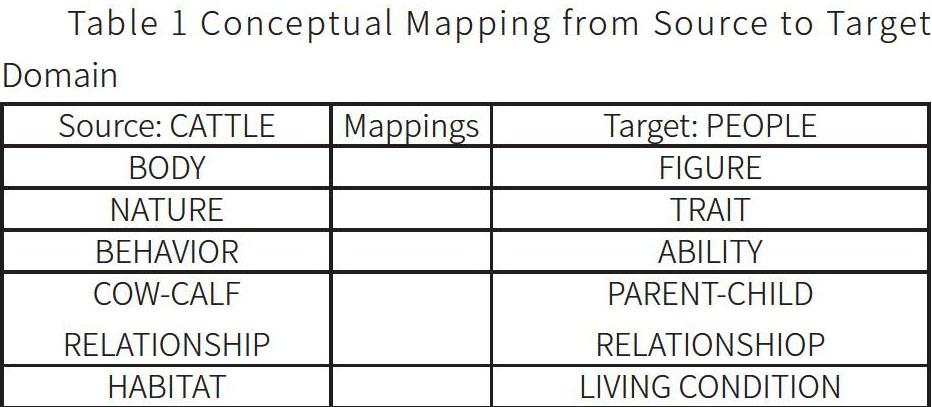
To conclude, CATTLE concept is used as source domain, whereby more abstract PEOPLE concept is interpreted. Comparative analyses reveal that five aspects, including BODY, NATURE, BEHAVIOR, COW-CALF RELATIONSHIP and HABITAT in CATTLE domain are mapped onto PEOPLE domain (see Table 1).
3.2 Motivation of Animal Metaphors.Four factors are summarized to expound similarities and differences in CMs between Chinese and English, which include shared embodied experience, social contexts, cultural backgrounds and religious influences. The first explicates the similarities in CMs, while the last three illuminate the differences between the two.
The first factor is shared embodied experience. K?vecses (2002) notes that the metaphorical mappings between conceptual domains are motivated by human experience with the world. As humans are endowed with a species-specific view of the world because of their same physical structure, it makes sense that they perceive cattle in similar manners. That is, cattle are a kind of animals that have huge bodies and are physically inactive. As a result, the CMs, A FIT AND STURDY MAN IS A CATTLE, A STUPID MAN IS A CATTLE and A STUBBORN MAN IS A CATTLE are universal in both languages.
The second factor which motivates the metaphorical distinction is social contexts. As cattle in ancient China are the main labor force to cultivate lands, the Chinese owed a debt of gratitude to cattle. They gradually endowed the cattle with the admirable trait and this trait later metaphorically re-characterized human beings. Examples are “老牛舐犢”, “老黃牛”, etc. In contrast, no equivalents are found in English because westerners relied on cows to a lesser extent than the Chinese. Instead, horses played a crucial role in western countries, as horses are a major transport. As a result, some horse idioms function in similar ways as niu idioms, such as “as strong as a horse”, “work as a horse” and “wheel horse”. The corresponding CMs are A STRONG MAN IS A HORSE and AN INDUSTRIOUS MAN IS A HORSE.
The third factor that leads to the distinction is cultural backgrounds. As noted earlier, Englishmen delineate irritable men in terms of bulls, such as “a red rag to the bull” and “raging bull”. However, no equivalents occur in Chinese. The distinction might be ascribed to different cultural backgrounds. Western society is known for its bullfighting culture. That is, bullfighters provoke bulls by placing a red rag in front of their eyes. Consequently, the bulls leave a negative and violent impression on western people and they employ this perceived nature of bulls to describe bad-tempered men. The CM of AN IRRITABLE MAN IS A BULL thus arises.
The fourth factor is religious influences. It specifically explicates the CM, A VILLAIN IS A CATTLE, in Chinese idioms “牛頭馬面” and “牛鬼蛇神”. The two idioms are traceable to Buddhism. Originally, they referred to ox-headed and horse-faced demons in Hell who served to catch the dead spirit. Gradually, they metaphorically describe villains in real life. However, no such an image exists in Christianity, so no equivalent is found in English idioms.
4. Conclusion
Taking Chinese niu idioms and English cattle idioms as examples, the present study found that animal idioms in both languages are metaphorical in nature. Of the ten CMs summarized, three occur universally, five are Chinese-specific, and two are English-specific. The similar metaphorical mappings in Chinese and English are motivated by embodied experiences with the world, whereas different mappings are ascribed to distinctive social contexts, cultural backgrounds and religious influences.
References:
[1]K?vecses, Z.. Metaphor: A Practical Introduction[M]. Oxford: Oxford University Press,2002.
[3]Lakoff, G. & M.. Johnson.. Metaphors We Live by[M]. Chicago: The University of Chicago Press,1980.