The Differences between Tibetan and Hindi Vowels
2019-10-08 14:54:15范曉婷
校園英語(yǔ)·中旬 2019年9期
關(guān)鍵詞:大學(xué)
【Abstract】Although Tibetan and Hindi belong to different language families, both languages were influenced by Sanskrit in the history. This lays a foundation to compare the voices of two languages. This article attempts to present differences in quantity, writing rules and pronunciation between these two languages, in order to analyze and understand the characteristics of Tibetan students when they learn Hindi vowels.
【Key words】differences; Tibetan; Hindi; vowels
【作者簡(jiǎn)介】范曉婷,現(xiàn)就職于西藏民族大學(xué)外語(yǔ)學(xué)院,碩士研究生,研究方向:印度語(yǔ)言文學(xué)。
【基金項(xiàng)目】西藏民族大學(xué)教學(xué)改革與研究青年項(xiàng)目“印地語(yǔ)語(yǔ)音教學(xué)中學(xué)生面臨的問(wèn)題與解決策略”,編號(hào):2018402。
1. Introduction
Hindi is one of the official languages of India, which belongs to the Indo-European language family. It is a modern language developed from the ancient Sanskrit language, and the language of people who living in Delhi, Uttar Pradesh, Uttar Khand and other parts in Northern India. In the process of its formation, it accepted the influences of other languages, such as Persian, Arabic and English. In addition, Hindi is the most popular language in India, and it is also popular in other countries with large Indian dwellers. Compared with Hindi, the Tibetan language belongs to the Sino-Tibetan language family. Lhasa Tibetan language is a kind of phonetic alphabet created according to the Indian ancient Sanskrit grammar rules and phonetic features.
Tibetan and Hindi belong to different language systems, but they were both influenced by Sanskrit in terms of the pronunciation of the two languages. This lays a platform for comparing the voices of the two languages to a certain extent. This article attempts to highlight some of the differences between these two languages.
2. Differences?
There are some similarities between the two languages vowels in terms of scripts and pronunciation. However, several dissimilarities and differences do exist between these two languages in quantity, writing rules and pronunciation.
2.1 Quantity
In terms of quantity, the number of Hindi vowels is seven more than Tibetan, which makes the Hindi consonants and vowels together to have more word changes. There are 11 Hindi vowels, including 8 Unit sounds (a, aa, i, ii, u, oo, e, o) and 2 composite vowels (ai, ao), and a special vowel “ri”. In addition to “ri”, other vowels have a double vowel corresponding to it.
On the other hand, there are 4 symbols of vowels: i, u, e, o. The four vowel symbols have their own names: kivguf, xabvjuf, nzhenggvbof, navrof, which are not the same as the pronunciation of vowels. In history, the famous Tibetan linguist and translator, Twain Sambuca, had studied in India for 13 years. He used the Sanskrit alphabet as a model, and combined it with Tibetan languages characteristics to create the 30 Tibetan basic letters. For example, the 4 Tibetan vowels were created from 16 vowels of Sanskrit.
2.2 Writing rules
The letter used in modern Hindi is called Devanagari, which is a kind of pinyin text, and each letter has its own form of writing. The vowels in Hindi can be used alone, or used in conjunction with consonants. When the 11 vowels of Hindi are combined with consonants, “aa, ii, o, ao” are written to the right of consonants, and “i” is written to the left of consonants, and “u, oo” are written below the consonants, and “e,ai” are written above the consonants. In addition, there are two special writing rules should be mentioned. The first one is when the vowel “a” is implicit after all consonants, the vowel loses its own writing shape. Another one is when “u, oo” are used with consonant letter “r”, they should be written to the right side of “r”, not below “r”.
There are just 4 symbols of vowels in Tibetan “i, u, e, o”. They must be combined with consonants to be used. The Tibetan character-shaped structure is centered on one letter, and the rest of the letters are added to the top and bottom, then combined into a complete word table structure. When the four vowels of Tibetan are combined with consonants, they can be indicated by using a variety of diacritic. For example “u” is written below the consonants, and the other three vowels “i, u, e” are written above the consonants.
In addition, the shape of vowel symbols of Tibetan, “u, e” are similar to Hindi vowel “u” and “e”, but the other vowel symbols of Tibetan are different from Hindi.
2.3 Pronunciation
The vowels are described and defined in three aspects: 1)the airflow is not obstructed in the oral cavity when the vowel is emitted; 2)the entire vocal tract is kept tense when the vowels are emitted; 3)the vocal cords are generally vibrated when the vowels are emitted.
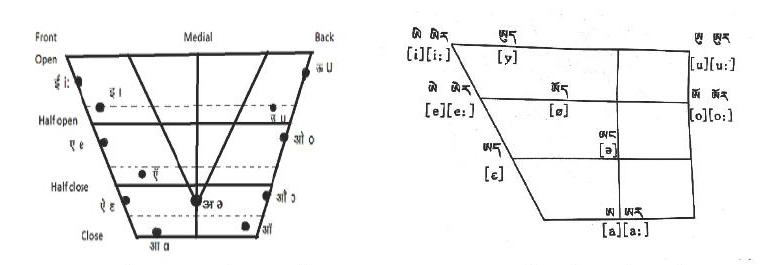
The vowel chart is a diagram to help understand vowel sounds, which tries to present where the tongues should lie in relation to the openness of mouth when people produce a vowel. Figure 1 and Figure 2 are the vowel chart of Tibetan and Hindi. The four horizontal lines in the figure indicate the height of tongue position, which are open, half open, semi-closed and closed from bottom to top. Three vertical lines in the figure indicate the front and rear of the tongue position, and from left to right are front, middle and back.
Figure 1 shows that there are 4 symbols of Tibetan, but there are14 vowel sounds in the Tibetan. Figure 2 shows that there are 11 vowels in Hindi, as the same as the number of the vowel sounds. This is a big difference between two languages vowel.
Sometimes when the Tibetan students learn Hindi, they will sense the similarities in the pronunciation of Tibetan and Hindi. However, comparing the position of the vowel “i” in Tibetan and that in Hindi shows that the “i” in Tibetan is little more closed than that in Hindi in terms of the openness of mouth, although they both are pre-tongue vowels. In addition, this phenomenon also could be found in other vowels.
3. Conclusion
This article has reviewed three aspects of the differences between Tibetan and Hindi vowels and the findings are listed below:
1) In terms of quantity, the number of Hindis vowels are more than Tibetan.
2) The writing rules of Tibetan is more complex in comparison to Hindi. Tibetan vowels must be combined with consonants to be used. In contrast, every vowel of Hindi have its own shape and can be used alone.
3) Although the number of Hindi is more than Tibetan, the number of the vowel voices of Tibetan is about as the same as Hindis.
Therefore, by knowing these findings will help to understand the characteristics of Tibetan students when they learn Hindi vowels.
猜你喜歡
中學(xué)生天地(A版)(2022年6期)2022-07-14 12:39:26
大學(xué)(2021年2期)2021-06-11 01:13:48
大學(xué)(2021年2期)2021-06-11 01:13:12
海峽姐妹(2020年12期)2021-01-18 05:53:08
文苑(2020年8期)2020-09-09 09:30:16
民主與法制(2020年16期)2020-08-24 06:54:50
新世紀(jì)智能(英語(yǔ)備考)(2020年6期)2020-08-14 01:06:20
華人時(shí)刊(2017年13期)2017-11-09 05:39:29
浙江工業(yè)大學(xué)學(xué)報(bào)(社會(huì)科學(xué)版)(2017年3期)2017-10-13 02:23:52
中國(guó)現(xiàn)當(dāng)代社會(huì)文化訪談錄(2016年0期)2016-09-26 08:46:07