B超探測胃內殘余量分析兩種禁飲禁食方式對斜視手術兒童的影響
2019-09-29 06:54:17陳超巧金約西程丹卓然姜愛芬
中國現代醫生 2019年21期
陳超巧 金約西 程丹 卓然 姜愛芬
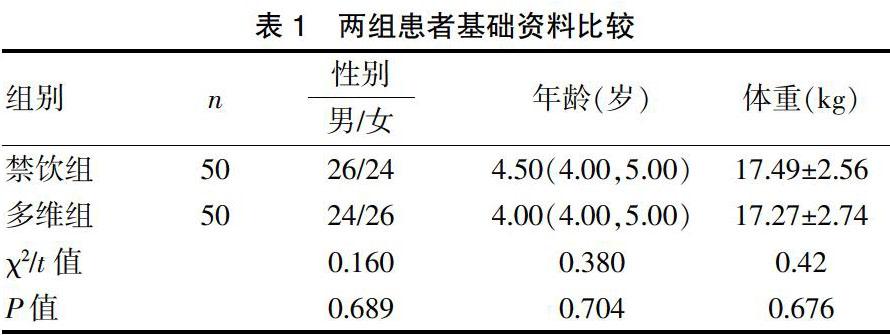
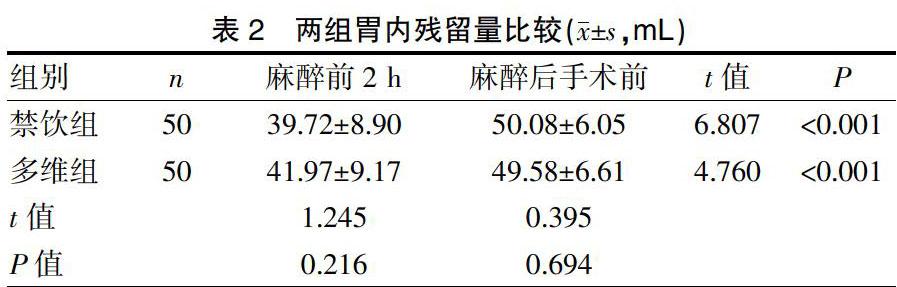

[摘要] 目的 利用B超探測胃內殘余量分析兩種禁食方式對斜視手術兒童的影響。 方法 選取本院2017年6月~2018年6月需全麻下行斜視矯正術3~6歲兒童100例,隨機數字表法分為禁飲組與多維組,各50例。兩組術前8 h禁食固體食物,禁飲組術前4 h禁止清飲,多維組術前2 h飲用5 mL/kg的多維飲料。兩組均在麻醉前2 h及麻醉后即刻B超測定胃內殘量;術前以及術后3 h測量血糖、胰島素;麻醉前記錄饑餓感指數;麻醉后記錄患兒蘇醒質量。 結果 B超探測兩組麻醉前2 h胃內殘余量(多維飲料組在口服飲料之前),以及麻醉以后即刻查胃內殘余量都無統計學差異(P>0.05),多維組患兒饑餓感評分降低(P<0.001);血糖及胰島素比較,麻醉前,多維組高于禁飲組,而術畢禁飲組血糖胰島素水平明顯高于多維組(P<0.001),兩組術后血糖胰島素水平無差異(P>0.05);蘇醒質量、排氣時間及惡心嘔吐程度,多維組均優于禁飲組(P<0.001)。 結論 擇期全麻斜視矯正手術患兒術前以及術后2 h口服多維飲料,并不增加胃內容量及反流誤吸的風險。相反,患兒血糖胰島素更趨于穩定,減少臨床不適。
[關鍵詞] 斜視手術;禁飲禁食;胃內殘余量;胰島素水平
[中圖分類號] R779.6? ? ? ? ? [文獻標識碼] B? ? ? ? ? [文章編號] 1673-9701(2019)21-0094-04
Analysis of the effect of two forbidden to drink fast modes on children with strabismus surgery by using B-ultrasound to detect residual amount in the stomach
CHEN Chaoqiao1? ?JIN Yuexi1? ?CHENG Dan2? ?ZHUO Ran3? ?JIANG Aifen1
1.Department of Anesthesiology, the Eye Hospital of Wenzhou Medical University, Wenzhou? ?325000, China; 2.Fundus Specialist, the Eye Hospital of Wenzhou Medical University, Wenzhou? ?325000, China; 3.Strabismus and Amblyopia Specialist, the Eye Hospital of Wenzhou Medical University, Wenzhou? ?325000, China
[Abstract] Objective To analyze the effect of two fasting methods on children with strabismus surgery by using B-ultrasound to detect residual amount in the stomach. Methods A total of 100 children aged 3-6 years who underwent general anesthesia strabismus correction from June 2017 to June 2018 were enrolled. They were divided into the forbidden to drink group and the multi-dimensional beverage group according to random number table method, with 50 cases in each group. The two groups were forbidden to eat solid food at 8 hours before the operation, and the forbidden to drink group was forbidden to drink at 4 hours before the operation. The multi-dimensional group was given 5 mL/kg of multi-dimensional beverage at 2 hours before surgery. The residual amount in the stomach of two groups was measured by B-ultrasound at 2 hours before anesthesia and immediately after anesthesia. The blood glucose and insulin were measured before and at 3 hours after surgery. The hunger-sensation index was recorded before anesthesia. The quality of recovery was recorded after anesthesia. Results There was no significant difference in the residual amount in the stomach detected by B-ultrasound at 2 hours before anesthesia (before the oral drink in the multi-dimensional beverage group) and immediately after anesthesia between two groups (P>0.05). The hunger-sensation score in the multi-dimensional group was reduced (P<0.001). Before the anesthesia, the blood glucose and insulin in the multi-dimensional beverage group was higher than that of the forbidden to drink group. And after the surgery, the blood glucose level in the forbidden to drink group was significantly higher than that in the multi-dimensional group (P<0.001). There was no difference in postoperative glucose and insulin levels between the two groups(P>0.05). The quality of recovery, exhaust time, and degree of nausea and vomiting were better in the multi-dimensional group than those in the forbidden to drink group(P<0.001). Conclusion Oral multi-dimensional beverage before and after 2 hours of elective general anesthesia strabismus surgery does not increase the risk of gastric content and reflux aspiration. In contrast, blood glucose insulin of children tend to be more stable, reducing clinical discomfort.