高中英語讀后課例設(shè)計
2019-09-10 07:22:44陶勇王勇
云南教育·中學教師 2019年2期
陶勇 王勇

一、引言
普通高中英語課程的總目標是全面貫徹黨的教育方針,培養(yǎng)和踐行社會主義核心價值觀,落實立德樹人根本任務(wù),在義務(wù)教育的基礎(chǔ)上,進一步促進學生英語學科核心素養(yǎng)的發(fā)展,培養(yǎng)具有中國情懷、國際視野和跨文化溝通能力的社會主義建設(shè)者和接班人(普通高中英語課程標準,教育部,2017)。英語學科核心素養(yǎng)主要包括語言能力、文化意識、思維品質(zhì)和學習能力。
閱讀課教學是高中英語教學的重點,讀后活動有著極其重要的作用。“讀前——讀時——讀后”三階段閱讀活動模式是現(xiàn)在高中英語閱讀課普遍采用的模式。讀后活動側(cè)重檢查閱讀效果以及對所學語言的應(yīng)用和鞏固,使學生能在閱讀的基礎(chǔ)上將與閱讀材料相關(guān)的主題內(nèi)容、觀點和所學知識點結(jié)合起來,進行語言輸出。
本課例依據(jù)英語學科核心素養(yǎng)的要求,圍繞本單元語言與文化交流融合的主題,旨在幫助學生樹立人類命運共同體意識和多元文化意識,形成開放包容的態(tài)度,發(fā)展健康的審美情趣和良好的鑒賞能力,加深對祖國文化的理解,增強愛國情懷,堅定文化自信,樹立正確的世界觀、人生觀和價值觀,從而塑造優(yōu)秀的文化意識和思維品質(zhì)。
讀后課(post-reading)是閱讀課的第三個環(huán)節(jié),是一個鞏固、提升和拓展的環(huán)節(jié)。在這個環(huán)節(jié)中,學生可以通過復(fù)述課文、角色扮演、討論辯論、演講、寫作等活動形式對所學知識進行消化、運用,鍛煉語言技能,提升寫作、小組合作等學習能力。
二、教學分析
1. 分析教學內(nèi)容
這是一節(jié)讀后教學課。首先,學生需要借助時間軸回顧上一節(jié)課所學的閱讀文本介紹的英語語言的發(fā)展歷程;之后學生將會閱讀一篇課外拓展的文章:The Road to Modern Chinese.
對于這篇文章,學生需要利用skimming的閱讀技巧快速獲取主旨大意,然后對比英語和中文兩種語言的發(fā)展歷程,挖掘其中影響語言發(fā)展的潛在因素。之后,學生之間展開討論,思考在未來,英語和中文的發(fā)展將會發(fā)生什么變化,并且進行辯論“英語和中文誰將影響誰?結(jié)果是什么?”最后實現(xiàn)以讀促寫,學生需要收集辯論過程中思維碰撞產(chǎn)生的火花,整理成一篇短文。
2. 教學目標
文化意識、情感態(tài)度和思維品質(zhì):通過這節(jié)課,學生不僅回顧了英語的發(fā)展史,而且還學習了我們的母語——中文的發(fā)展史,學生將會樹立人類命運共同體意識、多元文化意識和培養(yǎng)跨文化交流的意識,加深對祖國文化的理解,增強愛國情懷,并堅定文化自信。同時,學生思維的邏輯性、批判性以及創(chuàng)新性等也得到了鍛煉。
三、教學重點與難點
本堂課的重點:學生需要用分析英語發(fā)展歷程的方法舉一反三,思考我們自己的母語的發(fā)展歷程,通過對比兩種語言的發(fā)展史,挖掘出影響語言發(fā)展的潛在因素。
本堂課的難點: 教師要引導(dǎo)學生打開思路,形成開放包容的態(tài)度,激發(fā)批判性思維,辯證地看待兩種語言的影響與發(fā)展,有理有據(jù)地支撐自己的觀點。
四、教學過程
1. 回顧上節(jié)課的內(nèi)容
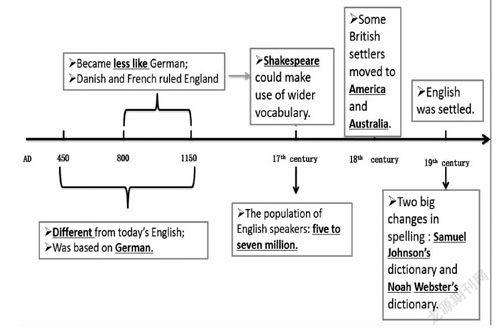
學生借助時間軸回顧閱讀文本中介紹的英語語言的發(fā)展歷程,然后教師請學生來講述:
【設(shè)計解析】在不允許學生看課文的情況下,教師要求他們借助時間軸上已給的時間點和提示信息,回憶閱讀中獲取的信息,補全時間軸,并運用適當?shù)年P(guān)聯(lián)詞組織句子進行表達,鍛煉學生的語言技能。此外,這樣做還能激活學生上節(jié)課所學的內(nèi)容,為拓展相關(guān)話題做了鋪墊。
2.課外文本導(dǎo)入
當學生復(fù)述完英語的發(fā)展史后,教師進行承上啟下的引導(dǎo):
Teacher: As you can see, English has experienced so many changes and finally become one of the greatest languages in the world. Chinese is also one of the greatest languages. But do you know how our mother tongue has developed?
Teacher: Here are some pictures that can tell us the development of Chinese. Let’s see them and tell me what they are.
圖一:關(guān)于中國古文字的圖片,引出Chinese characters;
圖二:獸骨上的漢字,引出Chinese written on bones;
圖三:秦始皇一統(tǒng)天下的照片,引出Emperor Qin Shihuang and Qin dynasty;
圖四:一張有成吉思汗頭像的元朝地圖,引出Mongolian nationality;
圖五:一張清朝滿族人的照片,引出Manchu nationality;
圖六:一張?zhí)栒俅蠹抑v普通話的標語圖片,引出Putonghua/Mandarin。
【設(shè)計解析】這六張圖片反映了中文發(fā)展歷程中一些重要的事件,旨在給學生留下一個總體印象,為即將引出的新文本做鋪墊,同時還可以順勢引出文本中的重點生詞。
在展示完以上六張圖片后,教師引出課外拓展的閱讀文本“The Road to Modern Chinese”:
The Road to Modern Chinese
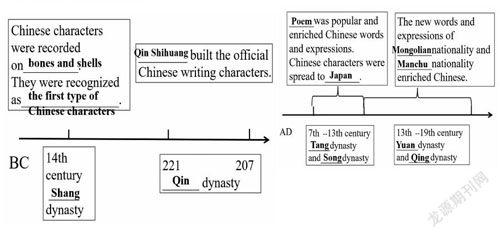
At first, about BC 14th century, in Shang dynasty, Chinese characters were recorded on bones or shells. It was recognized as the first type of Chinese characters. Then between about BC 221 and 207, Qin Shihuang, the first formal emperor in Chinese history, built a center government to control the main parts of China, which built the official Chinese writing characters.
Later, from about AD 7th century to 13th century, two great dynasties, Tang and Song, controlled China. It was so popular to write poems that there were a lot of various words and expressions to join Chinese language. At that time, Chinese characters were spread to Japan because Tang dynasty was the most powerful country in Asia. Then, between about AD 13th century and 19th century, some new words and expressions of Mongolian nationality and Manchu nationality enriched Chinese.
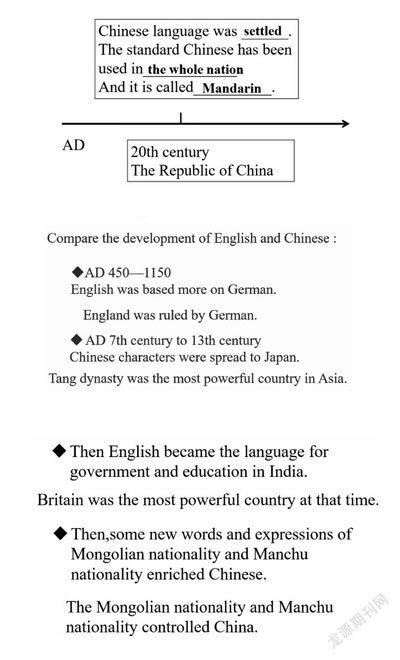
Finally, the Chinese national language was settled in 20th century, because the Republic of China began to use the standard Chinese in the whole nation. Now the standard Chinese language is called Mandarin.
學生人手一份閱讀材料,先快速閱讀并標記時間點(time point),然后教師給出一個中文發(fā)展的時間軸,并邀請學生在電子白板上填寫句子,學生需要仿照之前英語發(fā)展的時間軸填空,并嘗試根據(jù)時間軸上的信息復(fù)述中文的發(fā)展歷程。
【設(shè)計解析】這篇關(guān)于中文發(fā)展史的文章,句式和敘述風格都跟課本中的閱讀文本相似,便于學生理解和獲取信息。此處由英語發(fā)展史轉(zhuǎn)向中文發(fā)展史,讓學生反觀母語的發(fā)展歷程,學以致用,學會整理和歸納中文的發(fā)展過程,從而實現(xiàn)英語語言的實踐和輸出。從情感和文化意識上,讓學生體會到一門語言的復(fù)雜演變過程,感受中華文化的源遠流長。
3.評價總結(jié)與對比思考
在學生完成復(fù)述之后,教師給予評價和總結(jié):
Teacher: Through the history, we find that both English and Chinese have changed a lot and finally settled as great languages in the world.
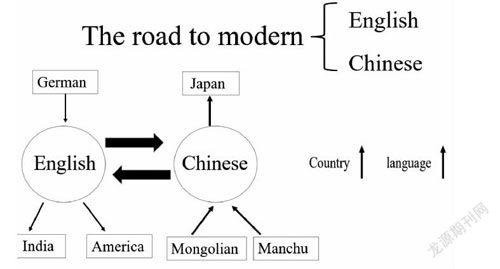
Teacher: Now, let’s look through the history again and find out what changes have happened to English and Chinese. And why?
Teacher: From AD 450 to 1150, why was English based more on German?
Students: Because England was ruled by German during that time.
Teacher: Why were Chinese characters spread to Japan from AD 7th century to 13th century?
Students: Because Tang dynasty was the most powerful country in Asia.
Teacher: After that, why did English become the language for government and education in India?
Students: Britain was the most powerful country at that time.
Teacher: Then, some new words and expressions of Mongolian nationality and Manchu nationality enriched Chinese, why?
Students: Because the Mongolian nationality and Manchu nationality had controlled China.
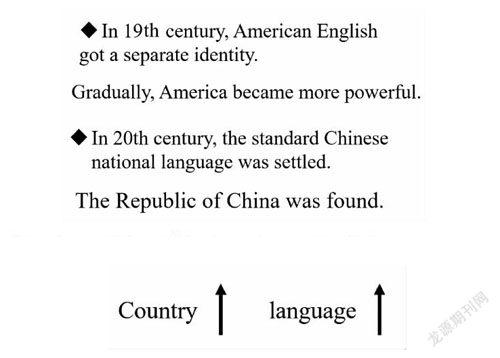
Teacher: Why did American English get a separate identity in 19th century?
Students: Because America became more powerful gradually.
Teacher: Why was the standard Chinese national language settled in 20th century?
Students: Because the Republic of China was founded.
Teacher: What can you find from these events in language’s development?
Students: The country’s power will influence language’s development.
Teacher: Very good. Can you tell me the specific relationship between the country’s power and language’s development?
Students:If a country becomes stronger and more powerful, its language will influence other languages deeply.
【設(shè)計解析】教師復(fù)現(xiàn)英語和中文發(fā)展史上的關(guān)鍵節(jié)點,讓學生結(jié)合時代背景思考其變化的原因,深入挖掘一門語言與其國家實力之間的聯(lián)系,從而得出結(jié)論:語言相互影響的背后,是國與國之間實力的角逐。如果一個國家國力強大,則該國的語言對其他國家的語言有輸出影響。
4. 思考中英語言之間的相互影響
在學生總結(jié)出語言相互影響的背后,是國與國之間實力的角逐之后,教師進一步提出問題,提升學生的思維層次:
Teacher: In 21st century, when Chinese meet English, how will they influence each other? Now, think about the influence on Chinese and on English. You can do the brainstorming with your partners.
Teacher and students come up with some ideas:
關(guān)于英語對中文的影響:
咖啡coffee;互聯(lián)網(wǎng)Internet;綠色食品 green food;因吹斯汀(interesting)滑稽有趣的;“我想打個taxi”;“我要成為CEO,走向人生巔峰!”
- 你真好看!
-(舊時)哪里啦,沒有沒有。
-(現(xiàn)在)謝謝你!
得出結(jié)論:English enriches Chinese vocabulary and expression, and changes people’s thoughts. Also, China has the largest number of English learners.
關(guān)于中文對英語的影響:
Tai Chi 太極;Kungfu 功夫;The Great Wall 長城;panda 熊貓;Sharing bike 共享單車;square dance 廣場舞;mountain people mountain sea 人山人海;Long time no see. 好久不見;The Belt and Road.一帶一路。
得出結(jié)論:Chinese enriches English vocabulary and Chinese culture are introduced and spread with expressions.
In a word, all languages change and develop when cultures meet and communicate. (這句話來自課文)
5.思維拓展及討論
至此, 教師進一步發(fā)問:
Teacher: English and Chinese have influenced each other. So, what’s the final result in future? Here are three possible results. Which one do you prefer?
Teacher: Now, let’s make a debate. Choose the opinion which you agree with. It’s an open question so hold your idea and give supporting reasons. I will give you an example:
I support the result A that there will be only one language. I think it’s convenient and easy for us to use just one language to communicate. What’s more, we don’t need to spend so much time learning the second language.
Teacher(after students’ expression): What will the language be in future? Only time will tell. (這句話來自課文)
【設(shè)計解析】 隨著思維深度的層層遞進,學生逐步明白語言之間相互影響的背后是國與國之間實力的角逐,當今中文與英語的相互影響,體現(xiàn)出兩種文化的碰撞與交融。通過這幾個環(huán)節(jié),學生的思維更加開闊了,課堂氣氛活躍,文化意識也迸發(fā)出來了。當學生的思維火花四溢時,教師進一步提出一個更深層次的辯論問題:未來的語言是中文取代英文還是英文取代中文,抑或是多種語言融合形成一門新的語言?這是一個開放性的問題,教師做了一個示范性的觀點陳述,學生可以持自己的觀點,但是要有理有據(jù)。學生在自由陳述其觀點時,要在紙上記下主要論據(jù)。因為本節(jié)課最后還要以讀促寫,學生的課后作業(yè)便是整理辯論的發(fā)言,將其觀點寫成一篇小議論文。
6. 布置作業(yè)
Collect the reasons of classmates for the same result. Then finish a short article with the clear parts: your idea, supporting reasons and conclusions.
五、板書設(shè)計
六、結(jié)語
閱讀課教學在高中英語教學中有著極其重要的作用,有助于單元話題的延伸、語言的應(yīng)用與檢測,最重要的是有利于培養(yǎng)學生的核心素養(yǎng)。這是一節(jié)普通的高中英語讀后課例設(shè)計,在高中英語學科核心素養(yǎng)培養(yǎng)目標的指導(dǎo)下,圍繞本單元語言與文化交流融合的主題,旨在幫助學生拓展思維,提升思維層次,培養(yǎng)批判性思維,樹立人類命運共同體意識和多元文化意識,形成開放包容的態(tài)度,發(fā)展健康的審美情趣和良好的鑒賞能力,加深對祖國文化的理解,增強愛國情懷,堅定文化自信,樹立正確的世界觀、人生觀和價值觀,從而培養(yǎng)優(yōu)秀的文化意識和思維品質(zhì)。
猜你喜歡
小哥白尼(野生動物)(2022年6期)2022-08-17 08:05:28
小哥白尼(野生動物)(2022年4期)2022-07-16 03:37:32
小哥白尼(野生動物)(2022年2期)2022-06-01 06:21:20
小哥白尼(野生動物)(2022年1期)2022-04-26 14:01:18
文苑(2020年4期)2020-05-30 12:35:30
小學生作文(中高年級適用)(2018年3期)2018-04-18 01:24:47
華北電力大學學報(社會科學版)(2016年4期)2016-12-01 03:59:30
小學生導(dǎo)刊(低年級)(2016年2期)2016-02-24 23:02:11
少兒科學周刊·少年版(2015年4期)2015-07-07 21:11:17
小天使·五年級語數(shù)英綜合(2014年5期)2014-06-25 05:22:42