玉米不同葉位氣孔數量及其形態的差異研究
2018-09-19 07:24:52崔麗娜董樹亭
安徽農業科學 2018年26期
關鍵詞:差異
崔麗娜,董樹亭
(1.德州學院,山東德州 253023;2.山東農業大學農學院,山東泰安271018)
葉片是玉米進行光合作用及氣體交換的重要器官,葉片的氣孔是玉米進行CO2及H2O交換的場所。葉片氣孔形態及數量的差異導致葉片的生理作用產生差異。掌握玉米不同葉位葉片的的生理特性差異對挖掘作物品種遺傳潛力和提高栽培管理水平具有重要意義。目前有關玉米葉片氣孔的研究多集中在氣孔導度與氣象水肥等的關系[1-2]以及氣孔導度與光合作用、蒸騰作用的關系上[3-4],而對玉米不同葉位氣孔數量及其形態的研究較少。對不同葉位葉片氣孔數量及其形態的研究有助于了解葉片因不同葉位導致的葉片形態及生理性的差異。鑒于此,筆者以區試品種鄭單 958為試驗材料,探討灌漿期玉米不同葉位葉片氣孔數目和形態的差異,以期為該時期進行正確的田間管理,以及為育種工作者挖掘玉米的產量潛力提供理論依據。
1 材料與方法
1.1試驗地概況試驗在山東農業大學玉米科技園進行。試驗地土壤質地為壤土,0~20 cm 土壤 pH 7.40,含全碳 12.76 g/kg、全氮 1.06 g/kg、堿解氮 79.45 mg/kg、速效磷 74.16 mg/kg、速效鉀 94.45 mg/kg。
1.2供試材料玉米品種為鄭單 958。
1.3試驗方法分別于每年的 6 月 17 日播種,種植密度為75 000株/hm2。采用完全隨機區組排列,重復3次,小區面積為 3 m×10 m=30 m2。基施復合肥(N-P-K:16%-16%-16%)300 kg/hm2,大喇叭口期追施尿素 675 kg/hm2,田間管理同高產田。試驗期間玉米生長發育正常,分別于每年的 10 月 18 日收獲。
1.4玉米穗位葉解剖結構的觀察玉米開花期從每小區選 80 株生長一致、能代表該區生長狀況的玉米掛牌。在每小區選定 5 株掛牌的玉米,取人工授粉的玉米(授粉后20 d)不同葉位葉中段部分,在距離葉脈及葉片邊緣的中間部分切取葉片(葉片大小為0.5 cm×0.5 cm),橫切面用4%戊二醛前固定,磷酸緩沖液沖洗。再用1%鋨酸后固定,乙醇梯度脫水。Epon-812(環氧樹脂)浸透與包埋。瑞典LKB-7800 型超薄切片機切片,切片厚0.6 μm。材料重新建斷層后噴金屬粉,利用日本JSM-660LV掃描電鏡觀察照相。
2 結果與分析
2.1不同葉位葉表皮氣孔的形態比較由圖1可知,上表皮氣孔從上而下先增大后減小,最大值出現在第5葉;下表皮氣孔從上而下先增大后減小,最大值出現在第6葉。不同葉位上表皮氣孔形態基本一致,不同葉位下表皮氣孔形態也基本一致,上表皮與下表皮氣孔形態也基本一致。
2.2不同葉位葉表皮氣孔數目的差異由表1可知,鄭單958玉米不同葉位葉上表皮氣孔數由上而下逐漸降低;下表皮氣孔數由上而下先降低后升高,從高到低依次為倒1葉>倒3葉=倒7葉>倒5葉>倒6葉。由上述分析可知,不同葉位葉中倒7葉(穗位葉)上表皮氣孔數最低,下表皮氣孔數居中。穗位葉的這種氣孔形態有利于減少蒸騰作用,進行外界氣體及水分交換。
3 小結
氣孔是植物進行氣體和水分交換與代謝,響應環境條件,包括病菌侵染的重要通道,其大小、密度和分布既受到遺傳的控制,也受到生長環境的影響。玉米氣孔的密度既受遺傳的控制,又受光照、溫度、二氧化碳濃度和水分等環境因素及栽培措施的影響。研究表明,氣孔特征參數與玉米抗逆性密切相關[4]。氣孔是植物用以調節自身和外界環境關系的重要機構,是影響植物光合作用的一個重要因素[5-6]。而營養條件對植物葉片氣孔的形成有很大的影響。不同葉位葉中穗位葉上表皮氣孔數最低,下表皮氣孔數居中。穗位葉的這種氣孔形態有利于減少蒸騰作用,又有利于進行外界氣體及水分交換。因此,在玉米生長的關鍵時期可以通過肥水等栽培措施條件改變玉米氣孔特性,提高光合速率,增加玉米產量。進一步研究氣孔的這些特性為育種工作及玉米高產栽培提供參考。
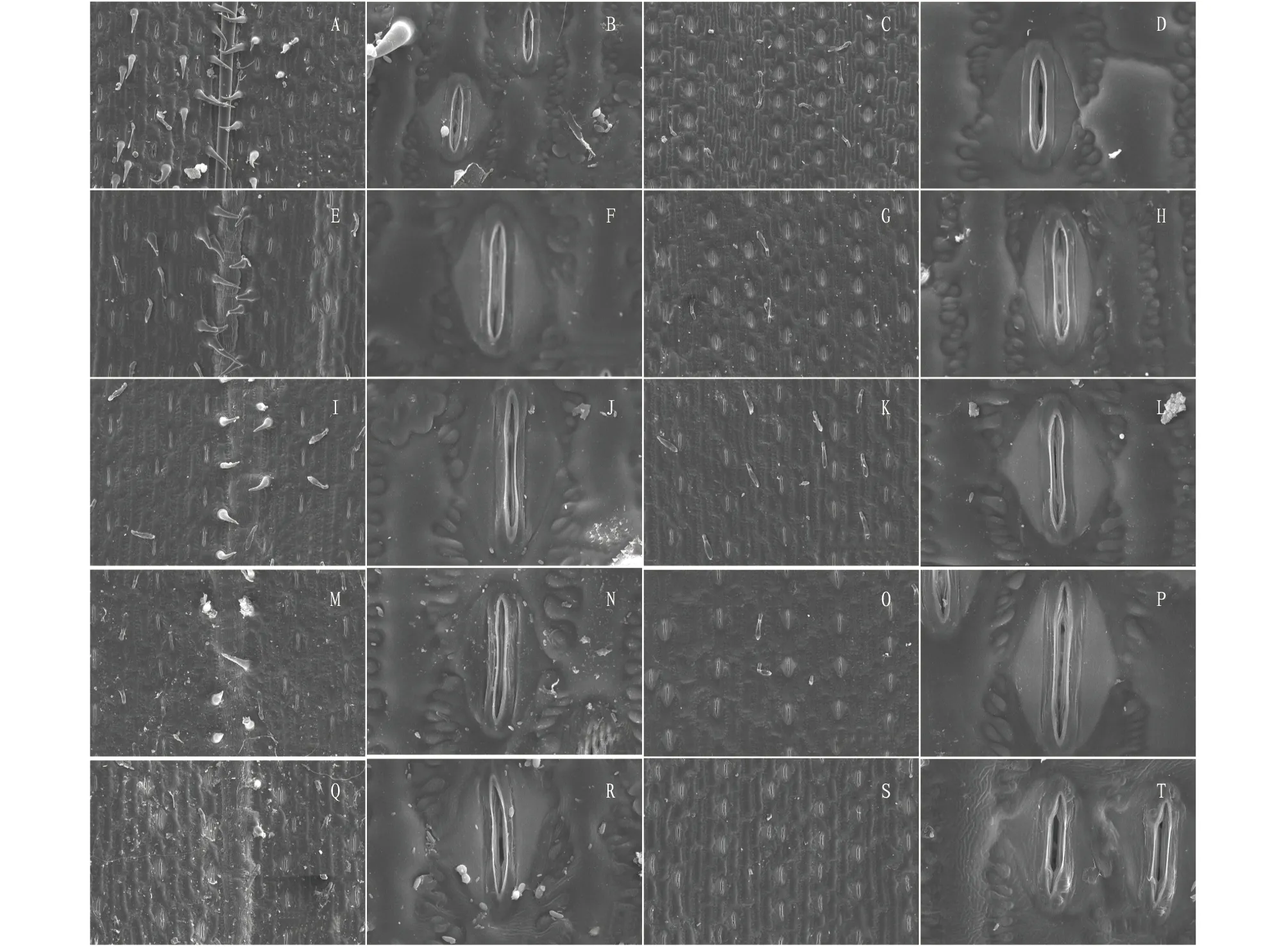
注:A.倒1葉上表皮氣孔,200×;B.倒1葉上表皮氣孔,1 500×;C.倒1葉下表皮氣孔,200×;D.倒1葉下表皮氣孔,1 500×;E.倒3葉上表皮氣孔,200×;F.倒3葉上表皮氣孔,1 500×;G.倒3葉下表皮氣孔,200×;H.倒3葉下表皮氣孔,1 500×;I.倒5葉上表皮氣孔,200×;J.倒5葉上表皮氣孔,1 500×;K.倒5葉下表皮氣孔,200×;L.倒5葉下表皮氣孔,1 500×;M.倒6葉上表皮氣孔,200×;N.倒6葉上表皮氣孔,1 500×;O.倒6葉下表皮氣孔,200×;P.倒6葉下表皮氣孔,1 500×;Q.倒7葉上表皮氣孔,200×;R.倒7葉上表皮氣孔,1 500×;S.倒7葉下表皮氣孔,200×;T.倒7葉下表皮氣孔,1 500× Note:A.Leaf stoma in upper epidermis of the first leaf from the top,200×;B.Leaf stoma in upper epidermis of the first leaf from the top,1 500×;C.Leaf stoma in lower epidermis of the first leaf from the top,200×;D.Leaf stoma in lower epidermis of the first leaf from the top,1 500×;E.Leaf stoma in upper epidermis of the third leaf from the top,200×;F.Leaf stoma in upper epidermis of the third leaf from the top,1 500×;G.Leaf stoma in lower epidermis of the third leaf from the top,200×;H.Leaf stoma in lower epidermis of the third leaf from the top,1 500×;I.Leaf stoma in upper epidermis of the fifth leaf from the top,200×;J.Leaf stoma in upper epidermis of the fifth leaf from the top,1 500×;K.Leaf stoma in lower epidermis of the fifth leaf from the top,200×;L.Leaf stoma in lower epidermis of the fifth leaf from the top,1 500×;M.Leaf stoma in upper epidermis of the six leaf from the top,200×;N.Leaf stoma in upper epidermis of the six leaf from the top,1 500×;O.Leaf stoma in lower epidermis of the six leaf from the top,200×;P.Leaf stoma in lower epidermis of the six leaf from the top,1 500×;Q.Leaf stoma in upper epidermis of the seventh leaf from the top,200×;R.Leaf stoma in upper epidermis of the seventh leaf from the top,1 500×;S.Leaf stoma in lower epidermis of the seventh leaf from the top,200×;T.Leaf stoma in lower epidermis of the seventh leaf from the top,1 500×圖1 玉米不同葉位葉片的氣孔形態比較Fig.1 Comparison of stoma morphology in different maize leave positions

葉位Leaf position葉片上表皮氣孔數Number leaf stoma in upper epidermis葉片下表皮氣孔數Number leaf stoma in lower epidermis倒1葉 The first leaf from the top28 a44 a倒3葉 The third leaf from the top23 b33 b倒5 葉The fifth leaf from the top22 b28 c倒6 葉The sixth leaf from the top21 bc27 c倒7 葉The seventh leaf from the top20 c33 b
注:同列不同小寫字母表示在0.05水平上差異顯著
Note:Different lowercases in the same coloumn indicated significant differences at 0.05 level
猜你喜歡
英語世界(2023年10期)2023-11-17 09:19:16
汽車實用技術(2022年10期)2022-06-09 11:16:58
音樂探索(2022年2期)2022-05-30 21:01:37
收藏界(2019年3期)2019-10-10 03:16:40
小天使·一年級語數英綜合(2019年8期)2019-08-27 02:23:00
中國特種設備安全(2018年11期)2019-01-08 02:08:32
小學科學(學生版)(2018年7期)2018-08-13 09:33:04
中國非營利評論(2017年1期)2017-11-09 03:09:10
海外華文教育(2017年8期)2017-11-07 04:42:02
現代語文(2016年21期)2016-05-25 13:13:50