金沙江攀枝花江段白緣的繁殖生物學
2018-05-28 04:27:52于學穎譚德清但勝國王劍偉
四川動物 2018年3期
于學穎, 譚德清, 但勝國, 王劍偉*
(1. 中國科學院水生生物研究所,水生生物多樣性與資源保護研究中心,武漢430072; 2. 欽州學院海洋學院,廣西北部灣海洋生物多樣性養護重點實驗室,廣西欽州535000)

1 材料與方法
1.1 研究對象及處理
樣品由漁民用定置刺網和餌釣捕獲,共計783尾,采集地點為金沙江中游四川省攀枝花市西區莊上村(101°29′19.21″E,26°34′36.97″N)至金沙灘(101°31′47.39″E,26°35′28.68″N)約5 km的江段,江面寬150 m左右,近岸水較淺,水流平緩,流速0.1~0.3 m·s-1;江中央流速較大,為3~5 m·s-1,巖石底質,間有泥沙,兩岸為頁巖。樣本采集后立即用10%福爾馬林固定,在實驗室進行常規生物學測量和解剖,包括體長、體質量、空殼質量、性腺及其發育期。各指標的標準為:體長(吻端至最后一枚脊椎骨的長度)(精確度為1 mm),體質量、空殼質量和性腺質量用電子天平稱量(精確至0.1 g)。
1.2 數據處理和分析
用Excel 2010和SPSS 19.0進行數據處理。優化模型的篩選以散點圖及回歸分析為依據,選擇R2值高且使用方便的模型。相關計算公式(殷名稱,1993)分別為:
成熟系數(GSI)=性腺質量(g)/空殼質量(g)×100;肥滿度=體質量(g)/體長(cm)×100;絕對繁殖力(F)=Ⅳ期卵巢卵粒數(全部已開始沉積卵黃的卵數);相對繁殖力(F/W)=絕對繁殖力/體質量(g)。
2 結果
2.1 性腺發育及成熟系數的周年變化
2.2 肥滿度的周年變化
2.3 繁殖群體結構
2.3.1性別比在性別可辨的729尾標本中,雌性332尾,雄性397尾。雌∶ 雄=1∶ 1.20(χ2=5.984,P<0.05),不符合1∶ 1理論比值。性成熟的141尾標本中,雌性64尾,雄性77尾,雌∶ 雄=1∶ 1.20(χ2=1.199,P>0.05),符合1∶ 1理論比值。
表1 白緣性腺發育各期組成的周年變化Table 1 The annual constitutions of Liobagrus marginatus (Günther) at different reproductive stages

表1 白緣性腺發育各期組成的周年變化Table 1 The annual constitutions of Liobagrus marginatus (Günther) at different reproductive stages
月份Month雌性Female雄性Male標本數NumberofspecimenⅡ/%Ⅲ/%Ⅳ、Ⅴ/%Ⅵ/%標本數NumberofspecimenⅡ/%Ⅲ/%Ⅳ、Ⅴ/%11926.373.70.00.02075.025.00.02333.333.333.30.0333.30.066.7310368.06.822.30.013273.513.612.945667.921.410.70.06277.416.16.551533.313.353.30.01376.923.10.065889.76.93.40.03873.726.30.072171.40.00.028.63177.49.712.98977.80.00.022.21275.016.78.39475.00.00.025.0450.025.025.0102321.717.48.752.2559.127.363.6111643.818.812.525.01625.037.537.512520.060.00.020.01127.345.527.3

圖1 白緣雌雄個體成熟系數的周年變化Fig. 1 Annual change of gonadosomatic index between male and female Liobagrus marginatus (Günther)
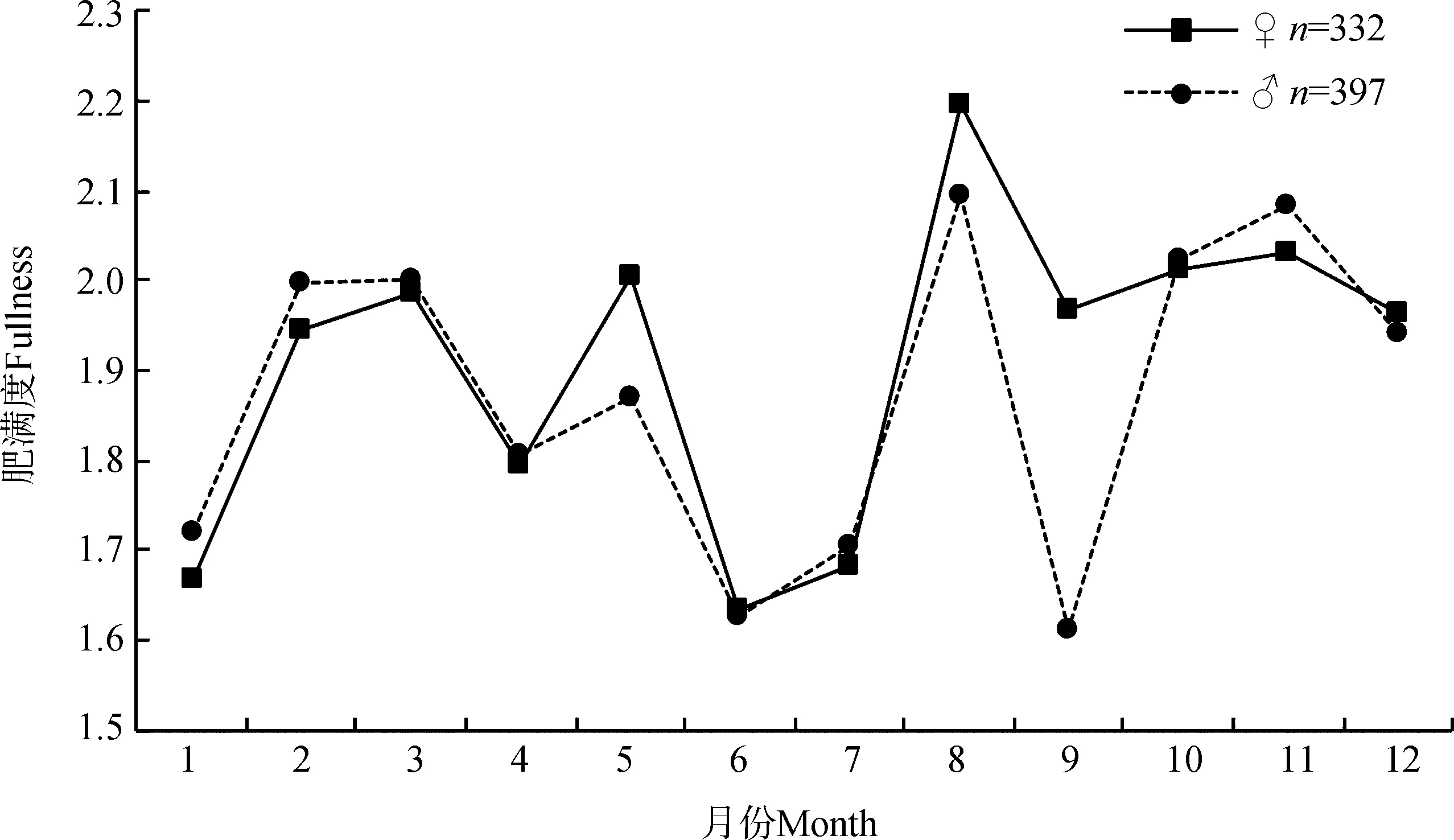
圖2 雌雄白緣個體肥滿度的周年變化Fig. 2 Annual change of fullness between male and female Liobagrus marginatus (Günther)
2.3.2初次性成熟大小雌性最小性成熟個體體長為66.80 mm,體質量為5.7 g,GSI為1.84,卵巢Ⅵ期,雄性最小性成熟個體體長為67.32 mm,體質量為6.7 g,GSI為0.61,精巢Ⅳ期。雌雄初次性成熟個體均為1齡,均為2月采到的標本。
表2 白緣繁殖群體的組成Table 2 Composition of the breeding stock ofLiobagrus marginatus (Günther)

表2 白緣繁殖群體的組成Table 2 Composition of the breeding stock ofLiobagrus marginatus (Günther)
年齡Age標本數Numberofspecimen性成熟個體數Maturalindividuals性成熟個體百分比Percentage/%1338164.7323259027.693423071.4346583.33合計711141

圖3 白緣繁殖群體的年齡組成Fig. 3 Age structure of the breeding stork of Liobagrus marginatus (Günther)
2.4 卵徑分布和繁殖力
2.4.1卵徑分布取9尾卵巢發育良好、GSI>20的個體作卵徑分布圖(圖4),可以看出,卵徑分布呈現雙峰,即同一個體卵巢中存在卵徑不同的2組卵,其卵子發育不是完全同步的。其中,卵徑較小的一組,其峰值多小于1 mm,解剖鏡下觀察時為半透明或者淺白色,為剛開始沉積卵黃的3時相卵母細胞;卵徑較大的一組,其峰值多在3 mm左右,顏色為黃色或白色,為卵黃沉積較多或已沉積飽滿的4時相卵母細胞。對不同月份其他樣本的觀察也表明,成熟個體卵巢中卵子大小差異很大,其卵徑分布與圖4類似。對35尾魚3 427粒沉積卵黃卵粒的統計結果顯示,卵徑為0.29~3.86 mm,平均值為2.42 mm±0.90 mm;卵徑<1.50 mm的占20.72%,卵徑≥2.5 mm的占64.25%。

圖4 白緣Ⅳ期卵巢卵徑分布Fig. 4 The distribution of ovum diameter in Stage Ⅳ ovaries of Liobagrus marginatus (Günther)
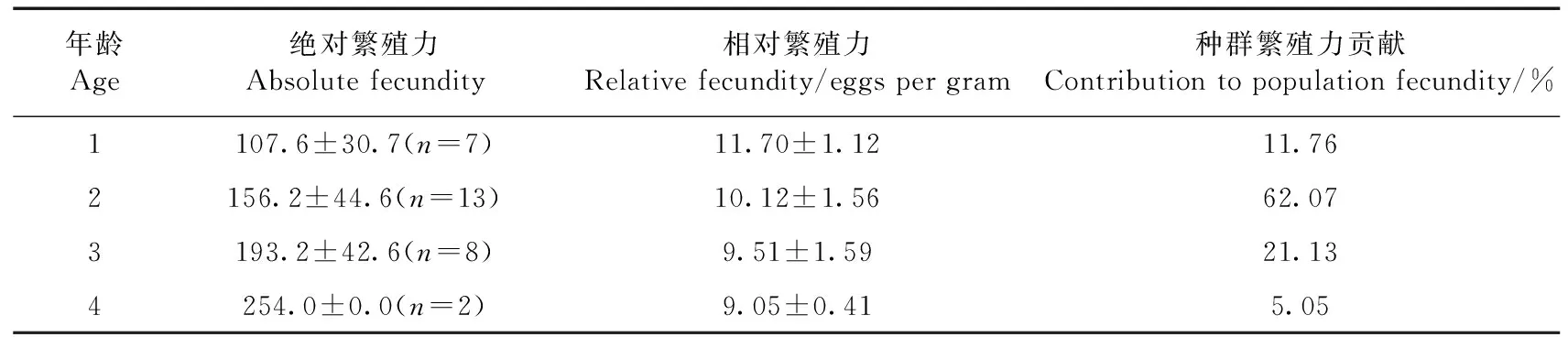
年齡Age絕對繁殖力Absolutefecundity相對繁殖力Relativefecundity/eggspergram種群繁殖力貢獻Contributiontopopulationfecundity/%1107.6±30.7(n=7)11.70±1.1211.762156.2±44.6(n=13)10.12±1.5662.073193.2±42.6(n=8)9.51±1.5921.134254.0±0.0(n=2)9.05±0.415.05
3 討論
3.1 性腺發育的周年變化和產卵類型
3.2 白緣的繁殖策略
3.3 資源保護
:
曹文宣. 1960. 梁子湖的團頭魴和三角魴[J]. 水生生物學集刊, 4(1): 57-82.
陳佩薰. 1959. 梁子湖鯽魚的生物學研究[J]. 水生生物學集刊, 3(4): 411-419.
丁瑞華. 1994. 四川魚類志[M]. 成都: 四川科學技術出版社.
段中華, 孫建貽. 1999. 瓦氏黃顙魚的繁殖生物學研究[J]. 水生生物學報, 23(6): 610-616.
湖北省水生生物研究所魚類研究室. 1976. 長江魚類[M]. 北京: 科學出版社
申嚴杰, 蒲德永, 高梅, 等. 2005. 福建紋胸年齡與生長的初步研究[J]. 西南農業大學學報(自然科學版), 27(1): 106-110.
楊家云. 1994. 瓦氏黃顙魚的繁殖生物學[J]. 西南師范大學學報, 19(6): 639-645.
殷名稱. 1993. 魚類生態學[M]. 北京: 中國農業出版社.
張春霖. 1960. 中國鲇類志[M]. 北京: 人民教育出版社.
Brickle P, Laptikhovsky V, Portela J. 2006. Reproductive biology ofPatagonotothenramsayi(Regin, 1913)(Pisces: Nototheniidae) around the Falkland Islands[J]. Polar Biology, 29(7): 570-580.
Clark FN. 1931. Maturity of the California sardine (Sardinacaerulea), determined by ova diameter measurements[J]. Fishery Bulletin, (42): 1-49.
Hickling CF, Rutenberg E. 1936. The ovary as an indicator of the spawning period in fishes[J]. Journal of the Marine Biological Association of the United Kingdom, 21(1): 311-318.
Justus R, Anthony JB. 2005. Reproductive biology of Ningu,Labeovictrianus(Pisces: Cyprinidae), in the Kagera and Sio Rivers, Uganda[J]. Environmental Biology of Fishes, 73(2): 153-162.
Macer CT. 1974. The reproductive biology of the horse mackerelTrachurustrachurusin the North Sea and England Channel[J]. Journal of Fish Biology, 6(4): 615-638.
猜你喜歡
中學生數理化·八年級物理人教版(2021年12期)2021-12-31 03:23:08
現代畜牧科技(2021年4期)2021-07-21 06:13:00
中學生數理化·中考版(2020年10期)2020-11-27 01:59:48
福建基礎教育研究(2019年1期)2019-09-10 07:22:44
中國生殖健康(2019年2期)2019-08-23 08:12:08
福建基礎教育研究(2019年1期)2019-05-28 08:39:49
產品可靠性報告(2017年7期)2017-09-05 09:49:12
數學物理學報(2017年2期)2017-06-05 09:12:30
汽車觀察(2016年3期)2016-02-28 13:16:26
醫學研究雜志(2015年11期)2015-06-10 06:44:03