基于事件相關電位P300的動物認知研究進展
2018-05-28 04:27:58張小琴鮮雪梅方光戰
四川動物 2018年3期
張小琴, 鮮雪梅, 方光戰
(1. 阿壩師范學院資源與環境學院,四川汶川623002; 2. 中國科學院成都生物研究所兩棲爬行動物研究室,成都610041)
事件相關電位(event-related potential,ERP)是感覺運動或認知事件在大腦內誘發的、具有鎖時關系的電位變化,與認知過程(包括注意、辨別、判斷、選擇和決策等)密切相關,其幅度和潛伏期可用于考察大腦對信息的加工過程、加工效率和時間進程。ERP作為研究認知功能的電位生理學方法,在臨床及動物認知研究中有廣泛的應用前景(Duncanetal. ,2009)。ERP包含多種成分,其中由英國人Sutton 1965年發現的第三個正相波是大腦誘發電位的晚成分,因其與認知過程密切相關,故被稱為認知誘發電位(cognitive evoked potential);同時該成分通常于刺激后300 ms左右出現,故被簡稱為P300(Suttonetal. ,1965)。一般用振幅(幅度或波幅)、潛伏期、頭皮分布等參數來表征P300。振幅有2種常用測量方法:峰振幅測量,即特定時間窗內的最大峰值;平均振幅測量,即特定時間窗內所有振幅的平均值(Luck,2005)。對于特定ERP成分,潛伏期通常是指從刺激開始到最大振幅之間的持續時間(Johnson,1993),常用峰潛伏期(對應峰振幅)和半面積潛伏期(對應平均振幅)來描述。頭皮分布是指ERP成分在不同腦區(對應于不同電極)的空間分布。
注意是心理活動對一定對象的指向和集中,伴隨著感知覺、記憶、思維、想象等心理過程,具有指向性和集中性2個基本特征。Posner(1980)將注意分為內源性注意(endogenous)和外源性注意(exogenous):前者指根據觀察者的行為目標或意圖來分配注意,后者指由外部信息引起的注意定向。P300是ERP的主要內源性成分(Polich,2007),是在注意某一客體并進行認知加工時產生的,是高級思維活動如感覺、知覺、識別和判斷等過程的結果,亦是大腦各皮質間綜合活動的一種表現(Twomeyetal. ,2015)。因此,P300是研究人類(Tsolakietal. ,2015)、靈長類(Pineda & Westerfield,1993;Swicketal. ,1994a)、哺乳類(Ehlersetal. ,2014;Grupeetal. ,2014)和兩棲爬行類(Elliott & Kelley,2007;Fangetal. ,2015)等認知加工及腦機制的重要電生理指標(魏景漢,羅躍嘉,2010),在神經病學、精神病學、心理學及其他臨床學科、動物認知和大腦功能、腦機接口、測謊、毒理藥理等研究領域具有廣泛的應用價值。
P300通常由Oddball實驗范式的偏差刺激誘發,即以不同概率呈現刺激,大概率者稱為標準刺激,小概率者稱為偏差刺激或靶刺激(圖1)。P300可在視覺、聽覺、嗅覺、體感等多種模態或視聽雙模態下誘發,其幅度可用來辨別刺激差異(Johnson,1989b;Miltneretal. ,1989;Yamaguchi & Knight,1991b)。與聽覺、嗅覺2種模態相比,視覺P300的幅度和潛伏期均較大,但P300在視覺、聽覺、嗅覺3種模態下的頭皮分布無本質差別(Pictonetal. ,1984),表明3種模態下的P300均由共同的神經系統產生(Snyderetal. ,1980),但這一推論尚存爭論。動物模型ERP的研究也顯示存在類似的P300成分,其潛伏期和振幅具有任務特異性(Hattorietal. ,2010);在實際的動物研究中,往往參考人類P300的潛伏期。P300家族中最常見的亞成分是P3a,其潛伏期通常較短[對人而言,不同研究采用的范圍略有不同,如視覺任務中取280~360 ms(Barceló & Rubia,1998)、聽覺任務中取250~400 ms(Wronkaetal. ,2012)等],主要分布于額葉-中央區域,是定向反應出現的標志(Friedmanetal. ,2001);同時P3a與大腦抑制以及新穎刺激加工有關,反映新穎刺激處理過程的早期階段。經典的P300實際上是P3b,其潛伏期較長[對人而言,不同研究采用的范圍亦略有差異,如視覺任務中取450~600 ms(Barceló & Rubia,1998)、聽覺任務中取400~700 ms(Wronkaetal. ,2012)等],依賴于被試主動辨別刺激類型,即由任務相關的靶刺激誘發,它要求被試在接受靶刺激后立即執行某種特定任務,且在頂葉波幅最大。P3a是對信號的初始反應,反映了從刺激出現到大腦開始意識到刺激信號并達到覺醒狀態所需的時間,而P3b反映了大腦對信號的注意和記憶過程所需時間(Polich,2007)。Soltani和Knight(2000)認為,P3a與新穎刺激的自動覺察有關,而P3b與靶刺激的主動覺察有關。人類P300潛伏期與識別需要的時間及對刺激的反應時間都有關(Allen,2002)。
1 基于P300的動物認知研究
動物相關研究往往采用經典的Oddball范式,通常與操作性條件反射、經典條件反射和被動觀看、訓練動物參與任務等技術結合。現有的動物實驗表明,包括哺乳動物在內的多個類群在多種模態中均存在類似人類P300成分,通常稱為類P300(like-P300,lP300),其潛伏期和波幅隨著任務不同而變化(Imada,2013)。理想的動物模型是腦疾病機理研究和藥物開發的重要基礎,亦被當作連續記錄ERP特征和大腦皮層功能定位的工具(Pineda & Westerfield,1993),雖然這一技術存在2個重要局限:(1)在一個物種上觀察到的ERP和另外一個物種是否相同,很難證明;(2)人類的一些ERP成分不能直接泛化到動物上,因為它們可能不適用,比如語言特殊反應。為了規避這些局限,研究者通過一系列任務操作來證明在動物上發現的ERP成分與人類相同或相似;此時要求動物和人類的行為及大腦結構必須存在對應的關聯。
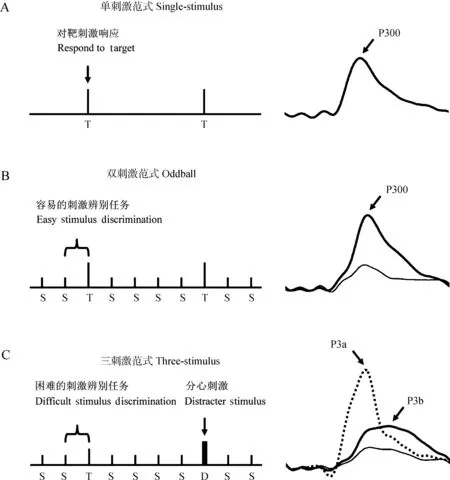
圖1 誘發P300的實驗范式
Fig. 1 Schematic illustration of paradigms eliciting P300
A、B、C分別對應于單刺激范式、雙刺激范式和三刺激范式; 每個子圖右側呈現相應的P300成分; 在單刺激范式中,僅呈現概率小的靶刺激(T), 而無其他刺激; 在雙刺激范式中, 按隨機順序呈現2種不同刺激, 其中一種刺激的出現概率少于另一種[前者為靶刺激(T), 后者為標準刺激(S)]; 三刺激范式類似于雙刺激范式, 只是另外增加了一個呈現概率小的分心刺激(D); 在每一項任務中, 被試僅對靶刺激T響應; 三刺激范式中的分心刺激會誘發出P3a, 靶刺激會誘發出P3b(Polich & Criado, 2006)
The single-stimulus (A), oddball (B), and three-stimulus (C) paradigms are shown with the elicited ERPs from the stimuli of each task presented at the right; the single-stimulus task presents an infrequent target (T) in the absence of any other stimulus; the oddball task presents 2 different stimuli in a random sequence, with one occurring less frequently than the other (target=T, standard=S); the three-stimulus task is similar to the oddball with a compelling distracter (D) stimulus that occurs infrequently; in each task, the subject is instructed to respond only to the target and to refrain from responding otherwise; the distracter in the three-stimulus task elicits a P3a, and target elicits a P3b (Polich & Criado, 2006)
訓練豚尾猴Macacanemestina從高概率呈現的純音(非靶刺激2.5 kHz,持續時間400 ms)中辨別稀少的純音(靶刺激1 kHz,持續時間400 ms),然后利用這2種刺激進行ERP實驗,發現豚尾猴的事件相關正成分lP300類似于人類的P300,且振幅與刺激概率成反比(Arthur & Starr,1984)。同樣貓Feliscatus(O’connor & Starr,1985)亦有相似的聽覺lP300響應。對松鼠猴Saimirisciureus肌肉注射可樂定(α-2腎上腺素能受體激動劑,能減少去甲腎上腺素釋放和抑制藍斑神經元活動),發現其lP300幅度顯著減少,潛伏期顯著增加,但對ERP早期成分(P1、N1、P2)無影響(Swicketal. ,1994a),說明藍斑及其傳出投射系統在調制lP300活動中起重要作用。
在視覺研究方面,給松鼠猴呈現小的藍色矩形作為標準刺激(90%或50%),小的黃色矩形作為偏差刺激(10%或50%),刺激間隔為2 s,發現概率為10%的偏差刺激誘發的lP300波幅比50%的更大,同時lP300幅度對刺激序列和任務敏感(Pineda & Swick,1992),這一結果類似于人類視覺P300。同樣短尾猴Macacaarctoides(Snyderetal. ,1979)和食蟹猴Macacafascicularis(Ghilardietal. ,1987;Gloveretal. ,1991)的視覺lP300亦與人類類似。給松鼠猴呈現3 kHz純音(70 db,持續時間50 ms)作為聽覺標準刺激,1 kHz純音(70 db,持續時間50 ms)作為偏差刺激,同時1個黃色矩形(持續時間50 ms)作為稀少視覺刺激,采集給予安慰劑或不同濃度α腎上腺素受體拮抗劑時的ERP波形,結果發現,聽覺偏差刺激和視覺刺激均誘發出大的lP300,兩者具有不同的分布且有不同的來源,支持2個獨立源的存在;藥物操作導致頂葉區域lP300幅度降低。這些數據支持去甲腎上腺素是一種調節位于頂葉區域的聽覺和視覺lP300共有的神經遞質這種假設;另外,中線和顳葉對應的lP300不受去甲腎上腺素活性的影響(Pineda & Westerfield,1993)。注射可樂定后,相對于聽覺lP300,偏差刺激的差異大小更易影響松鼠猴視覺lP300的振幅大小,即當視覺偏差刺激與背景差異大時,更易獲得顯著的振幅差異。表明相對于聽覺lP300,松鼠猴的視覺lP300對可樂定更為敏感。松鼠猴內側顳葉的雙側損傷對硬腦膜外lP300沒有影響(Palleretal. ,1988),雙邊內側顳葉病變的松鼠猴仍能產生lP300,這表明內側顳葉并非lP300產生的關鍵。同樣,松鼠猴的lP300也受類膽堿和腎上腺素的影響(O’Neilletal. ,2000)。因此,靈長類存在與人類相似的P300這一事實為進一步探索該成分潛在的神經機制和解剖學基礎提供了可能(Arthur & Starr,1984)。在被動非任務條件和主動任務條件下,分別記錄食蟹猴的聽覺lP300,發現其對偏差刺激的響應十分類似于相似條件下的人類P300,且可能與記憶功能和內側顳葉活動有關,尤其是海馬(Palleretal. ,1988;Swicketal. ,1994b)。依次切除雙側海馬、杏仁核和皮層,食蟹猴出現類似于人類的遺忘癥(Zola-Morganetal. ,1982),說明靈長類與人類的大腦功能具有同源性。被動條件和主動條件下的2種實驗可能反映了lP300的2個成分P3a和P3b,但要嚴格區分這2個成分是不可能的。在聽覺任務中(無論是被動條件還是主動條件),呈現概率小的音調能誘發出靈長類的晚正成分,該成分的波形特征、潛伏期、極性和頭皮分布均類似于人類的P300,提示其功能特征的相似性。在連續雙任務中,對第一個任務的lP300波幅響應隨著第二個任務處理需求的增加而減少,亦與人類類似;雖然相對于任務條件,在非任務條件下,食蟹猴的lP300波幅較人類的更小,但其他特征與人類的極度相似性進一步為跨物種相似提供了支持,同時也反映了常見(或同源)的神經生理學過程。食蟹猴的lP300誘發不需要海馬、杏仁核或鄰近皮質的完整性,如雙側內側顳葉病變的食蟹猴誘發的lP300與健康個體的lP300基本相似。這種人類與靈長類研究結果的融合有望提高動物模型的有效性,并進一步完善對P300神經基礎和相關認知過程的理解(Palleretal. ,1988)。
研究發現,邊緣系統、緣上回和海馬都對貓聽覺lP300的產生有貢獻,膈區損毀后,貓的lP300消失(O’connor & Starr,1985);同時lP300的潛伏期在頭骨記錄、硬膜外記錄和顱內記錄三者間具有明顯差異。損傷初級聽覺皮層對貓顱內lP300的振幅沒有明顯影響(Harrisonetal. ,1986),提示貓的lP300存在多個起源,這一點與人類研究結果類似。而寬吻海豚Tursiopstruncatus對聽覺偏差刺激產生一個長潛伏期的增強型正向成分(P550),類似于人類的P300(Woodsetal. ,1986)。對家兔Oryctolaguscuniculus的聽覺ERP研究表明,在前扣帶皮層和丘腦均能記錄到lP300電位,而且lP300取決于皮質毒蕈堿的受體激活,在頂葉皮層注射鹽酸利多卡因(酰胺類局麻藥)(Wangetal. ,1998)或莨菪堿(乙酰膽堿拮抗劑)(Wangetal. ,1999)均能導致頂葉lP300振幅減少,說明頂葉皮層是局部lP300產生的必需結構(Wangetal. ,1998,1999)。另外,Meynert基底核可能亦是家兔lP300的起源之一(Wangetal. ,1997)。
通過被動實驗范式和主動Go/No-Go范式,重點分析大鼠Rattusnorvegicus前額和枕葉等注意相關腦區的ERP成分,幫助判別各種峰值的功能意義以及比較大鼠和人類之間的異同(Imada,2013;Ehlersetal. ,2014)。研究顯示,大鼠與人類具有相同的ERP成分和極性,且主動范式誘發的lP300波幅大于被動實驗范式誘發的lP300(Hattorietal. ,2010)。據此推斷,大鼠和人類可能有著相似的注意ERP成分的發生源(Sambethetal. ,2003)。與人類類似,大鼠在主動任務和被動任務下誘發出的ERP幅度不同(前者更大),說明大鼠和人類在感覺信息加工上可能存在相似性(Utheretal. ,2003)。
有意思的是,在諸如蛙類這樣低等的動物中亦存在lP300。以等概率范式給峨眉仙琴蛙Babinadaunchina呈現白噪聲、2種同種鳴叫(從洞內發出和洞外發生的鳴叫),發現白噪聲誘發的lP300幅度顯著大于同種鳴叫,而2種同種鳴叫間的lP300幅度無顯著差異,說明仙琴蛙能對聲音進行分類,即將白噪聲從同種鳴叫中區分開來(Fangetal. ,2015)。具體來說,每種刺激的呈現概率占33.3%,同種鳴叫的呈現概率就是66.7%,為大概率的標準刺激;白噪聲為偏差刺激,能誘發出更大的lP300。該研究表明,lP300非常適合于研究動物物種識別和個體識別等認知行為,對描述動物認知過程及其神經機制起著不可或缺的作用。
2 P300的起源
正常人、患者及多個動物類群均可誘發出P300(Polich,1987;Nieuwenhuisetal. ,2005)。對腦內源進行研究有助于揭示P300的生理、心理實質和進一步認識大腦功能(Johnson,1993)。目前對于P300的起源有著多種假說:
一是起源于海馬。海馬位于人類和其他靈長類動物大腦顳葉內部,具有調節情緒、參與學習記憶等功能。P3a依賴于參與注意力維持的額葉和參與處理新穎信息的海馬(Knight,1997;Polich,2003);而P3b可能起源于海馬(Slaweckietal. ,2000;Polich & Criado,2006)。但在雙側顳葉切除和海馬毀損的實驗中(Johnson,1989a)并未觀察到lP300波幅明顯減少,說明海馬并非lP300的直接起源(Nieuwenhuisetal. ,2005)。
二是起源于前扣帶回(anterior cingulated gyrus,ACG)(Hattorietal. ,2010)。ACG屬于邊緣系統,包括胼胝體、扣帶回以內的環狀部分,是一非均質結構,功能不盡相同。因此有研究認為,P3a往往在刺激間有較大差異時出現(不論被試是否作出反應);無需執行任務,是被試對隨機出現的、與背景刺激不同的偏差刺激在大腦中的被動響應,它的起源更傾向于前額-中央皮質(Ehlersetal. ,1994)。
三是多部位起源(Isrealetal. ,1980)。Halgren等(1998)記錄P300時同步記錄顱內腦電圖(intracranial electroencephalogram,iEEG),發現多個腦區(包括額顳葉前部、顳葉上部、后頂葉的廣泛皮層及海馬區)的iEEG活躍,認為P300在腦內的起源十分廣泛,涉及各個系統。切除癲癇患者單側顳葉后,其P300波幅并沒有明顯降低(Johnson,1989);雙內側顳葉損毀的食蟹猴依然能產生lP300(Palleretal. ,1988),這些結果表明顳葉并非是產生lP300的關鍵腦區。對松鼠猴聽覺和視覺ERP的研究發現,lP300的起源在左右半球是相對獨立的(Pineda & Westerfield,1993);切除食蟹猴的雙側海馬、杏仁核及上覆皮質結構(Palleretal. ,1988)或貓的初級聽覺皮層和聯合皮層(Harrisonetal. ,1990),lP300并未受到顯著影響,說明這些腦區并非lP300起源的必要腦區。這些結果表明,單一腦結構不能解釋不同認知任務下的lP300產生(Utheretal. ,2003),藥理學研究亦發現lP300可能具有多個神經起源(Pineda & Westerfield,1993)。另外,P3a和P3b不僅是P300的2個功能獨特的電位成分,而且有各自獨立的多重皮層起源(Soltani & Knight,2000)。前者主要定位在額葉皮層和前扣帶回,后者起源包括頂上小葉和部分后扣帶回(Wronkaetal. ,2012)。因此,Polich(2007)提出一種認知模型:P3a起源于任務處理過程中刺激驅動的前額注意機制;而P3b起源于注意相關的顳頂活動,且與記憶處理相關。
3 影響P300的因素
波幅一般反映神經活動范圍的信息,波面積代表大腦神經元在單位時間內的發放總和,并且面積與記憶清晰度相關(Hermensetal. ,2010)。影響P300波幅的因素包括刺激呈現概率(Calcusetal. ,2014)、刺激順序、刺激質量和刺激間隔(Duncanetal. ,2009;Wangetal. ,2015)、刺激強度(Lindínetal. ,2005)、注意力和刺激任務的相關性(Patel & Azzam,2005)、刺激意義、任務難度、動機和警覺(Sommer & Matt,2010)等。潛伏期表明激活的開始,P300潛伏期反映了記憶場景更新時,大腦對刺激的辨認速度和選擇過程(Dienetal. ,2004)。潛伏期與被試對刺激做出辨別時中樞所需的皮層突觸數量相關,參與的突觸數量越多,潛伏期越長(Joosetal. ,2014);同時也可能和心理功能的速度相關,較短的潛伏期對應較快的認知功能:隨著正常兒童發育期、正常老齡化和癡呆的順序,潛伏期增加(van Dinterenetal. ,2014)。
P300波幅和潛伏期均與任務難度正相關(Polich,1987),這是因為任務難度越大,包含信息越多,從而需要投入更多的認知加工資源,這種效應也稱為任務效應。刺激模態不同,產生的P300亦不同,如,視覺刺激對應的潛伏期較軀體刺激短,聽覺刺激對應的P300則較穩定、變異小、波形易辨認、無視力影響因素,目前應用廣泛;刺激強度越大,間期越長(Junetal. ,1999),或偏差刺激概率越小(Snyderetal. ,1980),P300波幅越大,而潛伏期一般無變化。視覺、聽覺和觸覺P300波幅和潛伏期均與年齡呈負相關(Yamaguchi & Knight,1991a;Tsolakietal. ,2015):從10歲左右開始,隨著年齡的增長,潛伏期逐漸縮短,波幅逐漸增高,20歲左右時潛伏期最短、波幅最高;之后隨年齡增長,潛伏期又以每年1~2 ms的幅度增寬,波幅逐漸降低(Johnson,1989b),但反應時間沒有明顯改變(Pictonetal. ,1984;Yamaguchi & Knight,1991a)。P300波幅還受遺傳因素影響,是高度遺傳的表型,其遺傳度為39%~79%(Euseretal. ,2012)。關于P300的性別差異尚存爭論,部分關于人和蛙類的研究均顯示其無性別差異(Husteretal. ,2011;Fangetal. ,2015),雖然在執行Oddball任務中發現男性的反應時間更短(Glaseretal. ,2012;Tsolakietal. ,2015);但另一些研究發現,性別會影響P300的波幅和潛伏期(Arnoneetal. ,2011;Glaseretal. ,2012)。另外,睡眠、認知語境、喚醒度、注意水平(Halgrenetal. ,1980;Swicketal. ,1994b;Polich & Kok,1995)、利手、情緒效價及喚醒度的性別差異均會影響P300的波幅和潛伏期(Arnoneetal. ,2011;Glaseretal. ,2012)。
4 展望
目前關于P300神經基礎研究已有較大進展,但其大腦起源及各起源之間的作用機制仍然不甚明晰。首先,P300的起源有哪些?這些起源或多個處理系統如何連接產生定向反應或偵測行為的?不同模態下的起源是否具有共性和特異性差異?可考慮用腦網絡方法對此進行深入研究。其次,P300的特征、起源及與大腦認知功能的聯系在不同物種中存在何種差異?利用ERP方法在不同物種中進行比較生理學研究,從而揭示其中的差異。這類研究將有助于確定非人動物的lP300研究成果在多大程度上可以向其他物種特別是人類泛化。最后,P300在不同物種間的差異與大腦功能進化和生物多樣性形成的關系如何?P300的特征在不同種群中是否存在差異?同域分布與否和環形種與否是否影響P300的特征?可從進化的角度對這一問題進行深入研究,進一步了解P300與動物認知能力之間、P300與種群擴散之間及P300與生物多樣性形成之間的關聯。
:
魏景漢, 羅躍嘉. 2010. 事件相關電位原理與技術[M]. 北京: 科學出版社: 52-55.
Allen JJB. 2002. The role of psychophysicology in clinical assessment: ERPs in the evaluation of memory[J]. Psychophysiology, 39(3): 261-280.
Arnone B, Pompili A, Tavares MC,etal. 2011. Sex-related memory recall and talkativeness for emotional stimuli[J]. Frontiers in Behavioral Neuroscience, 5: 52.
Arthur DL, Starr A. 1984. Task-relevant late positive component of the auditory event-related potential in monkeys resembles P300 in humans[J]. Science, 223(4632): 186-188.
Barceló F, Rubia FJ. 1998. Non-frontal P3b-like activity evoked by the Wisconsin Card Sorting Test[J]. Neuroreport, 9(4): 747-751.
Calcus A, Deltenre P, Hoonhorst I,etal. 2014. MMN and P300 are both modulated by the featured/featureless nature of deviant stimuli[J]. Clinical Neurophysiology, 126(9): 1727-1734.
Dien J, Spencer KM, Donchin E. 2004. Parsing the late positive complex: mental chronometry and the ERP components that inhabit the neighborhood of the P300[J]. Psychophysiology, 41(5): 665-678.
Duncan CC, Barry RJ, Connolly JF,etal. 2009. Event-related potentials in clinical research: guidelines for eliciting, recording, and quantifying mismatch negativity, P300, and N400[J]. Clinical Neurophysiology, 120(11): 1883-1908.
Ehlers CL, Desikan A, Wills DN. 2014. Event-related potential responses to the acute and chronic effects of alcohol in adolescent and adult Wistar rats[J]. Alcoholism Clinical and Experimental Research, 38(3): 749-759.
Ehlers CL, Kaneko WM, Robledo P,etal. 1994. Long-latency event-related potentials in rats: effects of task and stimulus paramenters[J]. Neuroscience, 62(3): 759-769.
Elliott TM, Kelley DB. 2007. Male discrimination of receptive and unreceptive female calls by temporal features[J]. Journal of Experimental Biology, 210(Pt 16): 2836-2842.
Euser AS, Arends LR, Evans BE,etal. 2012. The P300event-related brain potential as a neurobiological endophenotype for substance use disorders: a meta-analytic investigation[J]. Neuroscience & Biobehavioral Reviews, 36(1): 572-603.
Fang GZ, Yang P, Xue F,etal. 2015. Sound classification and call discrimination are decoded in order as revealed by event-related potential components in frogs[J]. Brain Behavior Evolution, 86(3-4): 232-245.
Friedman D, Cycowicz YM, Gaeta H. 2001. The novelty P3: an event-related brain potential (ERP) sign of the brain’s evaluation of novelty[J]. Neuroscience & Biobehavioral Reviews, 25(4): 355-373.
Ghilardi MF, Marx MS, Onofrj MC,etal. 1987. Scalp distribution of pattern visual evoked potentials in normal and hemianopic monkeys[J]. Physiology & Behavior, 41: 297-302.
Glaser E, Mendrek A, Germain M,etal. 2012. Sex differences in memory of emotional images: a behavioral and electrophysiological investigation[J]. International Journal of Psychophysiology, 85(1): 17-26.
Glover A, Ghilardi MF, Bodis-Wollner I,etal. 1991. Visual ‘cognitive’ evoked potentials in the behaving monkey[J]. Electroencephalography Clinical Neurophysiology, 90(1):65-72.
Grupe M, Grunnet M, Laursen B,etal. 2014. Neuropharmacological modulation of the P3-like event-related potential in a rat two-tone auditory discrimination task with modafinil and NS9283, a positive allosteric modulator of alpha4 beta2 nAChRs[J]. Neuropharmacology, 79: 444-455.
Halgren E, Marinkovic K, Chauvel P. 1998. Generators of the late cognitive potentials in auditory and visual oddball tasks[J]. Electroencephalography and Clinical Neurophysiology, 106(2): 156-164.
Halgren E, Squires N, Wilson C,etal. 1980. Endogenous potentials generated in the human hippocampal formation and amygdala by infrequent events[J]. Science, 210(4471): 803-805.
Harrison J, Buchwald J, Kaga K. 1986. Cat P300 present after primary auditory cortex ablation[J]. Electroencephalography & Clinical Neurophysiology, 63(2): 180-187.
Harrison JB, Dickerson LW, Song S,etal. 1990. Cat-P300 present after association cortex ablation[J]. Brain Research Bulletin, 24(4): 551-560.
Hattori M, Onoda K, Sakata S. 2010. Identification of rat P3-like processes in the anterior cingulate cortex and hippocampus[J]. Neuroscience Letters, 472(1): 43-46.
Hermens DF, Ward PB, Hodge M,etal. 2010. Impaired MMN/P3a complex in first-episode psychosis: cognitive and psychosocial associations[J]. Progress in Neuro-Psychopharmacology & Biological Psychiatry, 34(6): 822-829.
Huster RJ, Westerhausen R, Herrmann CS. 2011. Sex differences in cognitive control are associated with midcingulate and callosal morphology[J]. Brain Structure & Function, 215(3-4): 225-235.
Imada A. 2013. Analysis of rat event related potentials in frontal and parietal lobes as a possible neural correlate of attention in passive Oddball and active Go/No-Go paradigms[D]. Massachusetts: Wellesley College: 11-20.
Isreal JB, Chesney GL, Wickens CD,etal. 1980. P300 and tracking difficulty: evidence for multiple resources in dual-task performance[J]. Psychophysiology, 17(3): 259-273.
Johnson RJ. 1989a. Auditory and visual P300s in temproal lobectomy patients-evidence for modailtiy-dependent generators[J]. Psychophysiology, 26(6): 633-650.
Johnson RJ. 1989b. Developmental evidence for modality-dependent P300 generators: a normative study[J]. Psychophysiology, 26(6): 651-667.
Johnson RJ. 1993. On the neural generators of the P300 component of the event-related potential[J]. Psychophysiology, 30(1): 90-97.
Joos K, Gilles A, Van de Heyning,etal. 2014. From sensation to percept: the neural signature of auditory event-related potentials[J]. Neuroscience & Biobehavioral Reviews, 42(5): 148-156.
Jun J, Porjesz B, Begleiter H,etal. 1999. P300: the similarities and differences in the Scalp distribution of visual and auditory modality[J]. Brain Topography, 11: 315-327.
Knight RT. 1997. Distributed cortical network for visual attention[J]. Journal of Cognitive Neuroscience, 9(1): 75-91.
Lindín M, Zurrón M, Díaz F. 2005. Stimulus intensity effects on P300 amplitude across repetitions of a standard auditory oddball task[J]. Biological Psychology, 69(3): 375-385.
Luck SJ. 2005. An introduction to the event-related potential technique[M]. Cambridge, Massachusetts: MIT Press:229-235.
Miltner W, Johnson JR, Braun C,etal. 1989. Somatosensory event-related potentials to painful and non-painful stimuli: effects of attention[J]. Pain, 38(3): 303-312.
Nieuwenhuis S, Aston-Jones G, Cohen JD. 2005. Decision making, the P3, and the locus coeruleus-norepinephrine system[J]. Psychological Bulletin, 131(4): 510-532.
O’connor TA, Starr A. 1985. Intracranial potentials correlated with an event-related potential, P300, in the cat[J]. Brain Research, 339(1): 27-38.
O’Neill J, Halgren E, Marinkovic K,etal. 2000. Effects of muscarinic and adrenergic agonism on auditory P300 in the macaque[J]. Physiology & Behavior, 70(1-2): 163-170.
Paller KA, Zolamorgan S, Squire LR,etal. 1988. P3-like brain waves in normal monkeys and in monkeys with medial temporal lesions[J]. Behavioral Neuroscience, 102(5): 714-725.
Patel SH, Azzam PN. 2005. Characterization of N200 and P300: selected studies of the event-related potential[J]. International Journal of Medical Sciences, 2(4): 147-154.
Picton TW, Stuss DT, Champagne SC,etal. 1984. The effects of age on human event-related potentials[J]. Psychophysiology, 21(3): 312-326.
Pineda JA, Swick D. 1992. Visual P3-like potentials in squirrel monkey: effects of a noradrenergic agonist[J]. Brain Research Bulletin, 28(3): 485-491.
Pineda JA, Westerfield M. 1993. Monkey P3 in an “oddball” paradigm: pharmacological support for multiple neural sources[J]. Brain Research Bulletin, 31(6): 689-696.
Polich J, Criado JR. 2006. Neuropsychology and neuropharmacology of P3a and P3b[J]. International Journal of Psychophysiology, 60(2): 172-185.
Polich J, Kok A. 1995. Cognitive and biological determinants of P300: an integrative review[J]. Biological Psychology, 41(2): 103-146.
Polich J. 1987. Task difficulty, probability, and inter-stimulus interval as determinants of P300 from auditory stimuli[J]. Electroencephalography & Clinical Neurophysiology, 68(4): 311-320.
Polich J. 2003. Theoretical overview of P3a and P3b[M]// Polich J. Detection of change: event-related potential and fMRI findings. Boston: Kluwer Academic Press: 83-98.
Polich J. 2007. Updating P300: an integrative theory of P3a and P3b[J]. Clinical Neurophysiology, 118(10): 2128-2148.
Posner MI. 1980. Orienting of attention[J]. Quarterly Journal of Experimental Psychology, 32(1): 3-25.
Sambeth A, Maes JH, van Luijtelaar G,etal. 2003. Auditory event-related potentials in humans and rats: effects of task manipulation[J]. Psychophysiology, 40(1): 60-68.
Slawecki CJ, Thomas JD, Riley EP,etal. 2000. Neonatal nicotine exposure alters hippocampal EEG and event-related potentials (ERPs) in rats[J]. Pharmacology Biochemistry & Behavior, 65(4): 711-718.
Snyder E, Hillyard SA, Galambos R. 1980. Similarities and differences among the P3 waves to detected signals in three modalities[J]. Psychophysiology, 17(2): 112-122.
Snyder EW, Beck EC, Dustman RE. 1979. Visual evoked potentials in monkeys[J]. Electroencephalography & Clinical Neurophysiology, 47(4): 430-440.
Soltani M, Knight RT. 2000. Neural origins of the P300[J]. Critical Reviews in Neurobiology, 14(3-4): 199-224.
Sommer W, Matt J. 2010. Awareness of P300-related cognitive processes: a signal detection approach[J]. Psychophysiology, 27(5): 575-585.
Sutton S, Braren M, Zubin J,etal. 1965. Evoked potential correlates of stimulus uncertainty[J]. Science,150:1187-1188.
Swick D, Pineda JA, Foote SL. 1994a. Effects of systemic clonidine on auditory event-related potentials in squirrel monkeys[J]. Brain Research Bulletin, 33(1): 79-86.
Swick D, Pineda JA, Schacher S,etal. 1994b. Locus coeruleus neuronal activity in awake monkeys: relationship to auditory P300-like potentials and spontaneous EEG[J]. Experimental Brain Research, 101(1): 86-92.
Tsolaki A, Kosmidou V, Hadjileontiadis L,etal. 2015. Brain source localization of MMN, P300 and N400: aging and gender differences[J]. Brain Research, 1603: 32-49.
Twomey DM, Murphy PR, Kelly SP,etal. 2015. The classic P300 encodes a build-to-threshold decision variable[J]. European Journal of Neuroscience, 42(1): 1636-1643.
Uther M, Jansen DHJ, Huotilainen M,etal. 2003. Mismatch negativity indexes auditory temporal resolution: evidence from event-related potential (ERP) and event-related field (ERF) recordings[J]. Brain Research Cognitive Brain Research, 17(3): 685-691.
van Dinteren R, Arns M, Jongsma ML,etal. 2014. Combined frontal and parietal P300 amplitudes indicate compensated cognitive processing across the lifespan[J]. Frontiers in Aging Neuroscience, 6(6): 294.
Wang F, He Y, Pan J,etal. 2015. A novel audiovisual brain-computer interface and its application in awareness detection[J]. Scientific Reports, 5: 9962.
Wang Y, Kawai Y, Nakashima K. 1999. Rabbit P300-like potential depends on cortical muscarinic receptor activation[J]. Neuroscience, 89(2): 423-427.
Wang Y, Nakashima K, Shiraishi Y,etal. 1997. P300-like potential disappears in rabbits with lesions in the nucleus basalis of Meynert[J]. Experimental Brain Research, 114(2): 288-292.
Wang Y, Shiraishi Y, Kawai Y,etal. 1998. Cortical anesthesia reduced the amplitude of local P300 event-related potential in rabbits by auditory oddball paradigm[J]. Neuroscience Letters, 244: 25-28.
Woods DL, Ridgway SH, Bullock TH. 1986. Middle- and long-latency auditory event-related potentials in dolphins[M]// Schusterman JR, Thomas JA, Wood FG. Dolphin cognition and behavior: a comparative perspective. London: Lawrence Erlbaum Associates: 61-77.
Wronka E, Kaiser J, Coenen AM. 2012. Neural generators of the auditory evoked potential components P3a and P3b[J]. Acta Neurobiologiae Experimentalis, 72(1): 51-64.
Yamaguchi S, Knight RT. 1991a. Age effects on the P300 to novel somatosensory stimuli[J]. Electroencephalography & Clinical Neurophysiology, 78(4): 297-301.
Yamaguchi S, Knight RT. 1991b. P300 generation by novel somatosensory stimuli[J]. Electroencephalography & Clinical Neurophysiology, 78(1): 50-55.
Zola-Morgan S, Squire LR, Mishkin M. 1982. The neuroanatomy of amnesia: amygdala-hippocampus versus temporal stem[J]. Science, 218(4579): 1337-1339.
猜你喜歡
體育科技文獻通報(2022年3期)2022-05-23 13:46:54
哈哈畫報(2022年4期)2022-04-19 11:11:50
大科技·百科新說(2021年6期)2021-09-12 02:37:27
天津外國語大學學報(2021年3期)2021-08-13 08:32:18
遼金歷史與考古(2021年0期)2021-07-29 01:06:54
英語文摘(2021年2期)2021-07-22 07:56:54
好孩子畫報(2020年5期)2020-06-27 14:08:05
科技傳播(2019年22期)2020-01-14 03:06:54
意林·全彩Color(2019年6期)2019-07-24 08:13:50
民用飛機設計與研究(2019年4期)2019-05-21 07:21:24