
Academic health sciences libraries as connectors to knowledge beyond literature
2018-03-21 01:09:04,,
中華醫(yī)學(xué)圖書(shū)情報(bào)雜志 2018年1期
, ,
Bernard Becker Medical Library Washington University in St. Louis 660 South Euclid Avenue, Campus Box 8132 St. Louis, Missouri, USA 63110
[Abstract]Libraries at large academic medical centers in the United States are undergoing a transformation from their traditional role as knowledge repositories to a new role as connectors to knowledge. This transformation is fueled by the move away from library-held print resources as the primary source of information used by researchers, clinicians and students. Knowledge resources critical to the missions of academic medical centers now include online books and journals, very large data sets, software tools, and expertise far beyond the walls of the library. This article illustrates how Bernard Becker Medical Library at Washington University in St. Louis has seized the opportunity to recast itself as a connector to knowledge beyond literature and strengthen its vital role within the university as a catalyst for learning and discovery.
[Key words]Knowledge repositories; Connector; Knowledge resources; Academic medical centers; Recast; Beyond literature
The library as a connector
The vast majority of current biomedical research is published in online journals and made available by medical libraries through license agreements with publishers. Faculty members, staff and students can now access the current literature without relying on a librarian or setting foot in the library. No longer is the library a gatekeeper to information stored within its walls; information is everywhere and the fundamental role of libraries and librarians has expanded beyond the library′s own collections. Libraries now help their patrons search and use information resources of every conceivable kind from locations around the globe. In short, libraries are building connections, rather than collections, for the people they serve. At Bernard Becker Medical Library at Washington University in St. Louis we have embraced this new role and have developed specific programs connecting people to resources beyond literature and databases. These programs have resulted in greater collaboration among faculty members within the School of Medicine, as well as increased visibility for the library and its value to the school. This paper provides brief summaries of five programs illustrating how Becker Medical Library has acted as a connector in a variety of disciplines.
Genomics in Medicine lecture series
Beginning in 2010, Becker Library′s bioinformatics experts developed a partnership with an oncologist interested in precision medicine[1]. He believed that clinicians, fellows, and post-doctoral scholars needed a practical background in molecular biology, an introduction to genomic research and applications of genomic technologies in the research environment, and an understanding of the clinical application of gained knowledge. His vision was to seek experts from within the medical school to create online lectures on relevant topics that would be openly available for anyone to view at any time. After consulting key stakeholders in the departments of medicine, genetics, and pediatrics, it was determined that the best format would be a weekly series of in-person lectures, rather than online video recordings. With the aid of the stakeholders group, a list of 22 desired specialty topics was identified. Becker Library′s bioinformatics experts assumed the responsibility for identifying and working with faculty experts to speak on each topic. The resulting lectures were presented January through June of 2011 with an estimated total attendance of 1,500 faculty, staff, and students. In following years, the series expanded to 24 lectures aligned with the school′s fall and spring semesters and is now a permanent series under the training program of Washington University′s Institute of Clinical and Translational Sciences (ICTS). The value of the lecture series was demonstrated by its continued popularity and by its acceptance into the ICTS training program. The library, in return, has benefitted from the visibility provided by the program, as well as the strong partnership it developed with ICTS. Figure 1 shows a recent poster used to advertise the lecture series throughout the medical school.
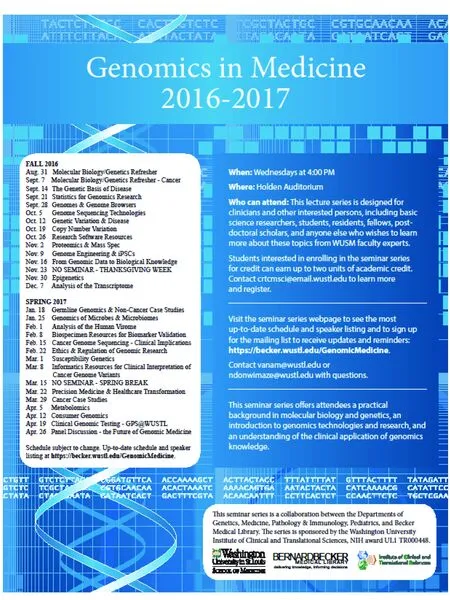
Figure 1
Building a collection of computational tools
In today′s biomedical research environment, computational tools are becoming as essential as books and journals. Recognizing this trend, Becker Library′s bioinformatics specialists began meeting with research labs to learn about their uses of genetic and proteomic analysis software packages. They found that a small number of software titles were being used by several labs-all of which purchased their own licenses. Formal training on these packages was often lacking, and informal training within labs was being done by a lab member who had become a local expert on a particular software package. Becker Library recognized the opportunity to reduce the burden of managing licenses, improve availability of formal training, offer broader access to interested labs, and reduce lab expenses by coordinating site licenses and training within the medical school. To that end, it set out to identify and site-license a collection of the most popular software titles around 'omics and statistics'. Accomplishing this meant not only reaching out to a large number of labs for their input, but also required a lot of negotiations with software vendors. Ultimately, nine software packages were selected for site licensing, which provided significant price reductions to existing lab users and a newly affordable option to those labs that were previously interested but couldn′t afford individual lab licenses. Once acquired, Becker Library′s bioinformatics specialists worked closely with the software vendors to facilitate training for anyone interested. This involved providing a suitable computer-equipped training room, scheduling the sessions, managing registration and attendance, and advertising the training throughout the medical school.
Besides the savings and training benefits derived by the individual labs, several additional positive outcomes resulted from this program, including:
?More labs were able to afford specialized software tools,
?A broader suite of leading-edge computational tools was available,
?Professional training from vendors was widely accessible,
?Better access to technical support for software packages was available
While providing better access at a better price, this program has fostered a community of users around core software tools, thereby enhancing the collaborative possibilities among labs. The library, in return, gains a better understanding of lab needs which can be used to improve or develop new services to support them.
Onramp to Informatics
Just as software tools have become essential elements of research, there is a growing recognition that basic computational and informatics skills are necessary to be a successful researcher. While establishing its software licensing program Becker Library developed a partnership with the Center for High Performance Computer (CHPC) to provide university-wide access to Galaxy[2]and Partek Flow[3]. These tools are designed to make computationally intensive tools accessible to research scientists who lack computational experience. As the library′s bioinformatics specialists worked with CHPC and labs on implementation and training they recognized a need and strong desire among researchers to have introductory training in computational methods. In collaboration with CHPC, Becker Library began developing an Introduction to Research Computing workshop to be taught by a member of CHPC. Becker bioinformatics specialists made sure the material was in line with the wants and needs of researchers and not intimidating or beyond their technical reach. The resulting sessions covered three basic areas:
1.Tools to connect and move data; basic use of the Linux command line interface
2.Text editors and shell scripts
3.Running jobs on the CHPC cluster
The workshop was extremely popular, filling the training facility to capacity with a waiting list of enough people to fill it again. The success of this workshop led to workshops in Python and R, which have proven to be just as popular.
Becker Library organized, advertised, and reviewed the content for all the workshops and created and taught the R workshop. The program began as the library acting as a connector between researchers and CHPC, but it has now led to a formal partnership with Washington University′s Institute of Informatics to develop a full suite of introductory workshops. The vision is to provide a smooth onramp for researchers to learn about informatics so they can decide where to go from there. The Institute for Informatics is developing an advanced training program for those interested in going further.
#SciComm Thursdays
Becker Library has long been an advocate for improving health literacy and using plain language when communicating health information. The library′s health information specialist provides assistance in crafting clear and understandable messages for patients and research subjects and teaches students how to be sensitive to cultural, socioeconomic, educational, and other factors that might lead to a poor understanding by the patient of their illness or care plan. Providing clear and understandable health information to patients is one example of good science communication skills. Beyond health literacy, effectively communicating the concepts and impacts of science to the general public, media, politicians, and colleagues has now become more important than ever to maintain the public′s trust and ensure continued funding. In partnership with the medical school′s Vice Chancellor for Research, who has a keen interest in helping researchers better communicate their science, Becker Library developed and coordinated a four-day symposium that included presentations and workshops by the Alan Alda Center for Communicating Science, as well as sessions led by Washington University specialists. Based on the popularity of the symposium, Becker Library and the Washington University Institute for Clinical and Translational Sciences established a formal series called #SciCommThursdays with monthly topical presentations about communicating science. Each session includes a technical expert who gives an overview of the topic with practical advice, and a faculty member who shares their experiences in the topic area. Topics included:
?Social Media for Promoting Science and Research
?Preparing Dynamic & Engaging Presentations
?Elevator Pitches - Stories in 3 Minutes or Less
?Complex Messages Simplified for a Lay Audience
Here again, Becker Library is a connector, bringing those interested in improving their communication skills together with those who have the knowledge and experience. The library benefits by raising awareness of its health communication services, as well as its changing role within the institution.
Vesalius and the Invention of the Modern Body
Elisabeth Brander, Rare Book Librarian at Becker Library, writes in her digital exhibit, Vesalius and the Invention of the Modern Body,
“De Humani Corporis Fabrica by the 16thcentury Flemish anatomist Andreas Vesalius is rightly regarded as one of the greatest books in the history of medicine. It is a monumental work, both in terms of its intellectual content and as a spectacular example of early modern printing. Printed on large paper in folio format, and written in a complex form of Latin, it was a book for the intellectual elite. Today it has pride of place in rare book collections all over the world, and it is celebrated for its contributions to the intellectual and artistic development of anatomy.”[4]
Becker Library′s rare books collection holds 1543 (see frontispiece in Figure 2) and 1555 editions of this historic work, and to commemorate the 500th anniversary of Vesalius′ birth, Elisabeth Brander sug gested hosting an interdisciplinary symposium recognizing Vesalius′ contributions to medicine, art, and publishing. In collaboration with Washington University′s Medical Humanities program and Center for History of Medicine, as well as St. Louis University′s history department, Becker Library coordinated the development of a three-day symposium, bringing together physicians, historians, literary scholars, and artists from around the world. The hugely successful symposium was held on the Washington University Medical Center campus in February 2015 with approximately 100 people in attendance.
Through its work as a connector for the Vesalius symposium, the library forged a stronger partnership with Washington University′s Medical Humanities program, improved collaboration with local universities, and raised international awareness of Becker Library′s significant rare book collections.

Figure 2
Connectingthedots
Libraries, by virtue of the services and resources they offer, are uniquely positioned to foster collaboration within their institutions. Through the relationships they develop, librarians can connect those seeking expertise with local experts and develop collaborative communities around common areas of need. The library sustains these communities through enhanced programs and services which, in turn, may create connections between communities, further enhancing collaboration. At Washington University in St. Louis, Bernard Becker Medical Library is actively embracing its natural role as connector to strengthen its position as a catalyst for learning and discovery.
 中華醫(yī)學(xué)圖書(shū)情報(bào)雜志2018年1期
- 中華醫(yī)學(xué)圖書(shū)情報(bào)雜志的其它文章
- 文獻(xiàn)管理軟件功能向開(kāi)放型科研社交網(wǎng)絡(luò)拓展的趨勢(shì)
- 信息學(xué)工作者在密歇根大學(xué)課程革新中的作用與合作
- Informationist roles and collaborations in curriculum innovation at the University of Michigan′s A.Alfred Taubman Health Sciences Library
- 醫(yī)學(xué)圖書(shū)館的研究整合
- “互聯(lián)網(wǎng)+”分級(jí)診療信息化體系構(gòu)建
- 中醫(yī)藥論文影響力評(píng)價(jià)系統(tǒng)(TCM-PIES)的設(shè)計(jì)與實(shí)現(xiàn)