
利用凍脹能的農產品冷藏設備防結冰表面優化設計
2018-01-09 08:29:40陳廷坤孫成彬金敬福
農業工程學報 2017年24期
關鍵詞:深度
叢 茜,陳廷坤,孫成彬,金敬福
?
利用凍脹能的農產品冷藏設備防結冰表面優化設計
叢 茜1,2,陳廷坤1,2,孫成彬1,2,金敬福1※
(1. 吉林大學生物與農業工程學院,長春 130022; 2. 吉林大學工程仿生教育部重點實驗室,長春 130022)
農產品冷藏設備換熱表面上的結冰堆積造成能源消耗,并影響了農產品的儲藏品質。該文基于水結冰相變過程中的膨脹應力及不同冰點的溶液相變時差對結冰界面穩定性的影響現象,采用帶有不同尺寸的凹坑且表面粘附雙向拉伸聚丙烯薄膜(biaxially oriented polypropylene, BOPP)的6061鋁合金為凍粘基體,探究凹坑直徑、凹坑深度及凹坑內的不同質量分數的乙醇溶液對結冰附著強度的影響規律。對試驗結果進行方差分析,建立了評價指標與各影響因素的數學回歸模型,確定防結冰表面對結冰附著強度影響的主次順序為凹坑深度、乙醇溶液質量分數、凹坑直徑,結合響應面分析得到對結冰附著強降低率具有顯著作用的工藝參數組合為:質量分數為8.05%的乙醇溶液和直徑23.172 mm、深度4.349 mm的凹坑時,表面結冰附著強度的降低率達到了92.72%。利用水凍結成冰的過程中,釋放的凍結膨脹能,破壞冰與材料之間接觸界面的穩定性,降低了結冰附著強度,提高冷藏設備表面的主動除冰特性,為后期基于相變膨脹進行防除冰方法的開發提供新思路及試驗依據。
制冷;凍結;回歸分析;膨脹;附著強度
0 引 言
隨著中國經濟快速的發展和人們生活水平的提高,人們對肉類、海鮮、水果、蔬菜等農副產品保鮮質量的要求越來越高[1-3],推動了農副產品貯藏保鮮業的快速發展,增加了冷庫、冷藏車等農產品冷藏保鮮設備的保有數量[4-6]。為大力支持和促進農副產品冷藏保鮮行業的發展,微型冷庫等冷凍冷藏設備已經連續5 a被列入農業部補貼項目指南[7],并且國家發展和改革委員會和國務院于2010年、2014年分別印發了《農產品冷鏈物流發展規劃》和《物流業發展中長期規劃(2014-2020年)》[8-10]。
保鮮冷庫作為農副產品保鮮鏈的核心部件,其運行的高效性、節能性一直是農副產品冷藏保鮮行業追求的目標,但冷風機、蒸發器等作為冷凍、冷藏庫的關鍵零部件,在低溫高濕條件下極易發生結冰、結霜現象[11-13],降低了冷風機的熱交換能力和換熱器的換熱效率[14-16],增加了空氣流動阻力和冷庫運行的能耗,導致冷凍儲藏設備的失效,造成蔬菜、水果等農副產品的冷藏失效[17-20],造成巨大的社會經濟損失和資源浪費。
目前,國內外針對冷藏設備表面的結冰、結霜現象多采用超聲振蕩、熱氨、電加熱等常規融冰、除霜方式進行清除[21-23],但常規除霜/冰方法存在成本高[24]、能耗高[25]、污染環境等使用缺陷[26]。近年來,隨著材料科學和制備技術的快速發展,諸多研究學者通過潤濕性改良技術,制備了具有防結冰能力的疏水涂層,但已有文獻表明,防結冰/霜涂層在使用過程中存在耐久性差[27-28]、成本高[28-29]、易受環境污染[28,30-31]等使用缺陷,不能滿足工業領域中的使用要求。因此,如何提高農副產品冷藏保鮮設備表面的防結冰性能、降低材料表面的結冰附著強度一直是制冷行業中的核心問題之一。
該文通過回歸方法設計試驗,建立試驗因素對結冰附著強度影響的數學模型,分析試驗因素對材料表面結冰附著強度的影響效應,為開發利用相變膨脹的防結冰表面或防覆冰囊膜提供試驗依據。
1 防覆冰模型作用原理
項目組根據冬季結冰膨脹對農業領域中輸水溝渠、渡槽等水工建筑物岸壁造成嚴重破壞的現象[32-34],提出利用相變膨脹,使農產品冷藏設備表面具備主動防除冰的能力,設計了如圖1所示的防除冰模型。在基體表面制備凹坑形態,并填充冰點不同于水的低冰點溶液,覆蓋彈性薄膜,使同一種材料存在2種冰點不同的凍結介質。由于導熱性等因素,基體表面附著的水首先凍結結冰,凹坑內后結冰的低冰點水溶液發生相變膨脹。但受到凹坑周圍剛性邊界的約束,膨脹應力只能作用于柔性邊界,導致彈性接觸界面產生膨脹凸起,破壞基體表面已形成的接觸穩定性,降低表面結冰附著強度。
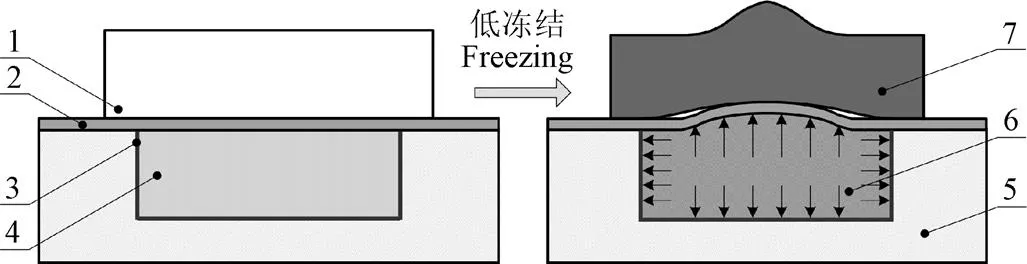
1.水 2.彈性邊界 3.剛性邊界 4.低冰點水溶液 5.基底 6.冰Ⅰ 7.冰Ⅱ
2 結冰附著強度測試試驗
2.1 試驗條件與材料
試驗采用冷藏保鮮設備常用的6061鋁合金材料作為凍粘試樣(尺寸為60 mm×60 mm×6 mm),在表面制備凹坑,填充不同質量分數的乙醇溶液,并且表面覆蓋雙向拉伸聚丙烯薄膜(biaxially oriented polypropylene,BOPP)。利用項目組自制的結冰附著強度測試裝置,如圖2所示。在溫度為?25 ℃的低溫環境下,凍結1 h進行冰的制取。
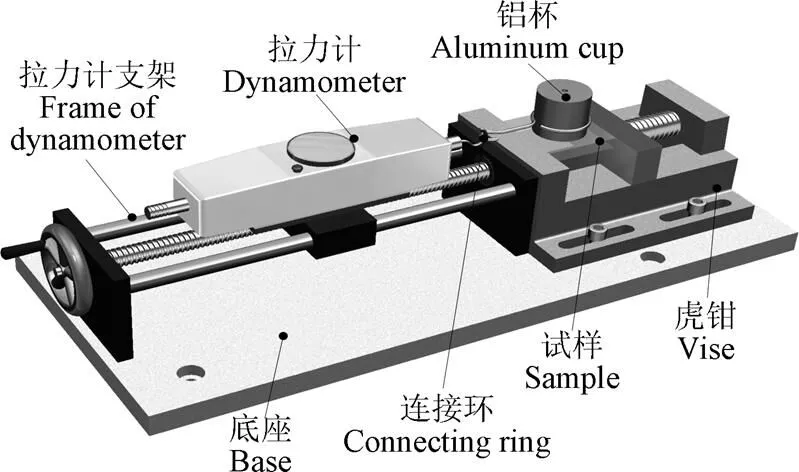
圖2 切向結冰附著強度測試裝置
2.2 試驗方法
通過結冰附著強度測試試驗,以結冰附著強度的降低率作為衡量防覆冰模型的指標,以乙醇溶液的質量分數、凹坑直徑及凹坑深度為影響因素,重復測試10次,進行二次回歸正交組合試驗。
2.2.1 試驗指標
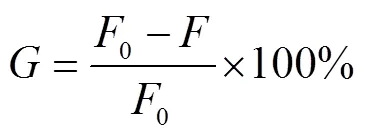
結冰附著強度降低率越高,越有利于清除試樣表面的覆冰,除冰難度和除冰成本越低。試樣表面的結冰附著強度降低率為
2.2.2 試驗因素
防覆冰模型采用凹坑內低冰點液體凍結釋放的相變膨脹能,影響冰在材料表面的結冰附著強度。因此,乙醇溶液的質量分數、凹坑的尺寸決定凹坑內液體釋放相變膨脹能的大小,達到影響材料表面結冰附著強度的目的。根據中國冬季的平均氣溫、試樣的尺寸以及初期試驗中凹坑尺寸對結冰附著強度的影響,該文中選取質量分數為6%~20%的乙醇溶液、22~30 mm的凹坑直徑、2.3~4.7 mm的凹坑深度進行回歸模擬試驗。
2.2.3 試驗設計

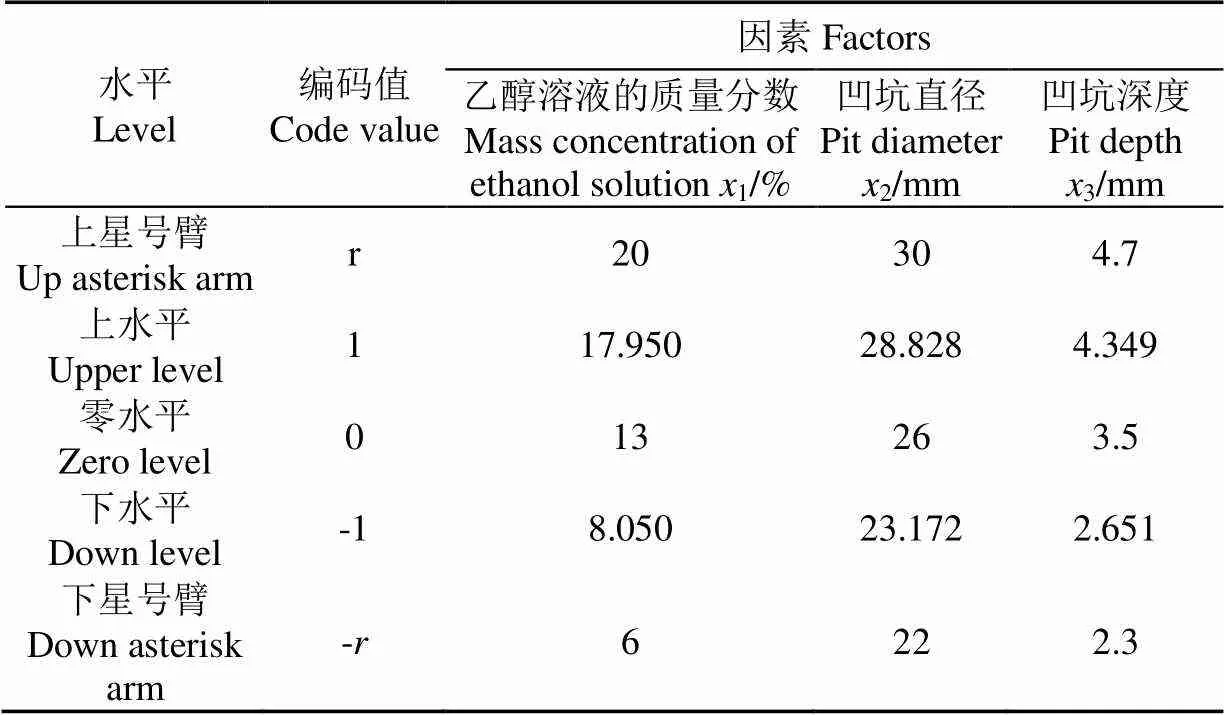
表1 因素水平編碼表
注:代表編碼空間中星號點與中心點之間的距離,=1.414。
Note:represents the distance between asterisk point and central point,=1.414.
根據文獻[35]編制試驗方案。試驗測試方案中試樣表面設計的凹坑尺寸達到了微米量級,而在實際工程應用中無須加工至此精度。但為確保試驗的嚴謹性,試驗時仍按照編制的試驗方案,采用銑削加工的方式,分別在6061鋁合金試樣表面制備試驗方案中規定尺寸的凹坑。
利用項目組自制的切向結冰附著強度測試裝置,分別測試光滑鋁合金試樣及帶凹坑試樣的表面結冰附著強度,依據公式(1)計算每種試樣的結冰附著強度降低率。試驗中,每種試樣表面的結冰附著強度進行10次重復測試試驗,取結冰附著強度降低率的平均值作為防覆冰模型對試樣表面結冰附著強度降低效果的評價指標。編制的試驗方案及相應結果如表2所示。
2.3 回歸模型建立與顯著性分析

式中1為乙醇溶液的質量分數,%;2為凹坑直徑,mm;3為凹坑深度,mm;取值范圍為?1.414~1.414。
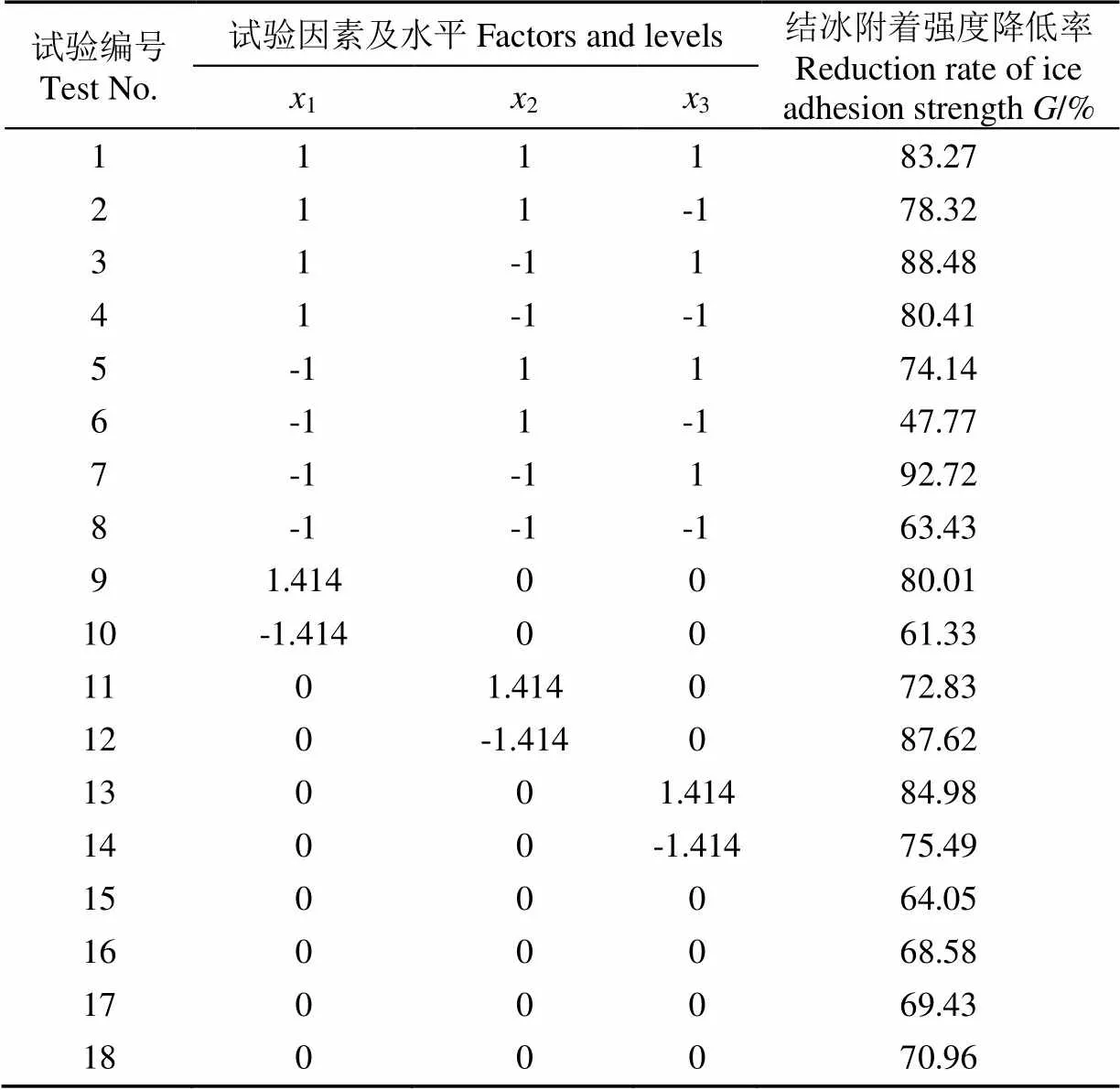
表2 試驗方案及相應結果
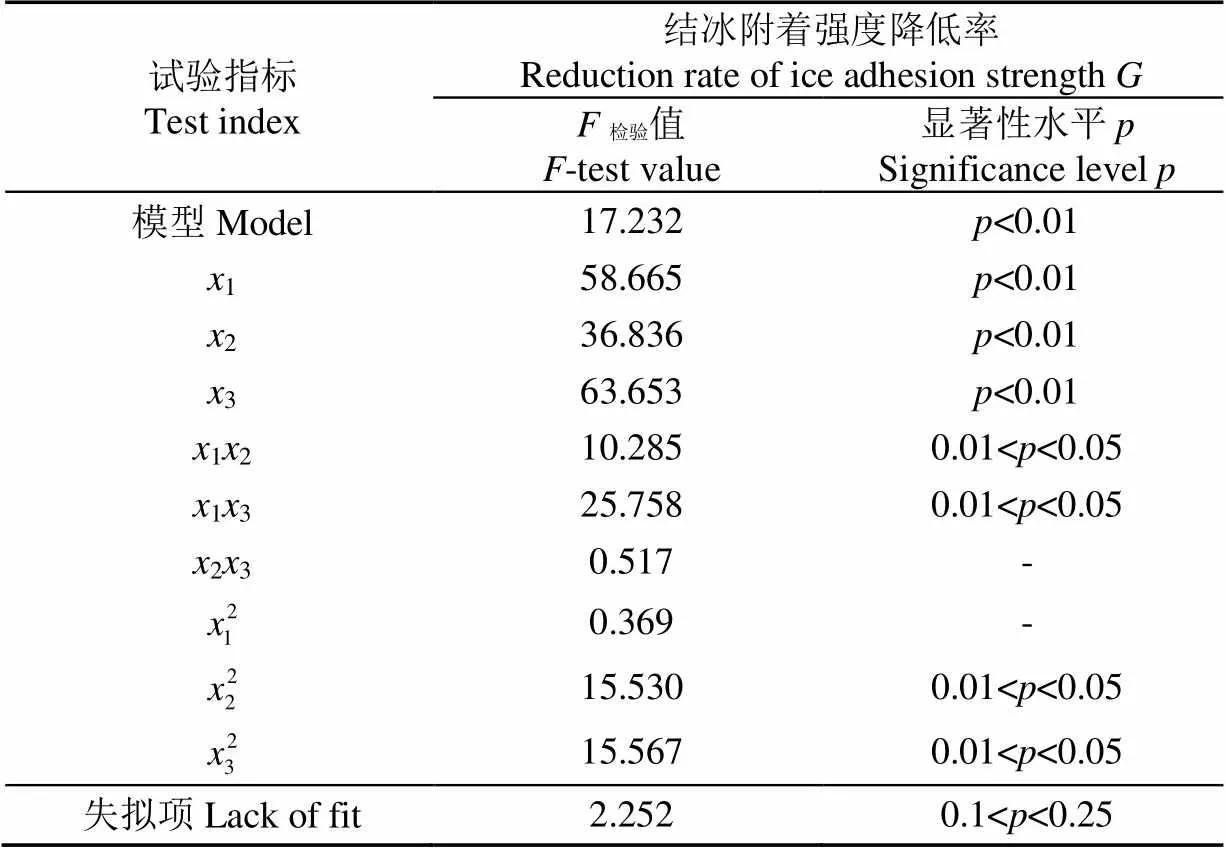
表3 結冰附著強度降低率G回歸模型的方差分析
注:<0.05為顯著,<0.01為極顯著。
Note:<0.05 represents significance,<0.01 means extremely significance.
由表3的方差分析結果可知,結冰附著強度降低率的回歸數學模型的值小于0.01,表明該回歸數學模型具有極好的顯著性,其中因子乙醇溶液的質量分數1、凹坑直徑2、凹坑深度3對結冰附著強度降低率的影響極顯著;該數學模型的失擬項的值大于0.1,擬合程度高,說明該回歸模型可預測防覆冰模型中試樣的結構參數與表面結冰附著強度降低率之間的關系。
2.4 響應面分析
運用響應曲面法分析各因素對結冰附著強度降低率的影響,固定3因素中的1個因素為零水平,考察其他2個因素對結冰附著強度降低率的影響。


由公式(3)和圖3可知,結冰附著強度降低率隨凹坑直徑2的增加,先降低并逐漸趨于平緩;隨著凹坑深度3的增加,結冰附著強度降低率增大。響應曲面沿2方向的變化速率先降低后逐漸平緩,沿3方向的變化速率快,表明在該試驗水平下,凹坑深度3對結冰附著強度降低率的影響比凹坑直徑2的影響顯著。
2)當凹坑直徑保持26 mm不變時,得到乙醇溶液的質量分數1和凹坑深度3與結冰附著強度降低率的關系及其響應曲面圖4分別為

由式(4)和圖4可知,結冰附著強度降低率隨乙醇溶液質量分數1的增加,結冰附著強度降低率逐漸增大;隨凹坑深度3的增大而增大。響應面沿3方向的變化速率大于沿1方向的變化速率,說明在該試驗水平下,凹坑深度3比乙醇溶液的質量分數1對結冰附著強度降低率的影響明顯。
3)當固定凹坑深度保持3.5 mm時,得到乙醇溶液的質量分數1和凹坑直徑2與結冰附著強度降低率的關系及其響應曲面圖5分別為

由式(5)和圖5可知,結冰附著強度降低率隨乙醇溶液質量分數1的增加而增大;隨凹坑直徑2的增加,結冰附著強度降低率先降低而后逐漸增加。響應面沿1方向的變化速率大于沿2方向變化的速率,表明在該試驗水平下,乙醇溶液的質量分數1比凹坑直徑2對結冰附著強度降低率的影響顯著。
綜上可見,對結冰附著強度降低率的影響順序依次為凹坑深度3、乙醇溶液的質量分數1和凹坑直徑2。
2.5 討 論
結合表2及響應面分析可見,試樣表面的凹坑尺寸及凹坑內填充的乙醇溶溶液影響了試樣表面的結冰附著強度,具有顯著的降低作用,并且不同尺寸的凹坑、不同質量分數的乙醇溶液對結冰附著強度的降低作用不同。當凹坑直徑為23.172 mm、凹坑深度為4.349 mm、填充8.05%質量分數的乙醇溶液,試樣表面的結冰附著強度降低率可達到92.72%;質量分數為8.05%的乙醇溶液填充在直徑為28.828 mm、深度為2.651 mm的凹坑,結冰附著強度降低率為47.77%。
低冰點溶液中水的質量分數升高時,低冰點溶液蓄含的相變膨脹能增加,降低了冰點,減小了防覆冰模型中凹坑內的低冰點溶液與界面上水之間的凍結時間差,導致表面覆冰重新附著于已變形的彈性界面,減小了基底表面的結冰附著強度降低率,如圖4、圖5所示,結冰附著強降低率沿乙醇溶液質量分數1增大的方向而逐漸降低。
當防覆冰模型中的凹坑直徑增大時,凹坑蓄含的相變膨脹能越多。如公式(6)所示,同等條件下,表面凹坑的接觸面積成平方趨勢增加,導致彈性界面單位面積承受的能量密度,對基底表面覆冰的接觸穩定性影響減小,降低了材料表面的結冰附著強度降低率,如圖3、圖5所示,結冰附著強降低率沿凹坑直徑2增大方向降低。當防覆冰模型中凹坑的深度增加時,凹坑體積增大,相同濃度下的低冰點溶液蓄含的相變膨脹能越高,作用于彈性界面的單位能量越高,致使彈性界面的變形越大,對冰與界面之間粘附穩定性的破壞程度越大,模型中材料表面的結冰附著強度越低,如圖3、圖4所示,結冰附著強降低率沿凹坑深度3增大方向升高。
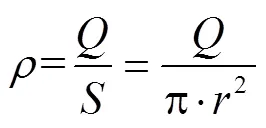
式中為乙醇溶液的相變膨脹能,為試樣表面的凹坑直徑。
3 結 論
1)利用相變膨脹作為除冰動力的防覆冰模型可明顯的降低材料表面的結冰附著強度,并且防覆冰模型對基底材料表面結冰附著強度的影響大小依賴于模型中凹坑的尺寸以及凹坑內填充的低冰點溶液。
2)采用二次回歸正交組合設計方法,已確定乙醇溶液的質量分數、凹坑直徑和凹坑深度對結冰附著強度降低率影響的數學模型,并且各因素對結冰附著強度降低率的影響顯著性順序依次為:凹坑深度、乙醇溶液的質量分數、凹坑直徑,并且凹坑深度、凹坑直徑分別與乙醇溶液質量分數對結冰附著強度降低率的影響具有交互作用。當防覆冰模型中采用質量分數為8.05%的乙醇溶液、凹坑直徑為23.172 mm、凹坑深度為4.349 mm時,可使表面結冰附著強度降低率達到92.72%。
隨著乙醇溶液質量分數的增加、凹坑直徑的降低、凹坑深度的增大,擴大了乙醇溶液與水之間的冰點,增大了凍結時釋放相變膨脹能,破壞冰與材料之間的接觸穩定性,降低了冰在材料表面的結冰附著強度。利用凍結過程中產生的相變膨脹,提升冷藏設備表面的主動防除冰特性,降低冷藏保鮮行業對表面積冰的除冰成本,為后期通過冰的相變膨脹開發新式防、除冰方法提供試驗數據的參考,如通過該原理制備膠囊狀的防結冰覆膜。
[1] 張新林,成耀榮. 基于系統動力學的冷庫發展調控模型與仿真[J]. 鐵道科學與工程學報,2015,12(6):1464-1470.
Zhang Xinlin, Cheng Yaorong. Cold storage development control model and simulation based on system dynamics[J]. Journal of Railway Science and Engineering, 2015, 12(6): 1464-1470. (in Chinese with English abstract)
[2] 謝晶,邱偉強. 我國食品冷藏鏈的現狀及展望[J]. 中國食品學報,2013,13(3):1-7.
Xie Jing, Qiu Weiqiang. Recent situation and development of food cod chain in china[J]. Journal of Chinese Institute of Food Science and Technology, 2013, 13(3): 1-7. (in Chinese with English abstract)
[3] 譚晶瑩,王清,安偉科. 預冷庫溫濕度控制與熱工響應試驗[J]. 農業機械學報,2010,41(3):139-142,194.
Tan Jingying, Wang Qing, An Weike. Experiment on the control of temperature and humidity and thermal response for pre-cooling cold storage[J]. Transactions of the Chinese Society for Agricultural Machinery, 2010, 41(3): 139-142, 194. (in Chinese with English abstract)
[4] 謝晶,繆晨,杜子崢,等. 冷庫空氣幕性能數值模擬與參數優化[J]. 農業機械學報,2014,45(7):189-195.
Xie Jing, Miao Chen, Du Zizheng, et al. Numerical simulation and parameter optimization on performance of air curtain in cold stores[J]. Transactions of the Chinese Society for Agricultural Machinery, 2014, 45(7): 189-195. (in Chinese with English abstract)
[5] 鐘曉輝,翟玉玲,勾昱君,等. 小型冷庫內部融霜與預冷過程的數值模擬[J]. 工程熱物理學報,2012,32(12):2103-2105.
Zhong Xiaohui, Zhai Yuling, Gou Yujun, et al. Numerical simulation of small cold storage under pre-cooling and defrosting conditions[J]. Journal of Engineering Thermophysics, 2012, 32(12): 2103-2105. (in Chinese with English abstract)
[6] 李錦,謝如鶴. 冷藏車開門狀態升溫影響因素分析[J]. 農業機械學報,2014,6(45):254-259.
Li Jin, Xie Ruhe. Influence factors analysis of air-temperature increasing within refrigerated trucks during the door-opening[J]. Transactions of the Chinese Society for Agricultural Machinery, 2014, 6(45): 254-259. (in Chinese with English abstract)
[7] 趙松松,楊昭,陳愛強,等. 微型冷庫復合加熱循環除霜系統的研制與試驗[J]. 農業工程學報,2015,31(2):306-311.
Zhao Songsong, Yang Zhao, Chen Aiqiang, et al. Development and experiment about recombination heating circulation defrosting system of mini cold storage house[J]. Transactions of the Chinese Society of Agricultural Engineering (Transaction of the CSAE), 2015, 31(2): 306-311. (in Chinese with English abstract)
[8] 劉曉輝,魯墨森,王淑貞,等. 小型冷庫多效冷凝制冷機組的能耗及節能分析[J]. 農業工程學報,2010,26(6):103-108.
Liu Xiaohui, Lu Mosen, Wang Shuzhen, et al. Analysis of energy consumption and energy conservation of multi-effect condensed refrigeration unit in small cold storage[J]. Transactions of the Chinese Society of Agricultural Engineering (Transaction of the CSAE), 2010, 26(6): 103-108. (in Chinese with English abstract)
[9] 中華人民共和國國家發展和改革委員會.《農產品冷鏈物流發展規劃》[EB/OL]. 2010-06-18[2010-07-30]. http://bgt.ndrc.gov.cn/zcfb/201007/t20100730_498782.html.
[10] 國務院.《物流業發展中長期規劃(2014-2020年)》[EB/OL].2014-09-12[2014-10-04]. http://www.gov.cn/zhengce/ content/2014-10/04/content_9120.htm.
[11] 吳松,陳雷,王艷華. 對某型船用冷庫低溫冷風機嚴重結霜問題的研究[J]. 制冷,2015,34(3):79-83.
Wu Song, Chen Lei, Wang Yanhua. Study on cold air cooler with severe frost problem of a certain type of ship[J]. Refrigeration, 2015, 34(4): 79-83. (in Chinese with English abstract)
[12] Huang J M, Hsieh W C, Ke X J, et al. The effects of frost thickness on the heat transfer of finned tube exchanger subject to the combined influence of fan types[J]. Applied Thermal Engineering, 2008(28): 728-737.
[13] 郭憲民,王善云,汪偉華,等.環境參數對空氣源熱泵蒸發器表面霜層影響研究[J].西安交通大學學報,2011,45(3):30-34.
Guo Xianmin, Wang Shanyun, Wang Weihua, et al. Effect of environmental condition on evaporator surface frost layer air force heat pump[J]. Journal of Xi’an Jiaotong University, 2011, 45(3): 30-34. (in Chinese with English abstract)
[14] 譚海輝,陶唐飛,徐光華,等. 翅片管式蒸發器超聲波除霜理論與技術研究[J]. 西安交通大學學報,2015,49(9):105-113.
Tan Haihui, Tao Tangfei, Xu Guanghua, et al. Ultrasonic defrosting theory and technology for finned-tube evaporator[J]. Journal of Xi’an Jiaotong University, 2015, 49(9): 105-113. (in Chinese with English abstract)
[15] 董建鍇,姜益強,姚楊,等. 空氣源熱泵相變蓄能除霜蓄能特性實驗研究[J]. 土木建筑與環境工程,2011,33(2):74-79.
Dong Jiankai, Jiang Yiqiang, Yao Yang, et al. Experimental analysis on characteristics of energy storage for defrosting of air source heat pump with phase change energy storage[J]. Journal of Civil, Architectural & Environmental Engineering, 2011, 33(2): 74-79. (in Chinese with English abstract)
[16] 曹小林,曹雙俊,段飛,等. 空氣源熱泵除霜問題研究現狀與展望[J]. 流體機械,2011,39(4):75-79.
Cao Xiaolin, Cao Shuangjun, Duan Fei, et al. Current situation and development prospect of air source heat pump defrosting research[J]. Fluid Machinery, 2011, 39(4): 75-79. (in Chinese with English abstract)
[17] Knabben F T, Hermes C J L, Melo C. In-situ study of frosting and defrosting process in tube-fin evaporators of household refrigerating appliances[J]. International Journal of Refrigeration, 2011, 34(8): 2031-2041.
[18] 劉耀民,劉中良,黃玲艷,等.結霜對微型冷庫性能影響的實驗研究[J]. 工程熱物理學報,2010,31(10):1755-1758.
Liu Yaomin, Liu Zhongliang, Huang Lingyan, et al. An experimental study of the influences of frost deposition on the performance of a cold store[J]. Journal of Engineering Thermophysics, 2010, 31(10): 1755-1758. (in Chinese with English abstract)
[19] Bansal P, Fothergill D, Fernandes R. Thermal analysis of the defrost cycle in a domestic freezer[J]. International Journal of Refrigeration, 2010, 33(3): 589-599.
[20] 賴艷華,吳濤,趙琳研,等. 低溫吸濕復合吸附劑的制備及吸濕性能[J]. 化工學報,2015,66(S1):154-157.
Lai Yanhua, Wu Tao, Zhao Linyan, et al. Preparation and dehumidification performance of composite adsorbent for low-temperature desiccants[J]. CIESC Journal, 2015, 66(S1): 154-157. (in Chinese with English abstract)
[21] 李棟,陳振乾. 超聲功率對冷壁面凍結液滴脫除效果的影響[J]. 東南大學學報:自然科學版,2014,44(4):751-755.
Li Dong, Chen Zhenqian. Effect of ultrasonic power on removal of frozen water droplets from cold surface[J]. Journal of Southeast University: Natural Science Edition, 2014, 44(4): 751-755. (in Chinese with English abstract)
[22] 秦海杰,李維仲,趙之海,等. 空氣冷卻器結霜特性的實驗研究[J]. 太陽能學報,2014,6(34):1080-1085.
Qin Haijie, Li Weizhong, Zhao Zhihai, et al. Experimental study on frosting characteristics of fan cooler[J]. Acta Energiage Solaris Sinica, 2014, 6(34): 1080-1085. (in Chinese with English abstract)
[23] 王棟,陶樂仁,劉訓海. 加濕量對低溫冷庫冷風機融霜的影響[J]. 化工學報,2014,65(S2):58-63.
Wang Dong, Tao Leren, Liu Xunhai. Effect of humidifying amount on defrosting of air cooler in low-temperature cold storage[J]. CIESC Journal, 2014, 65(S2): 58-63. (in Chinese with English abstract)
[24] Melo C, Knabben F T, Pereira P V. An experimental study on defrost heaters applied to frost-free household refrigerators[J]. Applied Thermal Engineering, 2013(51): 239-245.
[25] 王棟,陶樂仁. 有無隔斷裝置對冷風機熱氣融霜的影響[J].低溫與超導,2014,42(2):56-58,61.
Wang Dong, Tao Leren. Influence of the partition board on the hot-gas defrosting of air-cooler[J]. Cryogenics & Superconductivity, 2014, 42(2): 56-58, 61. (in Chinese with English abstract)
[26] 李輝,趙蘊慧,袁曉燕. 抗結冰涂層院:從表面化學到功能化表面[J]. 化學進展,2012,24(11):2087-2096.
Li Hui, Zhao Yunhui, Yuan Xiaoyan. Anti-icing coatings: From surface chemistry to functional surfaces[J]. Progress in Chemistry, 2012, 24(11): 2087-2096. (in Chinese with English abstract)
[27] Tang Y Q, Zhang Q H, Zhan X L, et al. Superhydrophobic and anti-icing properties at overcooled temperature of a fluorinated hybrid surface prepared via a sol-gel process[J]. Soft Matter, 2015(11): 4540-4550.
[28] 鄭海坤,常士楠,趙媛媛. 超疏水/超潤滑表面的防疏冰機理及其應用[J]. 化學進展,2017,29(1):102-118.
Zheng Haikun, Chang Shinan, Zhao Yuanyuan. Anti-icing &icephobic mechanism and applications of superhydrophobic/ultra slippery surface[J]. Progress in Chemistry, 2007, 29(1): 102-118. (in Chinese with English abstract)
[29] 安光明,凌世全,王智偉,等. 基于微納結構液體灌注的超滑表面的制備與應用[P]. 化學進展,2015,27(12):1705-1713.
An Guangming, Ling Shiquan, Wang Zhiwei, et al. Fabrication and application of ultra-slippery surfaces based on liquid infusion in micro/nano structure[J]. Progress in Chemistry, 2015, 27(12): 1705-1713. (in Chinese with English abstract)
[30] Boreyko J B, Collier C P. Delayed frost growth on jumping-drop surperhydrophobic surfaces[J]. Acs Nano, 2013, 7(2): 1618-1627.
[31] Hao Q Y, Pang Y C, Zhao Y, et al. Mechanism of delayed frost growth on superhydrophobic surfaces with jumping condensates: more than interdrop freezing[J]. Langmuir, 2014, 30(51): 15416-15422.
[32] 劉孟凱,王長德,馮曉波. 長距離控制渠系結冰期的水力響應分析[J]. 農業工程學報,2011,27(2):20-27.
Liu Mengkai, Wang Changde, Feng Xiaobo. Analysis on the hydraulic response of long distance canal control system during ice period[J]. Transactions of the Chinese Society of Agricultural Engineering (Transactions of the CSAE), 2011, 27(2): 20-27. (in Chinese with English abstract)
[33] 劉月,王正中,王羿,等. 考慮水分遷移及相變對溫度場影響的渠道凍脹模型[J]. 農業工程學報,2016,32(17):83-88.
Liu Yue, Wang Zhengzhong, Wang Yi, et al. Frost heave model of canal considering influence of moisture migration and phase transformation on temperature field[J]. Transactions of the Chinese Society of Agricultural Engineering (Transactions of the CSAE), 2016, 32(17): 83-88. (in Chinese with English abstract)
[34] 陳武,劉德仁,董元宏,等. 寒區封閉引水渡槽中水溫變化預測分析[J]. 農業工程學報,2012,28(4):69-75.
Chen Wu, Liu Deren, Dong Yuanhong, et al. Prediction analysis on water temperature in closed aqueduct in cold regions[J]. Transactions of the Chinese Society of Agricultural Engineering (Transactions of the CSAE), 2012, 28(4): 69-75. (in Chinese with English abstract)
[35] 任露泉. 回歸設計及其優化[M]. 北京:科學出版社,2009:39-59.
Design of active de-icing surface for refrigeration equipment of agricultural by-products
Cong Qian1,2, Chen Tingkun1,2, Sun Chengbin1,2, Jin Jingfu1※
(1.130022,; 2.130022,)
The accreted ice on the exposed surface is well known to result in severe accidents to power transmission lines, aircraft, boats, and so on, and cause the significant economic losses. The refrigeration equipment of the agricultural by-products is no exception. With the rapid development of the refrigeration industry and the improvement of the food requirement, the number of the China’s refrigeration equipment to store the agricultural by-products increases gradually every year. The problem of the influence of the ice accumulation on the refrigeration equipment has become outstanding gradually. In order to reduce the harm and the economic losses of storage of agricultural by-products caused by the icing adhesion phenomenon, an active de-icing model was designed according to the volume expansion during the freezing process. The de-icing model adopted the swelling force as the active power to destroy the stability of the contact interface between the ice and the substrate surface. During the experiment, ternary quadratic regression orthogonal experiment method was adopted to design the experiment conditions, like the range of the solution mass concentration and the size of the pits, and the mathematic model was set up to analyze the relationship between the experimental factors and the ice adhesion strength. The test used the 6061 aluminum alloy whose size is 60 mm × 60 mm × 6 mm as the sample material and took the laser processing or milling to fabricate the different sizes of pits. And the pits were full of different mass concentrations of ethanol solution. The sample surface was covered by the biaxially oriented polypropylene (the abbreviation is BOPP). The experimental results showed that the de-icing model significantly reduced the ice adhesion strength, and the different pit sizes and mass concentrations of filled ethanol solution had different effects on reducing the ice adhesion strength. When the pit diameter was 23.172 mm, the depth was 4.349 mm, and the pit was filled with 8.05% ethanol solution, the reduction rate of ice adhesion strength by the model was 92.72%. The regression analysis method was used to solve the regression equation. And the order of the influence of different experiment factors on decreasing ice adhesion strength was determined, which was pit depth, mass concentration of ethanol solution and pit diameter from high to low. The mechanism of the de-icing model was analyzed through the adopted regression equation. The paper considered that the freezing of solution in the pits would release the expansion energy in a short time and directly act on the freezing interface due to both rigid sides of the pit. The ethanol solution would contain more and more phase transformation energy with the increasing of the pit depth. The higher the energy density acting on the BOPP film, the greater the damage to the stability of the contact interface, the greater the ice adhesion strength decreased. When the mass concentration of ethanol solution in the pits was reduced, it would generate more expansion energy. That meant that the elastic film would bear more expansion force under the same conditions and it would increase the reduction rate of the ice adhesion strength. However, the decrease rate of the ice adhesion strength would not increase as the radius of the pit increasing. As the radius increased, the area of the expansion load acting on the contact interface would increase in square. Therefore, it decreased the power density on the BOPP film and the reduction rate would be reduced. The study takes the phase expansion force to improve the surface active characteristics of the refrigeration equipment and provides the experimental basis for developing the active de-icing method and a new thought for de-icing methods.
refrigeration; freezing; regression analysis; expansion; adhesion strength
10.11975/j.issn.1002-6819.2017.24.037
TB131
A
1002-6819(2017)-24-0283-07
2017-06-05
2017-11-14
國家自然科學基金委員會與英國皇家學會合作交流項目(51711530236)資助
叢 茜,女,吉林長春人,教授,博士,博士生導師,主要從事工程仿生學、材料防凍粘的方向研究。Email:chentk16@mails.jlu.edu.cn
金敬福,男,吉林長春人,副教授,博士,主要從事機械界面效應及低溫防凍粘方向的研究。Email:jinjingfu@jlu.edu.cn
叢 茜,陳廷坤,孫成彬,金敬福. 利用凍脹能的農產品冷藏設備防結冰表面優化設計[J]. 農業工程學報,2017,33(24):283-289. doi:10.11975/j.issn.1002-6819.2017.24.037 http://www.tcsae.org
Cong Qian, Chen Tingkun, Sun Chengbin, Jin Jingfu. Design of active de-icing surface for refrigeration equipment of agricultural by-products[J]. Transactions of the Chinese Society of Agricultural Engineering (Transactions of the CSAE), 2017, 33(24): 283-289. (in Chinese with English abstract) doi:10.11975/j.issn.1002-6819.2017.24.037 http://www.tcsae.org
猜你喜歡
中學生數理化·七年級數學人教版(2022年6期)2022-06-05 06:50:50
快樂學習報·教育周刊(2022年16期)2022-05-01 21:25:05
中學生數理化·七年級數學人教版(2020年11期)2020-12-14 06:59:52
藝術品鑒證.中國藝術金融(2018年8期)2019-01-14 01:14:28
藝術品鑒證.中國藝術金融(2018年10期)2019-01-08 02:44:26
藝術品鑒證.中國藝術金融(2018年6期)2019-01-08 02:43:04
藝術品鑒證.中國藝術金融(2018年12期)2018-08-26 06:03:48
新聞傳播(2016年10期)2016-09-26 12:14:59
新聞傳播(2015年10期)2015-07-18 11:05:40
交通建設與管理(2015年15期)2015-03-20 15:18:57
