
基于熱成像技術(shù)的牛舍圍護結(jié)構(gòu)傳熱阻測試方法
2018-01-09 01:59:21施正香王朝元
農(nóng)業(yè)工程學報 2017年24期
曹 哲,施正香,安 欣,王朝元
?
基于熱成像技術(shù)的牛舍圍護結(jié)構(gòu)傳熱阻測試方法
曹 哲1,2,施正香1,3※,安 欣1,2,王朝元1,3
(1. 中國農(nóng)業(yè)大學水利與土木工程學院,北京 100083; 2. 農(nóng)業(yè)部設施農(nóng)業(yè)工程重點試驗室,北京 100083; 3. 北京市畜禽健康養(yǎng)殖環(huán)境工程技術(shù)研究中心,北京 100083)
針對傳統(tǒng)的接觸式傳熱阻測試方法對測試場合要求高、操作復雜、操作時間相對較長等難以應用于環(huán)境較為惡劣的畜禽舍問題,該文引入熱成像技術(shù),開展了黑龍江地區(qū)2種不同類型牛舍的圍護結(jié)構(gòu)熱特性參數(shù)現(xiàn)場測試,獲得了基于熱成像法和傳統(tǒng)接觸式測試法下牛舍墻體、屋面、門窗的特征溫度值。在此基礎(chǔ)上,計算了牛舍圍護結(jié)構(gòu)材料的傳熱阻,并與相應建筑材料的傳熱阻理論計算值進行了對比分析。結(jié)果表明,對于墻體、屋面等圍護結(jié)構(gòu),2種方法所獲得的傳熱阻測試值與理論計算值的偏差小于15%;對于圍護結(jié)構(gòu)窗體和門,2種方法所獲得的傳熱阻測試值與理論計算值的偏差在20%~30%之間;雖然熱成像法和接觸式測試法現(xiàn)場實測值與理論計算值之間都存在偏差,但因現(xiàn)場測試能綜合材料老化、脫落、受潮和施工質(zhì)量等實際情況,相對而言實測值的可信度更高;但綜合考慮2種方法,熱成像法的操作簡單、便捷,可以很好地用于畜禽舍圍護結(jié)構(gòu)的熱工性能評價。
墻體;傳熱阻;熱成像儀;接觸式測試法;現(xiàn)場測試
0 引 言
建筑圍護結(jié)構(gòu)熱工性能是決定舍內(nèi)熱環(huán)境的重要因素,影響著舍內(nèi)溫度高低和分布的均勻性[1]。相比于人居環(huán)境,畜禽舍內(nèi)濕度大、有害氣體濃度高,溫度分布不均,粉塵顆粒物含量高,長期積累會引起建筑圍護結(jié)構(gòu)材料熱工性能的改變。如何在現(xiàn)場環(huán)境下進行材料傳熱阻的準確測定,對設計畜禽舍圍護結(jié)構(gòu),獲得良好的舍內(nèi)環(huán)境具有重要意義。
傳熱阻是確定建筑圍護結(jié)構(gòu)保溫性能的重要參數(shù),也是建筑熱舒適性的重要指標,對舍內(nèi)熱環(huán)境狀況及加熱或降溫能耗影響極大。傳熱阻的大小不僅取決于材料自身的類型,厚度及每層材料的密度,還與材料所處的外界環(huán)境因素緊密相關(guān),包括風速、風向、太陽輻射以及外界環(huán)境溫度分布[2-5]。傳熱阻值越大,材料的保溫性能越好。現(xiàn)有的材料傳熱阻值標定方法大部分均是在氣候試驗室內(nèi)完成[6],由于建筑材料傳熱阻的測定會受多種因素的共同影響,準確反映材料熱工性能具有一定的難度,經(jīng)常會出現(xiàn)材料加工制造商所反映的材料傳熱阻值與真實值不符[7]。目前,用于建筑結(jié)構(gòu)傳熱阻的測試方法主要有接觸式測試法(非破壞性測試法)及直接取樣測定法(破壞性測試法)2種方法[8-9]。該2種主要缺點是:對測試環(huán)境要求嚴格,操作復雜,能耗高,測點孤立。近年來,熱成像法作為熱故障診斷和測試領(lǐng)域的先進手段之一,已被廣泛應用于各行各業(yè)[10-16]。相比于上述2種測試方法,熱成像法可通過拍攝熱譜圖進行直觀、無損測試,且測試速度快、操作簡單,能對物體結(jié)構(gòu)或建筑的保溫性、氣密性、施工缺陷等進行多目標測試[17-20]。
本試驗采用熱成像技術(shù),通過對中國東北地區(qū)2種不同建筑形式牛舍的圍護結(jié)構(gòu)熱特性參數(shù)進行測定,對比傳統(tǒng)接觸式測試法和熱成像法現(xiàn)場測定圍護結(jié)構(gòu)材料的傳熱阻值,結(jié)合理論計算值評價熱成像法的準確性和可靠性,以期為牛舍圍護結(jié)構(gòu)保溫性能的現(xiàn)場評價提供新思路。
1 傳熱阻計算原理
1.1 熱成像法傳熱阻計算
熱成像儀能夠快速準確地測量物體表面的溫度,在使用其測定圍護結(jié)構(gòu)熱工性能時,只能測得墻體表面的溫度,無法客觀評價不同建筑圍護結(jié)構(gòu)的保溫性能,實際測試時需要結(jié)合熱平衡理論對建筑壁面?zhèn)鳠嶙柽M行有效估算。
結(jié)合一維穩(wěn)態(tài)導熱條件下的導熱微分方程,考慮對流換熱和輻射換熱并存的復合邊界條件,推導出利用熱成像儀測試參數(shù)計算傳熱阻1的公式:

式中1為熱成像法計算得到的傳熱阻值,m2·K/W;w,ref,in,out分別表示墻體內(nèi)表面溫度、墻體反射溫度、室內(nèi)環(huán)境溫度和室外環(huán)境溫度,K;表示材料表面發(fā)射率;表示斯蒂芬-玻爾茲曼常數(shù),5.67×10-8(W/m2·K4);in為內(nèi)墻體表面對流換熱系數(shù),W/(m2·K)。
分析知冬季建筑外墻的室內(nèi)壁面散熱模型可簡化為平板壁面自然對流傳熱,關(guān)于這種傳熱模型,Churchill等在整理大量文獻數(shù)據(jù)的基礎(chǔ)上推導出平板自然對流傳熱準則關(guān)聯(lián)式[21],如下:


式中為無量綱努塞爾數(shù),表示對流換熱強度的準則數(shù);為傳熱面的幾何特征長度,m;為流體對流換熱系數(shù),W/(m2·K);為靜止流體的導熱系數(shù),W/(m·℃);為無量綱瑞利數(shù),為無量綱普朗特數(shù),為體積熱膨脹系數(shù),1/K;為當?shù)刂亓铀俣龋琺/s2;為平板與豎直面的夾角,°;為熱擴散率,m2/s;ν流體運動粘度,m2/s;T,T,∞分別為豎直表面溫度,特征溫度,邊界層外空氣溫度,K。
通過上式(2),帶入現(xiàn)場測得相關(guān)特征值以及查得相關(guān)理論參數(shù)即可計算出墻體、屋面等結(jié)構(gòu)各自內(nèi)表面對流傳換熱系數(shù)in。此外,熱成像儀測試物體表面的溫度場分布和測定精度還要考慮來自自身參數(shù)設定與外界環(huán)境狀態(tài)的影響[22-23],其中環(huán)境反射溫度ref和發(fā)射率對其影響最大。
1.1.1 反射溫度(ref)
根據(jù)熱成像儀測定反射溫度原理[24],ref應為固定在被測試樣表面的發(fā)射率接近于1的褶皺鋁箔的表面溫度,可通過如圖1所示的方法間接測得。具體做法為:將反射鋁箔平行于試樣表面放置,將熱成像儀的表面發(fā)射率設定為1,保持熱成像儀和試樣適宜的距離(保證成像儀中的物像清晰),測定鋁箔表面溫度3次,求得材料表面的平均反射溫度ref。

圖1 反射原理測量材料表面反射溫度
1.1.2 材料表面發(fā)射率()
被測試樣的表面發(fā)射率(),不僅取決于材料本身,還與材料表面粗糙度、環(huán)境溫度、濕度及材料形狀等有關(guān)[25]。現(xiàn)場測試中,試樣表面的發(fā)射率可依據(jù)熱輻射基本原理(圖2)[26]進行計算。

注:ε為物體表面發(fā)射率,τ為大氣透射率,T為溫度值,W為輻射能,下標obj, ref, atm 分別表示試樣、反射和空氣環(huán)境。
首先,需要確定熱成像儀所接收的總輻射能,即

式中tot為熱成像儀接收總輻射能,W/m2;obj為目標輻射能,W/m2;ref為周圍環(huán)境的反射輻射能,W/m2;atm為大氣輻射能,W/m2;是物體表面發(fā)射率;為大氣透射率。
由于舍內(nèi)大氣透射率接近于1[27],取=1,化簡上式得到物體表面的發(fā)射率

式中ref,obj可由給定溫度下某波段內(nèi)黑體輻射力計算公式得到



1.2 其他測試方法的傳熱阻計算
通常,圍護結(jié)構(gòu)傳熱阻計算主要采用現(xiàn)場接觸式測試法,或按照國際標準方法(BS EN ISO 6946:1997)得到。接觸式測試法是依據(jù)圍護結(jié)構(gòu)材料兩側(cè)對流和導熱傳熱原理建立熱平衡,由此推導出基于熱電偶測試圍護結(jié)構(gòu)表面溫度的傳熱阻2計算公式,即

國際標準中關(guān)于圍護結(jié)構(gòu)傳熱阻的理論計算公式如下
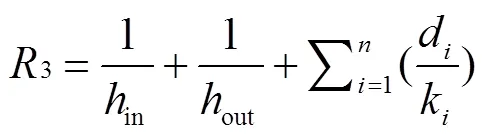
式中2,3分別為利用接觸式測試法和理論計算方法得到的圍護結(jié)構(gòu)傳熱阻,m2·K/W;out為圍護結(jié)構(gòu)外部墻體的表面換熱系數(shù),W/(m2·K);d表示材料層的厚度,m;k表示材料層導熱系數(shù)W/(m·K);out的值也可以通過對流傳熱關(guān)聯(lián)式(2)帶入相應特征參數(shù)求得。材料層導熱系數(shù)可以從相關(guān)標準中查得[28]。
2 材料與方法
2.1 試驗對象
分別選擇黑龍江密山市密閉式和雙城市卷簾式泌乳牛舍各1棟為測試對象,其圍護結(jié)構(gòu)材料見表1。

表1 牛舍材料
2.2 測試儀器和方法
試驗中,主要測試室內(nèi)外溫濕度,以及圍護結(jié)構(gòu)的表面溫度。
2.2.1 室內(nèi)外空氣溫濕度測試
采用APresys179-TH溫濕度傳感器感器(量程:溫度:?40~100 ℃,濕度:0~100%RH,測量精度:±0.3 ℃,±3%RH),測試前對各傳感器進行統(tǒng)一標定。
2.3.2 圍護結(jié)構(gòu)壁面溫度測試
使用S6手持式熱成像儀(量程:?20~650 ℃,測量精度:±2 ℃,波長范圍8~14m)和貼片式T型熱電偶(量程:?200~350 ℃,精度±0.5 ℃,響應時間3 s)測量,熱電偶溫度用Agilent 34972A數(shù)采儀采集。
1)熱成像法
熱成像儀的視場角為25°×19°,垂直視角為19°,現(xiàn)場測量側(cè)墻圍護結(jié)構(gòu)的垂直高度為4 m, 經(jīng)幾何計算,拍攝距離應為12 m。采集舍內(nèi)圍護結(jié)構(gòu)表面溫度時,手持熱成像儀沿牛舍東西向進行測量,依據(jù)牛舍尺寸等間距采取南北兩側(cè)紅外熱譜圖像各7張。紅外熱譜圖像采集與熱電偶測牛舍圍護結(jié)構(gòu)表面溫度同時進行,每棟牛舍測量之前需要根據(jù)現(xiàn)場環(huán)境參數(shù)對發(fā)射率、反射溫度、濕度、環(huán)境溫度、測試距離進行設定。環(huán)境溫度測試樣點選取牛舍內(nèi)東西和南北方向的6個測點,儀器安裝在與牛體站立時等高的1.5 m位置,測點布置如下圖3所示。

圖3 試驗測點布置
熱成像儀設置參數(shù)中發(fā)射率采用現(xiàn)場試測法,步驟如下:
①利用T型熱電偶采用接觸式測試法測量目標表面溫度obj,由公式(6)求得obj;
②利用1.1.1中測得環(huán)境反射溫度ref,由公式(5)求得ref;
③設置熱成像儀發(fā)射率,使=1,讀出熱成像儀中目標表面溫度obj,由公式(6)求得obj,由于在舍內(nèi),=1,由公式(3)得tot=obj;
④ 依照上述步驟將測得數(shù)據(jù)obj、ref、tot帶入公式 (4)計算發(fā)射率;
2)接觸式測試法
采用傳統(tǒng)測試材料表面?zhèn)鳠嶙璧姆椒ǎ瑖o結(jié)構(gòu)表面溫度采用貼片式T型熱電偶測試,并利用Agilent 34972A數(shù)據(jù)采集儀進行數(shù)據(jù)的連續(xù)采集。測試時間選擇在利用熱成像儀進行測試的時間段(每天17:00-20:00時),與紅外熱譜圖像采集同時進行。測試方法為:在待測區(qū)熱成像儀所采集的單張紅外圖像所對應的區(qū)域范圍內(nèi)布置3組貼片式T型熱電偶,將Agilent 34972A數(shù)據(jù)采集儀的時間間隔設置為每30 min記錄1次。
2.3 測試時間選擇
本試驗于2016年1月份進行。由于太陽輻射以及環(huán)境風速[29]對圍護結(jié)構(gòu)表面溫度和熱成像儀測溫精度有較大影響,為確保試驗期間所測結(jié)果的準確性,圍護結(jié)構(gòu)的內(nèi)外溫差至少保證為10 ℃[30-32]。因此,需要首先確定一天當中環(huán)境溫度基本處于穩(wěn)定狀態(tài)的時間區(qū)間。試驗前通過對所在地的室外溫度進行連續(xù)5 d的監(jiān)測,得到17:00-20:00時間段內(nèi)外界環(huán)境溫度波動較小且穩(wěn)定,加之此時間段試驗地受太陽輻射的影響比較小,故認為該段時間牛舍圍護結(jié)構(gòu)的熱量傳遞方式為穩(wěn)態(tài)傳熱,滿足傳熱阻計算要求。因此傳熱阻測試選擇在17:00-20:00時段內(nèi)進行。監(jiān)測試驗期間,外界環(huán)境溫度的變化情況,如圖4所示。

圖4 外界環(huán)境溫度日變化
2.4 數(shù)據(jù)處理
利用熱成像分析軟件RDIRs對測得的熱譜圖像進行處理提取有用的溫度信息,采用spss20.0軟件進行數(shù)據(jù)處理分析,進行獨立樣本檢驗。
3 結(jié)果與分析
3.1 圍護結(jié)構(gòu)不同部位的傳熱阻值
按照理論計算、熱成像法、接觸式測試法,對所測牛舍圍護結(jié)構(gòu)的側(cè)墻體等部位的傳熱阻值進行了計算,結(jié)果見表2。

表2 不同測試方法下被測牛舍圍護結(jié)構(gòu)不同部位的傳熱阻值
注:不同小寫字母表示處理間數(shù)據(jù)差異顯著(<0.05);不同大寫字母表示處理間數(shù)據(jù)差異極顯著(<0.01)。
Note: Different lowercase and uppercase indicate significant difference and extremely significant difference among treatments, at 0.05 and 0.01 level, respectively.
3.1.1 理論計算值與實測值的差異分析
由表2可知,熱成像法和接觸式測試法測得牛舍圍護結(jié)構(gòu)不同部位的傳熱阻值均小于理論計算值。產(chǎn)生此結(jié)果的原因為:圍護結(jié)構(gòu)在使用過程中,材料老化、受潮、腐蝕等綜合作用使其熱阻值相對于初始值有所降低[33]。而牛舍門、窗在使用的過程中受外界環(huán)境因素干擾更大(磨損嚴重),因此其實測值與理論計算值的差異更大。同時,日常管理中操作不當造成結(jié)構(gòu)破損等因素也可能引起傳熱阻值減小,結(jié)構(gòu)的保溫性能降低。
3.1.2 熱成像法和接觸式測試法的差異比較
由表2可得,利用熱成像法測得圍護結(jié)構(gòu)各部位的傳熱阻值與接觸式測試法測得值之間存在差異。其中密閉牛舍的屋頂和卷簾牛舍的屋頂在2種方法下測得值差異極顯著(<0.01);密閉牛舍的側(cè)墻體、門、窗和卷簾牛舍的矮墻、卷簾、側(cè)墻體、門在2種方法下測得值差異比較顯著(<0.05)。
接觸式測試法在原理上僅考慮了傳導和對流傳熱過程,而熱成像法不僅考慮了上述2種傳熱過程,還包含了輻射傳熱過程[34],因此測得結(jié)果會存在一定的差異。同時,由于2種方法的測試手段不同,所用測試裝置不同,測試結(jié)果會受裝置測量精度的影響,因而也會造成一定的偏差。
3.1.3 測試值與理論計算值吻合度比較
為進一步解析熱成像法和接觸式測試法結(jié)果的可靠性,本文依據(jù)相對偏差百分比,對不同方法下的傳熱阻值與理論計算值進行了比較,結(jié)果如圖5。

圖5 不同熱阻測試方法吻合度對比
由圖5可以看出,2種方法測得傳熱阻值與理論計算值均存在偏差,接觸式測試法測得值與理論計算值的吻合度更高。在測定牛舍主要圍護結(jié)構(gòu)部位側(cè)墻體、屋頂、矮墻、卷簾的傳熱阻值時,2種方法的偏差百分比均小于15%;在測定圍護結(jié)構(gòu)窗體和門的傳熱阻值時,2種方法均與理論計算值存在較大偏差,偏差百分比在20%~30%。因此,2種方法用于測試牛舍主要圍護結(jié)構(gòu)材料傳熱阻,結(jié)果均比較可靠。
與接觸式測試法相比,熱成像法測點數(shù)量多,可有效補償由于單個測點數(shù)據(jù)不穩(wěn)定波動所引起的誤差,采用所有點計算傳熱阻值所得結(jié)果會更加符合材料在真實環(huán)境下的傳熱阻值。同時,由于接觸式測試法需要選擇測點、布置測點,而且需經(jīng)過長時間待測試參數(shù)穩(wěn)定后才能記錄數(shù)據(jù),如果考慮現(xiàn)場測試操作的便捷性,熱成像法的優(yōu)勢更加明顯,尤其是在濕度大、有害氣體濃度高,粉塵顆粒物含量高,密閉性差,門窗洞口較多的畜禽舍內(nèi)。綜合以上因素,熱成像法更適合于復雜環(huán)境下畜禽舍圍護結(jié)構(gòu)傳熱阻的現(xiàn)場測試。
3.2 密閉牛舍和卷簾牛舍圍護結(jié)構(gòu)的熱特性分析
由于牛舍圍護結(jié)構(gòu)的熱特性與組成圍護結(jié)構(gòu)的材料有關(guān),因此不同結(jié)構(gòu)部位門、窗、墻體的材料在圍護結(jié)構(gòu)組成中所占比例不同,圍護結(jié)構(gòu)的整體熱特性也不同。基于表2測得的結(jié)果,本文又對密閉牛舍和卷簾牛舍圍護結(jié)構(gòu)的整體熱特性進行了分析。針對本試驗,由于側(cè)墻、山墻、屋面等圍護結(jié)構(gòu)由不同傳熱阻值的材料復合而成,進行圍護結(jié)構(gòu)傳熱阻計算時,要考慮組合材料的平均傳熱阻值,其計算方法如下。
墻體:

屋面:

式中:4,8為墻體、屋面平均傳熱阻,m2·K/W;1,2,3為主墻體、門、窗面積,m2;5,6,7主墻體、門、窗傳熱阻,m2·K/W;4,5為主體屋面、采光板面積,m2;9,10為主體屋面、采光天窗傳熱阻,m2·K/W。
由公式(9)、(10)計算不同測試方法下的圍護結(jié)構(gòu)平均傳熱阻值,結(jié)果見表3。對比2棟牛舍圍護結(jié)構(gòu)(側(cè)墻、山墻、屋面)的冬季低限傳熱阻值和現(xiàn)場實測值、理論計算值發(fā)現(xiàn),對于密閉牛舍,墻體和屋面?zhèn)鳠嶙柚稻哂诙舅蟮牡拖迋鳠嶙柚担I岜匦阅芊显O計要求。而對于卷簾牛舍,屋面?zhèn)鳠嶙璺隙镜拖迋鳠嶙柚档囊螅饕獓o結(jié)構(gòu)側(cè)墻(組成為卷簾和矮墻)的傳熱阻值不符合墻體冬季低限傳熱阻值的設計要求。因此,在東北地區(qū),密閉牛舍結(jié)構(gòu)較卷簾牛舍結(jié)構(gòu)更能滿足牛舍保溫設計的要求(實際傳熱阻值高于冬季低限傳熱阻值)。

表3 不同方法得到牛舍圍護結(jié)構(gòu)熱阻值
4 結(jié) 論
1)熱成像法和接觸式測試法均考慮了材料在現(xiàn)場環(huán)境下因老化、脫落、受潮和施工質(zhì)量等問題對傳熱阻值的影響。因而測得牛舍圍護結(jié)構(gòu)不同部位的傳熱阻值小于理論計算值。
2)與熱成像法相比,利用接觸式測試法計算傳熱阻值與理論計算值的吻合度更高。在測定牛舍主要圍護結(jié)構(gòu)部位側(cè)墻體、屋頂、矮墻、卷簾的傳熱阻值時,2種方法的偏差百分比均在15%以內(nèi);在測定圍護結(jié)構(gòu)窗體和門的傳熱阻值時,2種方法的偏差百分比在20%~30%。
3)對比接觸式測試法,熱成像法計算原理包含了圍護結(jié)構(gòu)材料的輻射傳熱過程,理論基礎(chǔ)更加完善。同時,考慮到現(xiàn)場操作環(huán)境對測試值準確性的影響,熱成像法的操作更加便利。綜合以上因素,熱成像法更適合于復雜環(huán)境下畜禽舍圍護結(jié)構(gòu)傳熱阻的現(xiàn)場測試。
[1] 國家奶牛產(chǎn)業(yè)技術(shù)體系. 中國現(xiàn)代農(nóng)業(yè)產(chǎn)業(yè)可持續(xù)發(fā)展戰(zhàn)略研究[M]. 北京:中國農(nóng)業(yè)出版社,2016.
[2] Hagishima Aya, Tanimoto Jun. Field measurements for estimating the convective heat transfer resistance at building surfaces[J]. Building and Environment, 2003, 38(7): 873-881.
[3] Shao Jiantao, Liu Jing, Zhao Jianing, et al. A novel method for full-scale measurement of the external convective heat transfer resistance for building horizontal roof[J]. Energy and Buildings, 2009, 41(8): 840-847.
[4] Irving A D, Dewson T, Hong G, et al. Time series estimation of convective heat transfer resistance[J]. Building and Environment, 1994, 29(1): 89-96.
[5] Emmel Marcelo G, Abadie Marc O, Mendes Nathan. New external convective heat transfer resistance correlations for isolated low-rise buildings[J]. Energy and Buildings, 2007, 39(3): 335-342.
[6] Cucumo M, De Rosa A, Ferraro V, et al. A method for the experimental evaluation in situ of the wall conductance[J]. Energy and Buildings, 2006, 38(3): 238-244.
[7] Desogus Giuseppe, Mura Salvatore, Ricciu Roberto. Comparing different approaches to in situ measurement of building components thermal resistance[J]. Energy and Buildings, 2011, 43(10): 2613-2620.
[8] Cabeza Luisa F, Castell Albert, Medrano M, et al. Experimental study on the performance of insulation materials in Mediterranean construction[J]. Energy and Buildings, 2010, 42(5): 630-636.
[9] Zarr R R. A History of testing heat insulators at the national institute of standards and technology[J]. Ashrae Transactions, 2001, 107(2): 661-671.
[10] Mccafferty Dominic J. The value of infrared thermography for research on mammals: Previous applications and future directions[J]. Mammal Review, 2007, 37(3): 207-223.
[11] Kordatos E Z, Aggelis D G, Matikas T E. Monitoring mechanical damage in structural materials using complimentary NDE techniques based on thermography and acoustic emission[J]. Composites Part B Engineering, 2012, 43(6): 2676-2686.
[12] Gottschalk K, Mészáros Cs. IR thermometry for heat and mass transfer analysis of surface drying of fruit[C]//11th International Conference on Quantitative Infrared Thermography, Naples, Italy, June, 2012.
[13] Bagavathiappan Subramnaiam, Philip John, Jayakumar Tammana, et al. Correlation between plantar foot temperature and diabetic neuropathy: A case study by using an infrared thermal imaging technique[J]. Journal of diabetes science and technology, 2010, 4(6): 1386-1392.
[14] Lewandowski Witold M, Ryms Micha?, Denda Hubert. Infrared techniques for natural convection investigations in channels between two vertical, parallel, isothermal and symmetrically heated plates[J]. International Journal of Heat and Mass Transfer, 2017, 114: 958-969.
[15] O’Grady M, Lechowska A A, Harte A M. Infrared thermography technique as an in-situ method of assessing heat loss through thermal bridging[J]. Energy & Buildings, 2016, 135: 20-32.
[16] O’Grady Ma?gorzata, Lechowska Agnieszka A, Harte Annette M. Quantification of heat losses through building envelope thermal bridges influenced by wind velocity using the outdoor infrared thermography technique[J]. Applied Energy, 2017, 208: 1038-1052.
[17] Bodnar J L, Candoré J C, Nicolas J L, et al. Stimulated infrared thermography applied to help restoring mural paintings[J]. Ndt & E International, 2012, 49: 40-46.
[18] Defer D, Shen J, Lassue S, et al. Non-destructive testing of a
building wall by studying natural thermal signals[J]. Energy and Buildings, 2002, 34(1): 63-69.
[19] Kylili A, Fokaides P A, Christou P, et al. Infrared thermography (IRT) applications for building diagnostics: A review[J]. Applied Energy, 2014, 134: 531-549.
[20] Bagavathiappan S, Lahiri B, Saravanan T, et al. Infrared thermography for condition monitoring-a review[J]. Infrared Physics & Technology, 2013, 60: 35-55.
[21] Churchill S W, Ozoe H. A Correlation for laminar free convection from a vertical plate[J]. Journal of Heat Transfer, 1973, 95(4): 540.
[22] Stewart M, Webster J R, Schaefer A L, et al. Infrared thermography as a non-invasive tool to study animal welfare[J]. Animal Welfare, 2005, 14(4): 319-325.
[23] Johnson Shylo R, Rao Sangeeta, Hussey Stephen B, et al. Thermographic eye temperature as an index to body temperature in ponies[J]. Journal of Equine Veterinary Science, 2011, 31(2): 63-66.
[24] Standard Test Methods for Measuring and Compensating for Reflected Temperature Using Infrared Imaging Radiometers: ASTM E 1862-97[S]. West Conshohoken: ASTM international, 2002.
[25] 楊永軍,王中宇,張術(shù)坤,等. 基于多光譜測溫優(yōu)化的材料光譜發(fā)射率測量[J]. 北京航空航天大學學報,2014,40(8):1022-1026.
Yang Yongjun, Wang Zhongyu, Zhang Shukun, et al. Material spectral emissivity measurement optimized by multi-spectral temperature measured[J]. Journal of Beijing University of Aeronautics and Astronautics, 2014, 40(8): 1022-1026. (in Chinese with English abstract)
[26] Fokaides Paris A, Kalogirou Soteris A. Application of infrared thermography for the determination of the overall heat transfer resistance (U-Value) in building envelopes[J]. Applied Energy, 2011, 88(12): 4358-4365.
[27] 羅曉春,孫繼銀. 物體表面發(fā)射率的測量方法[J]. 自動測量與控制,2007(8):72-74.
Luo Xiaochun, Sun Jiyin. Method for measuring object surface emissivity[J]. Automatic Measurement and Control, 2007(8): 72-74. (in Chinese with English abstract)
[28] 民用建筑熱工設計規(guī)范:GB/50176-1993[S].北京:中國計劃出版社,1993.
[29] Church John S, Hegadoren P R, Paetkau M J, et al. Influence of environmental factors on infrared eye temperature measurements in cattle[J]. Research in veterinary science, 2014, 96(1): 220-226.
[30] Feuermann Daniel. Measurement of envelope thermal transmittances in multifamily buildings[J]. Energy and Buildings, 1989, 13(2): 139-148.
[31] Trethowen H. Measurement errors with surface-mounted heat flux sensors[J]. Building and Environment, 1986, 21(1): 41-56.
[32] Achenbach Paul R. Design of a calibrated hot-box for measuring the heat, air, and moisture transfer of composite building walls[J]. Thermal Performance of the Exterior Envelopes of Buildings, Proceedings-1, 1981: 308-324.
[33] Grinzato E, Vavilov V, Kauppinen T. Quantitative infrared thermography in buildings[J]. Energy & Buildings, 2010, 29(1): 1-9.
[34] 章熙敏,任澤霈,梅飛鳴. 傳熱學(第六版)[M]. 北京:中國建筑工業(yè)出版社,2014.
[35] 工業(yè)建筑供暖通風與空氣調(diào)節(jié)設計規(guī)范:GB/50019-2015[S]. 北京:中國計劃出版社,2015.
Evaluation on measure method of heat transfer resistance for enveloped structure of cattle barn based on infrared imaging method
Cao Zhe1,2, Shi Zhengxiang1,3※, An Xin1,2, Wang Chaoyuan1,3
(1.100083; 2.100083,; 3.100083,)
The heat transfer resistance of enveloped building structure plays an important role in the heat gain and heat loss of building environment. It is also a crucial index related to building thermal comfort. Compared with the housing conditions of residents, those conditions of housings for animals are more complex, which are filled with heavy moisture, highly toxic gases, and high-level dust. The accumulation of these factors can have a negative effect on the thermal performance on the surface material of building structure. For minimizing the heat loss of material, it is vital to accurately measure the material heat transfer resistance in the field environment. In recent years, the infrared imaging method, an advanced technology in the area of fault diagnosis and detection, has been widely used in various industries, such as the thermal performance test of enveloped structures on industrial and civil building. It has the distinct advantage on the portable and prompt detection of surface temperatures with the visualized thermal image. This article mainly focuses on the application of infrared thermal image technology in 2 different forms of cattle barns in northeast region. To determine heat transfer resistance of enveloped structure, the derivation of related heat transfer equation would be taken into account. Compared with the traditional method, the infrared imaging method is more reliable to evaluate the heat transfer resistance of the enveloped structure in the cattle barn. The hand-held infrared thermal imager was used to measure the surface temperature of enveloped structure with setting the view from center passageway towards the wall of the barn. The instrument was carefully calibrated to ensure the setting parameters (emissivity, reflection temperature, humidity, and so on) to be in the optimal conditions before the measurement. For the validation of the infrared image method, the environment temperature was also recorded by the T & RH sensors with 6 testing points in the north and south sides of the barn. The T thermocouples were installed at the height of 1.5 m (the same level as standing cattle) and automatically measured the enveloped structure temperature. A data acquisition system (Agilent 34972A) was applied for continuous data collection. The results showed that the thermal imaging method could be used for the detection of thermal properties in some places unavailable for the contact measurement, such as side walls, roof, and shutter. Compared with the theoretical value obtained from the theoretical calculation, these 2 methods both had a high agreement (absolute deviation percentage was basically within 15%). However, the detection of heat transfer resistance in windows and doors by these methods was not consistent (deviation percentage was between 20% and 30%). Thermal imaging technology made comprehensive use of the site environment parameters and the actual heat value of enveloped structures, which was affected by materials aging, falling off, damp air conditions, scene construction quality, and so on. Therefore, the result from infrared imaging method on the detection of the heat transfer resistance is acceptable and reliable. The results of heat transfer resistance with some conventional methods, such as formula deduction and correlation equations, were significantly influenced by the precision of the measuring instrument, some accidental errors, and limitation on the defects detection. Therefore, the infrared image technology can be an alternative method for the detection of thermal properties in the housing system for animal.
wall; heat transfer resistance; thermography; contact test method; field test
10.11975/j.issn.1002-6819.2017.24.031
S23
A
1002-6819(2017)-24-0235-07
2017-07-31
2017-12-09
現(xiàn)代農(nóng)業(yè)(奶牛)產(chǎn)業(yè)技術(shù)體系(CARS-36);國家863課題任務(2013AA10230602)。
曹 哲,男,陜西安康人,主要從事畜禽養(yǎng)殖工藝與環(huán)境研究。Email:zhecao@cau.edu.cn
施正香,女,江蘇啟東人,教授,博士生導師,主要從事畜禽養(yǎng)殖工藝與環(huán)境研究。Email:shizhx@cau.edu.cn
曹 哲,施正香,安 欣,王朝元. 基于熱成像技術(shù)的牛舍圍護結(jié)構(gòu)傳熱阻測試方法[J]. 農(nóng)業(yè)工程學報,2017,33(24):235-241. doi:10.11975/j.issn.1002-6819.2017.24.031 http://www.tcsae.org
Cao Zhe, Shi Zhengxiang, An Xin, Wang Chaoyuan. Evaluation on measure method of heat transfer resistance for enveloped structure of cattle barn based on infrared imaging method[J]. Transactions of the Chinese Society of Agricultural Engineering (Transactions of the CSAE), 2017, 33(24): 235-241. (in Chinese with English abstract) doi:10.11975/j.issn.1002-6819.2017.24.031 http://www.tcsae.org
