
基于SPEI和TVDI的河南省干旱時空變化分析
2018-01-09 01:07:06陳少丹張利平湯柔馨黃勇奇
農業工程學報 2017年24期
陳少丹,張利平,,湯柔馨,楊 凱,黃勇奇
?
基于SPEI和TVDI的河南省干旱時空變化分析
陳少丹1,張利平1,2※,湯柔馨1,楊 凱2,黃勇奇2
(1. 武漢大學水資源與水電工程科學國家重點實驗室,武漢430072; 2. 黃岡師范學院旅游文化與地理科學學院,黃岡438000)
近年來干旱在中國頻發且影響不斷加劇,因此監測干旱對氣候變化、農業生產都有重要意義。基于1961-2016年56年的氣象資料,利用標準化降水蒸散指數(SPEI)定量地分析了河南省不同時間尺度(1、3、6和12個月)的干旱發生的時空變化特征和強度;另外采用溫度植被干旱指數(TVDI)分析了河南省的區域面積上的干旱空間變化,并探討了SPEI和TVDI的相關性。結果表明:1961-2016年56 a間,SPEI值在各時間尺度上都呈微弱的濕潤化,隨著時間尺度的增大,SPEI值波動幅度減小;河南省各地區干旱分布不均勻,發生干旱年的是1961、1965、1966、1968、1972、1976、1978、1981、1986、1988、1997、2001、2013共13年,與實際情況較為一致。在月時間尺度上,SPEI與TVDI的相關性分析表明,SPEI-1與TVDI呈負相關關系,即TVDI越小,SPEI的值越大,干旱程度越輕;TVDI越大,SPEI的值越小,干旱程度越嚴重。研究結果可為河南省干旱影響評估提供參照標準。
氣候變化;干旱;遙感;SPEI;TVDI;MODIS;河南省
0 引 言
干旱是全球最常見、最復雜的自然災害之一,其發生的頻率高、持續時間長、并且影響范圍廣,對農業生產、自然生態系統和社會經濟都造成了巨大的影響[1]。目前對于干旱的監測方法應用最廣泛的主要有帕爾默干旱指數(palmer drought severity index,PDSI)、標準化降雨指數(standard precipitation index,SPI)和標準化降雨蒸散指數(standard precipitation evapotranspiration index,SPEI)[2-4]。
PDSI是由Palmer(1965)在水平衡原理的基礎上提出的一個氣象干旱指數,主要考慮了前期降水、水分供給及潛在蒸散發等因素。然而,PDSI具有固定的時間尺度,不能多尺度反映干旱特征[5]。SPI指數具有多尺度特性且計算簡單,能夠很好地反映干旱強度及持續時間,缺點是只考慮了降水對干旱的影響,不能反映由于全球變暖導致的溫度上升而引起的蒸發量的變化[6]。2010年,Vicente-Serrano等[7]在SPI的基礎上,通過引入潛在蒸散,構建了SPEI指數,它融合了PDSI和SPI的優點,不僅考慮了PDSI中干旱對蒸散的響應,而且結合了SPI的計算簡單和多時間尺度特征,因此能很好地對干旱進行監測與分析[8-12]。近年來,許多學者也開始采用SPEI進行研究,莊少偉、高蓓等利用SPEI分別研究了中國區域及東北地區近幾十年來干旱時空變化特征[9-11],研究結果證明SPEI在該地區有較好的適用性。另外,植被作為聯結土壤、大氣和水分的自然紐帶,也受干旱影響顯著[13-14]。隨著遙感技術的發展,研究范圍從基于站點的觀測延展到整個區域,對于站點分布不均并且數據較少的區域提供了干旱計算新的途徑,并且可以對大面積干旱進行實時動態的監測。基于溫度植被干旱指數(temperature vegetation dryness index,TVDI)的遙感干旱監測模型已在國內很多地方得到了驗證[15-17]。MODIS遙感影像具有高的空間分辨率,但由于影像的時間序列較短,因此采用遙感反演技術很難對研究區的干旱演變進行長時間分析。目前單獨采用SPEI和TVDI進行干旱監測分析較多,但是同時利用SPEI和TVDI兩種指數對干旱進行監測,并且分析兩者之間關系的研究較少。基于此,本研究以河南省為研究區域,基于SPEI和TVDI指數,分析了區域干旱多時空尺度演變特征,采用相關分析探討了上述2種方法描述干旱的差異和相關性,分析了干旱對于植被生長的影響,以期為河南省的干旱監測預警和農業生產提供參考依據。
1 研究區與數據
1.1 研究區概況
河南省位于中國中東部、黃河中下游,界于110°~116°E和31°~36°N之間[8]。研究區屬于暖溫帶-亞熱帶、濕潤-半濕潤季風氣候,降雨多集中在夏季,常伴有暴雨,年平均降水量約為500~900 mm,南部及西部山地分布較多,尤其大別山區可達1 100 mm以上,降水的時空分布不均,更易受旱澇災害的影響[18]。
1.2 研究數據
本文采用河南省1961-2016年逐月的氣象數據,由中國氣象科學數據共享網(http://cdc.cma.gov.cn/home.do)提供,包括降雨量、平均氣溫、最高氣溫、最低氣溫、風速與日照時數等。由于有的站點數據缺失,因此最終選取17個氣象站點的數據進行研究,站點的分布見圖1。遙感影像數據選用的是美國USGS數據中心(https://lpdaac.usgs.gov/)提供的空間分辨率為1km的植被指數產品MOD13A3 NDVI月合成數據,NDVI月合成主要是通過最大合成法對日數據進行合成得到;地表溫度數據是的MOD11A2,其分辨率是1km。然后利用NASA官方網站提供的MRT(MODIS ReProjection Tool)工具對MOD13A3、MOD11A2進行投影與文件格式的轉換,投影坐標系為常用的UTM投影,投影帶為49。

圖1 河南省氣象站點分布
2 研究方法
2.1 標準化降雨蒸散指數(SPEI)
SPEI是根據降水量和潛在蒸散發的差值偏離平均狀態的程度來計算研究區域的干旱狀況[19]。在SPEI計算過程中,潛在蒸散發目前常用的2種方法是Thornthwaite 公式和Penman-Monteith公式[20-22],但由于Thornthwaite公式只是溫度的函數,而Penman-Monteith公式不僅考慮了熱量因子,也考慮了空氣動力因子,因此本文選用Penman-Monteith公式來計算潛在蒸散發,其計算過程不再贅述,詳見文獻[23-24]。SPEI的計算過程如下:
1)計算逐月的降水與潛在蒸散量的差值,其公式如下

式中D為降水量與潛在蒸散量的差值,P為月降水,PET是根據Penman-Monteith公式計算的月潛在蒸散量,D、P和PET的單位均為mm。
2)計算不同時間尺度的水分盈虧累積序列,本文計算的時間尺度包括1、3、6和12個月。

式中是計算的次數,則是計算的時間尺度。
3)D數據序列進行正態化。采用log-logistic概率密度函數分布對D進行擬合,并求出累計函數
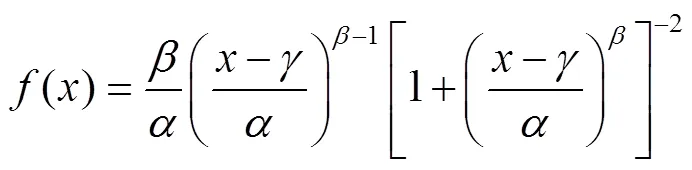

式中和分別是尺度參數、形狀參數和起始參數,可通過線性矩的方法計算得到。()是概率密度函數,()是概率分布函數。
4)SPEI值是通過對序列進行標準正態分布轉換獲得。
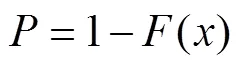


其中,常數0=2.515 5,1=0.802 9,2=0.010 3,1= 1.432 8,2=0.189 3,3=0.001 3。
SPEI具有多時間尺度的特征,本研究主要選取1、3、6和12個月的尺度進行分析。按照中國氣象局制定的SPEI干旱等級劃分標準對河南省的干旱等級進行分析(表1)。

表1 SPEI值干旱等級劃分
本文采用干旱頻率來評價河南省干旱發生的頻繁程度,其計算公式如下

式中為數據序列中干旱發生的次數,為數據的總月份數。文中選用SPEI-3來計算河南省17個氣象站干旱的發生頻率[8,25]。
2.2 溫度植被干旱指數(TVDI)
地表溫度(TS)與歸一化植被指數(NDVI)之間存在明顯的負相關關系,兩者的結合能夠提供植被生長狀況與土壤濕度分布信息[26]。當研究區植被覆蓋與土壤濕度變化范圍大時,與NDVI的散點圖呈三角形分布,在-NDVI的特征空間有很多的等值線,由此提出了溫度植被干旱指數(TVDI),其定義為[27-31]

式中min是最低地表溫度,℃,max是相同NDVI值條件下最高地表溫度,℃。min=1+1·NDVI,對應的是Ts-NDVI特征空間中的濕邊,max=2+2·NDVI,稱為干邊,1、1和2、2分別是濕邊和干邊的擬合方程的系數。離濕邊越接近,TVDI的值越小,干旱程度越輕;相反,越接近于干邊,TVDI的值會越大,說明干旱越嚴重[30]。因此,TVDI的取值介于0~1之間,其表達式如下

3 結果與分析
3.1 干旱的多時間尺度
本研究選用河南省的17個氣象站點1961-2016年的逐月氣象數據,根據前面介紹的步驟分別對各站點56年的SPEI值進行計算,研究共計算了1、3、6和12個月4種時間尺度,然后對計算得到的17個氣象站點的SPEI值進行月平均得到1、3、6和12個月的年際變化特征(圖2)。
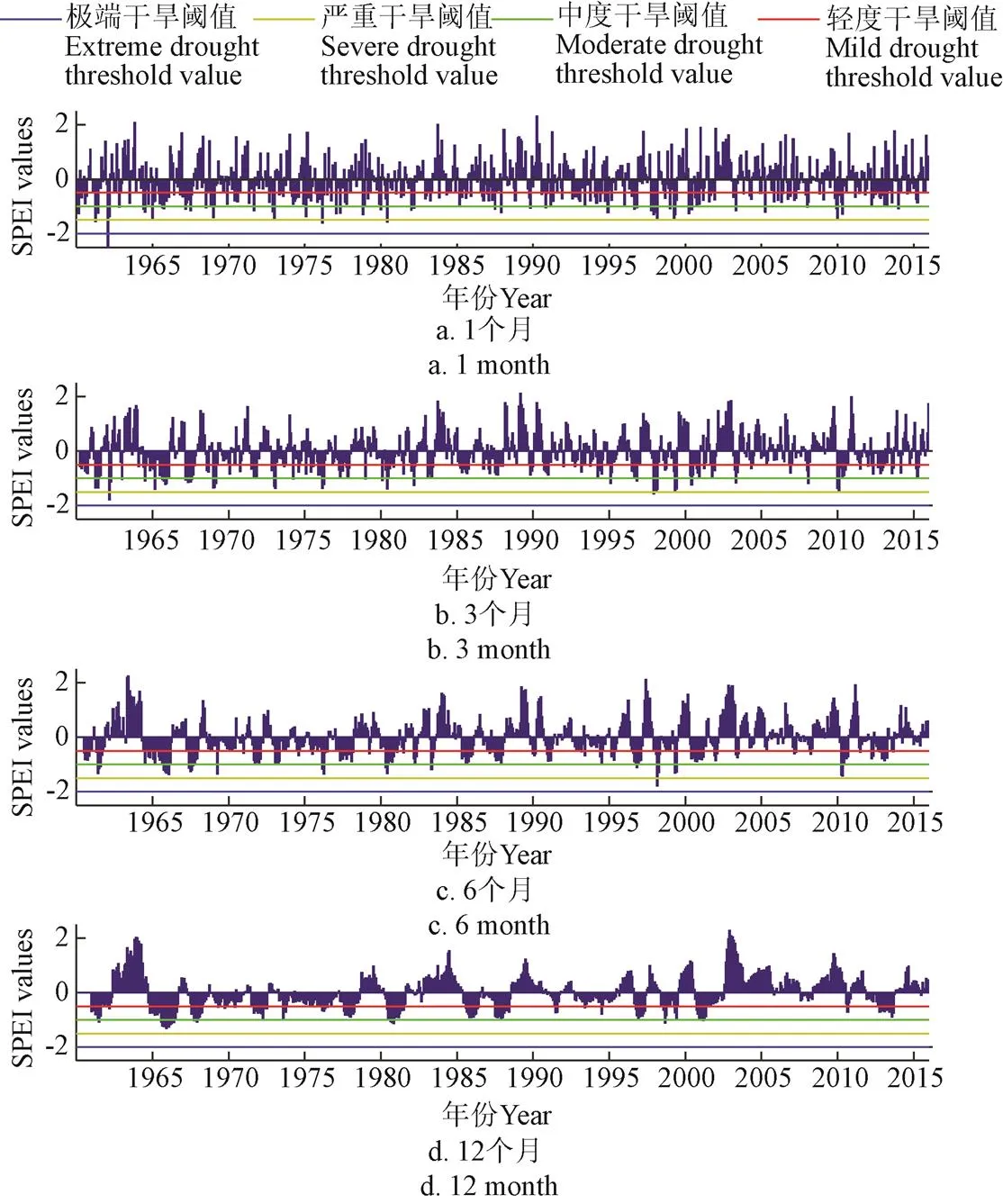
圖2 1961-2016年1、3、6和12個月的時間尺度年際變化
從圖2中可以看出,隨著時間尺度的變大,波動的幅度在減小,SPEI值在各時間尺度上都呈微弱的濕潤化。1個月尺度的SPEI值(SPEI-1)波動幅度最大,其次為3個月(SPEI-3)、6個月(SPEI-6),波動幅度最小的是12個月的尺度(SPEI-12)。
為了表示河南省不同年份的干旱事件,本文繪制了各個時間尺度的月等高線圖及在圖上繪制了相應干旱事件的嚴重程度等級(圖3)。通常SPEI-3的值表示的是季尺度的干旱狀況,每年的5、8、11、2月分別代表春、夏、秋、冬的干旱狀況。SPEI-6的是半年的干旱狀況,每年的10、2月代表的是前半年、后半年的干旱狀況。SPEI-12是年干旱狀況,12月代表的是年干旱的SPEI值。從圖3中可以看出,輕度干旱發生的最為頻繁,然后是中度干旱。SPEI-1和SPEI-3反映的是短期的干旱過程,SPEI-6和SPEI-12反映的是中長期的干旱過程。從圖3b中SPEI-3中看出發生春旱、夏旱、秋旱和冬旱的年數分別是12、12、13和15年(表2)。從圖3d中,SPEI-12中可以看出發生干旱的年份是:1961、1965、1966、1968、1972、1976、1978、1981、1986、1988、1997、2001、2013共13年,與實際情況較為一致。
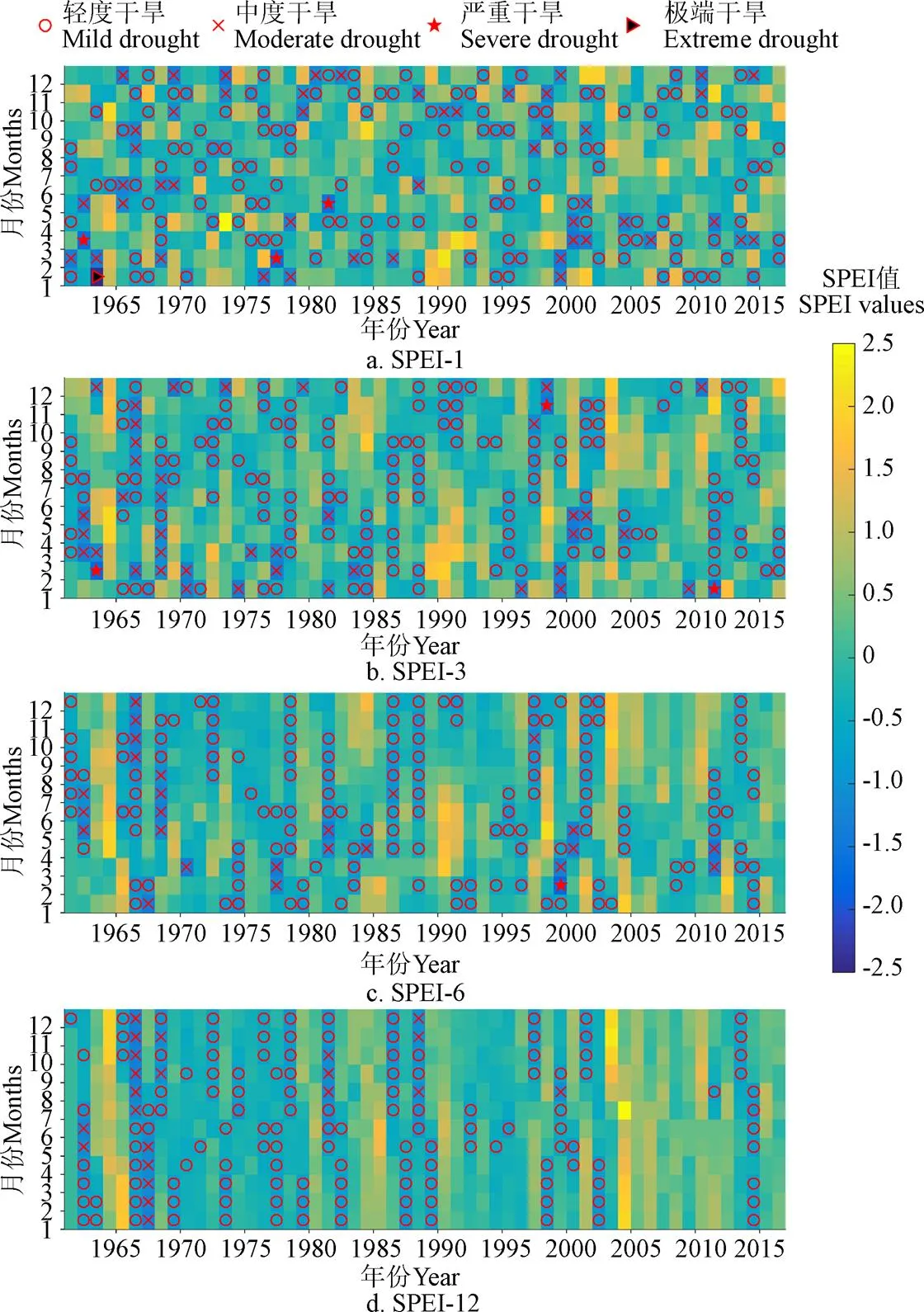
注:SPEI-1、SPEI-3、SPEI-6 與SPEI-12 分別指1、3、6 和12 個月尺度的SPEI指數值。

表2 基于SPEI-3的河南省發生春旱、夏旱、秋旱和冬旱的年份
為分析河南省17個氣象站的干旱頻率分布特征,根據氣象站56 a的SPEI-3值統計出不同等級干旱頻率(圖4)。從圖4中可以看出,輕度干旱發生頻率最高,除了西華氣象站,其余氣象站的輕度干旱發生頻率都大于15%;其次是中度干旱,大部分氣象站的中度干旱頻率都在5%到10%之間;嚴重干旱和極端干旱的頻率較低,基本都在5%以內。56 a來干旱頻率最大的地方是鄭州(33.10%),共23次;其次是信陽和欒川,分別為32.14%和31.55%,發生頻率最小的地方是洛陽和西華,分別為25.10%和25.30%。
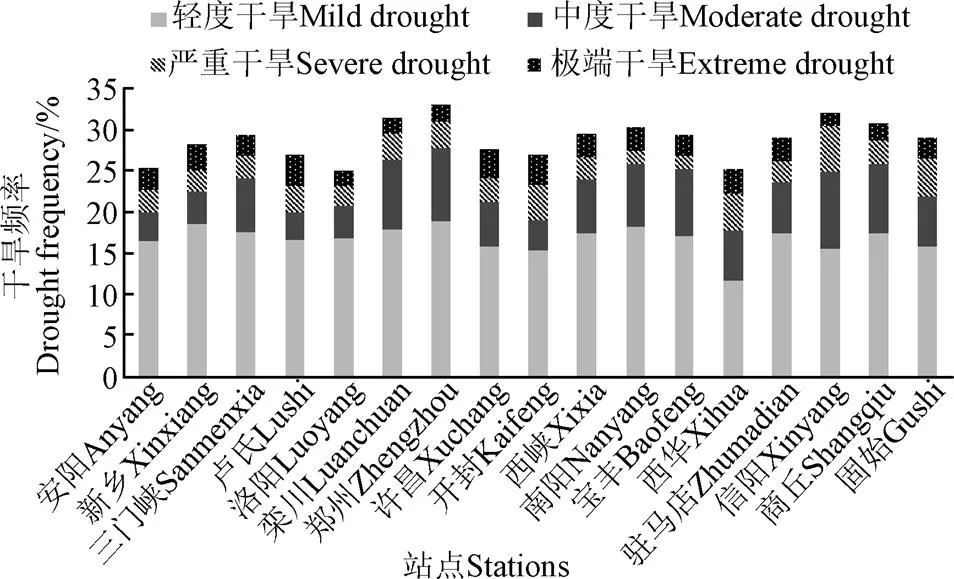
圖4 河南省不同等級干旱頻率分布特征
3.2 SPEI指數與TVDI的相關性分析
為了研究SPEI與遙感干旱監測的相關性,本文利用MODIS數據產品MOD13A3得到NDVI,時間分辨率為8 d的MOD11A2遙感影像進行月加權平均得到月溫度LST數據,根據前面計算方法得到河南省的TVDI分布,以2013年12個月干旱為例,表3表示的是1個月尺度SPEI-1與TVDI每月的相關性,從中可以看出,SPEI-1與TVDI呈負相關關系,即TVDI越小,SPEI-1的值越大,干旱程度越輕;TVDI越大,SPEI-1的值越小,干旱程度越嚴重。另外,SPEI-1與TVDI的相關性較大,且通過了顯著性檢驗。為了更充分展現SPEI-1與TVDI相關性,對17個氣象站點的不同時間也做了相關性分析(表4),從表4中可以看出,同一地點的不同時間中SPEI-1與TVDI也呈現負相關關系,與前面結論一致。TVDI的值介于0~1之間,TVDI的值越小,說明研究區越濕潤,其值越大,越干旱,圖5中展現了2013年共12個月的河南省干旱狀況圖,從圖5中看出,豫南和豫中發生干旱的頻率較高,最低的是豫西地區,從圖中可以很清晰地看到河南省干旱的空間和時間變化趨勢。

表3 SPEI與TVDI相關性分析

表4 基于不同站點的SPEI與TVDI的相關性

圖5 基于TVDI的河南省干旱分布狀況
4 討 論
通過利用SPEI和TVDI對河南省的干旱進行了時空變化分析,且探討了SPEI和TVDI的相關性。在進行干旱研究中,構建合理的干旱等級標準是一個重要的科學問題,本文統一按照國家干旱等級標準規定的干旱發生等級SPEI值,但是對于農業干旱來說,同一干旱等級,不同時間尺度的SPEI值應存在差異性,其值需用實際受干旱的情況來確定和進行驗證。由于存在土壤水分的緩沖作用,短時間尺度的值應該比長時間尺度的值偏高一些,因此,在以后的研究中,需要考慮干旱等級指標的確定問題。
另外,進行SPEI各尺度分析時,要考慮作物的生長季節、作物的耐旱能力,比如冬季,北部地區冬小麥處于越冬期,不存在受干旱影響的問題,但南部不越冬的小麥有可能受旱。所以監測農作物類型的干旱狀況可以考慮3個月尺度類型,文中選取的12月的值主要是從年際變化方面來看河南省的干旱變化特征。總體來說,SPEI和TVDI都能夠很好地對河南省的干旱狀況進行反映。
5 結 論
基于17個氣象站點的1961-2016年共56 a的氣象數據,利用SPEI定量地分析了河南省不同時間尺度(1、3、6和12個月)的干旱發生的時空變化特征和強度;并采用溫度植被干旱指數(TVDI)分析了河南省的區域面積上的干旱空間變化,且探討了SPEI和TVDI的相關性。得到以下結論:
1)SPEI-1和SPEI-3反映的是短期的干旱過程,SPEI-6和SPEI-12反映的是中長期的干旱過程,不同時間尺度SPEI的值波動規律不同,尺度越小,波動的幅度就越大,根據SPEI值的時間尺度的干旱發生狀況可以看出,在季尺度上,冬旱的發生年數比較多,共15次,在年尺度上,發生干旱的年份是:1961、1965、1966、1968、1972、1976、1978、1981、1986、1988、1997、2001、2013共13年,與實際情況較為一致。
2)在干旱發生強度上,56 a來發生干旱次數最多的地區是鄭州,共23次;發生次數最少的分別是西華和洛陽,共12次,河南是極易發生干旱的省份。
3)根據SPEI月尺度與遙感干旱監測方法進行相關性研究發現,兩者之間呈現負相關關系,即TVDI越小,SPEI-1的值越大,干旱程度越輕;TVDI越大,SPEI-1的值越小,干旱程越嚴重,且通過了顯著性檢驗,說明SPEI-1與TVDI的相關性較大,也為進一步研究氣象干旱指數與遙感監測兩者結合之間提供了思路。SPEI雖然考慮的因素較多,但是,干旱易受地形以及人類活動等的影響[32],因此針對此方法的研究還有待進一步的深入。
[1] 王兆禮,黃澤勤,李軍,等. 基于SPEI和NDVI的中國流域尺度氣象干旱及植被分布時空演變[J]. 農業工程學報,2016,32(14):177-186.
Wang Zhaoli, Huang Zeqin, Li Jun, et al. Assessing impacts of meteorological drought on vegetation at catchment scale in China based on SPEI and NDVI[J]. Transactions of the Chinese Society of Agricultural Engineering (Transactions of the CSAE), 2016, 32(14): 177-186. (in Chinese with English abstract)
[2] Benitez J B, Domecq R M. Analysis of meteorological drought episodes in Paraguay[J]. Climatic Change, 2014, 127(1): 15-25.
[3] Mishra A K, Singh V P. Drought modeling: A review[J]. Journal of Hydrology, 2011, 403(1/2): 157-175.
[4] Wang Qianfeng, Shi Peijun, Lei Tianjie, et al. The alleviating trend of drought in the Huang-Huai-Hai Plain of China based on the daily SPEI[J]. International Journal of Climatology, 2015, 35(13): 3760-3769.
[5] Palmer W. Meteorological drought[Z]. U.S. Department of Commerce Weather Bureau Research Paper, 1965.
[6] Stagge J H, Kohn I, Tallaksen L M, et al. Modeling drought impact occurrence based on meteorological drought indices in Europe[J]. Journal of Hydrology, 2015, 530: 37-50.
[7] Vicente-Serrano S M, Begueria S, Lopez-Moreno J I. A multiscalar drought index sensitive to global warming: The standardized precipitation evapotranspiration index[J]. Journal of Climate, 2010, 23(7): 1696-1718.
[8] 史本林,朱新玉,胡云川,等. 基于SPEI指數的近53年河南省干旱時空變化特征[J]. 地理研究,2015,34(8):1547-1558.
Shi Benlin, Zhu Xinyu, Hu Yunchuan, et al. Spatial and temporal variations of drought in Henan province over a 53-year period based on standardized precipitation evapotranspiration index[J]. Geographical Research, 2015, 34(8): 1547-1558. (in Chinese with English abstract)
[9] 莊少偉. 基于標準化降水蒸發指數的中國區域干旱化特征分析[D]. 蘭州:蘭州大學,2013.
Zhuang Shaowei. Drought Characteristics in the Regions of China Based on the Standardized Precipitation Evapotranspiration Index[D]. Lanzhou: Lanzhou University, 2013. (in Chinese with English abstract)
[10] 高蓓,姜彤,蘇布達,等. 基于SPEI的1961-2012年東北地區干旱演變特征分析[J]. 中國農業氣象,2014,35(6):656-662.
Gao Bei, Jiang Tong, Su Buda, et al. Evolution analysis on droughts in northeast China during 1961-2012 based on SPEI[J]. Chinese Journal of Agrometeorology, 2014, 35(6): 656-662. (in Chinese with English abstract)
[11] 孫濱峰,趙紅,王效科. 基于標準化降水蒸發指數(SPEI)的東北干旱時空特征[J]. 生態環境學報,2015,24(1):22-28.
Sun Binfeng, Zhao Hong, Wang Xiaoke. Spatiotemporal characteristics of drought in Northeast China based on SPEI[J]. Ecology and Environment Sciences, 2015, 24(1): 22-28. (in Chinese with English abstract)
[12] Potop V, Boroneant C, Mozny M, et al. Observed spatiotemporal characteristics of drought on various time scales over the Czech Republic[J]. Theoretical and Applied Climatology, 2014, 115(3/4): 563-581.
[13] 嚴建武,陳報章,房世峰,等. 植被指數對旱災的響應研究:以中國西南地區2009年-2010年特大干旱為例[J]. 遙感學報,2012,16(4):720-737.
Yan Jianwu, Chen Baozhang, Fang Shifeng, et al. The response of vegetation index to drought: Taking the extreme drought disaster between 2009 and 2010 in Southwest China as an example[J]. Journal of Remote Sensing, 2012, 16(4): 720-737. (in Chinese with English abstract)
[14] 王鵬新,孫威. 基于植被指數和地表溫度的干旱監測方法的對比分析[J]. 北京師范大學學報:自然科學版,2007,43(3):319-323.
Wang Pengxin, Sun Wei. Comparison study on NDVI and LST based drought monitoring approaches[J]. Journal of Beijing Normal University: Natural Science, 2007, 43(3): 319-323. (in Chinese with English abstract)
[15] Li Zhengguo, Wang Yanglin, Zhou Qingbo, et al. Spatiotemporal variability of land surface moisture based on vegetation and temperature characteristics in Northern Shaanxi Loess Plateau, China[J]. Journal of Arid Environments, 2008, 72(6): 974-985.
[16] Wang C Y, Qi S H, Niu Z, et al. Evaluating soil moisture status in China using the temperature-vegetation dryness index (TVDI)[J]. Canadian Journal of Remote Sensing, 2004, 30(5): 671-679.
[17] 趙杰鵬,張顯峰,廖春華,等. 基于TVDI的大范圍干旱區土壤水分遙感反演模型研究[J]. 遙感技術與應用,2011,26(6):742-750.
Zhao Jiepeng, Zhang Xianfeng, Liao Chunhua, et al. TVDI based soil moisture retrieval from remotely sensed data over large areas[J]. Remote Sensing Technology and Application, 2011, 26(6): 742-750. (in Chinese with English abstract)
[18] 余衛東,柳俊高,常軍,等. 1957-2005年河南省降水和溫度極端事件變化[J]. 氣候變化研究進展,2008,4(2):78-83.
Yu Weidong, Liu Jungao, Chang Jun, et al. Changes in extreme temperature and precipitation in Henan province during 1957-2005[J]. Advances in Climate Change Research, 2008, 4(2): 78-83. (in Chinese with English abstract)
[19] 陳斐,楊沈斌,王春玲,等. 基于SPEI指數的西北地區春旱時空分布特征[J]. 干旱氣象,2016,34(1):34-42.
Chen Fei, Yang Shenbin, Wang Chunling, et al. Spatial and temporal distribution of spring drought in Northwest China based on standardized precipitation evapotranspiration index[J]. Journal of Arid Meteorology, 2016, 34(1): 34-42. (in Chinese with English abstract)
[20] 劉珂,姜大膀. 基于兩種潛在蒸散發算法的SPEI對中國干濕變化的分析[J]. 大氣科學,2015,39(1):23-36.
Liu Ke, Jiang Dapang. Analysis of dryness/wetness over China using standardized precipitation evapotranspiration index based on two evapotranspiration[J]. Journal of Atmospheric Sciences, 2015, 39(1): 23-36. (in Chinese with English abstract)
[21] Monteith J L. Evaporation and environment[J]. Symp Soc Exp Biol, 1965, 19: 205-234.
[22] Thornthwaite C W. An Approach toward a Rational Classification of Climate[J]. Geographical Review, 1948, 38(1): 55-94.
[23] 丁加麗,彭世彰,徐俊增,等. 基于Penman-Monteith方程的節水灌溉稻田蒸散量模型[J]. 農業工程學報,2010,26(4):31-35.
Ding Jiali, Peng Shizhang, Xu Junzeng, et al. Estimation of rice evapotranspiration under controlled irrigation by using Penman-Monteith method[J]. Transactions of the Chinese Society of Agricultural Engineering (Transactions of the CSAE), 2010, 26(4): 31-35. (in Chinese with English abstract)
[24] 焦醒,劉廣全,匡尚富,等. Penman-Monteith模型在森林植被蒸散研究中的應用[J]. 水利學報,2010,41(2):245-252.
Jiao Xing, Liu Guangquan, Kuang Shangfu, et al. Review on application of Penman-Monteith Equation to studying forest vegetation evapotranspiration[J]. Journal of Hydraulic Engineering, 2010, 41(2): 245-252. (in Chinese with English abstract)
[25] 趙林, 于家爍, 薄巖, 等. 基于SPEI的湖北省近52年干旱時空格局變化[J]. 長江流域資源與環境, 2015, 24(7) :1230-1237.
Zhao Lin, Yu Jiashuo, Bo Yan, et al. Temporal and spatial distribution of drought in Hubei province during 1961-2012 based on SPEI[J]. Resources and Environment in the Yangtze Basin, 2015, 24(7):1230-1237. (in Chinese with English abstract)
[26] 齊述華,王長耀,牛錚. 利用溫度植被旱情指數(TVDI)進行全國旱情監測研究[J]. 遙感學報,2003,7(5):420-427.
Qi Shuhua, Wang Changyao, Niu Zheng. Evaluating soil moisture status in China using the temperature/vegetation dryness index (TVDI)[J]. Journal of Remote Sensing, 2003, 7(5): 420-427. (in Chinese with English abstract)
[27] Patel N R, Anapashsha R, Kumar S, et al. Assessing potential of MODIS derived temperature/vegetation condition index (TVDI) to infer soil moisture status[J]. International Journal of Remote Sensing, 2009, 30(1): 23-39.
[28] Sandholt I, Rasmussen K, Andersen J. A simple interpretation of the surface temperature/vegetation index space for assessment of surface moisture status[J]. Remote Sensing of Environment, 2002, 79(2/3): 213-224.
[29] 范遼生,姜紀紅,盛暉,等. 利用溫度植被干旱指數(TVDI)方法反演杭州伏旱期土壤水分[J]. 中國農業氣象,2009,30(2):230-234.
Fan Liaosheng, Jiang Jihong, Sheng Hui, et al. Reverse of soil moisture for summer drought period in Hangzhou by using TVDI method[J]. Chinese Journal of Agrometeorology, 2009, 30(2): 230-234. (in Chinese with English abstract)
[30] 杜靈通,侯靜,胡悅,等. 基于遙感溫度植被干旱指數的寧夏2000-2010年旱情變化特征[J]. 農業工程學報,2015,31(14):209-216.
Du Lingtong, Hou Jing, Hu Yue, et al. Drought variation characteristics in Ningxia from 2000 to 2010 based on temperature vegetation dryness index by remote sensing[J]. Transactions of the Chinese Society of Agricultural Engineering (Transactions of the CSAE), 2015, 31(14): 209-216. (in Chinese with English abstract)
[31] 鮑艷松,嚴婧,閔錦忠,等. 基于溫度植被干旱指數的江蘇淮北地區農業旱情監測[J]. 農業工程學報,2014,30(7):163-172.
Bao Yansong, Yan Jing, Min Jinzhong, et al. Agricultural drought monitoring in north Jiangsu by using temperature vegetation dryness index[J]. Transactions of the Chinese Society of Agricultural Engineering (Transactions of the CSAE), 2014, 30(7): 163-172. (in Chinese with English abstract)
[32] 王隨繼,閆云霞,顏明,等. 皇甫川流域降水和人類活動對徑流量變化的貢獻率分析——累積量斜率變化率比較方法的提出及應用[J]. 地理學報,2012,67(3):388-397.
Wang Suiji, Yan Yunxia, Yan Ming, et al. Contributions of precipitation and human activities to the runoff change of the Huangfuchuan drainage basin: Application of comparative method of the slope changing ratio of cumulative quantity[J]. Acta Geographica Sinica, 2012, 67(3): 388-397. (in Chinese with English abstract)
Analysis on temporal and spatial variation of drought in Henan Province based on SPEI and TVDI
Chen Shaodan1, Zhang Liping1,2※, Tang Rouxin1, Yang Kai2, Huang Yongqi2
(1.,,430072,;2.,,438000,)
In the context of global warming, drought is the most complex and damaging natural disaster, which becomes more and more frequent, causing negative impacts on agriculture, water resources, natural ecosystems, and society activities. There are several kinds of drought indices derived from station-based meteorological data that are widely used for monitoring drought evolution, mainly including the Palmer drought severity index (PDSI), the standardized precipitation index (SPI) and the standardized precipitation evapotranspiration index (SPEI). The SPEI not only considers precipitation and temperature data, but also integrates the sensitivity of PDSI to changes in evaporation demand and the simplicity of calculation and the multi-scale features of the SPI that identify different types of drought. Therefore, the SPEI was used to describe the drought severity determined by the difference between precipitation and potential evapotranspiration, based on the monthly meteorological data from 1961 to 2016 in Henan Province. And the regional SPEI was obtained at different time scales (1-, 3-, 6-, and 12-month) to characterize the dry or wet conditions in the study area. And the 1-month SPEI can clearly see the subtle changes of drought occurrence and reflect a short-term condition; the 3-month SPEI provides the seasonal drought occurrence; the 12-month SPEI reflects the drought variation at inter-annual time scales. In addition, the remote sensing method, which can provide large coverage, and multispectral and multitemporal observations from satellite sensors at various scales, is another method used to monitor drought conditions on a regional scale, especially in the areas with few meteorological stations. Numerous studies have suggested that a combination of surface temperature, normalized difference vegetation index (NDVI) and land surface temperature (LST) can reveal information on the regional drought conditions. Here, the temperature vegetation dryness index (TVDI) based on the interpretation of the simplified NDVI-LST space for estimating drought conditions was selected to monitor drought conditions on a regional scale, and the moderate resolution imaging spectroradiometer (MODIS) was used, which has many advanced characteristics such as wide spectral range, high temporal resolution and low cost. And the correlation between SPEI and TVDI was calculated. The results showed that SPEI was increasing slightly at different time scales during the period of 1961–2016, indicating that Henan was getting more humid. As the time scale increased, the amplitude of the SPEI decreased. However, the distribution in Henan has been uneven. Annually, droughts occurred in 1961, 1965, 1966, 1968, 1972, 1976, 1978, 1981, 1986, 1988, 1997, 2001 and 2013. Moreover, drought frequency was selected to calculate the probability of drought occurrence. During the period of 1961-2016, Zhengzhou had the highest frequency (33.10%), followed by Xinyang and Luanchuan (32.14% and 31.55%, respectively), whereas Luoyang and Xihua had the lowest frequency (25.10% and 25.30%, respectively). Correlation analysis between monthly TVDI and SPEI showed that there existed negative relationship between 1-month SPEI and TVDI, and as TVDI got smaller, SPEI became higher, reflecting that the severity of drought was lighter, and conversely drought would aggravate as TVDI got larger and SPEI became lower. Therefore, our study on the relationship between SPEI and TVDI can provide a scientific basis for early warning and risk management of water resources and agricultural production.
climate changing; drought; remote sensing; SPEI; TVDI; MODIS; Henan province
10.11975/j.issn.1002-6819.2017.24.017
S127
A
1002-6819(2017)-24-0126-07
2017-07-03
2017-12-08
國家自然科學基金項目(51339004);國家重點研發計劃項目(2017YFA0603704);湖北省科技計劃項目(2015BCA290)
陳少丹,博士生,主要從事水文水資源研究。 Email:chensd2014@163.com
張利平,教授,博士生導師,主要從事變化環境下水資源與氣候變化研究。Email:zhanglp@whu.edu.cn
陳少丹,張利平,湯柔馨,楊 凱,黃勇奇. 基于SPEI和TVDI的河南省干旱時空變化分析[J]. 農業工程學報,2017,33(24):126-132. doi:10.11975/j.issn.1002-6819.2017.24.017 http://www.tcsae.org
Chen Shaodan, Zhang Liping, Tang Rouxin, Yang Kai, Huang Yongqi. Analysis on temporal and spatial variation of drought in Henan Province based on SPEI and TVDI[J]. Transactions of the Chinese Society of Agricultural Engineering (Transactions of the CSAE), 2017, 33(24): 126-132. (in Chinese with English abstract) doi:10.11975/j.issn.1002-6819.2017.24.017 http://www.tcsae.org
猜你喜歡
體育科技文獻通報(2022年3期)2022-05-23 13:46:54
天津外國語大學學報(2021年3期)2021-08-13 08:32:18
遼金歷史與考古(2021年0期)2021-07-29 01:06:54
民用飛機設計與研究(2020年4期)2021-01-21 09:15:02
科技傳播(2019年22期)2020-01-14 03:06:54
民用飛機設計與研究(2019年4期)2019-05-21 07:21:24
電子制作(2018年18期)2018-11-14 01:48:24
汽車工程學報(2017年2期)2017-07-05 08:13:02
山東工業技術(2016年15期)2016-12-01 05:31:22
中國中醫藥現代遠程教育(2014年11期)2014-08-08 13:23:44
