
生物降解秧盤及播種量對機插水稻秧苗素質及產量的影響
2018-01-09 00:56:52史鴻志朱德峰張玉屏張義凱朱從樺陳惠哲
農業工程學報 2017年24期
關鍵詞:水稻
史鴻志,朱德峰,張玉屏,向 鏡,張義凱,朱從樺,武 輝,陳惠哲
?
生物降解秧盤及播種量對機插水稻秧苗素質及產量的影響
史鴻志,朱德峰,張玉屏,向 鏡,張義凱,朱從樺,武 輝,陳惠哲※
(中國水稻研究所/水稻生物學國家重點實驗室,杭州 310006)
為探明生物降解秧盤稀播育秧、帶盤機插的生產適用性,以秈型雜交稻中浙優8號和秈粳型雜交稻甬優538為材料,普通平盤作對照,研究了生物降解秧盤不同播種量(30,50,70和90 g/盤)育秧對機插水稻秧苗素質、機插特性與產量的影響。結果表明,生物降解秧盤育秧顯著提高出苗率(<0.05),且播種量越低,出苗率越高,中浙優8號30 g/盤處理的出苗率較普通平盤育秧高20.57個百分點。生物降解秧盤采用上毯下缽設計,所育秧苗根系獨立成缽狀,白根多且粗壯,其平均根直徑較普通平盤寬8.63%,且盤根力均大于100 N,滿足機插對秧塊成毯的要求。同時,可帶盤按缽精準機插,中浙優8號30 g/盤處理的漏秧率僅7.78%,較普通平盤機插低6.67個百分點。生物降解秧盤處理結實率和千粒重略低于普通平盤,群體穎花量則高于后者,最終產量較普通平盤機插略高。綜合育秧、機插效果及產量表現,生物降解秧盤育秧播種量以70 g/盤為宜。因此,生物降解秧盤帶盤機插可發揮稀播培育壯秧優勢,提高機插質量,有助于雜交稻少本稀植、充分發揮增產潛力。
農作物;機械化;播種;水稻;機插;生物降解秧盤;秧苗素質;產量
0 引 言
隨著農村勞動力轉移和老齡化,中國水稻生產正逐步向輕簡化、機械化作業轉型[1-3]。提高水稻生產機械化水平,實現全程機械化,是當前中國水稻生產技術變革的關鍵。目前中國水稻生產綜合機械化水平較低,種植機械化是其中的“瓶頸”環節[4-6]。機插秧以培育標準化壯秧與機械精確移栽,并配套高產高效農藝,相對更符合國情,是多數稻區種植機械化的基本方向[7]。
機插秧包括育秧和機插2個關鍵環節,其中育秧為保證秧塊成毯和降低漏秧率,播種密度極大,苗間競爭激烈,導致所育秧苗素質較差[7-8]。因秧苗較弱,機插每穴本數又過多,不利于雜交稻壯稈大穗優勢的發揮,使得雜交稻機插難以高產穩產[7]。此外,由于雜交稻制種產量低,其種子價格是常規稻種子的5~10倍,導致育秧成本較高[9]。在中國,雜交稻種植面積占到了水稻總種植面積50%~60%,實現雜交稻機插意義重大[10-11]。已有研究表明,降低播種量雖可顯著提高秧苗素質,但低播量下秧塊成毯性差,機插漏秧率高,大田基本苗不足,不利于實現高產[9,12-17]。低播量下如何保證秧塊成毯、降低漏秧率,從而培育壯秧,實現雜交稻少本稀植,已成為雜交稻機插中亟待解決的問題。中國水稻研究所和河南青源天仁生物技術公司開展產學研合作,以聚乳酸(PLA)生物基塑料為原料,結合上毯下缽設計,研制開發了生物降解秧盤,通過培育壯秧,帶盤機插,為雜交稻稀播機插提供了一種新的思路。本研究采用生物降解秧盤育秧,設置不同播種量,以普通平盤為對照,研究生物降解秧盤的農藝適用性,以期為雜交稻機插提供參考。
1 材料與方法
1.1 試驗地點及供試材料
試驗于2016年在中國水稻研究所富陽試驗基地(30°5′N,119°55′E)進行。該區位于長江三角洲南翼,屬中緯度亞熱帶季風性氣候區,年平均溫度16.1 ℃,無霜期為230 d,年日照時數為1 995 h,年平均降水量為1 501 mm。試驗地土質為黏性水稻土,冬閑。0~20 cm土層有機質含量為27.2 g/kg,堿解氮232.7 mg/kg,速效磷20.5 mg/kg,速效鉀136.9 mg/kg。
供試品種為秈型雜交稻中浙優8號和秈粳型雜交稻甬優538,中浙優8號由中國水稻研究所提供,甬優538由寧波種子公司提供。生物降解秧盤由河南青源天仁生物技術公司提供,規格為58 cm×28 cm×2.8 cm(長×寬×高),每盤648個缽穴。普通平盤采用市售大小一致的塑料硬盤。
1.2 試驗設計
設置2種秧盤類型,分別為生物降解秧盤和普通平盤,記為BS和CS。播種量設置4個水平,分別為30、50、70和90 g/盤(以干種子質量計),記為D30、D50、D70和D90。育秧時每處理播9盤,隨機排列,2品種合計144盤。采用常規泥漿育秧,5月25日播種,秧齡為19天,6月13日機插。機插時生物降解秧盤帶盤機插,普通平盤取秧塊機插。大田采用裂區設計,其中秧盤類型為主區,播種量為副區,小區面積為30 m2,3次重復,行株距為30 cm×18 cm,大田四周地膜包梗,排灌分開。試驗氮肥(純氮)施入量為180 kg/hm2,按基肥、蘗肥、穗肥=5∶3∶2分別施入。磷肥施過磷酸鈣450 kg/hm2,一次性作為基肥施入。鉀肥施氯化鉀112.5 kg/hm2,一次性作穗肥施入。分蘗肥在機插后第7 d施入,穗肥在倒4葉葉齡期施入。苗期淺水勤灌,分蘗末期排水曬田,堅持多次輕曬的原則。拔節到成熟期采用濕潤灌溉,干濕交替。其他管理措施統一按高產栽培要求實施。
1.3 測定項目與方法
1.3.1 出苗率
在播種后第9天每處理調查出苗數,采用專門的查苗器(尺寸15 cm×6 cm),計數查苗器內的秧苗。出苗率=出苗數/種子數×100%。
1.3.2 秧苗形態
在移栽前1天,每處理切取8 cm×8 cm秧塊,洗凈后選取有代表性秧苗30株,測定其株高、葉齡、莖基寬和葉面積;并分為地上部和根系,105 ℃殺青30分鐘,80 ℃烘干至恒質量,稱其質量。其中,秧苗重高比=秧苗地上部干質量/秧苗株高。
1.3.3 秧苗根系特征
在移栽前1天,每處理選取代表性秧苗3株,使用掃描儀(Epson V700,China)對秧苗根系進行數字化掃描,再使用與掃描儀配套的根系分析系統軟件WinRHIZO PRO 2013(Regent Instrument Inc., Canada)分析根系特征參數。3次重復。
1.3.4 盤根力
在移栽前1天,取標準秧塊(58 cm×28 cm),一端固定,另一端用夾板夾緊后,用數顯拉力計水平向外拉秧塊,秧塊斷裂時的拉力即為盤根力(單位:牛頓)。并對秧塊成毯效果進行評價,秧塊不能成毯記為差,勉強成毯記為一般,秧塊抖動不散、成毯效果好記為良。
1.3.5 機插漏秧率
機插第2天,每小區隨機選取3行,每行30叢,調查每叢機插苗數和漏插叢數。其中,漏插指機插后插穴內無秧苗。漏秧率=漏插叢數/調查總叢數×100%。
1.3.6 產量及其構成
在成熟期每小區調查60穴,計算有效穗數,并實收核產。取代表性3穴調查每穗粒數、結實率和千粒質量。
1.4 數據計算與統計分析
數據統計分析采用Microsoft Excel 2016和DPS 7.05軟件;Duncan新復極差法進行差異顯著性檢驗;Origin 2017軟件制圖。
2 結果與分析
2.1 生物降解秧盤育秧對出苗率的影響
由圖1所示,除中浙優8號普通平盤育秧外,出苗率隨播量減少均呈顯著增加趨勢(<0.05),其中以生物降解秧盤30 g/盤處理出苗率最高,中浙優8號和甬優538分別達到了91.08%和87.76%。播量為30和50 g/盤時,隨播量增加,中浙優8號中生物降解秧盤出苗率下降11.64個百分點,普通平盤下降10.22個百分點,甬優538則分別下降了8.53個百分點和17.6個百分點。2種秧盤比較,中浙優8號生物降解秧盤30和50 g/盤處理的出苗率顯著高于普通平盤(<0.05),分別高20.57個百分點和19.15個百分點,而甬優538兩種秧盤差異不顯著(>0.05)。播量為70和90 g/盤時,隨播量增加出苗率下降不顯著,2種秧盤間差異也不顯著,中浙優8號出苗率在58.96%~64.64%間,甬優538出苗率在61.24%~67.49%間。可見,稀播條件下(特指30 g/盤,下同)生物降解秧盤育秧有利于提高出苗率。
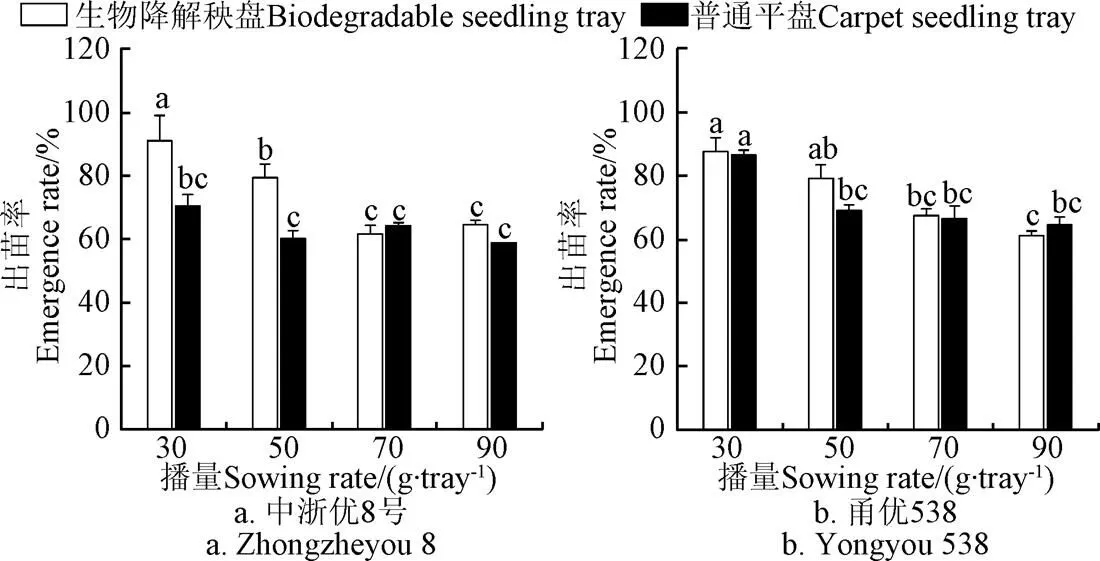
注:不同小寫字母表示不同處理間差異達到5%顯著水平。
2.2 生物降解秧盤育秧對秧苗素質的影響
2.2.1 秧苗形態
由表1可知,隨播量增加,秧苗株高、葉齡、莖基寬、葉面積、根數、地上部干質量、根干質量和重高比總體上呈降低趨勢。以生物降解秧盤為例,中浙優8號90 g/盤處理的莖基寬、葉面積、根數、地上部干質量、根干質量和重高比較30 g/盤處理分別下降21%、25%、17%、36%、24%和37%,甬優538中則分別下降16%、40%、32%、32%、25%和14%。不同秧盤間,生物降解秧盤所育秧苗的平均株高顯著高于普通平盤,而平均根數和平均根干質量則表現出低于普通平盤的趨勢,除中浙優8號中根數差異極顯著外,其他差異都不顯著(>0.05)。莖基寬差異不顯著(>0.05),葉齡、葉面積、地上部干質量和重高比在2品種中表現不一。稀播條件下,中浙優8號中生物降解秧盤所育秧苗的株高、莖基寬、地上部干質量、根干質量和重高比顯著高于普通平盤(<0.05),甬優538中生物降解秧盤所育秧苗的株高顯著高于普通平盤,而根干質量和重高比顯著低于普通平盤(<0.05)。可見,稀播有利于優化秧苗形態,生物降解秧盤所育秧苗形態與普通平盤無顯著差異,中浙優8號在稀播條件下使用生物降解秧盤育秧優于使用普通平盤。
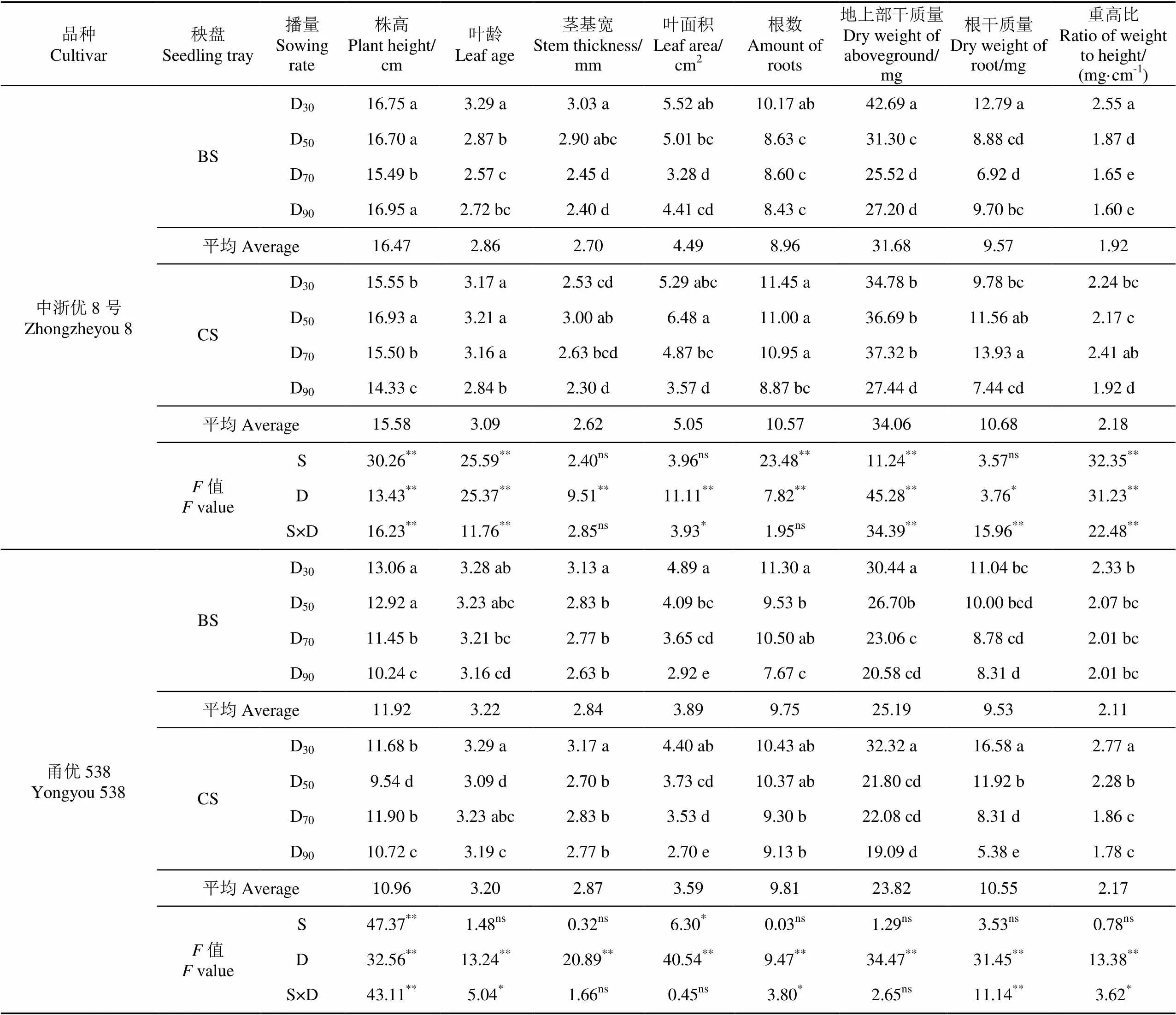
表1 不同秧盤和播量育秧的秧苗形態
注:BS表示生物降解秧盤;CS表示普通平盤;D30、D50、D70和D90分別表示播量30、50、70和90 g/盤;S表示秧盤;D表示播量;同列不同小寫字母表示相同品種中不同處理間差異達到5%顯著水平;*和**分別表示在0.05和0.01水平上差異顯著。ns表示在0.05水平上差異不顯著,下同。
Note: BS means biodegradable seedling tray. CS means carpet seedling tray. D30, D50, D70and D90mean that the sowing rates are 30, 50, 70 and 90 g/tray, respectively. S means seedling tray. D means sowing rate. Different lowercase letters in a column indicate significant difference at 0.05 level among different treatments in the same cultivar.*and**mean significant differences at 0.05 and 0.01 probability levels, respectively. ns means no significant differences at 0.05 levels, the same as below.
2.2.2 秧苗根系特征
由表2可知,隨著播量增加,秧苗根長度、根表面積和根體積均呈顯著下降趨勢,根直徑變化不明顯。以生物降解秧盤為例,中浙優8號90 g/盤處理的根長度、根表面積和根體積分別較30 g/盤處理減少了27%、35%和48%,甬優538中則分別減少了57%、58%和59%,秧苗根系生物量顯著減少。不同秧盤間,生物降解秧盤所育秧苗的平均根長度、根表面積和根體積均低于普通平盤,甬優538中差異極顯著,而中浙優8號中差異不顯著。就平均根直徑而言,生物降解秧盤顯著高于普通平盤,平均比普通平盤寬8.63%,中浙優8號中生物降解秧盤處理的平均根直徑較普通平盤寬9.03%,甬優538同比寬8.23%。試驗中發現生物降解秧盤所育秧苗的根系獨立成缽狀,白根多,而普通平盤所育秧苗的根系盤結交錯,根黃,老根多(見圖2)。可見,稀播有利于增加秧苗根系生物量,擴大根系的營養吸收面積;生物降解秧盤所育秧苗根系相對獨立、短粗、根白,吸收營養物質的能力相對較強。
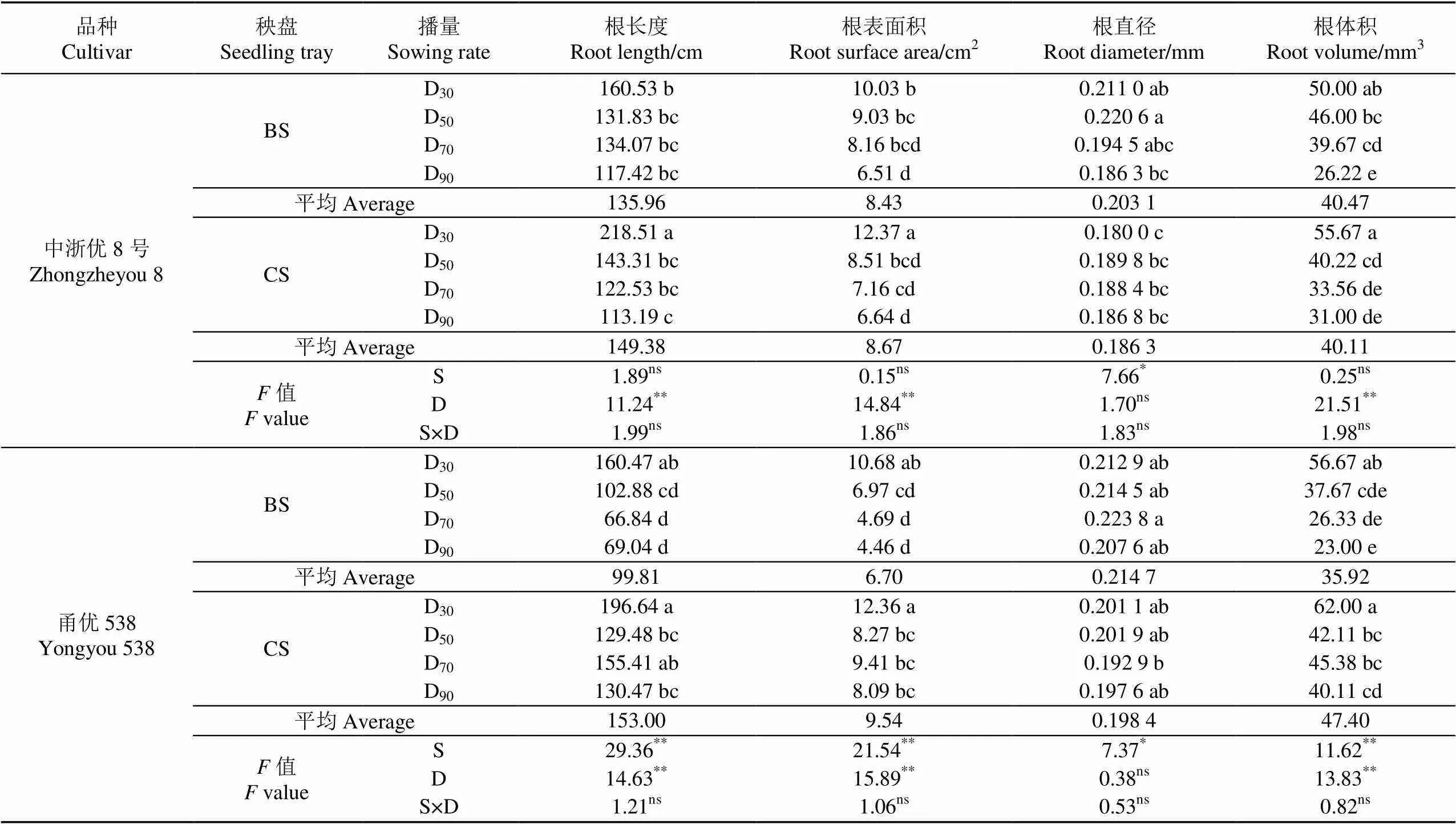
表2 不同秧盤和播量育秧的秧苗根系特征
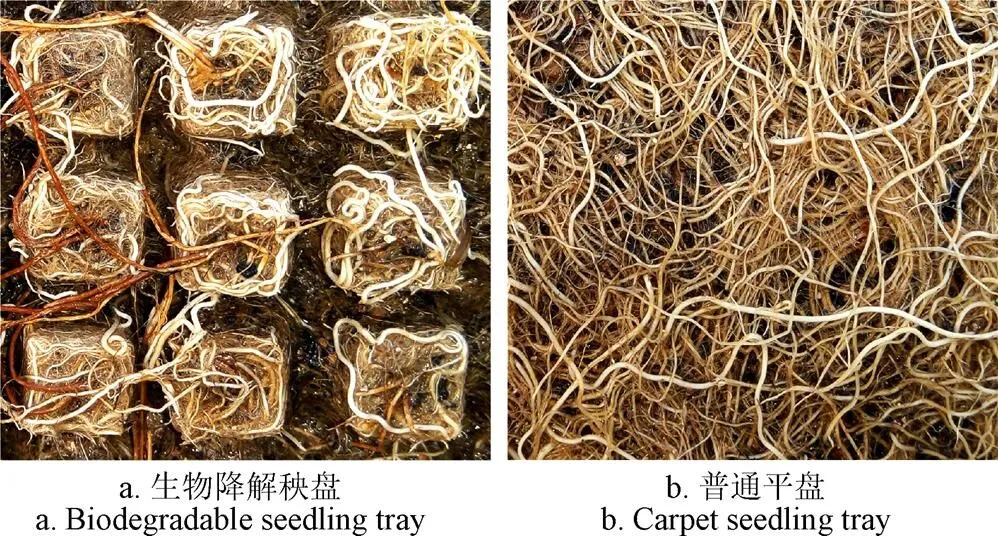
圖2 不同秧盤育秧秧苗根系比較(甬優538,70 g/盤)
2.3 生物降解秧盤的機插特性
2.3.1 盤根力
由表3可知,供試品種在生物降解秧盤育秧的條件下,各播量處理盤根力都超過了100 N,滿足起秧、運秧和裝秧過程中對秧塊結構性的要求。而普通平盤在稀播條件下成毯性差,幾乎不能起秧,中浙優8號在70 g/盤、甬優538在50 g/盤以上時成毯才能滿足機插要求。
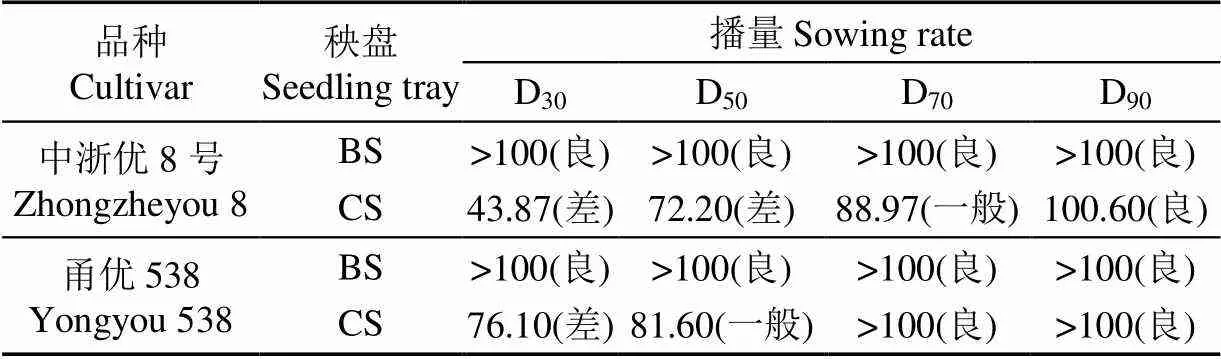
表3 不同秧盤和播量育秧的盤根力
2.3.2 漏秧率
隨播量增加,2種秧盤育秧的機插漏秧率均呈下降趨勢(圖3)。30 g/盤播量處理機插漏秧率最高,中浙優8號中生物降解秧盤和普通平盤的機插漏秧率分別達到了7.78%和14.44%,甬優538中也分別達到了18.33%和15.56%,均超過5%的機插漏秧率要求上限[8]。當播量達到90 g/盤時,各處理的機插漏秧率都控制在5%以內。不同秧盤間,2品種表現略有不同。中浙優8號中,除90 g/盤時2種秧盤差異不大外,30、50和70 g/盤生物降解秧盤的機插漏秧率分別比普通平盤低6.67、3.17和1.11個百分點。甬優538中,生物降解秧盤處理的機插漏秧率高于普通平盤處理,除70 g/盤外差異并不明顯。以上結果表明,稀播條件下,機插漏秧率普遍超過5%,中浙優8號中生物降解秧盤機插較普通平盤機插漏秧率顯著降低。
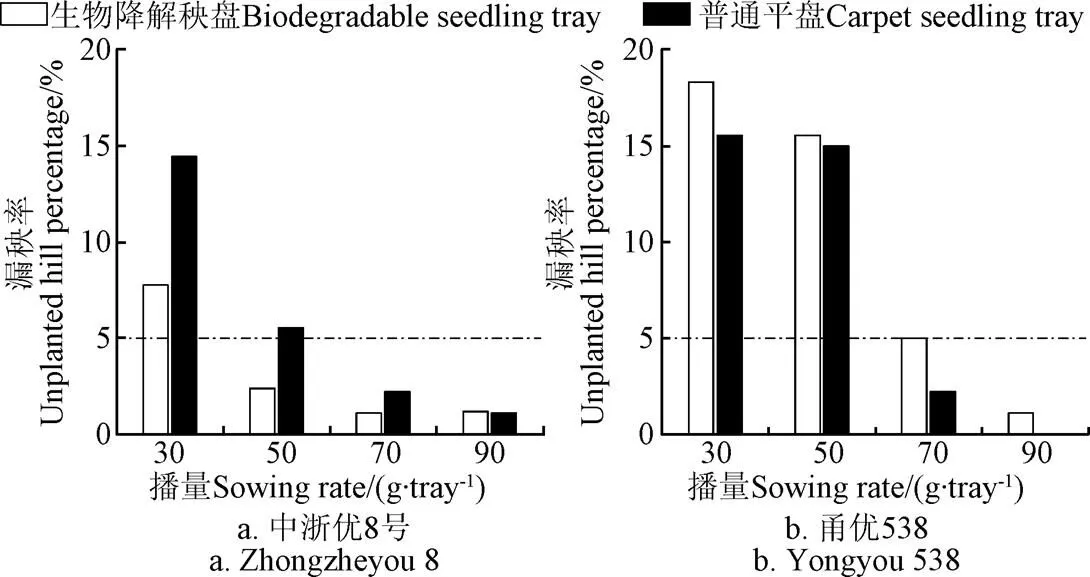
圖3 不同秧盤和播量機插的漏秧率
2.4 生物降解秧盤機插對水稻產量及其構成因素的影響
由表4可知,2品種中生物降解秧盤機插平均產量均略高于普通平盤。生物降解秧盤機插的平均穗數小于普通平盤,而平均每穗粒數高于后者。體現在平均群體穎花量上,生物降解秧盤機插高于普通平盤。平均結實率和平均千粒質量則小于普通平盤,除中浙優8號中結實率差異不顯著外(>0.05),其他差異顯著(<0.05)。隨播量增加,產量呈先升后降的趨勢。基本苗和穗數均呈上升趨勢,基本苗不同播量間差異顯著,但穗數總體上差異不明顯。中浙優8號中不同播量間每穗粒數差異不顯著(>0.05),而甬優538中差異顯著,以生物降解秧盤70 g/盤處理最高,達到每穗367.98粒。群體穎花量上,2品種均以生物降解秧盤70 g/盤處理最高,中浙優8號和甬優538分別達到49 059.76×10⁴和68 486.07×10⁴個/hm2。對群體穎花量與產量作相關性分析,相關系數為0.88,達到極顯著水平。結實率和千粒重變化規律則不明顯。秧盤與播量間互作極顯著(<0.01),以生物降解秧盤70 g/盤處理產量最高,中浙優8號和甬優538分別達到了10.23和11.44 t/hm2。可見,生物降解秧盤機插的平均群體穎花量比普通平盤機插高,但結實率和千粒重低,最終表現為生物降解秧盤機插產量略高于普通平盤機插。稀播條件下,雖然水稻群體自我調節作用能在一定程度上彌補基本苗的不足,但穗數依然偏低,導致群體穎花量較少,穗粒結構不協調,限制了雜交稻產量潛力的發揮。
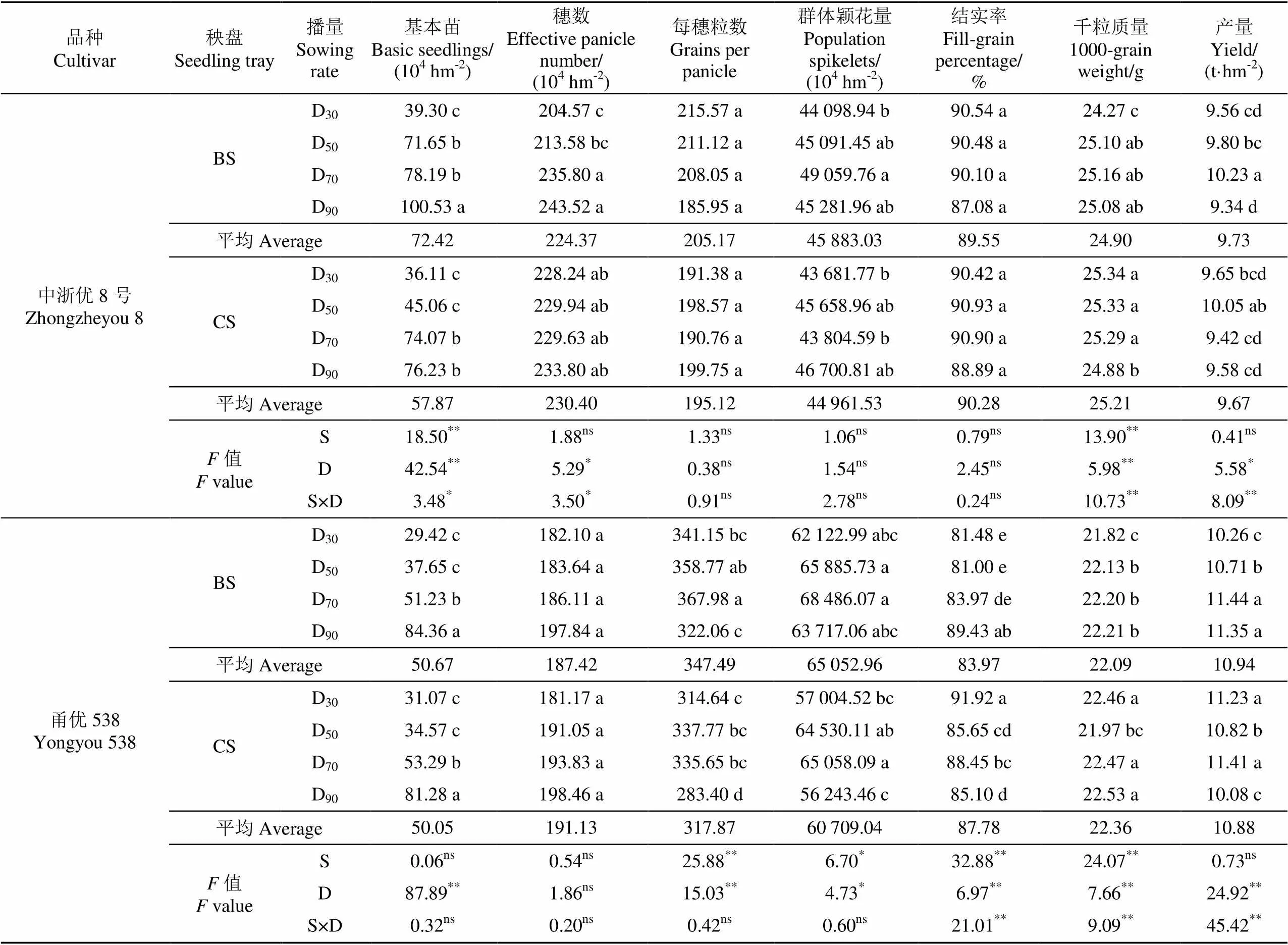
表4 不同秧盤和播量機插水稻的產量及其構成因素
3 討 論
3.1 水稻生物降解秧盤機插適應性
機插秧由于盤根成毯的需要,播種密度極大,秧苗生長空間狹小,導致器官發育不充分,秧苗素質較差[7]。對雜交稻機插而言,充分利用其分蘗力強和大穗優勢,就需少本稀植,育秧時降低播量,但低播量下就會出現秧塊成毯差和漏秧率高等問題[9,12,15-16]。本研究使用生物降解秧盤育秧,實現帶盤機插,播量不再成為制約秧塊成毯的因素,稀播條件下能夠滿足機插對秧塊結構性的要求。而普通平盤育秧依靠高播量盤根成毯,稀播條件下秧苗成毯差,幾乎不能起秧。生物降解秧盤采用上毯下缽的設計,通過調節插秧機取秧量,可實現機插按缽精確取秧栽插。本研究發現中浙優8號使用生物降解秧盤育秧,其機插漏秧率明顯低于使用普通平盤育秧,30 g/盤時生物降解秧盤的漏秧率比普通平盤低6.67個百分點。但稀播條件下,漏秧率仍普遍超過5%。因此,需通過精量勻播,提高秧苗成苗率和均勻度,適當增大插秧機取秧面積,將機插漏秧率控制在5%以下,以滿足機插要求[7,13-14,18-19]。
3.2 水稻生物降解秧盤育秧秧苗的生長特點
利用生物降解秧盤帶盤機插,使降低播量培育壯秧成為可能。眾多研究表明,降低育秧播量可改善秧苗生長生態環境,提高秧苗素質,增強秧齡彈性,并提高秧苗栽后相對生長率[9,13,16-17,20-26]。本試驗中,稀播可提高出苗率,綜合優化秧苗形態,并能提高秧苗根系生物量,擴大營養吸收面積。稀播條件下生物降解秧盤的出苗率明顯高于普通平盤,但秧苗形態兩者并無顯著差異。插秧機在機插過程中會對秧苗造成傷害,導致機插后秧苗會有一周左右的生長停滯[27-28]。生物降解秧盤所育秧苗的根系在缽碗中盤結,形成相對獨立的缽苗,機插時按缽取秧栽插,對根系傷害較小,利于水稻栽后早生快發[29-30]。再者,生物降解秧盤所育秧苗的根系較普通平盤粗短、根白,說明其根系吸收營養物質的能力相對較強[9]。
3.3 水稻生物降解秧盤機插產量及適宜播量
播量不僅影響秧苗素質,還通過影響基本苗和漏秧率來影響水稻大田生長和產量[17]。本研究中,生物降解秧盤機插的平均群體穎花量高于普通平盤機插,但結實率和千粒重低,最終生物降解秧盤機插產量略高于普通平盤機插。在撒播條件下,30 g/盤處理的基本苗明顯低于其他播量處理,雖然水稻群體自我調節作用能在一定程度上彌補基本苗的不足,但群體穎花量仍然偏少,導致產量較低,限制了雜交稻產量潛力的發揮[31-33]。相比之下,70 g/盤處理能夠保證足夠的基本苗,產量構成要素也較為合理,產量在所有處理中達到最高。播量再高時每穗粒數下降明顯,產量反而有所下降。可見,雜交稻使用生物降解秧盤機插,播量不是越低越好,必須提高播種質量,實現精播勻播,協調好漏秧率和種植密度,以發揮稀播育壯秧和無損移栽的優勢,創建高質量群體起點,實現高產穩產。
4 結 論
綜合上述分析和討論,本研究初步結論:1)生物降解秧盤帶盤機插,盤根力均大于100 N,使稀播培育壯秧成為可能。2)使用生物降解秧盤育秧,可提高出苗率,所育秧苗根系短粗、根白,且根系相對獨立,有利于減輕取秧和栽插過程中秧爪對秧苗根系的損傷。3)生物降解秧盤采用上毯下缽設計,調節插秧機取秧量可實現按缽精確機插,較普通平盤機插顯著降低漏秧率。4)撒播條件下生物降解秧盤育秧以70 g/盤為宜,能夠保證基本苗,實現高產穩產。如能實現精播勻播,協調好漏秧率和種植密度,可進一步減少育秧播量,降低水稻生產成本。因此,生物降解秧盤帶盤機插可發揮稀播培育壯秧優勢,提高機插質量,有助于雜交稻少本稀植、充分發揮增產潛力。
[1] 彭少兵. 轉型時期雜交水稻的困境與出路[J]. 作物學報,2016,42(3):313-319. Peng Shaobing. Dilemma and way-out of hybrid rice during the transition period in China[J]. Acta Agronomic Sinica, 2016, 42(3): 313-319. (in Chinese with English abstract)
[2] Peng Shaobing, Tang Qiyuan, Zou Yingbin. Current status and challenges of rice production in China[J]. Plant Production Science, 2009, 12(1): 3-8.
[3] IRRI. Rice almanac, 4th edition[M]. Philippines: Internation Rice Research Institute, 2013.
[4] Zhang Liyang, Zhang Zhongxu, Li Quanying, et al. Mechanical automation of rice transplanting and key agronomic techniques[J]. Applied Mechanics & Materials, 2013, 345: 498-501.
[5] Xu Lijun, Yang Minli. Paddy rice production mechanization in China:A review[J]. Ama-Agricultural Mechanization in Asia Africa and Latin America, 2014, 45(4): 7-11.
[6] 白人樸. 關于水稻生產機械化技術路線選擇的幾個問題[J]. 中國農機化學報,2011(1):15-18.
Bai Renpu. Several issues on the route choice of mechanization of rice production technology[J]. Chinese Agricultural Mechanization, 2011(1): 15-18. (in Chinese with English abstract)
[7] 張洪程,龔金龍. 中國水稻種植機械化高產農藝研究現狀及發展探討[J]. 中國農業科學,2014,47(7):1273-1289.
Zhong Hongcheng, Gong Jinlong. Research status and development discussion on high-yielding agronomy of mechanized planting rice in China[J]. Scientia Agricultura Sinica, 2014, 47(7): 1273-1289. (in Chinese with English abstract)
[8] 張洪程,李杰,戴其根,等. 機插稻“標秧、精插、穩發、早擱、優中、強后”高產栽培精確定量關鍵技術[J]. 中國稻米,2010,16(5):1-6.
Zhang Hongcheng, Li Jie, Dai Qigen, et al. Raising standardized seedling, quantitative transplanting by machine, tillering stable, draining paddy field early, optimizing middle growth, strengthening late growth-precise and quantitative key technology for high-yielding cultivation with manual and mechanical transplantation[J]. China Rice, 2010, 16(5): 1-6. (in Chinese with English abstract)
[9] 李澤華,馬旭,謝俊鋒,等. 雙季稻區雜交稻機插秧低播量精密育秧試驗[J]. 農業工程學報,2014,30(6):17-27.
Li Zehua, Ma Xu, Xie Junfeng, et al. Experiment on precision seedling raising and mechanized transplanting of hybrid rice under low sowing rate in double cropping area[J]. Transactions of the Chinese Society of Agricultural Engineering (Transactions of the CSAE), 2014, 30(6): 17-27. (in Chinese with English abstract)
[10] 鄧興旺,王海洋,唐曉艷,等. 雜交水稻育種將迎來新時代[J]. 中國科學:生命科學,2013,43(10):864-868.
Deng Xingwang, Wang Haiyang, Tang Xiaoyan, et al. Hybrid rice breeding welcomes a new era of molecular crop design[J]. Scientia Sinica Vitae, 2013, 43(10): 864-868. (in Chinese with English abstract)
[11] 張軍,王興龍,石廣躍,等. 不同機栽方式下雜交稻產量及其形成特征比較[J]. 農業工程學報,2015,31(10):84-91. Zhang Jun, Wang Xinglong, Shi Guangyue, et al. Yield and its formation of hybrid rice under different mechanical transplanted methods[J]. Transactions of the Chinese Society of Agricultural Engineering (Transactions of the CSAE), 2015, 31(10): 84-91. (in Chinese with English abstract)
[12] 彭長青,李世峰,卞新民,等. 機插水稻高產栽培關鍵技術的適宜值[J]. 應用生態學報,2006,17(9):1619-1623.
Peng Changqing, Li Shifeng, Bian Xinmin, et al. Appropriate parameters for high yielding cultivation of machine transplanted rice[J]. Chinese Journal of Applied Ecology, 2006, 17(9): 1619-1623. (in Chinese with English abstract)
[13] 胡劍鋒,楊波,周偉,等. 播種方式和播種密度對雜交秈稻機插秧節本增效的研究[J]. 中國水稻科學,2017,31(1):81-90.
Hu Jianfeng, Yang Bo, Zhou Wei, et al. Effect of seeding method and density on the benefit of mechanical transplanting in indica hybrid rice[J]. Chinese Journal of Rice Science, 2017, 31(1): 81-90. (in Chinese with English abstract)
[14] 徐一成,朱德峰,趙勻,等. 超級稻精量條播與撒播育秧對秧苗素質及機插效果的影響[J]. 農業工程學報,2009,25(1):99-103.
Xu Yicheng, Zhu Defeng, Zhao Yun, et al. Effects of broadcast sowing and precision drilling of super rice seed on seedling quality and effectiveness of mechanized transplanting[J]. Transactions of the Chinese Society of Agricultural Engineering (Transactions of the CSAE), 2009, 25(1): 99-103. (in Chinese with English abstract)
[15] 姚雄,楊文鈺,任萬軍. 育秧方式與播種量對水稻機插長齡秧苗的影響[J]. 農業工程學報,2009,25(6):152-157.
Yao Xiong, Yang Wenyu, Ren Wanjun. Effects of seedling raising methods and sowing rates on machine-transplanted long-age rice seedling[J]. Transactions of the Chinese Society of Agricultural Engineering (Transactions of the CSAE), 2009, 25(6): 152-157. (in Chinese with English abstract)
[16] 于林惠,丁艷鋒,薛艷鳳,等. 水稻機插秧田間育秧秧苗素質影響因素研究[J]. 農業工程學報,2006,22(3):73-78.
Yu Linhui, Ding Yanfeng, Xue Yanfeng, et al. Factors affacting rice seedling quality of mechanical transplanting rice[J]. Transactions of the Chinese Society of Agricultural Engineering (Transactions of the CSAE), 2006, 22(3): 73-78. (in Chinese with English abstract)
[17] 沈建輝,邵文娟,張祖建,等. 水稻機插中苗雙膜育秧落谷密度對苗質和產量影響的研究[J]. 作物學報,2004,30(9):906-911.
Shen Jianhui, Shao Wenjuan, Zhang Zujian, et al. Effects of sowing density on quality of medium-seedling nursed with two-layer plastic film and grain yield in mechanical transplanting rice[J]. Acta Agronomica Sinica, 2004, 30(9): 906-911. (in Chinese with English abstract)
[18] 李木英,黃程寬,譚雪明,等. 不同機插株距和取秧面積對雙季早稻產量的影響[J]. 江西農業大學學報,2015,37(6):947-954. Li Muying, Huang Chengkuan, Tan Xueming, et al. Impact of machine transplanting space and seedling-taken size on the yield of double season early rice[J]. Acta Agriculturae Universitatis Jiangxiensis, 2015, 37(6): 947-954. (in Chinese with English abstract)
[19] 羅漢亞,李吉,袁釗和,等. 雜交稻機插秧育秧播種密度與取秧面積耦合關系[J]. 農業工程學報,2009,25(7):98-102.
Luo Hanya, Li Ji, Yuan Zhaohe, et al. Coupling relationships of nursing seedling densities and finger sticking area by mechanized hybrid rice transplanter[J]. Transactions of the Chinese Society of Agricultural Engineering (Transactions of the CSAE), 2009, 25(7): 98-102. (in Chinese with English abstract)
[20] Toshihiko Nishio, Sadakichi Fujii. Studies on the physical characteristics of rice seedling: IV.The effects of some conditions in raising of seedling[J]. Japanese Journal of Crop Science, 1978, 47(1): 111-117.
[21] Ryouji Sasaki, Katsunori Gotoh. Characteristics of rooting and early growth of transplanted rice nursling seedlings with several plant ages in leaf number[J]. Japanese Journal of Crop Science, 1999, 68(2): 194-198.
[22] Naomichi Tanaka, Kin-ichi Nishikawa, Kenji Akita. Relation between characteristics and rooting activity of rice seedlings (Oryza sativa L.) with special reference to amylase activity[J]. Japanese Journal of Crop Science, 1990, 59(2): 334-339.
[23] 姚雄. 雜交中稻大苗機插植株生長特性與育秧技術研究[D]. 成都:四川農業大學,2010.
Yao Xiong. Research on the plant growth characteristics and seedling-raising techniques for machine-transplanted mid-season hybrid rice[D]. Chengdu: Sichuan Agricultural University, 2010. (in Chinese with English abstract)
[24] 劉義. 秧齡、移栽密度和播種密度對雙季稻生長特性的影響[D]. 武漢:華中農業大學,2015.
Liu Yi. The effect of seedling age, transplanting density and seedling rate on the growth characteristics in double season rice [D]. Wuhan: Huazhong Agricultural University, 2015. (in Chinese with English abstract)
[25] 黃大山. 播期、播量和移栽密度對寧粳1號機插稻產量形成及氮素吸收的影響[D]. 揚州:揚州大學,2008.
Huang Dashang. Effects of sowing date, sowing rate and transplanting density on the yield formation and nitrogen absorption of mechanical transplanting rice Ning Jing 1 [D]. Yangzhou: Yangzhou University, 2008. (in Chinese with English abstract)
[26] Ryouji Sasaki. Characteristics and seedling establishment of rice nursling seedlings[J]. Jarq-Japan Agricultural Research Quarterly, 2004, 38(1): 7-13.
[27] Ikeda H, Kamoshita A, Manabe T. Genetic analysis of rooting ability of transplanted rice (Oryza sativa L.) under different water conditions[J]. Journal of Experimental Botany, 2007, 58(2): 309-318.
[28] Yoshinori Yamamoto, Kazumi Maeda, Kisaburo Hayashi. Studies on transplanting injury in rice plant: I. the effects of root cutting treatments on the early growth of rice seedlings after transplanting[J]. Japanese Journal of Crop Science, 1978, 47(1): 31-38.
[29] 陳惠哲,朱德峰,徐一成. 水稻缽形毯狀秧苗機插技術及應用效果[J]. 中國稻米,2009,15(3):5-7.
Chen Huizhe, Zhu Defeng, Xu Yicheng. Mechanized planting technology of rice bowl-shaped blanket seedling and application effect[J]. China Rice, 2009, 15(3): 5-7. (in Chinese with English abstract)
[30] 張洪程,朱聰聰,霍中洋,等. 缽苗機插水稻產量形成優勢及主要生理生態特點[J]. 農業工程學報,2013,29(21):50-59.
Zhang Hongcheng, Zhu Congcong, Huo Zhongyang, et al. Advantages of yield formation and main charicteristics of physiological and ecological in rice with nutrition bowl mechanical transplanting[J]. Transactions of the Chinese Society of Agricultural Engineering (Transactions of the CSAE), 2013, 29(21): 50-59. (in Chinese with English abstract)
[31] Yoshida H, Horie T, Shiraiwa T. A model explaining genotypic and environmental variation of rice spikelet number per unit area measured by cross-locational experiments in Asia[J]. Field Crops Research, 2006, 97(2/3): 337-343.
[32] 張洪程,吳桂成,吳文革,等. 水稻“精苗穩前、控蘗優中、大穗強后”超高產定量化栽培模式[J]. 中國農業科學,2010,43(13):2645-2660.
Zhang Hongcheng, Wu Guicheng, Wu Wenge, et al. The SOI model of quantitative cultivation of super-high yielding rice[J]. Scientia Aricultura Sinica, 2010, 43(13): 2645-2660. (in Chinese with English abstract)
[33] 張洪程,趙品恒,孫菊英,等. 機插雜交粳稻超高產形成群體特征[J]. 農業工程學報,2012,28(2):39-44.
Zhang Hongcheng, Zhao Pinheng, Sun Juying, et al. Population characteristics of super high yield formation of mechanical transplanted japonica hybrid rice[J]. Transactions of the Chinese Society of Agricultural Engineering (Transactions of the CSAE), 2012, 28(2): 39-44. (in Chinese with English abstract)
Effects of biodegradable seedling tray and sowing rate on seedling quality and yield of mechanical transplanting rice
Shi Hongzhi, Zhu Defeng, Zhang Yuping, Xiang Jing, Zhang Yikai, Zhu Conghua, Wu Hui, Chen Huizhe※
(,,310006)
Mechanical transplanting is the tendency of planting mechanization for most of rice regions in China. The sowing rate of nursing seedling is usually high (90-120 g/tray) for forming seedling carpet and reducing the unplanted hill percentage, which leads to weak seedlings, excessive basic seedlings in fields, and poor heterosis representations for hybrid rice. The biodegradable seedling tray is made with bioplastic - polylactic acid (PLA, a kind of material widely used) and designed as bowl-blanket shape and mechanical transplanting with seedling tray, which could provide a new way to realize mechanical transplanting of hybrid rice under thin sowing rate model. This experiment was conducted to evaluate the applicability of biodegradable seedling tray in thin sowing and mechanical transplanting. Zhongzheyou 8 (indica hybrid rice) and Yongyou 538 (indica-japonica hybrid rice) were used as materials. The carpet seedling tray was applied as control. Four sowing rates: 30, 50, 70 and 90 g/tray were adopted (the weight of dry seeds). The nineteen-days-old seedlings under different tray and sowing rate treatments were transplanted in the plot of 30 m2separately with 30 cm × 18 cm planting density. A fertilizer dose of 180:450:112.5 kg/hm2of N:P:K was applied in the form of urea, calcium superphosphate, and potassium chloride, respectively. The nitrogen fertilizer was applied at soil preparation, tillering stage and panicle initiation stage in a proportion of 5:3:2. Total phosphorus fertilizer was applied at soil preparation and total potassium fertilizer was applied at panicle initiation stage. Weeds, insects and diseases were intensively controlled during the whole growing season to avoid yield loss. The other managements were uniform with high-yield cultivation. In this experiment, the emergence rate of seed, morphological characteristic of shoot and root of seedlings, root entwining force, unplanted hill percentage of mechanical transplanting, the yield and its components were investigated. Results showed that, nursing seedling with biodegradable seedling tray had significant the emergence rate increase (<0.05), and the lower sowing rate, the higher the emergence rate compared with carpet seeding tray. The emergence rate of Zhongzheyou 8 in 30 g/tray treatment was higher by 20.57 percentagepoints than that of the carpet seedling tray. The seedlings roots in biodegradable seedling tray treatment were white, stubby, separate and coiled in bowls due to bowl-blanket design and the average root diameter was 8.63% greater than that of the carpet seedling tray (<0.05). In addition, the root entwining force of seedlings with biodegradable seedling tray was greater than 100 N in all sowing rates treatments, which met the demand of mechanical transplanting. Because of bowl-shaped precision transplanting with seedling tray, the unplanted hill percentage of Zhongzheyou 8 in 30 g/tray treatment declined by 6.67 percentagepointscompared with carpet seedling tray. Despite the fill-grain percentage and the 1 000-grain weight of biodegradable seedling tray treatment were lower (<0.05) than that of carpet seedling tray, but the population spikelets and yield were slightly higher. According to the performance of nursing seedlings, mechanical transplanting and yield, 70 g/tray was appropriate sowing date for biodegradable seedling tray. Our results suggested that biodegradable seedling tray transplanted with tray was beneficial for nursing strength seedlings under thin sowing model, improving mechanical transplanting quality and yield potentiality of hybrid rice.
crops; mechanization; seed; rice; mechanical transplanting; biodegradable seedling tray; seedling quality; yield
10.11975/j.issn.1002-6819.2017.24.004
S233.71
A
1002-6819(2017)-24-0027-08
2017-07-22
2017-12-06
國家自然科學基金(31501272)、浙江省公益技術研究農業項目(2015C32044)、2014RG004-2。
史鴻志,主要從事水稻種植機械化研究。 Email:1178244522@qq.com。
陳惠哲,研究員,博士,主要從事水稻種植機械化研究。 Email:chenhuizhe@163.com。
史鴻志,朱德峰,張玉屏,向 鏡,張義凱,朱從樺,武 輝,陳惠哲. 生物降解秧盤及播種量對機插水稻秧苗素質及產量的影響[J]. 農業工程學報,2017,33(24):27-34. doi:10.11975/j.issn.1002-6819.2017.24.004 http://www.tcsae.org
Shi Hongzhi, Zhu Defeng, Zhang Yuping, Xiang Jing, Zhang Yikai, Zhu Conghua, Wu Hui, Chen Huizhe. Effects of biodegradable seedling tray and sowing rate on seedling quality and yield of mechanical transplanting rice[J]. Transactions of the Chinese Society of Agricultural Engineering (Transactions of the CSAE), 2017, 33(24): 27-34. (in Chinese with English abstract) doi:10.11975/j.issn.1002-6819.2017.24.004 http://www.tcsae.org
猜你喜歡
幼兒100(2023年39期)2023-10-23 11:36:32
青少年科技博覽(中學版)(2022年6期)2022-12-27 19:44:27
中國土壤與肥料(2021年5期)2021-12-12 02:02:11
今日農業(2021年21期)2021-11-26 05:07:00
軍事文摘(2021年22期)2021-11-26 00:43:51
今日農業(2021年14期)2021-10-14 08:35:40
金橋(2021年7期)2021-07-22 01:55:38
今日農業(2020年20期)2020-11-26 06:09:10
文苑(2020年6期)2020-06-22 08:41:52
文苑(2019年22期)2019-12-07 05:29:00
