
GF-1衛星多時相組合近紅外數據水稻識別能力
2017-12-20 05:05:45王利民楊福剛姚保民楊玲波
農業工程學報 2017年23期
王利民,劉 佳,楊福剛,姚保民,邵 杰,楊玲波
?
GF-1衛星多時相組合近紅外數據水稻識別能力
王利民,劉 佳※,楊福剛,姚保民,邵 杰,楊玲波
(中國農業科學院農業資源與農業區劃研究所,北京 100081)
針對近紅外波段水稻識別能力的問題,選擇銀川市所屬的5個縣區為研究區域,采用2016年5月18日、6月16日、7月30日、9月13日4個時相GF-1/WFV影像的近紅外波段(0.76~2.526m)數據,基于決策樹分類方法,獲取了4個單時相、3個多時相條件下的水稻識別結果,并與全波段數據分類結果進行了比較。單時相5、6、7和9月份近紅外波段水稻識別精度分別為83.63%、57.40%、75.82%和62.61%,除5月份精度高于全波段5.75個百分點外,其他時相都低于全波段識別精度,6月份相差最高為30.23個百分點。多時相5/6、5/7、5/6/7/9月份組合,近紅外水稻識別精度分別為83.76%、93.93%和94.03%,分別比全波段低5.47,高8.58和0.73個百分點。結果表明,水稻生長早期的5月份、中期的7月份,近紅外波段可以作為單時相遙感識別數據源,包括生長早期和中期2個時相在內的多時相近紅外波段組合都可以作為遙感識別的數據源,研究結果可以作為GF-1數據水稻遙感識別的依據。
遙感;作物;面積識別;多時相;近紅外波段;GF-1/WFV;水稻
0 引 言
水稻是中國三大糧食作物之一,準確掌握水稻種植面積是中國農作物種植結構調整的依據。遙感技術具有客觀性強,覆蓋范圍廣的特點,是區域農作物面積信息準確獲取的主要技術[1]。近紅外譜段(0.76~2.526m)介于可見光與中紅外光之間,水稻在近紅外波段有較高的反射率,而水體則對近紅外有較強的吸收作用,不同時相水稻由于兩者作用程度的差異,導致在光譜特征與其他地物的明顯差異,使得近紅外成為識別水稻最具代表性的波段[2-5]。
采用近紅外波段組合其他波段構建特征指數,通過決策樹、最大似然等方法進行類別確定,是常用的水稻面積提取方案[6-15],歸一化植被指數(normal difference vegetation index,NDVI)、地表水分指數(land surface water index,LSWI)和增強植被指數(enhanced vegetation index,EVI)是應用比較廣泛的3個指數。NDVI指數由紅光波段和近紅外波段組合而成,可較好地用于表達水稻的綠度變化,能消除影像內部和外部的噪音[16-21]。EVI利用可見光的藍光波段修正大氣對紅光波段的影響,通過削弱葉冠背景信號和降低大氣影響來改善對植被的監測,相對于NDVI更穩定[22-23]。LSWI指數由近紅外波段和對水體敏感的短波紅外波段組合而成,短波紅外處在水分吸收帶,對植物和土壤水分含量敏感,對處于泡田期的水稻監測有較好效果[24-26]。
魏新彩等[27]以HJ-1A/1B衛星為數據源,分析水稻移栽期的水分信息和生長期的NDVI變化信息,結合LSWI等指數,并給定各特征指數的合適閾值,最終獲得較高精度水稻識別率。朱良等[28]基于多時相TM影像,計算水稻移栽期、灌漿期和成熟期3個時期的NDVI和LSWI,提出一種時間差異的決策樹水稻提取模型,能有效區分出水域、玉米和菜地等較易與水稻混淆的地物。鄭長春[29]利用MODIS數據與水稻生長密切相關的7個光學反射率波段進行波譜信息分析,選取了紅、藍、近紅外、短波紅外4個特征波段,并構建了NDVI、EVI、LSWI三個特征參量作為水稻信息提取的工作波段識別水稻面積。
上述研究都是以近紅外波段為基礎,結合其他波段數據開展的,明確的近紅外波段水稻識別能力的研究尚不多見。在農業行業的水稻遙感監測業務中,近紅外波段水稻識別能力的分析,有利于從數據源簡化的角度開展算法優化研究。在衛星傳感器優化設計方面,在有限的星載資源限制條件下,有助于提升遙感譜段設置的優化配置能力。針對上述研究不足,該文基于GF-1/WFV數據,采用與全波段數據結果對比的方案,開展了單時相、多時相數據不同組合條件下近紅外水稻識別能力的研究。
1 研究區概況
研究區選擇在寧夏回族自治區銀川市所屬的西夏區、金鳳區、興慶區、永寧縣和賀蘭縣5個縣區,地理位置處于38°8′~38°48′N,105°50′~106°39′E,面積6.64′103km2。區域內地貌類型多樣,包括賀蘭山地、洪積沖積平原、河漫灘地等,略呈西南至東北方向傾斜,海拔在1 010~1 150 m之間,土層較厚。屬典型的大陸性半濕潤半干旱氣候,年平均氣溫在8~9 ℃之間,1月平均氣溫在-6 ℃以下,極端低溫在-27.7 ℃以下。年平均降水量200 mm左右,雨季集中在夏季,降水量不大。無霜期平均為185 d左右,年日照時數2 800~3 000 h,日照百分率69%,是全國日照資源豐富地區之一。農業是重要的支柱產業之一,小麥、玉米、水稻和瓜果是主要的農作物,研究區水稻面積占全區水稻總面積的51.11%[30]。
2 試驗數據獲取與處理
2.1 遙感數據預處理
GF-1衛星共有4臺16 m分辨率多光譜相機(WFV1~WFV4),每臺相機包含藍(0.45~0.52m)、綠(0.52~0.59m)、紅(0.63~0.69m)和近紅外(0.77~0.89m)4個波段,4臺相機組合幅寬可達800 km,重訪周期4 d。該文選取研究區的2016年5月18日、6月16日、7月30日、9月13日4景晴空WFV影像(見表1),數據來自中國資源衛星中心推送至農業部遙感應用中心的高分數據,覆蓋了水稻移栽到成熟期等不同階段。原始的WFV影像為1A級,需要進行輻射定標和大氣校正預處理,轉換為幾何精校正后的反射率數據,具體過程見相關參考文獻[31-32],大氣校正過程是采用6S輻射傳輸模型進行的,幾何校正結果的精度控制在1個像元以內。
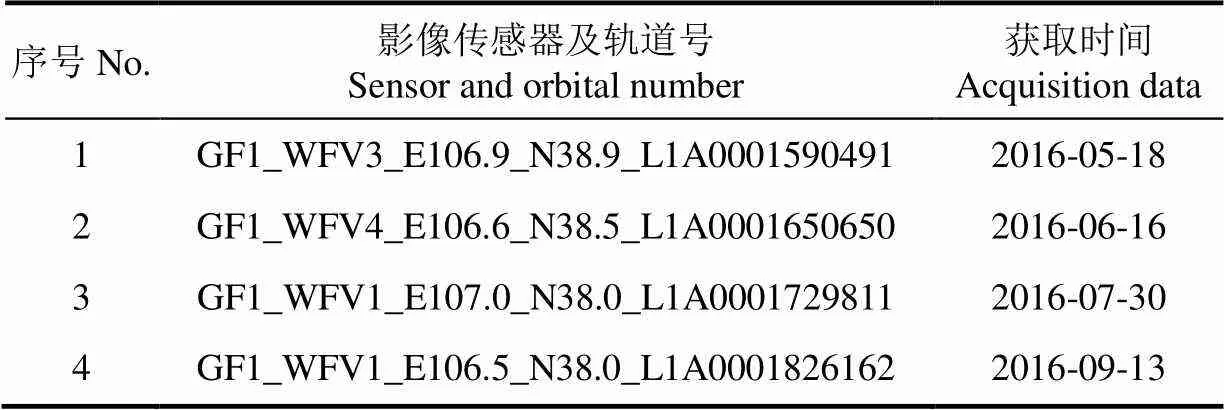
表1 研究區GF-1衛星WFV影像
2.2 研究區本底調查數據
水稻本底調查結果是基于GF-2/PMS數據,采用目視的方式解譯地塊邊界,結合地面調查對地塊屬性進行確認的方式獲取的。該數據共使用了2016年20景4 m空間分辨率的GF-2/PMS數據,其中5月6景、7月5景、8月9景,制圖精度能夠滿足農業行業應用的需求,圖1是水稻面積本底調查結果。該數據主要使用在決策樹閾值獲取、作為最大似然監督分類的訓練樣本、水稻空間分布結果的精度驗證樣本等3個方面。
2.3 水稻物候期及光譜特點
研究區內,水稻物候分為苗期、拔節、孕穗揚花、灌漿成熟等4發育時期,分別是在5月下旬以前、6月上中旬、6月下旬到7月上旬、7月中旬到9月中旬,歷時150 d左右。為保證水稻的正常發育,水稻全生育期內都需要保持10 cm水體深度,在拔節期以前水稻光譜以水體特征為主,拔節期以后以水稻光譜以作物反射特征為主。圖2是根據4個時相GF-1/WFV影像數據,基于本底數據掩模制作的水稻和其他地物類型的藍、綠、紅及近紅外波段反射光譜特征,以說明不同時間水稻與其他地物類型光譜反射率的差異。

圖1 基于GF-2/PMS影像的水稻本底調查結果
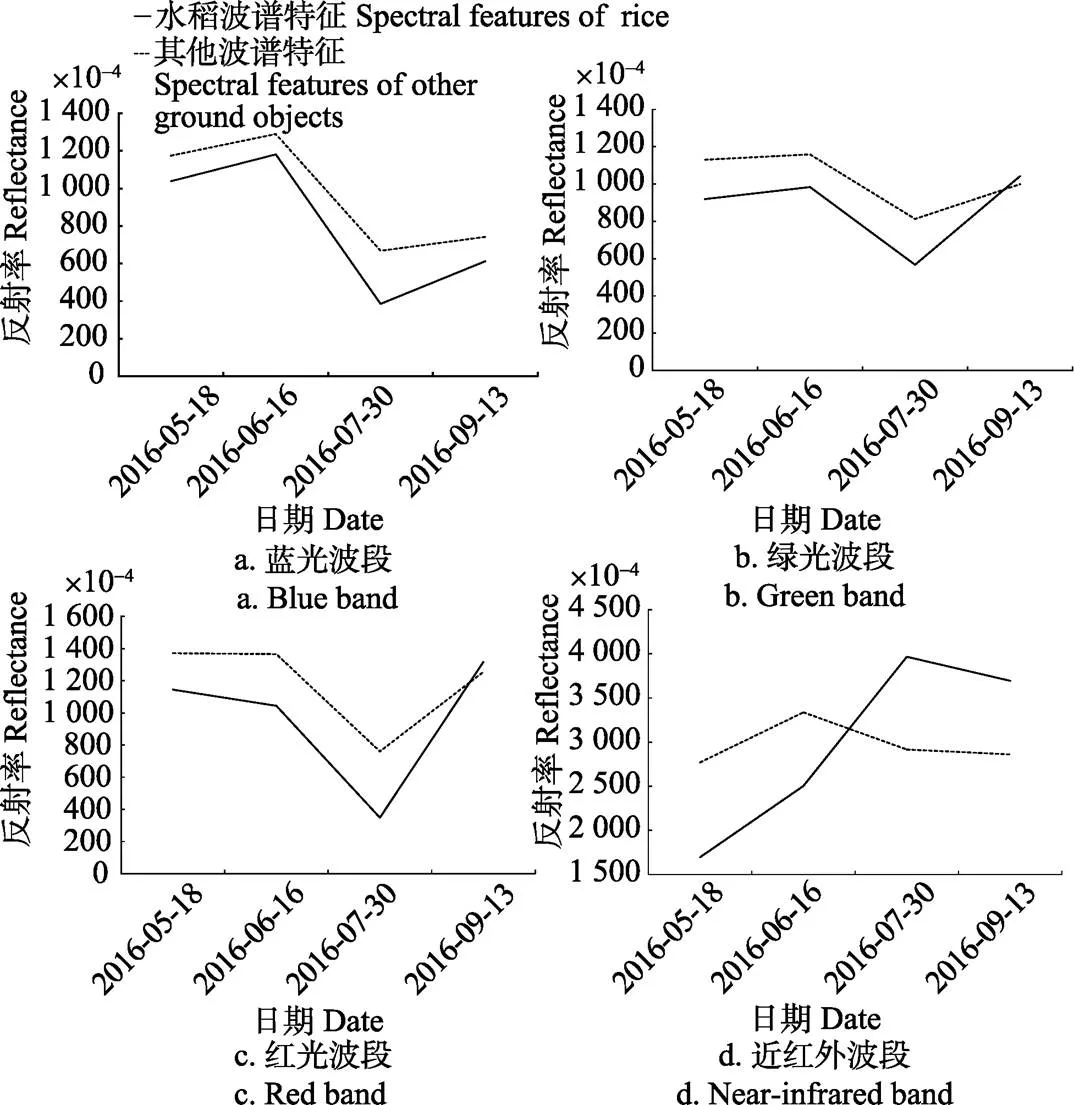
圖2 研究區水稻及其他地物類型光譜特征的季節變化
在近紅外波段,5、6月份水稻近紅外波段反射率值要低于其他地物類型,顯示了稻田水體反射特征;7、8月份水稻近紅外波段反射率值要高于其他地物類型,顯示了稻田的作物反射特征。與藍、綠、紅波段相比,近紅外波段4個時相反射率的變化也最為明顯,是近紅外波段水稻種植面積提取的依據及優勢所在。
3 研究方法
3.1 研究思路
該文研究的思路是,針對單時相、多時相2種時相條件下,通過近紅外波段、全波段數據的水稻面積提取精度的比較分析,獲取近紅外波段數據水稻的識別能力。單時相數據包括5、6、7、9月份4個時相,多時相數據包括5/6、5/7、5/6/7/9共3個時相組合,全部研究內容共有7個時相組合。
J-M距離是衡量不同作物類型在波段間分離能力的一個參數,通過J-M距離分析能夠對近紅外、全波段數據對水稻分離能力有初步的了解,便于分類結果識別能力的深入分析。針對近紅外波段數據,采用決策樹方案作為水稻識別能力的方法,首先是由于單波段數據不能使用最大似然分類的方法,其次是決策樹方法有利于保證單時相數據獲得最大分類精度的決策閾值,進一步采用與單時相一致的閾值,決策樹方法能夠保證單時相與多時相數據之間的分類精度保持一致,能夠更充分說明不同近紅外波段組合之間的精度。針對全波段數據,采用與業務監測一致的最大似然分類方法,更有利于說明近紅外波段的能力。在全波段情況下,如果近紅外波段識別結果高于全波段數據,則說明單獨的近紅外數據能夠達到一般性業務運行的需要;如果單獨的近紅外波段數據低于全波段結果,考慮到決策樹方案接近于最大精度,則用戶可以根據需要進行選擇使用。通過上述3種方法的使用,從數據分析、方法可行性、精度評價等方面說明了近紅外數據水稻識別能力。
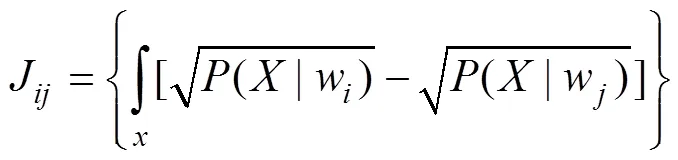
3.2 J-M距離指數
J-M距離指數用來區分不同波段組合的類別可分性,是基于條件概率理論的光譜可分性指標[33]
3.3 決策樹識別方法
按照一定的規則把遙感數據集逐級細分,得到具有不同屬性的各個子類別,是決策樹分類的基本思想[34]。該文以近紅外光譜反射率信息作為決策屬性,構建水稻類型識別的決策數據。閾值獲取是基于研究區水稻本底調查結果對各個時相近紅外數據進行掩模,以掩模后水稻和其他地物特征反射率值域的交點值作為決策節點。該方案可以保證決策樹方法的最高識別能力,提高研究結果的客觀性。圖3給出了5、6、7、9月份4個時相的反射率決策閾值,多時相組合結果是各個閾值疊加基礎上獲取的。出于計算方便,反射率值放大了10 000倍,5月18日近紅外反射率小于等于2 200、6月16日小于等于4 300、7月30日大于等于3 400、9月13日大于等于3 000,分別為包含水稻的閾值范圍。
3.4 最大似然分類方法
以研究區本底調查數據作為訓練樣本,采用最大似然分類算法,針對全波段WFV數據進行了水稻面積識別,作為近紅外波段數據結果對比的依據。最大似然分類算法也稱為極大似然估計,是一種常用的遙感影像分類方法[35]。使用本底數據作為訓練樣本,保證該方法獲取最大的精度。
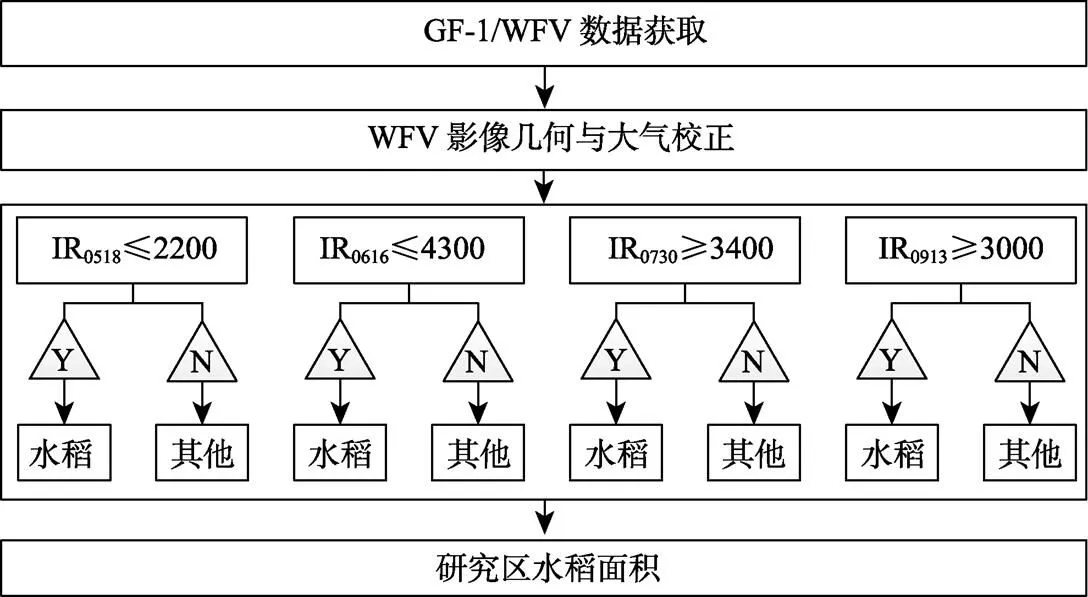
注:IR代表近紅外波段,下標是月份及日期,數據代表104倍反射率。
3.5 精度驗證
不同時相近紅外、全波段水稻面積提取結果的精度驗證是采用根據研究區本底調查數據結果進行的,驗證方法是采用混淆矩陣的方法進行的,總體精度、制圖精度、用戶精度、Kappa系數[36-38]4個參數是精度衡量指標。
4 結果與分析
4.1 基于分離度的水稻識別能力分析
由于單波段數據不能采用J-M距離指數進行分離度的評價,該文僅對多時相數據進行分析。計算J-M距離時,水稻和其他地物類型的樣本是基于目視解譯的水稻本底調查結果進行掩模獲取的,計算結果如表2所示。由表2可見,隨著5/6、5/7、5/6/7/9月份時相組合時相的增多,無論是近紅波段還是全波段數據,J-M距離指數都呈增高的趨勢,表明時相增多有助于識別能力的增強。近紅波段5/6月份組合的J-M距離指數與其他組合相比差異最大,表明這個組合的分類能力應該最低。
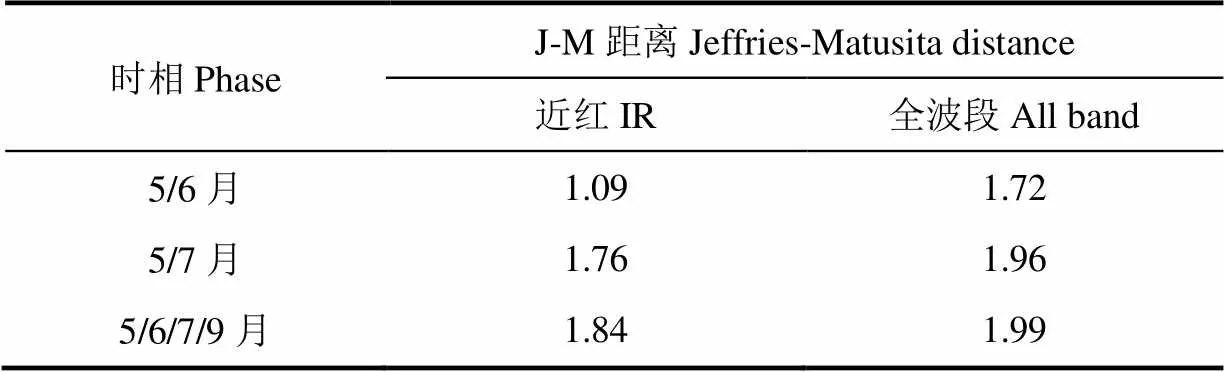
表2 水稻與其他地物類型4個時相的J-M距離
4.2 單時相近紅外波段數據水稻識別能力分析
針對5、6、7、9月份影像,分別使用決策樹方法對近紅外波段數據進行分類,使用最大似然分類方法對全波段數據進行分類,表3給出2種數據源的分類精度。由表3可見,就總體精度而言,除5月份近紅外單時相水稻識別精度高于全波段數據5.75個百分點以外,其他6、7和9月份近紅外單時相數據都低于全波段數據的識別精度,6月份相差最高為30.23個百分點,7月份相差最低為1.58個百分點,9月份為25.47個百分點,Kappa系數也表現出相同的趨勢。考慮到最大似然分類方法在一定程度上降低了5月份全波段數據的識別精度,單波段近紅外波段的識別能力總體上要低于全波段數據,但不同季節識別能力的差異是較大的。
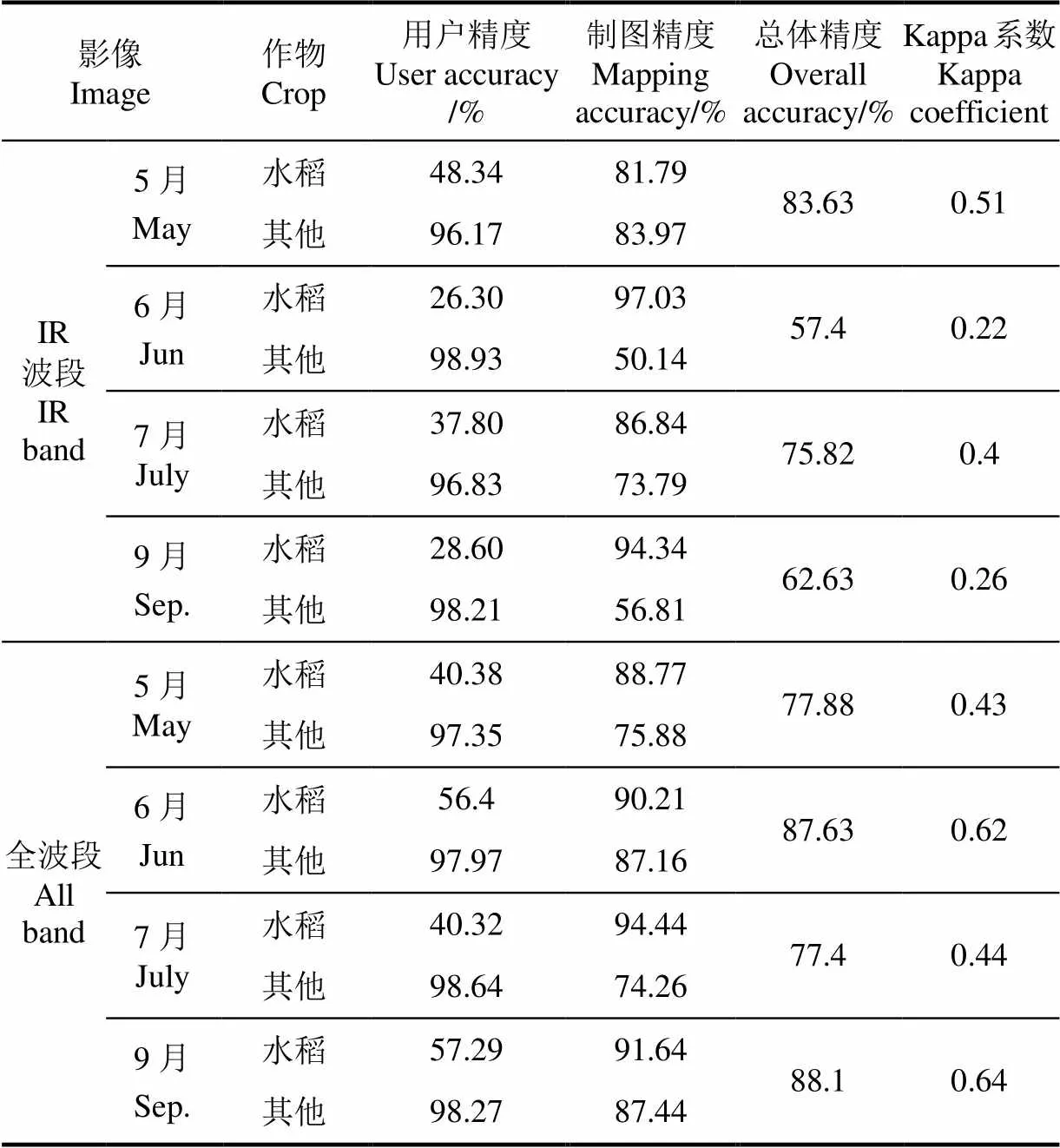
表3 單時相近紅外與全波段數據水稻遙感識別精度
當采用單時相近紅外波段影像作為水稻遙感識別數據源時,5和7月水稻識別精度都在75%以上,可以作為備選的水稻遙感識別的數據源,其中又以5月份數據為優。結合研究區范圍內作物種植特征,分析5月份近紅外影像能夠獲得較高精度的原因,主要是由于此時在田作物較少,同時稻田以水體特征為主,兩方面因素強化了5月份近紅外波段的水稻識別能力。7月份近紅外波段數據也獲得較高的精度,主要是由于稻田水體的作用,近紅外波段反射率開始下降,此時其他地物類型近紅外反射率正處在上升階段,導致稻田與其他地物類型近紅外反射率差異增加,是7月份近紅波段能獲得較高識別精度的原因,這種趨勢在圖2d中可以比較明顯地看出。
4.3 多時相近紅外波段水稻識別能力分析
覆蓋水稻生長早期、中期及后期發育時相的選擇,是農作物面積常用的監測組合。該文針對5/6、5/7、5/6/7/9月份3種組合方案的水稻識別能力進行了分析。為了給近紅外波段多時相組合水稻識別能力提供參考標準,同時也計算了全波段數據相應的多時相組合條件下水稻識別精度,計算結果如表4所示。方法不同雖然會對精度有影響,但考慮該文是以近紅外能力分析為主,全波段數據僅是提供參考。為了與實際應用情況相一致,研究中近紅波段的分類方法采取決策樹方案,全波段數據采用了監督分類方案。由表4可見,就總體精度而言,5/6月份組合的近紅外波段數據水稻識別的精度比全波段數據高5.77個百分點,5/7和5/6/7/9月份分別比全波段低8.58個百分點和0.73個百分點,Kappa系數也表現出類似的變化趨勢。總體上,近紅外組合的水稻識別能力達到全波段數據的識別能力,也高于單時相近紅外、單時相全波段數據的識別能力。
當采用近紅外多時相組合的方式進行水稻識別時,3種組合方式都可以作為備選的數據,精度都在83%以上;但以5/7、5/7/9月份數據為最優,精度達到了93%以上。這3種組合方式獲取的水稻自動分類結果基礎上,結合后期的目視修正業務,都能獲得比較可靠的水稻面積空間分布結果。分析多時相近紅外數據組合精度差異的原因,實際上是4個時相精度能力疊加,5和7月份近紅外波段對水稻的光譜反應比較敏感,這兩個時相疊加的結果要高于5、6月份疊加的結果。通過增加9月份數據,近紅外、全波段數據都不同程度提高了水稻的識別能力,也就提高了水稻識別精度。

表4 多時相近紅外與全波段數據水稻遙感識別精度
5 討 論
近紅外波段水稻識別能力的研究屬于波段優化研究領域,通過少數敏感波段的使用,在保證既定精度的目標下,可以達到提升計算效率的目標。從該文的研究可以看出,單時相GF-1衛星近紅外波段水稻識別精度平均為69.87%,而全部4個波段都使用的情況下水稻識別精度平均為87.25%,近紅外要比全波段數據低12.88個百分點左右。對至少包括水稻生長初期和中期的多時相數據而言,近紅外波段的識別精度平均為90.57%,比采用監督分類方法的多時相全波段數據組合的平均識別精度還高1.18個百分點,充分說明了近紅外波段在水稻識別中的有效性。
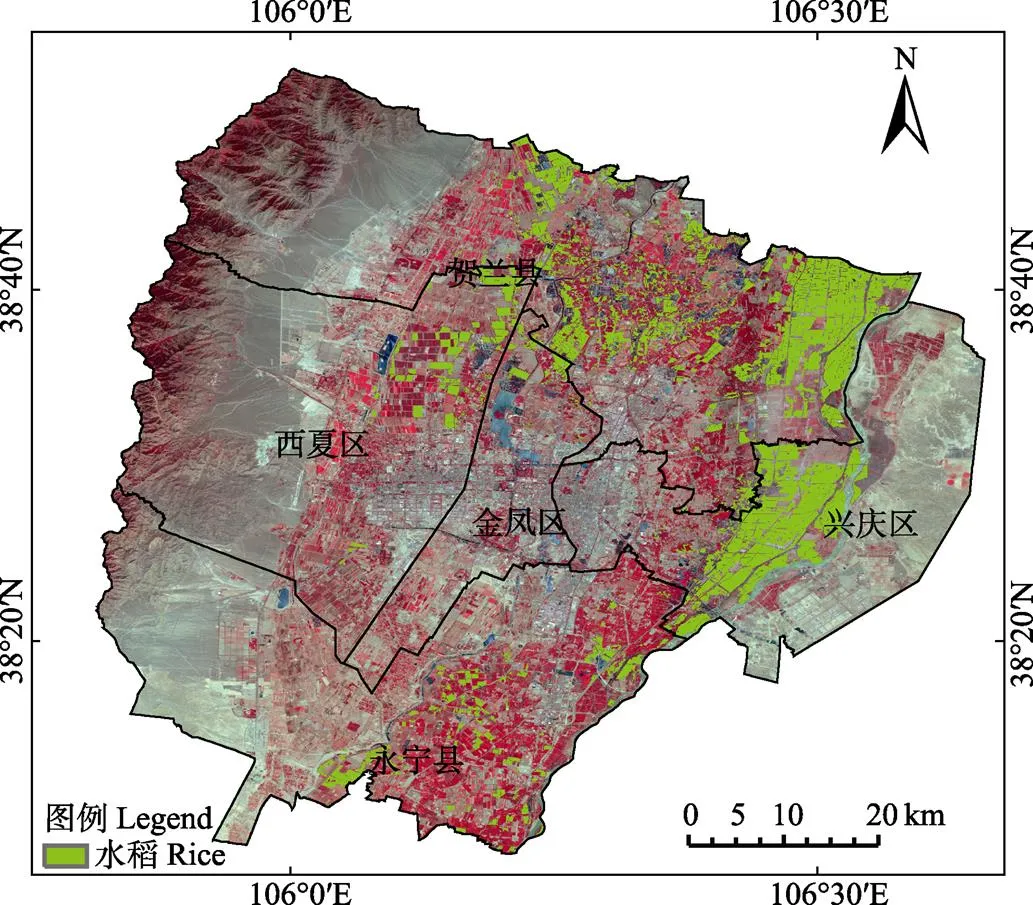
圖4 基于5/6/7/9月組合的近紅外波段數據的研究區水稻種植面積提取結果
采用近紅外波段開展水稻識別研究,基于單時相數據開展水稻類型識別,隨著發育階段的變化精度變化較大,主要是由于稻田中水體特征與作物特征轉化過程光譜反射率階段性變化決定的,此外同期內地物類型也是影響精度變化的主要原因。僅從單時相近紅外波段各個季節的識別精度來看,5月份是水稻水體特征突出,與其他地物類型相差最大的時期,此時影響水稻識別精度的地物主要是同期非稻田水體,如湖泊、濕地等,這些地物類型多則精度低,反之則高。其次是7月份影像,此時稻田是水體低反射率與植被高反射率的綜合,所以容易與旱地植被和純凈水體相區分,只是此時區分作用不如5月份明顯。在6和9月份,由于稻田近紅外波段上升、下降的速度沒有其他地物快,所以二者在這2個時期差別不大,導致基于近紅外識別精度較低。
采用近紅外數據進行水稻識別有利于采用多時相數據合成以規避云的影響。與遙感技術優勢并存的是云覆蓋、云陰影干擾及去除技術難點,當使用全波段數據有云的影響時,必須采取嚴格的云檢測技術以去除云,目前單獨使用GF-1影像不易實現,只能選擇晴空區影像開展監測,這大大限制了數據的獲取能力。如果僅使用近紅外波段數據,在水稻生長早期水體特征的提取,可以采取多時相近紅外最小值的方式獲取有效數據,能夠大大減少數據使用的局限性,這也是開展該項研究的主要目的之一。
6 結 論
就近紅外波段而言,在水稻面積識別精度要求在75.82%~83.63%左右的應用中,選擇生長早期的5月份、中期的7月份單時相近紅外WFV數據,可以作為遙感識別的數據源單獨使用。要達到85.35%以上的識別精度,則需要選擇包括生長初期、生長中期的5和7月份組合的近紅外WFV數據作為遙感數據源,能夠獲得識別精度較高的水稻面積空間分布結果,通過后期進一步目視修正,可以作為農作物面積遙感監測結果使用。
[1] 劉佳,王利民,姚保民,等. 基于多時相OLI數據的寧夏大尺度水稻面積遙感識別[J]. 農業工程學報,2017,33(15):200-209. Liu Jia, Wang Limin, Yao Baomin, et al. Ningxia rice area remote sensing estimation on large scale based on multi-temporal OLI data[J]. Transactions of the Chinese Society of Agricultural Engineering (Transactions of the CSAE), 2017, 33(15): 200-209. (in Chinese with English abstract)
[2] 文婷,張翔,張浩勤,等. 近紅外光譜在農業中的應用[J]. 農業技術與裝備,2009(20):20-22. Wen Ting, Zhang Xiang, Zhang Haoqin, et al. The application of near infrared spectrum in agriculture[J]. Agricultural Technology & Equipment, 2009(20): 20-22. (in Chinese with English abstract)
[3] 李炎,張月學,徐香玲, 等. 近紅外反射光譜(NIRS)分析技術及其在農業上的應用[J]. 黑龍江農業科學,2008(1):105-108. Li Yan, Zhang Yuexue, Xu Xiangling, et al. Applications of near infrared reflectance spectroscopy technology in agriculture[J]. Heilongjiang Agricultural Sciences, 2008(1): 105-108. (in Chinese with English abstract)
[4] 于燕波. 近紅外光譜分析技術在轉基因水稻識別和高油棉籽篩選中的應用研究[D]. 北京:中國農業大學,2014. Yu Yanbo. The Application of Near Infrared Spectroscopy in the Identification of Transgenic Rice and the Selection of High Oil Cottonseed[D]. Beijing: China Agricultural Univ-ersity, 2014. (in Chinese with English abstract)
[5] 黃振國,楊君. 高分一號衛星影像監測水稻種植面積研究綜述[J]. 湖南農業科學,2014(13):76-78. Huang Zhenguo, Yang Jun. Review of high-1 satellite image monitoring rice planting area[J]. Hunan Agricultural Sciences, 2014(13): 76-78. (in Chinese with English abstract)
[6] Kim Hyun-Ok, Yeom Jong-Min. Sensitivity of vegetation indices to spatial degradation of RapidEye imagery for paddy rice detection: A case study of South Korea[J]. GIScience & Remote Sensing, 2015, 52(1): 1-17.
[7] Gusso A, Arvor D, Ducati J R, et al. Assessing the MODIS crop detection algorithm for soybean crop area mapping and expansion in the Mato Grosso state, Brazil[J]. The Scientific World Journal, 2014(1): 1-9.
[8] L?w F, Duveiller G. Defining the spatial resolution requirements for crop identification using optical remote sensing[J]. Remote Sensing, 2014, 6(9): 9034-9063.
[9] Aguilar M, Vallario A, Aguilar J, et al. Object-based greenhouse horticultural crop identification from multi-tem-poral satellite imagery: A case study in Almeria, Spain[J]. Remote Sensing, 2015, 7(6): 7378-7401.
[10] Gusso A, Formaggio A R, Rizzi R, et al. Soybean crop area estimation by Modis/Evi data[J]. Pesquisa Agropecuaria Brasileira, 2012, 47(3): 425-435.
[11] 張猛,曾永年. 基于多時相Landsat數據融合的洞庭湖區水稻面積提取[J]. 農業工程學報,2015,31(13):178-185. Zhang Meng, Zeng Yongnian. Mapping paddy fields of Dongting Lake area by fusing Landsat and MODIS data[J]. Transactions of the Chinese Society of Agricultural Engine-ering (Transactions of the CSAE), 2015, 31(13): 178-185. (in Chinese with English abstract)
[12] 杜燁,郭長青,文寧,等. 基于多時相COSMO-SkyMedSAR數據對水稻信息提取方法的研究與應用[J]. 遙感信息,2014,29(3):30-34. Du Ye, Guo Changqing, Wen Ning, et al. Application of rice field extraction based on multi-temporal COSMO-SkyMed SAR data[J]. Remote Sensing Information, 2014, 29(3): 30-34. (in Chinese with English abstract)
[13] 于文穎,馮銳,紀瑞鵬,等. 基于MODIS數據的水稻種植面積提取研究進展[J]. 氣象與環境學報,2011,27(2):56-61. Yu Wenying, Feng Rui, Ji Ruipeng, et al. Advances in rice planting area extraction technology based on MODIS data[J]. Journal of Meteorology and Environment, 2011, 27(2): 56-61. (in Chinese with English abstract)
[14] 張煥雪,曹新,李強子,等. 基于多時相環境星NDVI時間序列的農作物分類研究[J]. 遙感技術與應用,2015,30(2):304-311. Zhang Huanxue, Cao Xin, Li Qiangzi, et al. Research on crop identification using multi-temporal NDVI HJ images[J]. Remote Sensing Technology and Application, 2015, 30(2): 304-311. (in Chinese with English abstract)
[15] 張曉憶,李衛國,景元書,等. 多種光譜指標構建決策樹的水稻種植面積提取[J]. 江蘇農業學報,2016,32(5):1066-1072. Zhang Xiaoyi, Li Weiguo, Jing Yuanshu, et al. Extraction of paddy rice area by constructing the decision tree with multi-ple spectral indices[J]. Jiangsu Journal of Agricultural Sciences, 2016, 32(5): 1066-1072. (in Chinese with English abstract)
[16] 許青云,楊貴軍,龍慧靈,等. 基于MODIS NDVI多年時序數據的農作物種植識別[J]. 農業工程學報,2014,30(11):134-144. Xu Qingyun, Yang Guijun, Long Huiling, et al. Crop information identification based on MODIS NDVI time-series data[J]. Transactions of the Chinese Society of Agricultural Engineering (Transactions of the CSAE), 2014, 30(11): 134-144. (in Chinese with English abstract)
[17] 楊閆君,占玉林,田慶久,等. 基于GF-1/WFV NDVI時間序列數據的作物分類[J]. 農業工程學報,2015,31(24):155-161. Yang Yanjun, Zhan Yulin, Tian Qingjiu, et al. Crop classification based on GF-1/WFV NDVI time series[J]. Transactions of the Chinese Society of Agricultural Engine-ering (Transactions of the CSAE), 2015, 31(24): 155-161. (in Chinese with English abstract)
[18] Wang Lin, Zhang Fucun, Jing Yuanshu, et al. Multi-temporal detection of rice phenological stages using canopy spec-trum[J]. Rice Science, 2014, 21(2): 108-115.
[19] 宋盼盼,杜鑫,吳良才,等. 基于光譜時間序列擬合的中國南方水稻遙感識別方法研究[J]. 地球信息科學學報,2017,19 (1): 117-124. Song Panpan, Du Xin, Wu Liangcai, et al. Research on the method of rice remote sensing identification based on spectral time-series fitting in southern China[J]. Journal of Geo-information Science, 2017, 19(1): 117-124. (in Chinese with English abstract)
[20] Son N T, Chen C F, Chen C R, et al. A comparative analysis of multitemporal MODIS EVI and NDVI data for large-scale rice yield estimation[J]. Agricultural & Forest Meteorology, 2014, 197(6): 52-64.
[21] Huang W, Huang J, Wang X, et al. Comparability of red/near-infrared reflectance and NDVI based on the spectral response function between MODIS and 30 other satellite sensors using rice canopy spectra[J]. Sensors, 2013, 13(12): 16023-16050.
[22] 郭鈮. 植被指數及其研究進展[J]. 干旱氣象,2003,21(4):71-75. Guo Ni. Vegetation index and its advance[J]. Arid Meteoro-logy, 2003, 21(4): 71-75. (in Chinese with English abstract)
[23] 張軍龍. 基于MODIS_EVI重慶水稻估產[D]. 重慶:重慶師范大學, 2014. Zhang Junlong. MODIS_EVI-based Rice Yield Estimation in Chongqing[D]. Chongqing: Chongqing Normal University, 2014. (in Chinese with English abstract)
[24] Elshorbagy A M, Imam E H, Nour M H. Rice area inter annual variation through a remote sensing based mapping algorithm[J]. ISPRS-International Archives of the Photogra-m-metry, Remote Sensing and Spatial Information Sciences, 2013, XL-7/W2: 81-85.
[25] Ardiansyah Ardiansyah, Sawitri Subiyanto, Abdi Sukmono. Identifikasi lahan sawah menggunakan NDVI dan PCA pada citra landsat 8 (Studi Kasus: Kabupaten Demak, Jawa Tengah)[J]. Jurnal Geodesi Undip, 2015, 4(4): 316-324.
[26] Peng D, Huete A R, Huang J, et al. Detection and estimation of mixed paddy rice cropping patterns with MODIS data[J]. International Journal of Applied Earth Observation & Geoinformation, 2011, 13(1): 13-23.
[27] 魏新彩,王新生,劉海,等. HJ衛星圖像水稻種植面積的識別分析[J]. 地球信息科學學報,2012,14(3):382-388. Wei Xincai, Wang Xinsheng, Liu Hai, et al. Extraction of paddy rice coverage based on the HJ satellite data[J]. Journal of Geo-Information Science, 2012, 14(3): 382-388. (in Chinese with English abstract)
[28] 朱良,平博,蘇奮振,等. 多時相TM影像決策樹模型的水稻識別提取[J]. 地球信息科學學報,2013,15(3):446-451. Zhu Liang, Ping Bo, Su Fenzhen, et al. Using decision tree model to extract paddy rice information from multi- temporal TM images[J]. Journal of Geo-Information Science, 2013, 15(3): 446-451. (in Chinese with English abstract)
[29] 鄭長春. 水稻種植面積遙感信息提取研究[D]. 烏魯木齊:新疆農業大學, 2008. Zheng Changchun. Stuy on Remote Sensing Information Extraction of Paddy Rice Planting Area[D]. Urumqi: Xin-jiang Agricultural University, 2008. (in Chinese with English abstract)
[30] 寧夏回族自治區統計局,國家統計局寧夏調查總隊.寧夏統計年鑒2016年[M].北京:中國統計出版社,北京數通電子出版社,2017.
[31] 劉佳,王利民,楊玲波,等. 基于6S模型的GF-1衛星影像大氣校正及效果[J]. 農業工程學報,2015,31(19):159-168. Liu Jia, Wang Limin, Yang Lingbo, et al. GF-1 satellite image atmospheric correction based on 6S model and its effect[J]. Transactions of the Chinese Society of Agricultural Engineering (Transactions of the CSAE), 2015, 31(19): 159-168. (in Chinese with English abstract)
[32] 劉佳,王利民,楊玲波,等. 基于有理多項式模型區域網平差的GF-1影像幾何校正[J]. 農業工程學報,2015,31(22):146-154. Liu Jia, Wang Limin, Yang Lingbo, et al. Geometric correc-tion of GF-1 satellite images based on block adjustment of rational polynomial model[J]. Transactions of the Chinese Society of Agricultural Engineering (Transactions of the CSAE), 2015, 31(22): 146-154. (in Chinese with English abstract)
[33] 譚玉敏,夏瑋. 基于最佳波段組合的高光譜遙感影像分類[J]. 測繪與空間地理信息,2014,37(4):19-22. Tan Yumin, Xia Wei. Optimum band combination based hy-perspectral remote sensing image classification[J]. Geomatics & Spatia Information Technology, 2014, 37(4): 19-22. (in Chinese with English abstract)
[34] 劉勇洪,牛錚,王長耀. 基于MODIS數據的決策樹分類方法研究與應用[J]. 遙感學報,2005,9(4):405-412. Liu Yonghong, Niu Zheng, Wang Changyao. Research and application of the decision tree classification using MODIS data[J]. Journal of Remote Sensing, 2005, 9(4): 405-412. (in Chinese with English abstract)
[35] 王增林,朱大明. 基于遙感影像的最大似然分類算法的探討[J]. 河南科學,2010,28(11):1458-1461. Wang Zenglin, Zhu Daming. A study of maximum likelihood classification algorithm based on remote sensing image[J]. Henan Science, 2010, 28(11): 1458-1461. (in Chinese with English abstract)
[36] Congalton R G. A review of assessing the accuracy of classifications of remotely sensed data[J]. Remote Sensing of Environment, 1991, 37(1): 35-46.
[37] Hay A M. The derivation of global estimation from a confusion matrix[J]. International Journal of Remote Sensing, 1988, 9(8): 1395-1398.
[38] Congalton R G. A comparison of sampling schemes used in generating error matrices for assessing the accuracy of maps generated from remotely sensing data[J]. Photogrammetric Engineering and Remote Sensing, 1988, 54(5): 593-600.
王利民,劉 佳,楊福剛,姚保民,邵 杰,楊玲波.GF-1衛星多時相組合近紅外數據水稻識別能力[J]. 農業工程學報,2017,33(23):196-202. doi:10.11975/j.issn.1002-6819.2017.23.025 http://www.tcsae.org
Wang Limin, Liu Jia, Yang Fugang, Yao Baomin, Shao Jie, Yang Lingbo. Rice recognition ability basing on GF-1 multi-temporal phases combined with near infrared data[J]. Transactions of the Chinese Society of Agricultural Engineering (Transactions of the CSAE), 2017, 33(23): 196-202. (in Chinese with English abstract) doi:10.11975/j.issn.1002-6819.2017.23.025 http://www.tcsae.org
Rice recognition ability basing on GF-1 multi-temporal phases combined with near infrared data
Wang Limin, Liu Jia※, Yang Fugang, Yao Baomin, Shao Jie, Yang Lingbo
(100081,)
Near-infrared wave bands have double sensitivities on water bodies and crop growth. Using near-infrared wave band on rice identification has notable advantage, and it is a key wave band in crop identification. The study chose 5 counties of Yinchuan City, Ningxia Hui Autonomous Region as the study area and took the near-infrared (770-890 nm) data of GF-1/WFV (wide field view) images on May 18, June 16, July 30, and September 13, 2016 as its data sources. By using decision-tree classification method, the study achieved the rice identification of 7 temporal combinations, including 4 single temporal data in May, June, July, and September, as well as 3 multi-temporal data of May/June, May/July, and May/June/July/September, and made a comparison with supervision classification results of full wave bands (0.45-0.52, 0.52-0.59, 0.63-0.69, 0.77-0.89 μm) of corresponding GF-1/WFV data. The rice identification accuracies of near-infrared wave bands of single temporal data in May, June, July, and September were 83.63%, 57.40%, 75.82% and 62.61% respectively. Except that the accuracy of May data was 5.75% higher than the full wave bands, the identification accuracies of other temporal phases were lower than that of full wave bands. The highest accuracy deviation was in June, 30.23%, and the lowest accuracy deviation was in July, 1.58%. The deviations in May and September were 5.75% and 25.47% respectively. The rice identification accuracies under 3 multi-temporal near-infrared combinations of May/June, May/July, May/June/July/September were 83.76%, 93.93%, and 94.03% respectively. The accuracies of near-infrared combinations of May/July, and May/June/July/September were 8.58% and 0.73% higher than that of full wave band data results respectively, but the accuracy of May/June was 5.47% lower. Regardless of near-infrared data or full wave band data, the minimum value, average value and maximum value of single temporal data identification accuracies were 57.40%, 76.31% and 88.10% respectively, with the Kappa coefficients of 0.22, 0.44 and 0.64 respectively; the minimum value, average value and maximum value of multi-temporal data identification accuracies were 83.76%, 89.98% and 94.03% respectively, with the Kappa coefficients of 0.52, 0.68 and 0.77 respectively; all identification accuracies of single temporal data were lower than the identification accuracies of the multi-temporal data. If using single temporal data as the data source of rice remote sensing identification, the identification accuracy can reach 75.82% based on the near-infrared WFV data of rice in middle growth period of July, which is consistent with the full wave band data result of this time phase; to reach the accuracy above 88.10%, it is necessary to use full wave band WFV data in September. If taking multi-temporal data of WFV data of temporal combinations of 2 rice growth periods i.e. early period of May and middle period of July as the data source of rice remote sensing identification, the identification accuracy can reach 93.93%, which is close to the highest identification accuracy of multi-temporal data. The study result shows that, for the near-infrared wave band, and in the applications with requirement on the rice identification accuracy of about 75%-85%, the 2 single temporal infrared WFV data in early growth period of May and middle growth period of July can be taken as the data sources of remote sensing identification. To reach the identification accuracy above 86%, it is necessary to choose the combination of near-infrared WFV data in early growth period of May and middle growth period of July as the remote sensing data sources, so as to achieve rice area spatial distribution results with relatively high identification accuracy. After further correction with visual observation, it can be taken as the crop area remote sensing supervision results.
remote sensing; crops; area recognition; multi-temporal phases; near-infrared band; GF-1/WFV; rice
10.11975/j.issn.1002-6819.2017.23.025
S127
A
1002-6819(2017)-23-0196-07
2017-06-13
2017-11-20
國家重點研發計劃“糧食作物生長監測診斷與精確栽培技術”課題“作物生長與生產力衛星遙感監測預測”(2016YFD0300603)
王利民,男,蒙古族,內蒙古寧城人,博士,主要從事農業遙感監測業務運行研究。Email:wanglimin01@caas.cn
劉 佳,女,漢族,湖南人,研究員,主要從事農業遙感監測業務運行研究。Email:liujia06@caas.cn
猜你喜歡
青少年科技博覽(中學版)(2022年6期)2022-12-27 19:44:27
體育科技文獻通報(2022年3期)2022-05-23 13:46:54
軍事文摘(2021年22期)2021-11-26 00:43:51
遼金歷史與考古(2021年0期)2021-07-29 01:06:54
數學小靈通(1-2年級)(2021年4期)2021-06-09 06:25:56
文苑(2020年6期)2020-06-22 08:41:52
科技傳播(2019年22期)2020-01-14 03:06:54
文苑(2019年22期)2019-12-07 05:29:00
民用飛機設計與研究(2019年4期)2019-05-21 07:21:24
中學生數理化·七年級數學人教版(2019年4期)2019-05-20 10:06:32
