
污損性海鞘的生態(tài)特點研究展望
2017-11-22 04:31:23韓帥帥王建軍林和山曹文浩
生態(tài)學(xué)報 2017年20期
嚴(yán) 濤,韓帥帥,王建軍,林和山,曹文浩
1 中國科學(xué)院南海海洋研究所熱帶海洋生物資源與生態(tài)重點實驗室, 廣州 510301 2 中國科學(xué)院大學(xué), 北京 100049 3 中國科學(xué)院海洋環(huán)境腐蝕與生物污損重點實驗室, 青島 266071 4 國家海洋局第三海洋研究所, 廈門 361005
污損性海鞘的生態(tài)特點研究展望
嚴(yán) 濤1,2,3,*,韓帥帥1, 2,王建軍4,林和山4,曹文浩1, 3
1 中國科學(xué)院南海海洋研究所熱帶海洋生物資源與生態(tài)重點實驗室, 廣州 510301 2 中國科學(xué)院大學(xué), 北京 100049 3 中國科學(xué)院海洋環(huán)境腐蝕與生物污損重點實驗室, 青島 266071 4 國家海洋局第三海洋研究所, 廈門 361005
海鞘生長快,繁殖迅速,能產(chǎn)生大量在短時間內(nèi)附著的幼蟲,是海洋污損生物群落中的重要成員,對海上人工設(shè)施會產(chǎn)生嚴(yán)重危害。污損性海鞘主要由悉尼海鞘(Ascidiasydneiensis)、史氏菊海鞘(Botryllusschlosseri)、米氏小葉鞘(Diplosomalisterianum)、柄瘤海鞘(Styelaclava)、紅賀海鞘(Herdmaniamomus)等9科29屬103種組成,其中在太平洋海域64種、印度洋23種、大西洋44種,而北冰洋海域僅3種;另外,其附著污損具有明顯的地域性和季節(jié)特點,并與深度有關(guān)。今后應(yīng)加強(qiáng)污損性海鞘的生態(tài)調(diào)查和分類研究,闡明深海及兩極海域附著污損特點,揭示幼蟲附著變態(tài)過程的分子調(diào)控機(jī)理,完善幼蟲采集培養(yǎng)技術(shù),以期更好地掌握海鞘生物學(xué)特性與生態(tài)特點,豐富和發(fā)展海洋生態(tài)學(xué)內(nèi)容,并為海洋污損生物的防除奠定基礎(chǔ),促進(jìn)海洋經(jīng)濟(jì)產(chǎn)業(yè)的發(fā)展。
污損性海鞘;種類組成;分布;附著
海鞘為脊索動物門尾索動物亞門中最主要的類群,其浮游幼蟲階段不進(jìn)食,成體則營固著濾食生活[1],是海洋污損生物重要組成部分。該類生物生長快,繁殖迅速,具備良好的環(huán)境適應(yīng)能力和強(qiáng)大的空間競爭力,通過產(chǎn)生大量在短時間內(nèi)附著的幼蟲[2],能迅速占據(jù)人工基質(zhì)[3],甚至?xí)淖冊械讞锶郝涞亩鄻有约捌浣Y(jié)構(gòu)特點[4- 5],因此,在海洋環(huán)境中,海鞘不僅是底棲生態(tài)系統(tǒng)中極為重要的成員[6- 7],也是海洋污損生物群落中人們需要重點關(guān)注的對象。
對水產(chǎn)養(yǎng)殖產(chǎn)業(yè)而言,除了與貽貝、扇貝、珍珠貝和牡蠣等經(jīng)濟(jì)貝類競爭餌料[8]和棲息空間[9],海鞘還會捕食其幼蟲和排擠稚貝[10],干擾足絲分泌,妨礙貝殼的張開,影響攝食和呼吸等生理活動的正常進(jìn)行[11- 12],導(dǎo)致養(yǎng)殖對象生長減緩,死亡率增加,產(chǎn)量下降,而且伴隨養(yǎng)殖海區(qū)的擴(kuò)展,還可能成為有害藻類擴(kuò)散的載體[13]。再有,海鞘的附著必然會堵塞養(yǎng)殖網(wǎng)籠的網(wǎng)孔或籠目,致使內(nèi)外環(huán)境水體交換量減少,降低水體中的溶解 氧含量,甚至損壞養(yǎng)殖器具,污染當(dāng)?shù)厮h(huán)境[14]。因此,分析和研究污損性海鞘具有重要的理論和現(xiàn)實意義。
世界各海區(qū)的環(huán)境狀況復(fù)雜多樣,污損性海鞘的種類組成及數(shù)量也會隨之相應(yīng)變化。開展污損性海鞘研究不僅有助于豐富海洋生物學(xué)知識,而且也是有效防治海洋污損生物危害的基礎(chǔ)。本文根據(jù)以往文獻(xiàn)資料,從種類組成、分布狀況和附著特點等方面, 綜合分析了世界各大洋污損性海鞘的生態(tài)特點,并對潛在的研究重點進(jìn)行了探討,以期更好地掌握海鞘生物學(xué)特性與生態(tài)特點,豐富和發(fā)展海洋生物學(xué)研究內(nèi)容,并為海洋污損生物防除提供數(shù)據(jù)資料,促進(jìn)海洋經(jīng)濟(jì)產(chǎn)業(yè)的發(fā)展。
1 種類組成與分布
對已有文獻(xiàn)資料分析可以看出,污損性海鞘種類繁多,分布廣泛,共有9科29屬103種出現(xiàn)在全球各海區(qū)人工設(shè)施上,其中太平洋海域64種、印度洋海域23種、大西洋海域44種、北冰洋海域3種,以悉尼海鞘(Ascidiasydneiensis)、史氏菊海鞘(Botryllusschlosseri)、米氏小葉鞘(Diplosomalisterianum)、柄瘤海鞘(Styelaclava)、紅賀海鞘(Herdmaniamomus)等種類為主,且主要分布在熱帶和溫帶海域。表1列出了主要污損性海鞘類在世界各大洋的分布狀況。
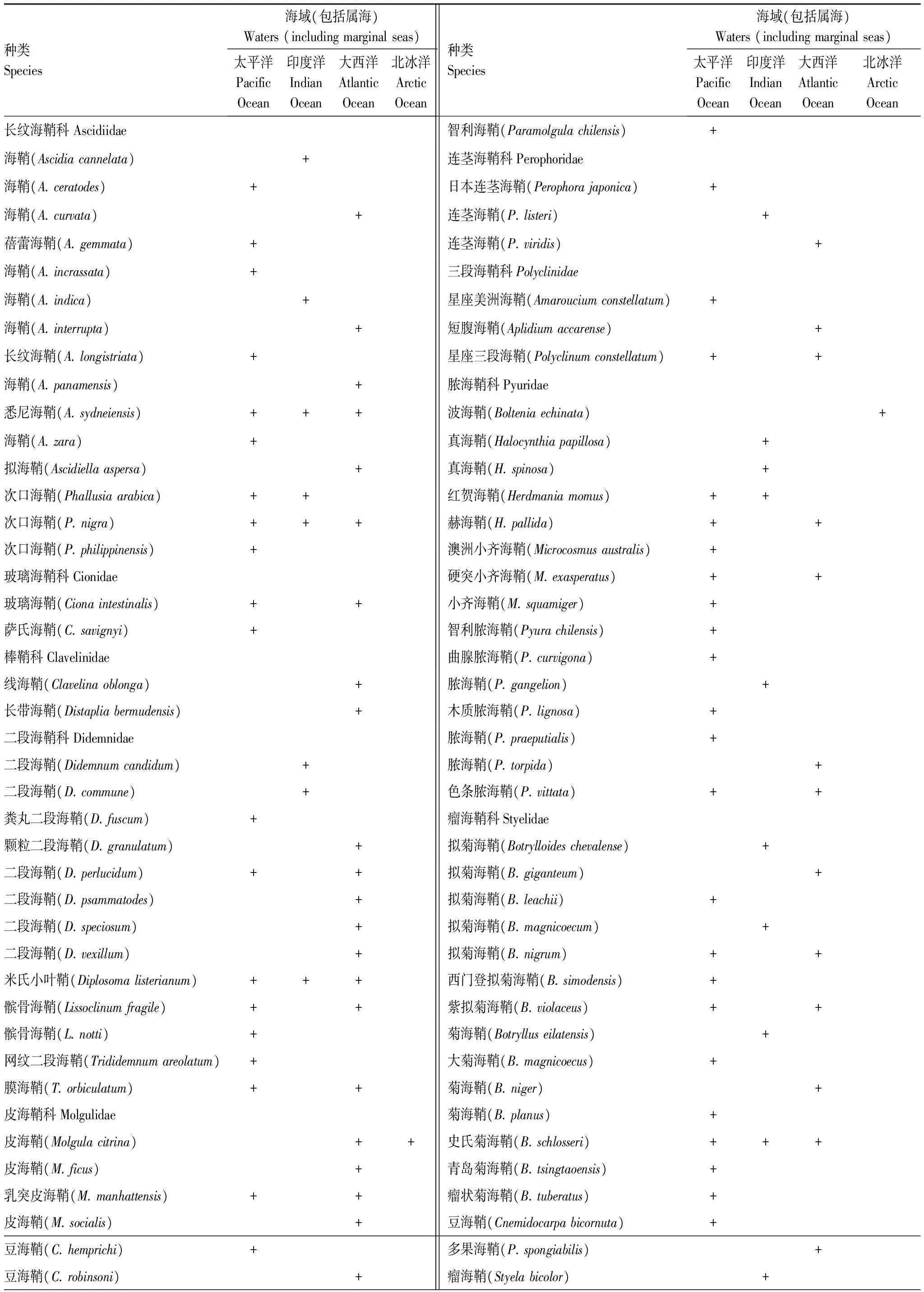
表1 各大洋污損性海鞘名錄
1.1 太平洋海域
在北美洲沿岸,不列顛哥倫比亞西南部海域的污損性海鞘以柄瘤海鞘為優(yōu)勢種,其次為史氏菊海鞘和紫擬菊海鞘(Botrylloidesviolaceus)[15],而加州南部海域,污損性海鞘優(yōu)勢種為皺瘤海鞘(Styelaplicata),其次為柄瘤海鞘、小齊海鞘(Microcosmussquamiger)、玻璃海鞘(Cionaintestinalis)等種類,常見種則為薩氏海鞘(C.savignyi)和精囊海鞘(Polyandrocarpazorritensis)[16]。
在中美洲的巴拿馬運(yùn)河入口,污損性海鞘優(yōu)勢種為縱列海鞘(Symplegmabrakenhielmi和S.rubra)、星座三段海鞘(Polyclinumconstellatum)、擬菊海鞘(Botrylloidesnigrum),其次為悉尼海鞘、硬突小齊海鞘(Microcosmusexasperatus)和精囊海鞘(Polyandrocarpazorritensis)[17];南美洲的東南部海域,則以智利膿海鞘(Pyurachilensis)為優(yōu)勢[18- 19]。
至于西太平洋海域,日本海域的污損性海鞘優(yōu)勢種為紫擬菊海鞘和米氏小葉鞘,其次為玻璃海鞘、皺瘤海鞘和柄瘤海鞘,日本連莖海鞘(Perophorajaponica)和日本膠海鞘(Corellajaponica)則為污損性海鞘罕見種,且只出現(xiàn)在位于日本東部的清水町海域[20- 21]。而日本廣島海域的污損性海鞘以玻璃海鞘為優(yōu)勢種[20]。
在黃渤海海域,污損性海鞘主要為玻璃海鞘、乳突皮海鞘(Molgulamanhattensis)和柄瘤海鞘,其次為米氏小葉鞘、史氏菊海鞘和青島菊海鞘(Botryllustsingtaoensis),至于紫擬菊海鞘、冠瘤海鞘(Styelacanopus)和長紋海鞘(Ascidialongistriata)等種類,則是污損生物群落中的常見種[22-26]。
東海污損性海鞘優(yōu)勢種以冠瘤海鞘、皺瘤海鞘、網(wǎng)紋二段海鞘(Trididemnumareolatum)、星座三段海鞘、乳突皮海鞘為主,其次為長紋海鞘、硬突小齊海鞘、紫擬菊海鞘,常見種為米氏小葉鞘、玻璃海鞘、澳洲小齊海鞘(Microcosmusaustralis)等種類,此外還有木質(zhì)膿海鞘(Pyuralignosa)、悉尼海鞘等罕見種[27-33]。
南海海區(qū)污損性海鞘以冠瘤海鞘、大洋縱列海鞘(Symplegmaoceania)、硬突小齊海鞘、悉尼海鞘、米氏小葉鞘居絕對優(yōu)勢,其次為皺瘤海鞘、綠鰓縱列海鞘(S.viride)、赫海鞘(Herdmaniapallida)、長方胃海鞘(Styelarectangularis)、史氏菊海鞘,常見的種類為玻璃海鞘、乳突皮海鞘、長紋海鞘、多果海鞘(Polycarpapapillata)和次口海鞘(Phallusiaarabica)等種類[34- 49]。
位于太平洋西南的新西蘭海域,污損性海鞘優(yōu)勢種為玻璃海鞘,其次為柄瘤海鞘和二段海鞘(Didemnumvexillum),此外,還有米氏小葉鞘、擬菊海鞘(Botrylloidesleachii)、史氏菊海鞘、髕骨海鞘(Lissoclinumnotti)、膠海鞘(Corellaeumyota)、豆海鞘(Cnemidocarpabicornuta)等種類出現(xiàn)[50-52]。
1.2 印度洋海域
在阿拉伯海東部沿岸,東北部的孟買港海鞘優(yōu)勢種為匍匐縱列海鞘(Symplegmareptans)、悉尼海鞘和擬菊海鞘(Botrylloidesmagnicoecum),常見種則為擬菊海鞘(B.chevalense)、綠鰓縱列海鞘[53]。在中部的新芒格洛爾港口,綠鰓縱列海鞘為污損性海鞘優(yōu)勢種,更偏向于附著在兩塊相對垂直懸掛的污損生物調(diào)查板的內(nèi)部,能夠覆蓋整個板[54]。而在東南部的Kollam灣,珍珠貝養(yǎng)殖場內(nèi)發(fā)現(xiàn)海鞘類4種,占污損生物總量的26.6%[12]。
在紅海北部的亞喀巴灣埃拉特海域,污損性海鞘以紅賀海鞘和顆粒二段海鞘(Didemnumgranulatum)為優(yōu)勢種,常見的種類則有真海鞘(Halocynthiaspinosa)、次口海鞘(Phallusianigra)、海鞘(Ascidiacannelata)、二段海鞘(Didemnumcandidum)和菊海鞘(Botrylluseilatensis)[55- 56]。
1.3 大西洋海域
在歐洲大陸西北的北海,污損近岸人工設(shè)施的海鞘以膠海鞘(Corellaparallelogramma)、玻璃海鞘、擬海鞘(Ascidiellaaspersa)、史氏菊海鞘和紫擬菊海鞘等種類為優(yōu)勢種[57- 59],而近海離岸設(shè)施則被擬海鞘和玻璃海鞘污損[60]。至于北美洲東北部沿岸海域,貝類養(yǎng)殖設(shè)施主要被皮海鞘(Molgulacitrina)、史氏菊海鞘、玻璃海鞘和柄瘤海鞘污損[61- 62]。
在加勒比海海域,巴拿馬運(yùn)河入口的污損性海鞘以硬突小齊海鞘和色條膿海鞘(Pyuravittata)為優(yōu)勢種,其次為冠瘤海鞘和赫海鞘等種類[17];而處在其東南端的帕里亞灣,污損游艇船體的海鞘優(yōu)勢種為冠瘤海鞘和硬突小齊海鞘,常見的種類則是線海鞘(Clavelinaoblonga)[63]。
至于南美洲沿岸海域,污損性海鞘主要為二段海鞘(Didemnumspeciosum和D.perlucidum)、線海鞘、米氏小葉鞘、菊海鞘(Botryllusniger)、縱列海鞘(Symplegmabrakenhielmi)、皺瘤海鞘和擬海鞘,從北往南優(yōu)勢種依次為二段海鞘(Didemnumspeciosum)、線海鞘,皺瘤海鞘、二段海鞘(D.perlucidum)、擬海鞘和乳突皮海鞘等種類[64- 69]。
1.4 北冰洋海域
白海處在北冰洋最南端,在0—5m水層溫度介于-0.98—14.78℃,其中7月份水溫最高;鹽度則隨深度增加,處在14.99—26.74之間,且以12月份鹽度最高。該海域水產(chǎn)養(yǎng)殖設(shè)施上的污損性海鞘以瘤海鞘(Styelarustica)為優(yōu)勢種,常見的種類則為皮海鞘(Molgulacitrina),波海鞘(Bolteniaechinata)偶而出現(xiàn)[70- 72]。
2 附著特點
污損性海鞘的分布具有明顯的地域性,多數(shù)喜歡生活在水溫較高的海域,即熱帶海區(qū)的多樣性明顯高于溫帶及寒帶海域。在太平洋黃渤海海域,污損性海鞘的優(yōu)勢種為柄瘤海鞘[25- 26],而東海和南海則以冠瘤海鞘為主[29,45];悉尼海鞘雖為南海的優(yōu)勢種,但在東海其數(shù)量顯著減少,而在緯度更高的黃、渤海沒有發(fā)現(xiàn)[29,45]。線海鞘和長帶海鞘(Distapliabermudensis)為大西洋海域污損性海鞘特有種[63],而波海鞘只出現(xiàn)在北冰洋海域[70]。
季節(jié)的變化是影響海鞘附著污損的另一關(guān)鍵因素,且不同海域存在差異。在太平洋海域,海鞘的附著高峰期主要集中在夏季,其中柄瘤海鞘和乳突皮海鞘的附著高峰期分別在6月和9月份[26]。然而,春、秋季則是印度洋海域海鞘的附著高峰,如紅海北部埃拉特海域,海鞘優(yōu)勢種紅賀海鞘最大附著量出現(xiàn)在春季,而顆粒二段海鞘則在秋季[56]。至于大西洋東北部沿岸海域,本地種海鞘的附著期出現(xiàn)在3—6月,而外來種為6—12月[58]。
沿海港口碼頭和水產(chǎn)養(yǎng)殖設(shè)施的污損生物群落中通常都有海鞘出現(xiàn),基于碼頭多處在突堤和防波堤所包圍的小水域中,而傳統(tǒng)的養(yǎng)殖器具也都布設(shè)在內(nèi)灣,再結(jié)合航標(biāo)等設(shè)施被海鞘附著污損的程度內(nèi)灣高于外海[41],故可以推斷,海鞘青睞棲息附著在近岸及半封閉水體中的人工設(shè)施,諸如布設(shè)在遮蔽水域的浮標(biāo)、碼頭、養(yǎng)殖器具等應(yīng)是其附著污損的首選,隨著離岸距離增加,水體開闊程度增大,海鞘的種類和污損程度下降。
人工設(shè)施浸海時間的長短會對污損生物群落中海鞘的種類及地位產(chǎn)生影響,如智利膿海鞘可逐漸成為污損群落的優(yōu)勢種[19],瘤海鞘(Styelarustica)的附著量在5年的污損生物群落中占74%[70],擬海鞘和玻璃海鞘則在北海近海石油平臺建成第4年成為優(yōu)勢種[60]。然而,某些種類卻似乎為群落的先驅(qū)者,如占優(yōu)勢的米氏小葉鞘會逐漸被水螅取代[68],而史氏菊海鞘和紫擬菊海鞘主要出現(xiàn)在新投放的人工物體上[59]。
再有,附著基質(zhì)的差異也可能造成其上棲息附著的污損性海鞘出現(xiàn)變化。如玻璃海鞘似乎在金屬表面的附著量更多,而膠海鞘(Corellaparallelogramma)和擬海鞘更青睞水泥樁柱[73],海鞘(Styelasp.)在塑料網(wǎng)衣的附著面積大于木質(zhì)試板[74],智利膿海鞘主要附著于繩索[11]。紅賀海鞘更偏向于污損物體的水平表面,次口海鞘(Phallusianigra)和海鞘(Ascidiacannelata)多附著在漂浮的人工設(shè)施組件上[56]。
深度是影響海鞘污損狀況的又一關(guān)鍵因素,不同種類的污損區(qū)間會出現(xiàn)明顯變化。在水下1—5m的深度范圍內(nèi),引發(fā)生物污損的海鞘優(yōu)勢種通常為智利膿海鞘[18]、瘤海鞘(Styelarustica)[70]等種類;顆粒二段海鞘的污損范圍則介于13—30m水層[55],而擬海鞘和玻璃海鞘可成為平臺水下部位36m深處污損生物群落的優(yōu)勢種[60]。
3 研究展望
遠(yuǎn)洋航運(yùn)和水產(chǎn)養(yǎng)殖往往是將污損性海鞘引到新棲息環(huán)境的載體。海鞘這類生物可耐受溫度、鹽度的大幅變化甚至污染,且生長速度快,成熟時間短,能產(chǎn)生大量的不攝食浮游幼蟲,在波浪較小、營養(yǎng)物豐富的港灣里,可迅速附著于浮碼頭、木樁、浮標(biāo)和船舶底部等處生長[75]。因此,伴隨著海洋經(jīng)濟(jì)活動的迅猛發(fā)展,需要著重關(guān)注人工設(shè)施污損生物群落的變化狀況,防范和研究外來海鞘對當(dāng)?shù)厣锒鄻有约吧a(chǎn)活動的影響。
基于海洋污損生物的附著會改變附著基表面微環(huán)境,從而影響材料腐蝕行為,改變腐蝕過程。已有研究表明,藤壺可對某些金屬材料產(chǎn)生“藤壺開花”的腐蝕現(xiàn)象[76],牡蠣在物體表面附著時分泌的一種粘液可腐蝕附著基[77]。作為大型污損生物重要類群的海鞘,其附著(尤其復(fù)海鞘大面積附著)與材料腐蝕之間的關(guān)系,目前尚未見有關(guān)報道,故今后要加大相關(guān)領(lǐng)域的研究,闡明海鞘大量附著對人工設(shè)施材料腐蝕行為的影響。
能否有效控制海鞘幼蟲的附著是避免其污損危害的關(guān)鍵,故利用幼蟲開展防除研究有助于迅速了解相關(guān)技術(shù)的成效,為進(jìn)一步的應(yīng)用研究提供參考。然而,出于統(tǒng)計分析的考慮,需要足夠數(shù)量的幼蟲作為實驗測試對象,基于目前海鞘幼蟲的來源仍依靠野外采集成熟個體和室內(nèi)陰干刺激的方法來獲取這一途徑,因此,今后應(yīng)加強(qiáng)對海鞘幼蟲采集、培養(yǎng)和儲存等方面的研究,以更好地保障大批量實驗測試對象的供給。
目前,常規(guī)的污損生物防除手段主要為人工清除、防污漆涂裝、電解海水、添加殺生劑等途徑,但這些方法各自都具有一定的局限性。基于基因調(diào)控在海鞘幼蟲變態(tài)過程中起到了重要作用[78],因此,在加強(qiáng)相關(guān)分子調(diào)控機(jī)理研究的前提下,可以探討各種處理技術(shù)對幼蟲附著變態(tài)過程相關(guān)基因表達(dá)的影響,從轉(zhuǎn)錄組和蛋白組水平上探究其抗附著機(jī)制,促進(jìn)新型、環(huán)保、高效、廣譜污損生物防除技術(shù)的發(fā)展。
生物分類主要是依據(jù)生物體所具備的形態(tài)特征和結(jié)構(gòu)特點,然而,在實際的分析鑒定過程中,某些海鞘由于形態(tài)十分相似,往往會被歸為一類,如玻璃海鞘鞘和薩氏海鞘長期以來都被認(rèn)為是同一物種[79];另外,由于棲息環(huán)境的差異,同種海鞘的形態(tài)特征偶爾也會出現(xiàn)一些變化。因此,單純依賴傳統(tǒng)手段進(jìn)行分類研究可能會導(dǎo)致爭議或出現(xiàn)誤判,此時分子生物學(xué)研究手段將可從分子水平提供有力證據(jù)。
目前污損生物的生態(tài)研究主要集中在熱帶和溫帶沿岸海域,有關(guān)深海及兩極等極端環(huán)境的研究仍局限于個別海域[80- 82]。因此,下一階段的工作除了繼續(xù)對熱點海域進(jìn)行深入系統(tǒng)地研究外,還需加強(qiáng)未知海域和極端環(huán)境的探討,以期徹底闡明污損性海鞘種群的動態(tài)變化規(guī)律及發(fā)展趨勢,揭示其與污損生物群落中其它生物之間的關(guān)系, 構(gòu)建生態(tài)數(shù)學(xué)模型, 從而更好地為海洋污損生物防除工作提供科學(xué)依據(jù),并為海洋生態(tài)科學(xué)發(fā)展積累數(shù)據(jù)資料。
[1] Lambert G. Nonindigenous Ascidians in Tropical Waters. Pacific Science, 2002, 56(3): 291- 298.
[2] Shenkar N, Bronstein O, Loya Y. Population dynamics of a coral reef ascidian in a deteriorating environment. Marine Ecology Progress Series, 2008, 367: 163- 171.
[3] Ruiz G M, Freestone A L, Fofonoff P W, Simkanin, C. Habitat distribution and heterogeneity in marine invasion dynamics: the importance of hard substrate and artificial structure // Wahl M, ed. Marine Hard Bottom Communities. Berlin Heidelberg: Springer, 2009: 321- 332.
[4] Castilla J C, Lagos N A, Cerda M. Marine ecosystem engineering by the alien ascidianPyurapraeputialison a mid-intertidal rocky shore. Marine Ecology Progress Series, 2004, 268(1): 119- 130.
[5] Blum J C, Chang A L, Liljesthr?m M, Schenk M E, Steinberg M K, Ruiz G M. The non-native solitary ascidianCionaintestinalis(L.) depresses species richness. Journal of Experimental Marine Biology and Ecology, 2007, 342(1): 5- 14.
[6] Bak R P M, Lambrechts D Y M, Joenje M, Nieuwland G, Van Veghel M L J. Long-term changes on coral reefs in booming populations of a competitive colonial ascidian. Marine Ecology Progress Series, 1996, 133(1/3): 303- 306.
[7] Bullard S G, Carman M R, Rocha R M, Dijkstra J A, Goodwin A M. Abundance and diversity of ascidians in the southern Gulf of Chiriquí, Pacific Panama. Aquatic Invasions, 2011, 6(4): 381- 390.
[8] Petersen J K. Ascidian suspension feeding. Journal of Experimental Marine Biology and Ecology, 2007, 342(1): 127- 137.
[9] Uribe E, Etchepare I. Effects of biofouling byCionaintestinalison suspended culture ofArgopectenpurpuratusin Bahia Inglesa, Chile. Bulletin of the Aquaculture Association of Canada, 2002, 102: 93- 95.
[10] Osman R W, Whitlatch R B, Zajac R N. Effects of resident species on recruitment into a community: Larval settlement versus post-settlement mortality in the oysterCrassostreavirginica. Marine Ecology Progress Series, 1989, 54(1/2): 61- 73.
[11] Lu Y T, Blake N J. The culture of the southern bay scallop in Tampa Bay, an urban Florida estuary. Aquaculture International, 1997, 5(5): 439- 450.
[12] Kripa V, Mohamed K S, Velayudhan T S. Seasonal Fouling Stress on the Farmed Pearl Oyster,Pinctadafucata, from Southeastern Arabian Sea. Journal of the World Aquaculture Society, 2012, 43(4): 514-525.
[13] Rosa M, Holohan B A, Shumway S E, Bullard S G, Wikfors G H, Morton S L, Getchis T. Biofouling ascidians on aquaculture gear as potential vectors of harmful algal introductions. Harmful Algae, 2013, 23:1- 7.
[14] Aldred N, Clare A S. Mini-review: Impact and dynamics of surface fouling by solitary and compound ascidians. Biofouling, 2014, 30(3): 259- 270.
[15] Murray C C, Pakhomov E A, Therriault T W. Recreational boating: a large unregulated vector transporting marine invasive species. Diversity and Distributions, 2011, 17(6): 1161- 1172.
[16] Lambert C C, Lambert G. Non-indigenous ascidians in southern California harbors and marinas. Marine Biology, 1998, 130(4): 675- 688.
[17] Carman M R, Bullard S G, Rocha R M, Lambert G, Dijkstra J A, Roper J J, Goodwin A, Carman M M, Vail E M. Ascidians at the Pacific and Atlantic entrances to the Panama Canal. Aquatic Invasions, 2011, 6(4): 371-380.
[18] Viviani C A, DiSalvo L H. Biofouling in a north-central Chilean coastal bay // Proceedings of the 5th International Congress on Marine Corrosion and Fouling. Barcelona: Northwestern University Press, 1980: 69- 74.
[19] Cifuentes M, Kamlah C, Thiel M, Lenz M, Wahl M. Effects of temporal variability of disturbance on the succession in marine fouling communities in northern-central Chile. Journal of Experimental Marine Biology and Ecology, 2007, 352(2): 280- 294.
[20] Arakawa K Y. Competitors and fouling organisms in the hanging culture of the Pacific oyster,Crassostreagigas(Thunberg). Marine Behaviour and Physiology, 1990, 17(2): 67- 94.
[21] Yamaguchi M. Growth and reproductive cycles of the marine fouling ascidiansCionaintestinalis,Styelaplicata,Botrylloidesviolaceus, andLeptoclinummitsukuriiat Aburatsubo-Moroiso Inlet (central Japan). Marine Biology, 1975, 29(3): 253- 259.
[22] 鄭成興. 黃、渤海沿岸污損生物中的海鞘類. 動物學(xué)報, 1988, 34(2): 180- 188.
[23] 張連震. 河北扇貝養(yǎng)殖區(qū)污損生物調(diào)查. 河北漁業(yè), 2007, (3): 52- 57.
[24] 黃修明, 尹建德, 劉建軍, 彭樹杰, 鄭國安, 劉書攻, 王旭, 劉萬山, 曹靜. 渤海石油平臺附著生物生態(tài)的研究. 海洋科學(xué)集刊, 1994, (35): 131- 141.
[25] 冷宇, 李繼業(yè), 劉一霆, 趙升, 劉旭東. 煙臺市龍口港污損生物生態(tài)研究. 海洋通報, 2012, 31(4): 454- 459.
[26] 李傳燕, 黃宗國, 王建軍, 鄭成興, 林盛. 煙臺港附著生物生態(tài)研究. 海洋學(xué)報, 1990, 12(1): 107- 114.
[27] 蔡如星, 陳樹慶, 薛俊增, 盧建平. 舟山枸杞水域的污損生物生態(tài). 東海海洋, 1994, 12(3): 42- 56.
[28] 周時強(qiáng), 柯才煥, 林大鵬. 羅源灣大官坂圍墾區(qū)附著生物生態(tài)研究. 海洋通報, 2001, 20(3): 29- 35.
[29] 黃宗國, 陳麗淑. 臺灣省兩個港灣污損生物初步研究. 海洋學(xué)報, 2002, 24(6): 92- 98.
[30] 黃宗國, 蔡如星, 許由焰. 平潭附著生物生態(tài)研究. 臺灣海峽, 1982, 1(1): 87- 92.
[31] 李傳燕, 黃宗國, 鄭成興, 王建軍. 湄洲灣附著生物與油污染生態(tài)學(xué)研究. 臺灣海峽, 1996, 15(4): 387- 393.
[32] 王建軍, 黃宗國, 李傳燕, 鄭成興, 林娜, 嚴(yán)頌凱. 廈門港網(wǎng)箱養(yǎng)殖場污損生物的研究. 海洋學(xué)報, 1996, 18(5): 93- 102.
[33] 林和山, 王建軍, 鄭成興, 李榮冠, 鄭鳳武, 林俊輝, 黃雅琴, 何雪寶, 江錦祥. 東山灣污損生物生態(tài)研究. 海洋學(xué)報, 2012, 34(6): 160- 169.
[34] 鄭東強(qiáng), 黃宗國. 大亞灣海水養(yǎng)殖箱、籠上附著的污損生物. 水產(chǎn)學(xué)報, 1990, 14(1): 15- 24.
[35] 嚴(yán)頌凱, 黃宗國. 大亞灣碼頭樁柱的污損生物群落. 海洋學(xué)報, 1992, 14(3): 114- 120.
[36] 張漢華, 梁超愉, 吳進(jìn)峰, 郭根喜, 張湛才, 賈曉平. 大鵬灣深水網(wǎng)箱養(yǎng)殖區(qū)的污損生物研究. 中國水產(chǎn)科學(xué), 2003, 10(5): 414- 418.
[37] 黃玉山, 黃宗國, 劉培生, 劉文華. 香港維多利亞港碼頭的附著生物群落. 海洋學(xué)報, 1999, 21(2): 86- 92.
[38] 徐志斌, 高陽. 珠江口深圳灣污損生物的生態(tài)研究. 海洋通報, 2010, 29(5): 509- 513.
[39] Huang Z G, Zheng C X, Lin S, Wang J J, Yan S K. Fouling organisms at Daya Bay nuclear power station, China // Morton B, ed. The Marine Biology of the South China Sea. Hong Kong: Hong Kong University Press, 1993: 121- 130.
[40] Lin S, Huang Z G, Li C Y, Zheng C X, Wang J J. Study on ecology of foulers on buoys in Dianbai, Guangdong, China. Acta Oceanologica Sinica, 1990, 9(4): 618- 621.
[41] 黃宗國,蔡如星, 江錦祥, 蔡爾西, 吳啟泉. 瓊州海峽及雷州半島沿岸浮標(biāo)的污損生物. 海洋與湖沼, 1982, 13(3): 259- 266.
[42] 黃宗國, 蔡爾西, 蔡如星. 清瀾港的附著生物. 海洋學(xué)報, 1982, 4(2): 215- 222.
[43] 鄭成興, 黃宗國, 張良興, 李傳燕, 李福榮. 瑯玡灣附著生物和鉆孔生物的初步研究. 海洋學(xué)報, 1984, 6(1): 81- 89.
[44] 李恒翔, 嚴(yán)巖, 何偉宏, 鄒曉理. 北部灣白龍半島鄰近海域污損生物生態(tài)研究. 熱帶海洋學(xué)報, 2010, 29(3): 108- 113.
[45] 黃宗國, 王建軍, 林盛, 李傳燕, 鄭成興. 北部灣污損生物生態(tài)研究. 1992, 14(4): 94- 104.
[46] 栗志民, 劉志剛, 黃文慶, 莊漢城. 北部灣江洪扇貝養(yǎng)殖區(qū)的污損生物. 廣東海洋大學(xué)學(xué)報, 2010, 30(1): 1- 6.
[47] Wang J J, Huang Z G, Lin S. An ecological study of fouling organisms in Beihai Harbour, Beibu Bay, China // Morton B, ed. The Marine Biology of the South China Sea. Hong Kong: Hong Kong University Press, 1993: 167- 180.
[48] Zhang L X, Huang Z G, Li C Y, Zheng C X. An ecological study of fouling organisms in Xisha Islands. Acta Oceanologica Sinica, 1984, 3(4): 547- 558.
[49] Lee S, Teo S L M, Lambert G. New records of solitary ascidians on artificial structures in Singapore waters. Marine Biodiversity Records, 2013, 6: e93.
[50] Woods C M C, Floerl O, Hayden B J. Biofouling on GreenshellTMmussel (Pernacanaliculus) farms: a preliminary assessment and potential implications for sustainable aquaculture practices. Aquaculture International, 2012, 20(3): 537- 557.
[51] Wong N A, McClary D, Sewell M A. The reproductive ecology of the invasive ascidian,Styelaclava, in Auckland Harbour, New Zealand. Marine Biology, 2010, 158(12): 2775- 2785.
[52] Fletcher L M, Forrest B M, Bell J J. Impacts of the invasive ascidianDidemnumvexillumon green-lipped musselPernacanaliculusaquaculture in New Zealand. Aquaculture Environment Interactions, 2013, 4(1): 17- 30.
[53] Swami B S, Chhapgar B F. Settlement pattern of ascidians in harbour waters of Mumbai, west coast of India. Indian Journal of Marine Sciences, 2002, 31(3): 207- 212.
[54] Venkat K, Anil A C, Khandeparker D C, Mokashe S S. Ecology of ascidians in the macrofouling community of New Mangalore Port. Indian Journal of Marine Sciences, 1995, 24(1): 41- 43.
[55] Oren U, Benayahu Y. Didemnid ascidians: rapid colonizers of artificial reefs in Eilat (Red Sea). Bulletin of Marine Science, 1998, 63(1): 199- 206.
[56] Shenkar N, Zeldman Y, Loya Y. Ascidian recruitment patterns on an artificial reef in Eilat (Red Sea). Biofouling, 2008, 24(2): 119- 128.
[57] Langhamer O, Wilhelmsson D, Engstr?m J. Artificial reef effect and fouling impacts on offshore wave power foundations and buoys - a pilot study. Estuarine, Coastal and Shelf Science, 2009, 82(3): 426- 432.
[58] Lindeyer F, Gittenberger A. Ascidians in the succession of marine fouling communities. Aquatic Invasions, 2011, 6(4): 421- 434.
[59] Gittenberger A, van Stelt R C. Artificial structures in harbors and their associated ascidian fauna. Aquatic Invasions, 2011, 6(4): 413- 420.
[60] Picken G B. Moray Firth marine fouling communities. Proceedings of the Royal Society of Edinburgh, 1986, 91(8): 213- 220.
[61] Bullard S G, Davis C V, Shumway S E. Seasonal patterns of ascidian settlement at an aquaculture facility in the Damariscotta River, Maine. Journal of Shellfish Research, 2013, 32(2): 255- 264.
[62] Arsenault G, Davidson J, Ramsay A. Temporal and spatial development of an infestation ofStyelaclavaon mussel farms in Malpeque Bay, Prince Edward Island, Canada. Aquatic Invasions, 2009, 4(1): 189- 194.
[63] Jute A H C, Gobin J F, Rocha R M. A preliminary list of ascidians for the island of Trinidad, West Indies. Marine Biodiversity Records, 2013, 6: e62.
[64] Rocha R M. Replacement of the compound ascidian species in a southeastern Brazilian fouling community. Boletim do Instituto Oceanográfico, 1991, 39(2): 141- 153.
[65] Ferreira C E L, Gon?alves J E A, Coutinho R. Ship hulls and oil platforms as potential vectors to marine species introduction. Journal of Coastal Research, 2006, 39: 1340- 1345.
[66] Marroig R G, Reis R P. Biofouling in Brazilian commercial cultivation ofKappaphycusalvarezii(Doty) Doty ex P.C. Silva. Journal of Applied Phycology, 2016, 28(3): 1803- 1813
[67] Rocha R M, Kremer L P, Baptista M S, Metri R. Bivalve cultures provide habitat for exotic tunicates in southern Brazil. Aquatic Invasions, 2009, 4(1): 195- 205.
[68] Rico A, Peralta R, Gappa J L. Succession in subtidal macrofouling assemblages of a Patagonian harbour (Argentina, SW Atlantic). Helgoland Marine Research, 2012, 66(4): 577- 584.
[69] Schwindt E, Gappa J L, Raffo M P, Tatián M, Bortolus A, Orensanz J M, Alonso G, Diez M E, Doti B, Genzano G, Lagger C, Lovrich G, Piriz M L, Mendez M M, Savoya V, SueiroM C. Marine fouling invasions in ports of Patagonia (Argentina) with implications for legislation and monitoring programs. Marine Environmental Research, 2014, 99: 60- 68.
[70] Khalaman V V. Fouling communities of mussel aquaculture installations in the White Sea. Russian Journal of Marine Biology, 2001, 27(4): 227- 237.
[71] Khalaman V V. Regular and irregular events in fouling communities in the White Sea. Hydrobiologia, 2013, 706(1): 205- 219.
[72] Khalaman V V, Komendantov A Y. Structure of fouling communities formed byHalichondriapanicea(Porifera: Demospongiae) in the White Sea. Russian Journal of Ecology, 2011, 42(6): 493.
[73] Andersson M H, Berggren M, Wilhelmsson D, ?hman M C. Epibenthic colonization of concrete and steel pilings in a cold-temperate embayment: a field experiment. Helgoland Marine Research, 2009, 63(3): 249- 260.
[74] Ezeri G N O. The effects of caging on the colonization of fouling organisms in the upper Bonny estuary. Journal of Applied Sciences & Environmental Management, 2002, 6(1): 29- 33.
[75] Marins F O, Novaes R L M, Rocha R M, Junqueira A O R. Non indigenous ascidians in port and natural environments in a tropical Brazilian bay. Zoologia (Curitiba), 2010, 27(2): 213- 221.
[76] 馬士德, 謝肖勃, 黃修明, 李言濤, 尹建德, 彭樹杰. 藤壺附著對海水中金屬腐蝕的影響. 中國腐蝕與防護(hù)學(xué)報, 1995, 15(1):74- 78.
[77] 梁金祿, 蔡成翔, 尹艷鎮(zhèn), 焦淑菲. 牡蠣腐蝕與防護(hù)技術(shù)研究進(jìn)展. 欽州學(xué)院學(xué)報, 2012, 27(3):61- 65.
[78] Chambon J P, Nakayama A, Takamura K, McDougall A, Satoh N. ERK- and JNK-signalling regulate gene networks that stimulate metamorphosis and apoptosis in tail tissues of ascidian tadpoles. Development, 2007, 134(6): 1203- 1219.
[79] 馬洪明, 張俊麗, 姚子昂, 劉利平, 金松君, 相建海. 中國玻璃海鞘屬一新紀(jì)錄種——薩氏海鞘Cionasavignyi. 水生生物學(xué)報, 2010, 34(5): 1056- 1059.
[80] DePalma, J.R. A study of deep-ocean fouling // Proceedings of the 2nd International Congress on Marine Corrosion and Fouling. Greece, Athens: Technical Chamber of Greece, 1968: 595- 600.
[81] Zhang H, Cao W H, Wu Z W, Song X K, Wang J J, Yan T. Biofouling on deep-sea submersible buoy systems off Xisha and Dongsha Islands in the northern South China Sea. International Biodeterioration & Biodegradation, 2015, 104: 92- 96.
[82] Blanco R, Shields M A, Jamieson A J. Macrofouling of deep-sea instrumentation after three years at 3690 m depth in the Charlie Gibbs fracture zone, mid-Atlantic ridge, with emphasis on hydroids (Cnidaria: Hydrozoa). Deep Sea Research Part II: Topical Studies in Oceanography, 2013, 98: 370- 373.
Anoverviewoffoulingascidians
YAN Tao1,2,3,*,HAN Shuaishuai1,2,WANG Jianjun4,LIN Heshan4,CAO Wenhao1, 3
1KeyLaboratoryofTropicalMarineBio-resourcesandEcology,SouthChinaSeaInstituteofOceanology,ChineseAcademyofSciences,Guangzhou510301,China2UniversityofChineseAcademyofSciences,Beijing100049,China3KeyLaboratoryofMarineEnvironmentalCorrosionandBio-fouling,InstituteofOceanology,ChineseAcademyofSciences,Qingdao266071,China4ThirdInstituteofOceanography,StateOceanicAdministration,Xiamen361005,China
Ascidians with rapid growth rate and sexual maturation are important benthic organisms in marine ecosystems and are also one of the major fouling groups. Following colonization on aquaculture facilities, ascidians cause a series of problems such as competing food and settlement substrata with the cultivated species, blocking netting holes, increasing the weight of cages and retarding water flow, leading to the deterioration of the aquaculture environment. Growth and quality of those cultivated species will therefore be negatively affected. To date, a total of 103 ascidian species within 29 genera and 9 families (Ascidiidae, Cionidae, Clavelinidae, Didemnidae, Molgulidae, Perophoridae, Polyclinidae, Pyuridae and Styelidae) are identified from fouling communities worldwide. Of them, the dominant species are the solitary ascidiansAscidiasydneiensis,Phallusianigra,Botryllusschlosseri,Diplosomalisterianum,Styelaclava,Symplegmabrakenhielmi,Herdmaniamomus,Microcosmusexasperates,Molgulamanhattensis, as well as the compound speciesCionaintestinalis. The distribution of fouling ascidians is highly relevant to geographic locations. Of them, 64 species were found in the Pacific Ocean, 23 in the Indian Ocean, 44 in the Atlantic Ocean and 3 in the Arctic Ocean. In the Pacific Ocean, the most common species areStyelaplicata,S.canopus,Cionaintestinalis,Microcosmusexasperatus,Diplosomalisterianum,MolgulamanhattensisandAscidialongistriara. Moreover, the speciesA.sydneiensis,Phallusianigra,Botryllusschlosseri,DiplosomalisterianumandSymplegmabrakenhielmiare found in the Indian and Atlantic Oceans, whereas,Styelarusticais the dominant fouling species in the Arctic Ocean. Season is a major factor affecting ascidian fouling. Summer is the settlement peak in the Pacific Ocean, however, in the Indian Ocean the highest ascidian fouling biomass occurs in spring and autumn. In addition, larval settlement of different ascidians presents distinct preferences for substrata. On floating units,PhallusianigraandAscidiacannelatawere generally abundant, whereasHerdmaniamomuspreferred to settle on horizontal surfaces of submerged objects. Current methods for fouling control more or less have some limitations in practical applications. Understanding gene regulation on the ascidian larval metamorphosis process may provide an effective way to develop novel antifouling technology. Moreover, by studying fouling communities colonizing various artificial facilities, the influences of alien ascidians on local biodiversity can also be elucidated. Compared with traditional morphological identification, DNA-based methodology might solve the problems on taxonomy of related ascidians. Biofouling can alter the substratum surface microenvironment and affect the corrosion processes of materials. Thus, the effects of fouling ascidians, particularly compound species, on material corrosion deserve further study. At present, most work on fouling ascidian investigations is limited to tropical and temperate zones, particularly in shallow waters. To thoroughly elucidate species compositions, biodiversity, distribution, population dynamics and role of ascidians in fouling communities, further studies should be extended to the polar regions and even deep water.
fouling ascidians;species composition;distribution;settlement
國家自然科學(xué)基金(41176102); 廣州市科技計劃項目(2013J4300046); 中國科學(xué)院海洋環(huán)境腐蝕與生物污損重點實驗室開放課題(MCKF201601)
2016- 08- 05; < class="emphasis_bold">網(wǎng)絡(luò)出版日期
日期:2017- 06- 01
*通訊作者Corresponding author.E-mail: yantao@scsio.ac.cn
10.5846/stxb201608051612
嚴(yán)濤,韓帥帥,王建軍,林和山,曹文浩.污損性海鞘的生態(tài)特點研究展望.生態(tài)學(xué)報,2017,37(20):6647- 6655.
Yan T,Han S S,Wang J J,Lin H S,Cao W H.An overview of fouling ascidians.Acta Ecologica Sinica,2017,37(20):6647- 6655.
猜你喜歡
天天愛科學(xué)(2022年9期)2022-09-15 01:12:54
天天愛科學(xué)(2022年4期)2022-05-23 12:41:48
當(dāng)代水產(chǎn)(2022年3期)2022-04-26 14:26:56
保健醫(yī)苑(2021年7期)2021-08-13 08:48:02
科學(xué)大眾(2021年9期)2021-07-16 07:02:54
軍事文摘(2020年20期)2020-11-28 11:42:50
學(xué)生天地(2020年36期)2020-06-09 03:12:30
小學(xué)科學(xué)(學(xué)生版)(2020年5期)2020-05-25 07:11:32
小學(xué)科學(xué)(學(xué)生版)(2020年4期)2020-05-21 07:30:46
小學(xué)科學(xué)(學(xué)生版)(2020年3期)2020-03-25 13:31:22
