
甜高粱籽粒與秸稈混合酒醅理化指標特征變化的研究
2017-10-16 01:50:57涂振東山其米克
新疆農業科學 2017年9期
關鍵詞:區域
岳 麗,涂振東,王 卉,山其米克,葉 凱
(新疆農業科學院生物質能源研究所,烏魯木齊 830091)
甜高粱籽粒與秸稈混合酒醅理化指標特征變化的研究
岳 麗,涂振東,王 卉,山其米克,葉 凱
(新疆農業科學院生物質能源研究所,烏魯木齊 830091)
目的明確甜高粱籽粒與秸稈固態發酵過程中混合酒醅溫濕度變化特征,理化指標的變化規律及各因素之間的相關性。方法以甜高粱籽粒與秸稈為原料進行固態發酵,利用自動溫濕度計對發酵溫度進行實時監測,定時取樣分析酒醅中酒精度、水分、總糖、還原糖、蛋白質、酸度的變化,并利用 SPSS 軟件對酒精度與各理化指標的相關性進行分析。結果窖池內各個部位的酒醅溫度存在差異,酒醅溫度上層>中層>下層,上層酒醅升溫及降溫過程比中層和下層更為平緩。同一發酵層中心區域與周圍區域酒醅溫度變化特征不同,中心區域酒醅溫度變化相對緩慢。發酵過程中酒醅濕度變化幅度為10% rh左右,酒醅濕度下層>中層>上層;酒醅濕度中心區域比周圍區域變化緩慢。發酵時酒醅理化指標變化規律為:①酒精度先增加后降低,于156 h時達到最高值12.5%;②總糖、還原糖含量快速降低,于第6 d后逐漸趨于穩定;③發酵后酒醅蛋白質含量由5.1%增加到了8.6%,提高了68.5%。結論依據甜高粱籽粒與秸稈發酵過程理化指標的變化規律, 選擇合適的出窖蒸餾時間,可有效提高乙醇產率。利用甜高粱籽粒與秸稈固態發酵生產乙醇,不僅實現了甜高粱的能源化,還可提高甜高粱發酵殘渣作為飼料的營養價值。
甜高粱;酒醅;固態發酵;酒精度;蛋白質
0 引 言
【研究意義】甜高粱(SorghumbicolorL.)是粒用高粱的一個變種[1],抗逆性強、生物通量高、莖稈多汁,出汁率可高達40%~70%,汁液中的總糖含量可達到16%~22%,被認為是最具發展潛力的生物乙醇原料[2]。研究表明[3],667 m2甜高粱秸稈經過發酵可生產乙醇250 kg,比單位面積玉米高出1.2倍,而用甜高粱莖稈制取乙醇的成本約為3 200元/t,比玉米低25%~30%。利用甜高粱生產燃料乙醇是發展生物質能源產業重要途徑之一[4],溫室氣體排放少[5],原料易得、價格相對較低,工藝、技術簡便易行,便于推廣[6],發酵后酒糟可以作為飼料,也可以作為原料生產菌體蛋白[7]。【前人研究進展】梁艷玲等[8]對甜高粱在燃料乙醇和白酒中的應用進行了研究;陳朝儒等[9]以甜高粱莖稈榨汁及渣混合原料進行同步糖化乙醇發酵并進行條件優化;韓冰等[10]采用先進固體發酵技術生產乙醇,篩選出高產乙醇酵母菌株并優化了固體發酵設備;葉凱等[11]采用多重誘變方式,從釀酒酵母菌中篩選出適宜新疆甜高粱秸稈六碳糖發酵的高產菌株。劉杰等[12]對2 個不同品種的甜高粱進行了固態發酵實驗,結果表明,品種不同乙醇產率不同,產率分別為 3.96 t/hm2和3.75 t/hm2;耿欣等[13]對甜高粱秸稈生產燃料乙醇工藝參數的變化規律及相關性進行了研究,結果表明平均13.5 kg高粱秸稈生產1kg無水乙醇;沈飛等[14]考察了干燥莖稈生產乙醇的可行性,發酵終點時乙醇質量分數可以達到67.06 mg/g(干基);王二強等[15]建立了酵母菌株TSH-SC- 1固態發酵生產乙醇的動力學模型。【本研究切入點】目前有關甜高粱乙醇的研究主要集中在實驗室規模的工藝優化[16]、菌種篩選[17]、副產物利用[18],對于中試生產的研究僅限于可行性評價、能耗分析[19],有關甜高粱籽粒與秸稈酒醅溫濕度的變化特征和物質動態變化規律還鮮見報道。研究甜高粱籽粒與秸稈混合酒醅理化指標特征變化。【擬解決的關鍵問題】通過研究甜高粱籽粒與秸稈混合酒醅溫濕度的變化特征、理化因子的動態變化規律,為揭示甜高粱乙醇發酵機理及物質代謝提供理論依據。
1 材料與方法
1.1 材 料
1.1.1 原料及試劑
甜高粱品種為新高粱3號,種植于新疆農業科學院瑪納斯試驗站,平均錘度為19.5%。安琪耐高溫釀酒酵母來源于安琪酵母股份有限公司;糖化酶來源于北京奧博星生物技術有限責任公司。
1.1.2 儀器設備
MIK-100溫濕度記錄儀,杭州美控公司;SH520型石墨消解儀,濟南海能儀器有限公司;SL3001電子天平,上海民僑精密科學儀器有限公司;XT-100型高速多功能粉碎機(50~100目),浙江永康市紅太陽機電有限公司;DL-1萬用電爐,北京市永光明醫療儀器廠;DHG-9240A型電熱鼓風干燥箱,上海一恒科技有限公司;K1100型全自動凱氏定氮儀,濟南海能儀器有限公司;DZKW-S-4熱恒溫水浴鍋,北京光明醫療儀器有限公司。
1.2 方 法
1.2.1 測定指標
水分:參照GB5009.3-2016食品中水分的測定;
總糖、還原糖:參照GB5009.7-2016食品中還原糖的測定;
蛋白質:參照GB5009.5-2010食品中蛋白質的測定;
酒精度:取100 g酒醅,加入蒸餾水,用蒸餾器蒸餾出100 mL液體,利用酒精計測定酒精度;
酸度:酸堿中和法測定。
1.2.2 發酵工藝流程1.2.2.1 發酵工藝流程
甜高粱籽粒與秸稈(含穗)→收割→粉碎→接種→拌料、調濕→入窖、密封→發酵→蒸餾
1.2.2.2 工藝操作要點
接種:稱取釀酒酵母(秸稈量的0.15%),用10倍于酵母量的2%糖水(38~40℃)活化10~20 min,與適量的糖化酶(秸稈量的0.08%)混合均勻,噴淋于攤開的甜高粱秸稈上。
拌料、調濕:人工翻料,攪拌均勻后進行調濕,將原料含水率控制在68%~72%。
入窖密封:將拌好的甜高粱籽粒與秸稈酒醅填入窖池(大小4 m×3 m×1.6 m),邊裝填邊踩實,直到裝滿為止,并放入自動溫濕度計。繪出溫濕度計分布(共15個),記錄時間段:封窖—起窖;記錄間隔30 min/次;取樣間隔12 h/次。圖1

圖1 發酵池中溫濕度計分布
Fig.1 The distribution of the temperature and humidity meter in the fermentation tank
1.3 數據處理
繪圖采用Prism 5.0軟件;統計分析采用SPSS 17.0 軟件。
2 結果與分析
2.1 酒醅理化指標變化
2.1.1 酒醅溫度變化
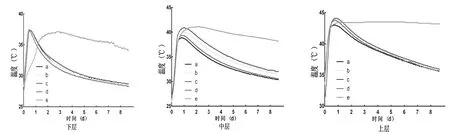
溫度是影響微生物發酵極其重要的因素之一,窖池中溫度的變化是由環境溫度(主要是地溫)和微生物進行生長代謝共同作用的結果[20]。通過對窖池內不同空間位置的溫度進行測定,研究表明,各個發酵層的溫度變化趨勢與白酒發酵時一致[21-22]。整個發酵過程酒醅的溫度變化幅度為 8.5~14.5℃,窖池內不同部位的發酵溫度存在差異,酒醅溫度上層>中層>下層;相對于周圍區域,中心區域酒醅溫度變化較為緩慢。圖2
注:a、b、c、d代表窖池周圍區域,e代表窖池中心區域
Note: a,b,c, d represent the area around the pit, e represents the central area of the pit
圖2 發酵過程中不同發酵層酒醅溫度變化
Fig.2 Fermentation temperature changes in the different layers
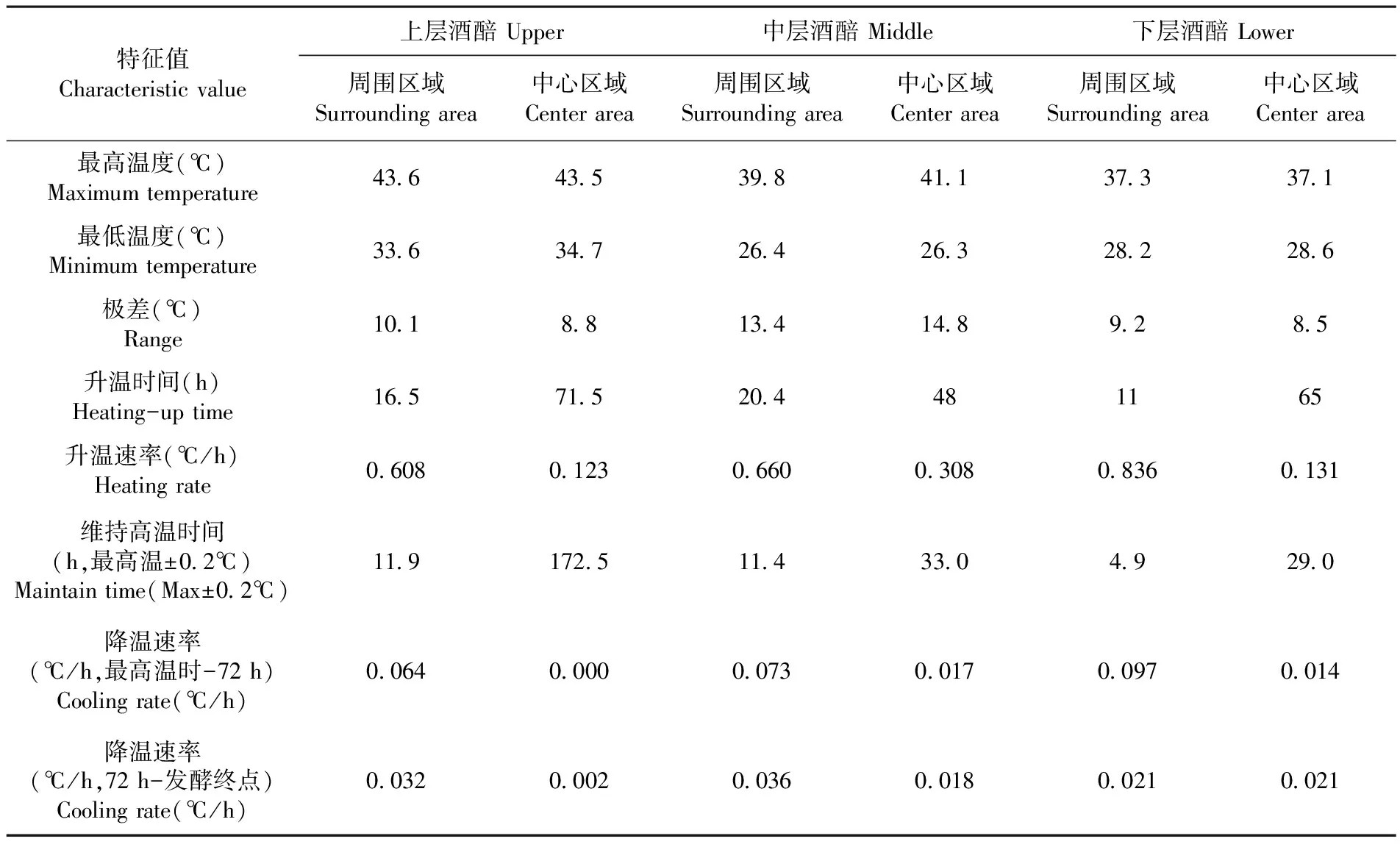
同一發酵層中心區域與周圍區域酒醅溫度變化特征不同。上層酒醅:中心區域與周圍區域酒醅溫度最高值接近,但是達到最高溫所需的時間相差4.3倍,周圍區域酒醅溫度于封窖后16.5 h時達到最高值43.6℃,而中心區域于71.5 h時達到最高值43.5℃,周圍區域的升溫速率是中心區域的5倍左右;中心區域酒醅溫度維持高溫時間為172.5 h,而周圍區域溫度在最高溫僅維持了11.9 h,然后開始緩慢下降,周圍區域下降速率明顯大于中心區域。中層酒醅:周圍區域和中心區域酒醅溫度極差相差1.4℃,周圍區域的升溫速率是中心區域的2倍左右。下層酒醅:周圍區域與中心區域酒醅溫度升溫速率相差最大,約為6.4倍;酒醅溫度下降初期速率相差6.9倍,后期降溫速率逐漸接近,達到0.021℃/h。
不同發酵層的酒醅溫度差異較大,酒醅溫度上層>中層>下層。上層酒醅溫度最高可達到43.6 ℃,下層酒醅最高時僅37.3 ℃,兩者相差6.3℃,這可能是由于水泥窖池地表溫度較低,下層酒醅與窖壁之間發生熱傳遞,降低了下層酒醅溫度。下層酒醅溫度變化較快,上層酒醅溫度變化較平穩。下層酒醅的溫度上升速率最快,可達到0.836℃/h,中層次之,上層最慢為0.608℃/h;酒醅溫度下降時,下層的下降速率最高可達到0.097℃/h,中層次之,上層最低0.064℃/h,相差0.033℃/h。表1
2.1.2 酒醅濕度變化
發酵過程中,初始的濕度會因蒸發和代謝活動而發生變化,所以僅僅控制初始底物濕度并不能保證整個固態發酵過程的順利進行,對固態發酵過程中濕度的監測也很關鍵[23]。研究表明,發酵過程中不同發酵層酒醅濕度變化情況為酒醅濕度從入窖后不斷升高,達到最高值然后基本保持穩定。其中下層酒醅濕度相對較高,最高可達到92.6%。整個發酵過程酒醅的濕度變化幅度10%rh左右,酒醅濕度下層>中層>上層;中心區域酒醅溫度比周圍區域變化較為緩慢。圖3
表1 發酵過程中不同發酵層酒醅溫度變化特征
Table 1 The temperature characteristics of different layers of fermented grains
特征值Characteristicvalue上層酒醅Upper中層酒醅Middle下層酒醅Lower周圍區域Surroundingarea中心區域Centerarea周圍區域Surroundingarea中心區域Centerarea周圍區域Surroundingarea中心區域Centerarea最高溫度(℃)Maximumtemperature43 643 539 841 137 337 1最低溫度(℃)Minimumtemperature33 634 726 426 328 228 6極差(℃)Range10 18 813 414 89 28 5升溫時間(h)Heating-uptime16 571 520 4481165升溫速率(℃/h)Heatingrate0 6080 1230 6600 3080 8360 131維持高溫時間(h,最高溫±0 2℃)Maintaintime(Max±0 2℃)11 9172 511 433 04 929 0降溫速率(℃/h,最高溫時-72h)Coolingrate(℃/h)0 0640 0000 0730 0170 0970 014降溫速率(℃/h,72h-發酵終點)Coolingrate(℃/h)0 0320 0020 0360 0180 0210 021
注:室溫為10℃~30℃
Note:The room temperature is 10℃~ 30℃
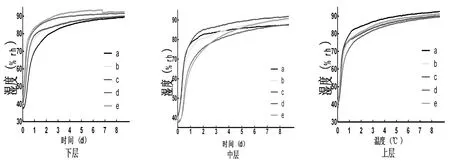
圖3 發酵過程中不同發酵層酒醅濕度變化
Fig.3 Fermentation humidity changes in the different layers
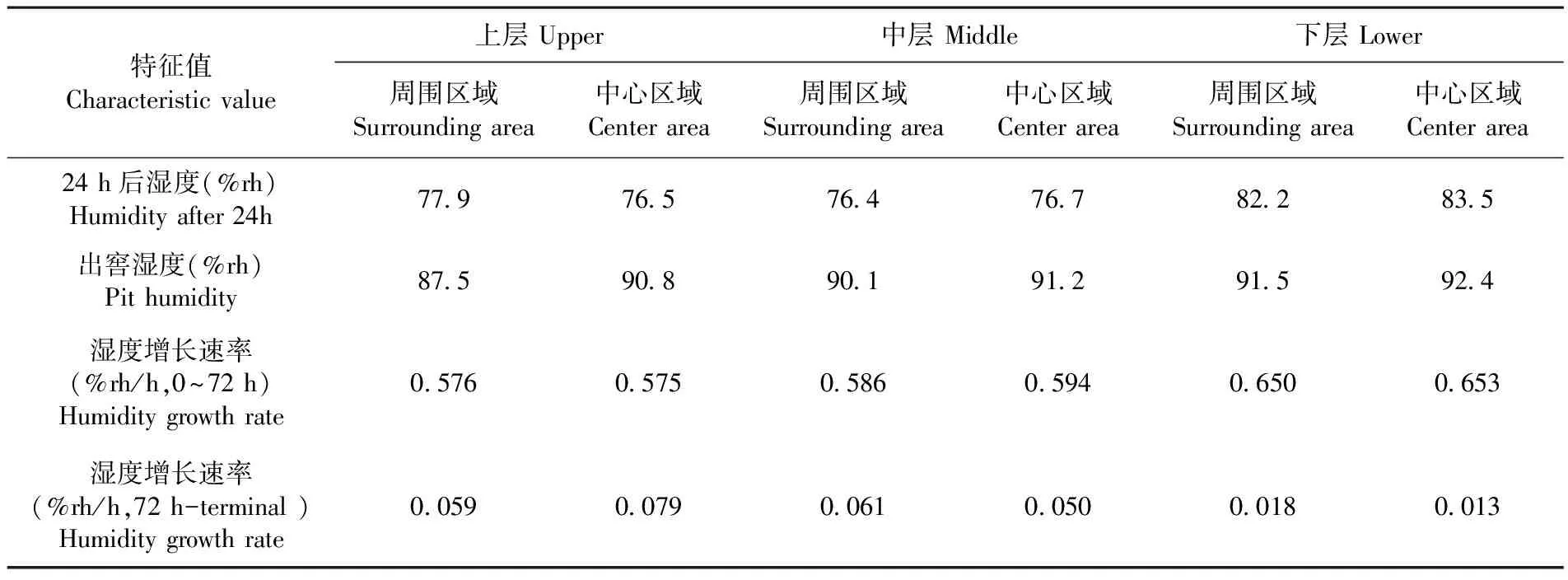
下層酒醅出窖濕度最高為92.4% rh,中層次之,上層最低為90.8% rh,這可能是由于受重力作用,酒醅中的水分由上層向下層移動,導致下層酒醅的濕度高于中層和上層。下層酒醅濕度增長速率最快,初期可達到0.65% rh/h,上層酒醅濕度增加最慢為0.576% rh/h。
中心區域酒醅濕度略高于周圍區域,兩者相差0.9% rh~3.3% rh,中心區域和周圍區域酒醅濕度增長速率接近。表2
表2 發酵過程中不同發酵層酒醅濕度變化特征
Table 2 The humidity characteristics of different layers of fermented grains
特征值Characteristicvalue上層Upper中層Middle下層Lower周圍區域Surroundingarea中心區域Centerarea周圍區域Surroundingarea中心區域Centerarea周圍區域Surroundingarea中心區域Centerarea24h后濕度(%rh)Humidityafter24h77 976 576 476 782 283 5出窖濕度(%rh)Pithumidity87 590 890 191 291 592 4濕度增長速率(%rh/h,0~72h)Humiditygrowthrate0 5760 5750 5860 5940 6500 653濕度增長速率(%rh/h,72h-terminal)Humiditygrowthrate0 0590 0790 0610 0500 0180 013
2.1.3 酒醅水分變化
窖池中適宜的水分含量,可以保證窖池中微生物的生長代謝,保證酒醅的正常發酵,酒醅水分含量的變化結果表明,甜高粱秸稈酒醅中水分含量呈上升趨勢,增加了8%左右。在整個過程中,初期水分含量變化較快,可能與此時段酵母菌及其它微生物代謝旺盛有關;后期微生物生長代謝趨于穩定,水分含量變化幅度也較小。圖4
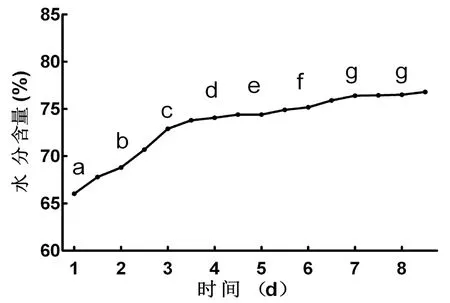
注:圖中不同小寫字母表示差異顯著,下同
Note:Different letters mean significant difference atP<0.05,the same below
圖4 酒醅水分含量變化
Fig.4 Changes of moisture content in the fermented grains
2.1.4 酒醅酒精度變化
酒醅中酒精度的變化是判斷秸稈發酵情況的重要依據。封窖后第1 d酒醅中乙醇含量增加非常明顯,酒精度增加了7%,然后酒精度增長速度趨于緩慢,第156 h達到最高值12.5%,然后開始下降并趨于穩定。這是由于甜高粱秸稈發酵時先轉化可溶性糖,然后在酵母菌、糖化酶的共同作用下將籽粒中的淀粉轉化為糖類,產生部分乙醇,發酵后期部分酒精轉化成酸和酯,導致酒精度明顯下降,最終趨于穩定。圖5
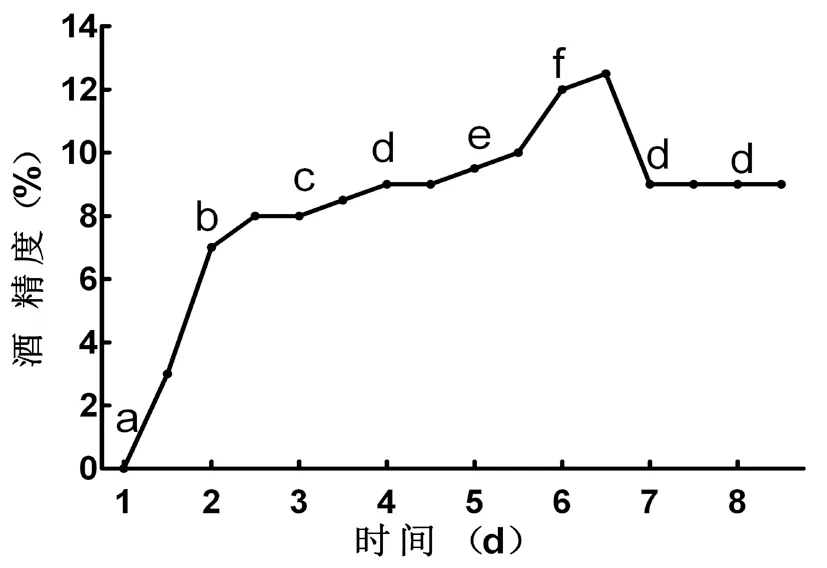
圖5 酒醅酒精度變化
Fig.5 Changes of alcohol content in the fermented grains
2.1.5 酒醅中總糖、還原糖變化
總糖、還原糖含量的變化可以從側面反應乙醇的生成速度。入窖后酒醅中的總糖、還原糖迅速減少,在48 h內消耗了總糖的75%,然后還原糖消耗速度逐漸變慢,第6 d后總糖、還原糖含量仍然降低但是無顯著變化,逐漸趨于穩定直至發酵結束。圖6

圖6 酒醅中總糖、還原糖含量變化
Fig.6 Changes of total sugar and reducing sugar content in the fermented grains
2.1.6 酒醅中蛋白質變化
研究表明,第1~4 d酒醅中蛋白質含量迅速增加(P<0.05),由5.1%增加到了8.6%,第6 d后,蛋白質含量變化不顯著(P>0.05)。與原料相比,發酵后酒醅蛋白質含量提高了68.5%。圖7

圖7 酒醅中蛋白質含量變化
Fig.7 Changes of protein content in the fermented grains
2.1.7 酒醅酸度變化
發酵時由于產酸微生物的代謝作用,產生一定量的酸類物質,酒醅酸度在整個發酵過程中呈上升趨勢,到第8 d時酸度為0.72 g/100 g,與發酵初期相比增加了2倍左右。圖8
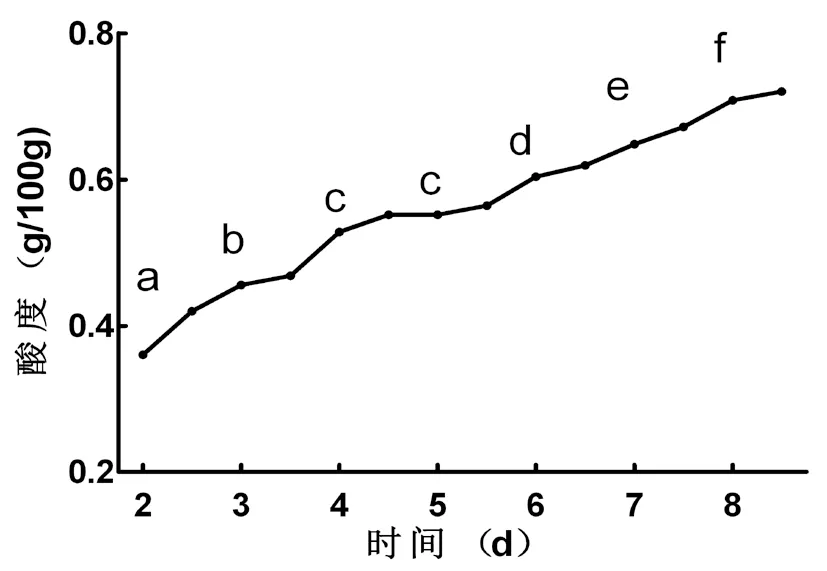
圖8 酒醅過程中酸度變化
Fig.8 The acidity of fermented grains in the process of change
2.2 酒醅酒精度與各理化指標的相關性
研究表明,酒精度變化與總糖、還原糖呈高度負相關性(P<0.01),相關系數分別為0.918、0.928,即總糖、還原糖含量降低,酒精度升高;酒精度與酸度、水分含量和濕度之間呈正相關性。表3
表3 酒醅酒精度與各理化指標間相關性
Table 3 Correlation between alcohol and physical and chemical indexes

溫度Temperature濕度Humidity水分Moisture總糖Totalsugar還原糖Reducingsugar蛋白質Protein酸度Acidity酒精度Alcoholic0 768??0 907??0 846??-0 918??-0 928??0 820??0 890??
注:**. 在P≤0.01 水平(雙側)上顯著相關,*. 在P≤0.05 水平(雙側)上顯著相關。
Note:*,**represent significantly different at 0.05 and 0.01 levels
3 討 論
3.1 溫度
在甜高粱秸稈酒醅過程中窖池內不同位置酒醅溫度存在差異,酒醅溫度上層>中層>下層;相對于周圍區域,中心區域酒醅溫度變化更加平緩。出現這一現象的原因可能是:下層酒醅及周圍區域酒醅與窖壁之間發生熱傳遞[24],降低了酒醅溫度,微生物的活動相對較弱,產生的熱量少溫度變化幅度較小。而上層酒醅及中心區域酒醅溫度受環境溫度的影響相對較小,主要是由酒醅中微生物代謝所決定的[25]。
3.2 酒精度
酒精度主要由秸稈中的含糖量決定的,含糖量越高,轉化出的酒精就相對較多。研究結果表明新高粱3號(錘度19.5%)在發酵時間為156 h時,酒醅酒精度可達到最高值12.5%,而與再吐尼古麗等[26]的研究結果發酵48 h酒精度達到最高值 2.52%存在差異。這可能是由于實驗選用的甜高粱秸稈含籽粒,籽粒中存在淀粉可以增加酒精度,且籽粒的發酵速度較慢會引起發酵時間的延長,而再吐尼古麗選用的原料是甜高粱的秸稈無籽粒。試驗的出酒率為120 L/t,與梅曉巖[19]的研究結果相似,每畝甜高粱可產 387~433 L/667 m2乙醇,此結果與任麗[27]的研究結果48.4 kg/t有一定的差異,可能與甜高粱的品種、發酵菌種和原料粉碎度不同有關。
3.3 蛋白質
發酵后酒糟中的蛋白質由5.1%增加到了8.6%,這與楊森[28]的研究結果相似,即發酵后飼料中粗蛋白質量分數提高。增加的蛋白質可能來自于非蛋白氮的轉化及菌體自溶產生的各種生物活性物質[29],還有可能是由于酵母菌消耗了一部分碳水化合物,導致干物質含量降低[30],發酵后的蛋白質含量(干基)與原料相比提高了,研究的結果符合上述觀點。發酵后酒糟略帶酒香味、蛋白質含量較高,質地松軟、適口性好,具有替代部分飼料糧的潛力,還可以作為原料生產菌體蛋白飼料[31],解決當前蛋白飼料嚴重短缺問題。
4 結 論
在甜高粱籽粒與秸稈混合酒醅固態發酵過程中,主要通過酵母菌將秸稈中的糖分和籽粒中的淀粉轉換成乙醇,所以發酵時間和釀酒酵母直接相關,發酵80 h后中層酒醅溫度出現下降,酒醅酸度開始直線上升時,酵母菌逐漸進入衰亡期,發酵時間為156 h接近發酵終點,此時乙醇產率可達到12.5%。利用甜高粱籽粒與秸稈固態發酵生產乙醇,不僅實現了甜高粱的能源化,還可提高甜高粱發酵殘渣作為飼料的營養價值。
References)
[1] 陳展宇,常雨婷,鄧川,等.鹽堿生境對甜高粱幼苗抗氧化酶活性和生物量的影響[J]. 吉林農業大學學報, 2017, 39(1):15-19.
CHEN Zhan-yu,CHANG Yu-ting,DENG Chuan,et al.(2017). Effect of Saline-alkali Habitat on Antioxidant Enzyme Activity and Biomass of Sweet sorghum seedlings [J].JournalofJilinAgriculturalUniversity,39(1):15-19. (in Chinese)
[2] Calvio, M., & Messing, J. (2012). Sweet sorghum as a model system for bioenergy crops.CurrentOpinioninBiotechnology, 23(3):323-329.
[3]肖明松, 楊家象. 甜高粱莖稈固體發酵制取乙醇產業化示范工程[J]. 農業工程學報, 2006,22(增1): 207-210.
XIAO Ming-song, YANG Jia-xiang.(2006). Showcase project: ethanol production through solid fermentation of sweet sorghum stalks [J].TransactionsoftheCSAE, 22(Supp 1): 207-210. (in Chinese )
[4] Matsakas, L., & Christakopoulos, P. (2013). Optimization of ethanol production from high dry matter liquefied dry sweet sorghum stalks.Biomass&Bioenergy, 51(2): 91-98.
[5]高慧, 胡山鷹, 李有潤, 等. 甜高粱乙醇全生命周期溫室氣體排放[J]. 農業工程學報, 2012, 28(1): 178-183.
GAO Hui, HU Shan-ying, LI You-run, et al.(2012). Greenhouse gas emission of sweet sorghum ethanol in life-cycle [J].TransactionsoftheCSAE, 28(1): 178-183. (in Chinese )
[6]趙建國. 廢渣固態發酵生產酵母蛋白質飼料及其產業化發展措施[J]. 飼料與畜牧, 2006, (11): 32-36.
ZHAO Jian-guo.(2006). Slag solid-state fermentation yeast protein feed production and its industrialization development measures [J].FeedandHusbandry, (11): 32-36. (in Chinese)
[7]代樹華. 甜高粱莖稈固態發酵酒精及飼料的研究[D]. 北京: 北京化工大學碩士學位論文, 2009.
DAI Shu-hua.(2009).Solid-statefermentationofsweetsorghumstalksofalcoholandfeedresearch[D]. Beijing: Beijing University of Chemical Technology, Beijing. (in Chinese)
[8]梁艷玲, 伍彥華, 林一雄. 甜高粱在制取燃料乙醇和白酒中的應用[J]. 輕工科技, 2016, (3): 15.
LIANG Yan-ling, WU Yan-hua, LIN Yi-xiong.(2016). Sweet sorghum in the application of producing fuel ethanol and white wine [J].LightIndustrialScienceandTechnology, (3): 15.(in Chinese)
[9]陳朝儒, 王智, 馬強, 等. 甜高粱莖汁及莖渣同步糖化發酵工藝優化[J]. 農業工程學報, 2016, 32(3):253-258.
CHEN Chao-ru, WANG Zhi, MA Qiang, et al.(2016). Optimization of ethanol production from bagasse and juice of sweet sorghum stem by simultaneous saccharification and fermentation [J].TransactionsoftheCSAE, 32(3): 253-258. (in Chinese)
[10]韓冰, 王莉, 李十中, 等. 先進固體發酵技術 (ASSF) 生產甜高粱乙醇[J]. 生物工程學報, 2010, 26(7): 966-973.
HAN Bing, WANG Li, LI Shi-zhong, et al.(2010). Ethanol production from sweet sorghum stalks by advanced solid state fermentation (ASSF) technology [J].ChineseJournalofBiotechnology, 26(7): 966-973.(in Chinese)
[11]葉凱. 甜高粱高生物糖量生產條件與乙醇發酵工程菌株構建[D]. 北京:中國農業大學博士學位論文, 2015.
YE Kai.(2015).TheMechanismofSugarAccmulationandMetabolisminTransformingProcessofSweetSorghumtoEthanol[D]. PhD Thesis. China Agricultural University, Beijing. (in Chinese)
[12]劉杰, 鄭士梅, 李原有, 等. 利用甜高粱莖稈提取乙醇的實驗報告 (第Ⅰ報)―不同品種乙醇提取量的實驗[J]. 釀酒科技, 2007,(5): 51-53.
LIU Jie, ZHENG Shi-mei, LI Yuan-you, et al.(2007). Experimental Reports on Ethanol Production from SweetSorghum Stems-Experiments on Ethanol Production from Different Species [J].Liquor-makingScience&Technology,(5): 51-53.(in Chinese)
[13]耿欣, 李天成, 李十中, 等. 甜高梁莖稈固態發酵制取燃料乙醇過程分析與中試研究[J]. 太陽能學報, 2010, 31(2): 257-262.
GENG Xin, LI Tian-cheng , LI Shi-zhong, et al.(2010). Studies on the process parameters of solid state fermentation for fuel ethanol production from sweet sorghum and pilot test [J].ActaEnergiaeSolarisSinica, 31(2): 257-262.(in Chinese)
[14]沈飛, 梅曉巖, 曹衛星, 等. 自然干燥甜高粱莖稈長期貯藏及乙醇發酵研究[J]. 農業工程學報, 2011, 27(12): 250-255.
SHEN Fei, MEI Xiao-yan, CAO Wei-xing.(2011). Air-dried sweet sorghum stalk for long-term storage and ethanol fermentation [J].TransactionsoftheCSAE, 27(12): 250-255. (in Chinese )
[15]王二強, 耿欣, 李十中, 等. 甜高梁稈分批固態發酵制乙醇動力學研究[J]. 食品與發酵工業, 2009 (10): 1-4.
WANG Er-qiang, GENG Xin, LI Shi-zhong, et al.(2009). Kinetics Study on Solid State Batch Fermentation of Sweet Sorghum Stalks to Produce Ethanol [J].FoodandFermentationIndustries, (10): 1-4. (in Chinese)
[16]薛潔, 王異靜, 賈士儒. 甜高粱莖稈固態發酵生產燃料乙醇的工藝優化研究[J]. 農業工程學報, 2007, 23(11): 224-228.
XUE Jie, WANG Yi-jing, JIA Shi-ru.(2007). Optimization of the technology for solid-state fermentation of sweet sorghum stems to produce fuel ethanol [J].TransactionsoftheCSAE, 23(11): 224-228.(in Chinese )
[17]王煒, 崔明九, 秦春林, 等. 基于文獻計量的甜高粱研究態勢分析[J]. 草業科學, 2016, 33(9): 1 846-1 858.
WANG Wei, CUI Ming-jiu, QIN Chun-lin.(2016). Status and trends of sweet sorghum research based on bibliometrics [J].PrataculturalScience, 33(9): 1,846-1,858.(in Chinese)
[18]劉乃新, 高誼, 張文彬, 等. 2015 年英文文獻甜高粱研究動向[J].中國糖料,2016,38(6):52-54.
LIU Nai-xin, GAO Yi, ZHANG Wen-bin, et al.(2016). Research Trend of Sweet Sorghum in English Literature of 2015 Year [J].SugarCropsofChina,38(6):52-54. (in Chinese)
[19]梅曉巖, 劉榮厚. 中國甜高粱莖稈制取乙醇的研究進展[J]. 中國農學通報, 2010, 26(5): 341-345.
MEI Xiao-yan, LIU Rong-hou.(2010). Present Situation of Ethanol Production from Sweet Sorghum Stalk in China [J].ChineseAgriculturalScienceBulletin, 26(5): 341-345.(in Chinese)
[20]黃治國, 羅惠波, 程鐵轅, 等. 酒醅發酵過程中溫度變化曲線的實時檢測及其數學模型建立[J]. 釀酒科技, 2008, (10): 20-22.
HUANG Zhi-guo, LUO Hui-bo, CHNEG Tie-yuan, et al.(2008). Real-time Detection & Establishment of Mathematical Model of Temperature Change Curve of Fermented Grains in Fermentation Process [J].Liquor-makingScience&Technology,(10): 20-22.(in Chinese)
[21]陳丙友, 韓英, 張鑫, 等. 酒醅溫度調控對清香型白酒發酵過程的影響[J]. 食品與發酵工業, 2016,42(6): 44-49.
CHEN Bing-you,HAN Ying,ZHANG Xin,et al.(2016). The effect of temperature control on the fermentation process of Fen-flavor liquor [J].FoodandFermentationIndustries,42(6): 44-49.(in Chinese)
[22]周瑞平, 王濤, 陳云宗, 等. 多糧濃醬兼香型白酒釀造過程中窖內糟醅溫度變化[J]. 釀酒科技, 2012, (10): 46-48.
ZHOU Rui-ping, WANG Tao, CHEN Yun-zong, et al.(2012). Change of the Temperature of Fermented Grains in Pits during the Fermentation of Multi-grains Luzhou-Maotai-flavor Liquor[J].Liquor-makingScience&Technology, (10): 46-48.(in Chinese)
[23] Pandey, A., Soccol, C. R., & Mitchell, D. (2000). New developments in solid state fermentation: i-bioprocesses and products.ProcessBiochemistry, 35(10):1,153-1,169.
[24]李明春, 程鐵轅, 黃治國, 等. 窖池酒醅溫度的三維結構圖[J]. 食品研究與開發, 2012, 33(2): 21-24.
LI Ming-chun,CHENG Tie-yuan,HUANG Zhi-guo, et al.(2012). Three-dimensional Image of Temperature in the Fermented Grains [J].FoodResearchandDevelopment, 33(2): 21-24.(in Chinese)
[25]李增勝, 任潤斌. 清香型白酒發酵過程中酒醅中的主要微生物[J]. 釀酒, 2005, 32(5): 33-34.
LI Zeng-sheng, REN Run-bin.(2005). Clear the main microbes in fermented grains during the process of wine fermentation [J].LiquorMaking, 32(5): 33-34.(in Chinese)
[26]再吐尼古麗,葉凱, 涂振東, 等. 甜高粱秸稈固態發酵提取粗乙醇初步研究[J]. 新疆農業科學, 2009, 46(3): 674-677.
Zaituniguli Kuerban, YE Kai, TU Zhen-dong, et al.(2009). Preliminary Study on Ethanol Distillation from Sweet Sorghum Stalks by the Solid Fermentation [J].XinjiangAgriculturalSciences, 46(3): 674-677.(in Chinese)
[27]任麗, 田瑞華, 段開紅, 等. 甜高粱秸稈固體發酵生產乙醇工藝研究[J]. 釀酒科技, 2008, (2): 52-54.
REN Li, TIAN Rui-hua, DUAN Kai-hong, et al.(2008). Research on Solid Fermentation of Sweet Sorghum Stalks to Produce Ethanol [J].Liquor-makingscience&technology, (2): 52-54. (in Chinese)
[28]楊森, 王石壘, 張雷, 等. 甜高粱莖稈殘渣生料多菌種固態發酵生產蛋白飼料[J]. 農業工程學報, 2015, 31(15): 309-314.
YANG Sen, WANG Shi-lei, ZHANG Lei, et al.(2015). Producing protein feedstuff by multiple strains solid-state fermentation with raw sweet sorghum stalk residue [J].TransactionsoftheCSAE, 31(15): 309-314. (in Chinese)
[29]張軒, 趙述淼, 陳海燕, 等. 釀酒酵母固態發酵白酒糟生產蛋白飼料的研究[J]. 飼料工業, 2012, (19): 27-31.
ZHANG Xuan, ZHAO Shu-miao, CHEN Hai-yan, et al.(2012). Study on producing protein feed through the solid state fermentation of distiller's grains with saccharomyces cerevisiae [J].Feedindustry, (19): 27-31. (in Chinese)
[30]張建華. 酒糟發酵蛋白質飼料菌種篩選的研究[J]. 糧食與飼料工業, 2010, (8): 46-48.
ZHANG Jian-hua.(2010).Studies on selection of bacterium for protein feed fermented from distiller's grain [J].Cereal&FeedIndustry, (8): 46-48. (in Chinese)
[31]張玉誠, 薛白, 達勒措, 等. 混菌固態發酵白酒糟開發為蛋白質飼料的條件優化及營養價值評定[J]. 動物營養學報, 2016, (11): 42.
ZHANG Yu-cheng, XUE Bai, Dalecuo, et al.(2016). Distillers Grains: Optimization of Mixed Bacterial Solid-State Fermentation Conditions to Produce Protein Feed and Nutrient Value Analysis [J].ChineseJournalofAnimalNutrition, (11): 42. (in Chinese)
Abstract:【Objective】 The purpose of this study is to make clear the temperature, humidity change characteristics and the physical and chemical index of the sweet sorghum fermented grains and understand the correlation between the factors.【Method】Using the whole plant (including spike) of sweet sorghum as raw materials for solid state fermentation, timing sampling and analysis the fermented grains temperature,moisture content, alcohol, total sugar, reducing sugar, protein, acidity. The correlation between alcohol and physical and chemical indexes was analyzed by SPSS software.【Result】The temperature of all parts of pits were different, the fermented grains temperature was: upper > middle > lower,and the upper fermented grains heating and cooling process went on more smoothly than the middle and lower parts. The fermented grains humidity center area changed more slowly than the surrounding areas. Change characteristics of region and its surrounding regions with a layer of fermentation of fermented grains temperature center was different. The same layer center area and the surrounding area fermented grains temperatures were different, and changes in central area of fermented grains temperature was relatively slow. The humidity of fermentation increased by 10%rh,the fermented grains humidity was: lower > middle > upper,centre of fermented grains humidity changed more slowly than the surrounding area. Fermented grains physical and chemical index change rule was: ① The alcohol content increased first and then decreased, and at the time of 156 h it reached the highest value 12.5%; ② The content of total sugar and reducing sugar decreased rapidly and stabilized gradually after sixth days; ③ After fermentation, protein content increased from 5.1% to 8.6%, which was increased by 68.5%.【Conclusion】Based on the variation process of fermentation of sweet sorghum grain and stalk physicochemical index, the appropriate pit distillation time is selected, which can effectively improve the yield of ethanol. The production of ethanol from sweet sorghum grain and stalk in solid state fermentation not only realizes the energy conversion of sweet sorghum, but also improves the nutritional value of sweet sorghum fermentation residue as feed.
Keywords: sweet sorghum; fermented grains; solid fermentation; ethanol; protein
StudyonthePhysicochemicalIndexVariationoftheSweetSorghumFermentedGrainsMixedwithStalks
YUE Li,TU Zhen-dong,WANG Hui,Shanqimike,YE Kai
(BioenergyResearchInstitute,XinjiangAcademyofAgriculturalSciences,Urumqi830091,China)
10.6048/j.issn.1001-4330.2017.09.016
S514
A
1001-4330(2017)09-1697-10
2017-03-31
國家現代農業產業技術體系“高粱產業技術體系”(CARS-06-03-01)
岳麗(1990-),女,新疆人,助理研究員,研究方向為生物能源,(E-mail)Yueli4467@163.com
葉凱(1962-),男,浙江人,研究員,研究方向為生物能源,(E-mail)yekai486@soho.com
Supported by: Modern agricultural industry technical system"Millet sorghum technology system-comprehensive utilization of straw and by-products" (CARS-06-13.5-A5)
Corresponding author:Ye Kai (1962-), male, native place: Zhejiang. Researcher, research field: Bioenergy. (E-mail) yekai486@ soho.com
doi:10.6048/j.issn.1001-4330.2017.09.017
猜你喜歡
發明與創新·小學生(2021年3期)2021-03-25 11:48:49
科學(2020年5期)2020-11-26 08:19:22
軟件(2020年3期)2020-04-20 01:45:18
商周刊(2018年15期)2018-07-27 01:41:20
敦煌學輯刊(2018年1期)2018-07-09 05:46:42
北京教育·普教版(2017年1期)2017-02-05 13:26:23
新疆農墾科技(2016年2期)2016-08-21 13:50:16
中國科技博覽(2016年2期)2016-04-25 20:32:39
小學生導刊(2016年34期)2016-04-11 00:49:44
新疆財經大學學報(2015年3期)2015-12-10 03:49:15
