
UP THE MOUNTAINS
2017-09-21 07:44:37
漢語世界 2017年5期
UP THE MOUNTAINS
As millennials tire of city life, the humble hermit makes a comeback
Wang Zhi depicted watching Go at Mount Lanke, Zhejiang
“ Ihave sat here quietly and let my brush fly/ Suddenly this volume is full,” the ninth-century poet Han Shan (寒山) once wrote, asked to describe what he found interesting about life on “Cold Mountain,” the jagged peak from which he took his name.
For many young people, living in the iron-and-concrete skyscrapers that dominate China’s newly developed cities, the view from the rugged mountaintop can seem far more attractive than the smoggy skies and crowded roads of their daily routine. The urge to “to be free of all this/against all the world, choose simplicity,” as wilderness poet Xie Lingyun (謝靈運) described after his exile from the capital in 422, is a common one.
Going back to nature, to a life of common simplicity, free from the din of materialism—it’s an attractive proposition. In part that’s because, for all its revered roots in tradition, the hermit life is one that blissfully rejects everything Chinese society now holds dear: family, property, career, connectivity.
THE HERMIT LIFE IS ONE THAT BLISSFULLY REJEcTS EVERYTHING cHINESE SOcIETY NOW HOLDS DEAR: FAMILY, PROPERTY, cAREER, cONNEcTIVITY
In the information age, to cut oneself off entirely is an actively transgressive choice—but one that some are more than happy to make. Shen Lixing, a cab driver from Zhengzhou, is among the several dozen who have traded a city apartment for a small cell on Wangwu, a mountain in Henan province that’s been imbued with spiritual symbolism since China’s legendary Yellow Emperor supposedly built the first altars on its summit.
In her previous occupation, Shen told Xinhua, she was “selfish, badtempered and greedy,” but life on Wangwu has given her a calming new perspective. Shen has a television and mobile phone, and checks the news daily, but others on Wangwu abjure even those small luxuries, passing their time solely with introspective activities like calligraphy practice, hiking, or meditation at one of the mountain’s Daoist temples.
Daoism is strongly associated with hermits in China because of its emphasis on harmony with nature’s rhythms—as opposed to the state’spreference for grand engineering projects, like the Three Gorges Dam, which seek to suborn nature to the human will. But it’s the rapid urbanization that China has undergone over the last four decades that is, perhaps, chiefly responsible for cultivating the renewed interest of people like Shen in the solitary life.
The pleasures and simplicity of passing weeks in a grotto with only the birds for company can seem particularly abundant compared to dealing with dodgy builders, crooked developers, complex ownership laws and skyrocketing prices, although the attractions of hermit life have never been limited to Chinese culture.
Third-century Egypt had its Desert Fathers and Mothers, Christian ascetics whose example proved so popular that, by the time their leader, Anthony the Great, died, “the desert had become a city,” according to Anthony’s biographer. Their spiritual thinking was collected in the Apophthegmata Patrum (“Sayings of the Fathers”), a collection of dialogues that embedded expectations of wisdom into the ascetic lifestyles that continue to this day. The recluse Richard Rolle, whose The Fire of Love celebrated the intense psychic joys of solitary prayer life, was one of the most widely read Christian mystics in the Middle Ages but, by the era of Roger Crab, a vegan prophet who died in Uxbridge in 1680, a more enlightened outlook was taking grip.
The “Age of Reason” celebrated scientific proof over religious fervor (Crab, who’d been severely wounded in the head while soldiering, may have been the inspiration for Lewis Carroll’s delirious Mad Hatter), and hermits became an ornamental accessory, hired by wealthy Georgians to decorate their newly landscaped estates, a tradition borrowed from Roman emperors like Hadrian. One was even paid a small fortune to live alone in Painshill Park for seven years, wearing nothing but a camelhair cloak, but supposedly only lasted three weeks before visiting a local tavern.
By the late 19th century, the frugal figure of the hermit had been entirely eclipsed by rich eccentrics like the fifth Duke of Portland, who built miles of tunnels beneath Welbeck Abbey for privacy, and was immortalized by Kenneth Graham’s Badger, who believed “there’s no security, or peace or tranquility, except underground.”
The present-day hermit takes several forms. There are the dozens of lookouts that man the remote sentry towers of America’s national parks, scanning the wilderness for plumes of smoke, affectionately known as“freaks on the peaks.” There are a few remaining “official” hermits, such as the occupant of Austria’s 350-year-old Saalfelden hermitage, who volunteer to live peacefully, spiritually and unpaid in church lodgings, without modern amenities. And there are the “Into the Wild” types like Chris McCandless, a young homeless American who died tragically trying to fulfill romantic notions of living rough in Alaska’s wilds, or Christopher Knight, the “North Pond Hermit,”who spent 27 years living makeshift in the Maine forest before being arrested for burglary.
China’s millennia-old tradition of mountain-high monasticism ensures a similar mix, though modern interest in this existence was mostly the work of an American—the writer, translator, and former monk Bill Porter, who calls himself “Red Pine” (赤松) in Chinese after the Daoist immortal. In 1989, after several years living at a Buddhist monastery in Taiwan, Porter set out to find what remained of China’s Daoist hermits, whose customs would have been completely at odds with the Maoist ethic of collectivism and industrialization sweeping the country after 1949.
Despite the decades of upheaval and political campaigns, Porter tracked down several hermits who’d survived unmolested in the Zhongnan mountainous region of southern Shaanxi, publishing his findings in Secluded Orchids in a Deserted Valley (《空谷幽蘭》) in 2001. The book, known as Road to Heaven: Encounters with Chinese Hermits in English editions, sold only a few thousand copies initially, but after it was republished in 2009 by a small business press, it became a sudden bestseller in China. As one of the earlier overseas cheerleaders for Chinese culture, Porter’s book provoked a spike of interest in a way of life many had assumed was long gone, but which had, alongside other, previously reviled spiritual customs, undergone a quiet resurgence in the reform era.
To some, Porter’s book was proof of the saying “The wise live on the mountains,” and the peaceful peaks of Zhongnan were soon bustling with aspirational ascetics and wannabe wise men. Some built their own shelter, wearing linen, practicing calligraphy, and keeping their hair long.
However, not everyone who builds a hut becomes a hermit. Zhang Jianfeng, whose own book on Zhongnan’s mountain men was directly inspired by Porter, has seen plenty of tourists come and go. “The arrival of the winter drives those pseudo-hermits back to the cities because the cold is extremely tough,”he observed. Others develop signs of mental illness, mumbling to unseen persons, seemingly driven crazy by the solitude.
Although much of this “hermit tourism” was inevitably short-lived and rather fanciful in nature, a few were inspired to go the distance. Some,such as Zhou Yu, editor of the lifestyle magazine Wendao (“Seeking Way”), which celebrates traditional culture, tried to physically retrace Porter’s footsteps. Several years ago, he trekked through the valleys and hill paths where Laozi, the mythical founder of Daoism, once roamed, in search of the sage’s modern equivalent.
Zhou found his Laozi in Ming, a cottage-dwelling ascetic who settled on the mountain after leaving a troubled home at 17, first roaming the country in search of answers, traveling through Fujian, Guangdong, Jiangxi, and Hubei with only a chipped mug for company, before finally settling on Zhongnan, where he pursues an existence at once traditional—reading sutras, tending to the cottage—and unconventional, owning a motorbike, and sometimes sharing his lonely quarters with a hermit girlfriend.
After several months living with Ming, Zhou published Deep in the Clouds (《白云深處》) in 2011 about the experience, describing Ming’s hermitage as “a place where he can live a life in which he can face disputes peacefully” and pinning much of modern society’s anxiety on having “too much information…and [not] dealing with it properly.” On the mountaintop, “you have time to think.” Nowadays, Wendao magazine offers weeklong “ascetic trips” for those who don’t need too much time.
A typical day begins at dawn with gardening (pulling weeds, planting herbs and vegetables), chores around the house with tea at noon, and ends with a simple dinner, then a postprandial walk followed by meditation before sunset, when, in the words of Han Shan, “soft grass serves as a mattress/my quilt is the dark blue sky/a boulder makes a fine pillow.”
Even this bucolic description elides the often tough, unglamorous nature of the hermit’s daily grind. In an interview with the New York Review of Books, Porter described day-to-day life as mostly “chopping firewood and hauling water…many people go in the spring and leave in the autumn. They don’t have the spiritual practice to sustain them during the winter.”
Worse than hardship are the dangers, which can sometimes be extreme: in winter, temperatures drop below minus 20 degrees Celsius, and every year there are reports of some amateur adventurers freezing to death on Zhongnan. Even foraging for food can be lethal—the area is home to deadly snakes, as well as poisonous fruit and fungi. But that hasn’t stopped newcomers from moving to the mountain.
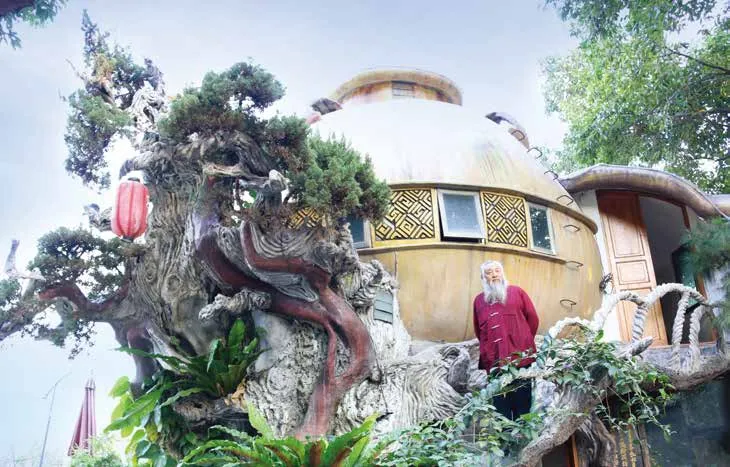
Not all hermits go to the mountains—this urban-dweller in Foshan, Guangdong, fnds tranquility in his treehouse
“Twenty years ago, there were just a few hundred people [here] but in the last few years, the number has increased very quickly,” one part-time hermit told AFP in 2014. Although most of the Daoist shrineson Zhongnan were destroyed during the Cultural Revolution, when antireligious fervor was at its height, several of the monks who survived the campaigns were said to not even be aware of the Communist takeover. Despite this professed ignorance, politics used to play an important role in the lives of these mountain dwellers. As keepers of ancient thought and values, hermits were sought out by feudal officials, who considered their advice to be pure of imperial intrigue.
The ancient hermits were themselves often privileged scholars who’d fallen out of favor with the regime, like Han Shan, exiled to Mount Tiantai in Zhejiang province, forced to make a virtue of their expulsion (“once you see through transience and illusion/ the joys of roaming free are wonderful indeed” Han claimed). Others, such as fellow Tang bard Li Bai, were courtly gentlemen who enjoyed reclusion as a form of holiday. They used simple poetic language to elevate the mundane, elevating the everyday as eternal. But the modern hermit may not necessarily be a poet, or monk, or even deeply spiritual.
There are now hundreds of small dwellings on Zhongnan, and, by some estimates, between 3,000 to 5,000 hermits dotted around its peak. Half are women, and most live without electricity, heating, or meat, subsisting on roots, herbs, and vegetables. When they trek further up the mountain for contemplation, journeys that can take several weeks, their diet can be little more than pine leaves and dew.
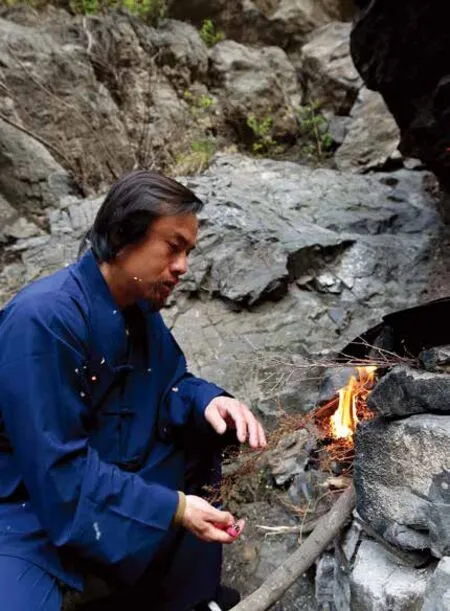
A hermit cooking food outside his cave dwelling on Henan’s Wangwu Mountain
Those drawn to the mountain path can include graduates seeking enlightenment on the career path, well-educated professionals, and people jaded with modern life. Some have read Porter’s book or articles in Wendao, or seen one of the documentaries about hermit life, such as 2005’s acclaimed Amongst White Clouds, directed by an American student who’d discovered Buddhism through reading Porter.
“When I lived in the city, I partied all the time,” one of Ellen Xu’s subjects recalls in her short film about millenial hermits, Summoning the Recluse, describing a typical social treadmill of restaurant, KTV bars, and card games. “You recycle the same routine every day.” By contrast, his new life was “unconstrained,” “simpler,”with “fewer desires.” While some of his fellow hermits announced their intention to stay indefinitely, another emphasized, “I won’t spend the rest of my life here, that’s for sure.”
Mountain life may not suit everyone wishing to escape the city or society, but nor is it the only option. Some prefer the comparative comforts of a vacation, or the structure of a religious order. For others, it’s a simple matter of leaving the city, or downsizing. Scholars have argued over the “right”way to live alone for centuries—Han Shan considered poets like Li Bai to be shallow interlopers, calling them“monkeys with those hats/ aping those who shun the dust and wind”—but for the truly enlightened, there is no single path. As Wendao’s Zhou Yu said: “Get to know your needs and desires, and find a proper position…if you can do that, you can find peace and quiet even if you live in the city.”
