
MAKING HISTORY
2017-09-21 07:56:33
漢語世界 2017年5期
關鍵詞:時代
MAKING HISTORY
BY JEREMIAH JENNE
A Manchu “banner village” repackages China’s past for tourists
“仿古時代”古在何方?
Just inside the southern gate of Fenghuangtai village (鳳凰臺村) in Hebei province, construction workers are picking through the rubble of an old courtyard home.
In front of the debris, the street has been stripped of its pavement, leaving a dusty surface which threatens to turn into a quagmire as rain begins to fall. The owners stare at the wreckage of their former home and the broken street with a happy mixture of anticipation and excitement.
Their village is going through a profound metamorphosis. Work crews are sweeping away all remnants of the old village in preparation for a gleaming “Old Town” which purports to celebrate the rich history of Fenghuangtai, or “Phoenix Garrison.”
In the new Old Town, gates and walls will have a uniform appearance. The street will be repaved with“historic” stones recently purchased from a building supplier in Shijiazhuang, the nearby provincial capital. The village temple, venerating Zhenwu (真武, “The Perfected Warrior”), a deity in Chinese popular religion associated with Northerners, has been completely rebuilt; Red Guards had razed the Qing-era original during the Cultural Revolution. Across from the village gate, a swampy area along the banks of the Yihe River is being excavated. Eventually, it will be a car park and service area for tourists.
“The hole in the ground is where the five-star restrooms will be installed,”Mr. Guan enthusiastically tells TWOC.
His family runs a homey guesthouse just inside the southern wall. The rooms are consistent with village inns and rural B&Bs throughout China (the author spent the previous evening in a large room with two beds, an enormous desk, and—of course—a mahjong table with the tiles ready to go) but the kitchen is spectacular, and Mr. Guan’s family serves some of the best food in the area.
They, too, are excited about their prospects in the new Fenghuangtai era. More development means tourists, which mean more people learning about Manchu culture—or at least a very particular presentation of that culture—and, of course, more revenue for the residents.
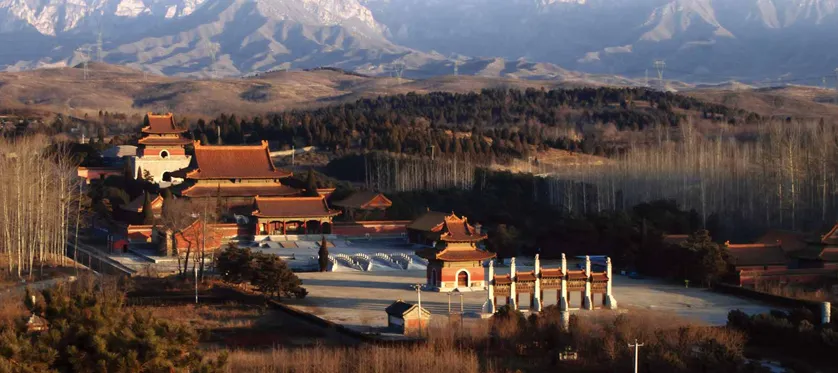
Fenghuangtai is one of a dozen settlements in Yixian county, Hebei, that surround the Western Qing Tombs (清西陵). Natives of the village are the remnants of Manchu banner troops and officials, once assigned to protect the tombs, with each village responsible for maintaining a particular burial site.
For nearly 120 years, the company at Fenghuangtai guarded the final resting place of Empress Xiaoshengxian, the mother of the Qianlong Emperor. Also known as the Empress Dowager Chongqing (and a major character in several TV series in recent years), the empress was beloved by her son and given her own mausoleum near that of the emperor’s father and predecessor, the Yongzheng Emperor.

A stained-glass portrait of Qing Emperor Yongzheng greets visitors at the Western Qing Tombs in Yixian county, Hebei
Like many of the elite “banner people”—who, during the Qing era, included not only ethnic Manchus but also Chinese and Mongolians—the Fenghuangtai community fell on hard times when the last Qing emperor abdicated in 1912. Technically, the terms of his resignation required the continued maintenance and protection of his ancestor’s tombs, but the instability of the early 20th century made such a task nearly impossible. Several of the Eastern Qing Tombs, another imperial complex located 150 kilometers northeast of Beijing and close to major traffic routes, were opened and robbed during this time.
The Western Qing Tombs fared a bit better, protected as much by the isolation of Yixian county as the dutiful attention of their former guardians. The tombs in Yixian also saw the final two imperial internments of the Qing Empire. In 1913, the new Republic of China supervised the completion of the tomb for the Guangxu Emperor, who died in 1908. Over 80 years later, the remains of his nephew, China’s last emperor Puyi, were moved from Beijing’s Babaoshan Revolutionary Cemetery to a hillside in Yixian not far from his late uncle. But the same isolation which helped to preserve the Western Qing Tombs has also worked against efforts to develop the site for tourism. The 13 tombs of the Ming emperors, conveniently close to Beijing and the popular Badaling Great Wall site, have long been overrun with tourists looking for a bit of history between all the gift shops.
It is clear that the residents of Fenghuangtai village are eager to cash in on their own proximity to the past. Like most former garrison villages, Fenghuangtai is just a few hundred yards away from their designated tomb. The newly reconstructed town center is hoped to provide accommodation for travelers looking to sample the local cuisine—including Manchu specialties like venison—and experience “traditional” Manchu culture.
Yue Xiaohong, a licensed tour guide and travel professional who grew up in the county, has mixed feelings about these changes to her hometown.
“The people who live near the Western Qing Tombs have developed a lot of tourist amenities in order to make money and I feel happy for them,” she told TWOC. “But at the same time, I’m concerned about the kind of over-development that has happened at other cultural and historical sites around China. I think we need to set a balance between development of tourism and the protection of imperial relics.”
The past two decades has seen a proliferation of similar “Old Towns”across China. Tourist hotspots like Pingyao in Shanxi, and Lijiang in northwest Yunnan, offer idealized reproductions of historic spaces. Both cities have had difficulty balancing historic preservation and restoration with the demands of development.
IT IS cLEAR THAT THE RESIDENTS OF FENGHUANG TAI VILLAGE ARE EAGER TO cASH IN ON THEIR OWN PROXIMITY TO THE PAST. BUT AT WHAT cOST?

The shrine to Zhengwu is the centerpiece of Fenghuangtai, completely rebuilt after the original was destroyed by Red Guards

Elaborate archways line the road to eternity: The Western Qing Tombs were the fnal resting place for 79 members of the imperial family, including four emperors

Newly constructed Old Towns are becoming a fxture of local tourism. These sites often feature idealized recrations of the past—enhanced with souvenir stands and fast-food outlets
Excessive commercialization in Lijiang’s Old Town, for example, has threatened its status as a UNESCO historical site.
Old Towns typically feature reproductions of historic buildings, sometimes with only a tenuous connection to the structures and landscape that existed in the past. In Beijing’s city center, for example, old homes and businesses have been bricked over or demolished to make way for “Cultural Zones” which seek to protect the city’s “intangible heritage” at the expense of tangible history. Qianmen, a district just south of Tian’anmen Square remade into a Disney Main Street version of a Republican-era Beijing neighborhood, serves as a cautionary tale of this sort of “preservation.”
Some existing structures will be preserved at Fenghuangtai: The old watchtower stands solemnly along the main highway through the valley, just as it has for centuries. A short section of the original defensive walls stretch across a marshy area just beyond the new parking lot.
Nor is every village in Yixian county due for a makeover. A few hundred meters down the highway is Taihe village, which once guarded the tomb of the Yongzheng Emperor and remains much as it has for decades.
Dirt roads and crumbling walls may not make for great brochure centerfolds, but they do convey a genuine sense of history lacking in some of the nearby makeover towns. Along the walls of the city, one can read the history of the residents’attempts to maintain old structures, with 18th-century bricks supported by more recent additions from the 19th and 20th centuries.
Whether most tourists will care is a matter for debate. Certainly, many international visitors to China bemoan a lack of “authenticity”at China’s historic sites. “I thought China had a long history, but it’s hard to find any actual structures older than the last few decades. So much has been rebuilt, then passed off as ‘ancient,’” one recent visitor to Beijing remarked.
Today the Western Qing Tombs are in the middle of their own renovation. The tomb of the Guangxu Emperor is covered in scaffolding. The final resting place of his beloved “Pearl Concubine”—possibly killed on orders from Empress Dowager Cixi, his aunt—is closed for renovations. History is being cleaned up for consumption. Perhaps the actual structures, raw and unreconstructed, would raise too many questions. Why for example, were so many temples and shrines, now lauded now as cultural landmarks, previously destroyed—and by whom? Why has it taken over a century to suddenly conclude that Manchu culture is something worth preserving, even celebrating?
Tour guide Yue believes there should be a “broad view” to preservation that stretches beyond dressing up physical relics. “Preserving also means Manchu cuisine, historical architecture, Manchu customs, ancient rituals and other aspects of Manchu cultural heritage,” she said,“so that 100 or 200 years from now, our descendants can have the same opportunity to appreciate the Western Qing Tombs as we do today.”
Back in Fenghuangtai, workers erect solar-powered street lamps to illuminate an ancient village made new. The new-old village shrine glows with candles and incense. Manchu culture has survived here despite nearly a century of war, turmoil, political campaigns, and not-so-benign neglect. It remains to be seen if its packaging and marketing for tourist consumption will be the salvation of this heritage, or will ultimately subsume it into a cheesy and commercialized traditionalism. But that’s a chance the villagers are willing to take.
猜你喜歡
小哥白尼(軍事科學)(2022年7期)2022-09-20 03:51:30
嶺南音樂(2022年4期)2022-09-15 14:03:12
陽光(2020年6期)2020-06-01 07:48:36
陽光(2020年5期)2020-05-06 13:29:18
人大建設(2019年11期)2019-05-21 02:54:48
電影(2018年9期)2018-10-10 07:18:38
金橋(2018年4期)2018-09-26 02:24:44
足球周刊(2016年14期)2016-11-02 10:56:23
足球周刊(2016年15期)2016-11-02 10:55:36
足球周刊(2016年10期)2016-10-08 10:54:55
