
不同大豆品種大豆皂苷組成分析
2017-07-19 12:47:57岳愛琴王衛東徐海軍郭春絨趙晉忠杜維俊
中國糧油學報 2017年5期
關鍵詞:大豆
岳愛琴 王衛東 徐海軍 王 敏 郭春絨 趙晉忠 杜維俊
(山西農業大學農學院1,太谷 030801)(山西農業大學文理學院2,太谷 030801)
不同大豆品種大豆皂苷組成分析
岳愛琴1王衛東2徐海軍2王 敏1郭春絨2趙晉忠2杜維俊1
(山西農業大學農學院1,太谷 030801)(山西農業大學文理學院2,太谷 030801)
為明確山西大豆資源胚和子葉中大豆皂苷含量的分布情況,篩選特異資源在育種中應用,本研究以71份山西大豆種質資源為材料,采用高效液相色譜-電噴霧離子化串聯質譜聯用技術(HPLC-ESI-MS/MS)分析不同材料中大豆皂苷組成和含量的差異。結果表明:參試材料胚和子葉中大豆皂苷含量變異范圍分別為17.02~83.51 mg/g和6.53~50.11 mg/g。A類、DDMP類、B類和E類皂苷均與總皂苷含量呈極顯著正相關。小粒型大豆材料胚中B類和E類皂苷含量、子葉總皂苷和DDMP類皂苷含量顯著高于中粒和大粒型材料。野生、半野生大豆材料胚中B類、E類大豆皂苷含量顯著高于栽培品種;野生大豆子葉總皂苷、DDMP類皂苷含量顯著高于半野生和栽培大豆。
大豆 皂苷 HPLC-ESI-MS/MS 百粒重
大豆皂苷是大豆種子生長過程中形成的主要次生代謝產物之一。大豆皂苷屬于三萜類齊墩果酸型皂苷,主要分為A類、DDMP(2, 3-dihydro-2, 5-dihydroxy-6- methyl -4H-pyran-4-one)類、B類和E類皂苷4類[1-2](表1)。A類皂苷是大豆皂醇A在C-3和C-22位結合2個糖鏈組成,其中C-22位糖鏈末端糖基乙酰化,大豆皂醇B在C-3位和C-22位分別結合1個糖鏈和DDMP基團形成DDMP類皂苷,而DDMP類皂苷C-22位失去DDMP基團形成B類皂苷,E類皂苷是B類皂苷C-22位發生氧化形成的[3-4]。研究表明,A類皂苷末端糖基乙酰化導致大豆及其制品具有苦味和澀味[5],而DDMP類、B類和E類皂苷具有降低膽固醇、抑制結腸癌細胞的增殖、抗血脂氧化、抗炎以及抗HIV病毒等多種對人體有益的生理功能[6-10]。DDMP類、B類和E類大豆皂苷在植物中還可引起植物的防御反應,使植物體具有抗菌、抗病毒和抗蟲等抗性[11-13]。因此,開展大豆皂苷遺傳改良,降低A類皂苷的合成積累,提高DDMP類、B類和E類皂苷含量,是提高大豆品質及市場價值的一條經濟有效途徑。

表1 大豆種子中大豆皂苷的種類
大豆皂苷組成和含量變異豐富的大豆資源以及大豆特異種質資源的發掘,有利于今后開展大豆皂苷品質的遺傳改良。目前,日本、韓國和美國等國家針對大豆種質資源的大豆皂苷進行了檢測[14-17]。Kim等[16]對來源于中國、美國、韓國3個國家大豆材料的大豆皂苷元A和B含量進行測定,發現我國大豆皂苷元含量位居首位,并且存在較大的變異范圍。然而我國對大豆皂苷的研究主要在醫藥和提取分離領域[18-20],關于大豆皂苷組成和含量的研究較少[21]。此外,當前研究者主要是對大豆整個籽粒的皂苷含量進行測定,將胚和子葉分別進行測定的報道較少。為此本研究利用HPLC-ESI-MS/MS對山西大豆種質資源胚和子葉中大豆皂苷組成和含量分別進行測定,明確皂苷各組成含量的變異范圍和規律,鑒定大豆皂苷組成和含量特異的種質資源,以用于改良大豆皂苷品質的育種與研究,為今后大豆功能產品的開發提供借鑒。
1 材料與方法
1.1 材料與儀器
由山西農業大學大豆育種室提供的71份大豆材料作為研究對象,其中7份野生大豆,20份半野生大豆,44份栽培大豆。供試大豆材料于2015年種植于山西農業大學實驗農場,按小區種植,成熟后收獲種子,風干,保存用于檢測大豆皂苷。Aa、Ab、Ba、Bb標準品:日本常磐植物化學研究所。
TSQ Quantum Ultra液質聯用儀:賽默飛世爾科技有限公司;震動球磨儀GT200:北京格瑞曼儀器設備有限公司。
1.2 試驗方法
1.2.1 大豆皂苷的提取
取0.1 g胚粉和子葉粉于離心管中,加入1 mL提取液(70%甲醇+0.01%乙酸),超聲振蕩10 min后室溫浸提24 h,取上清液用2倍體積的正己烷萃取脫脂,0.22 μm濾膜過濾,4 ℃冰箱保存備用。
1.2.2 HPLC-ESI-MS/MS分析大豆皂苷組分
1.2.2.1 色譜條件
色譜柱:Hypersil Gold(150 mm×2.1 mm,5 μm粒徑)。流動相A:0.025%(V/V)乙酸的乙腈溶液;流動相B:0.025%(V/V)乙酸的水溶液。梯度洗脫程序:0~12.5 min,13%~30%B;12.5~17.5 min,30%~40%B;17.5~23.5 min,40%B;23.5~27.5 min,40%~60%B;27.5~30 min,60%~100%B;30~35 min,100%B;36 min,13%B;平衡柱子6 min;運行時間42 min;流速200 μL/min;噴霧電壓:3 500 V;鞘氣壓力30;輔氣壓力5;毛細管溫度:350 ℃;進樣量:10 μL。
1.2.2.2 標準曲線的制備
用微量電子天平精確稱取大豆皂苷標準品Aa、Ab、Ba、Bb各5 mg,用甲醇溶解并定容至5 mL,配成1 000 μg/mL的儲備液。將各儲備液逐級稀釋為100、200、400、800、1 000 μg/mL的標準溶液。以質量濃度為橫坐標,以峰面積為縱坐標做標準曲線。Aa、Ab、Ba、Bb的標準曲線方程分別為YAa=34.244X+672.00、YAb=6.815X+125.53、YBa=21.926X-98.328、YBb=16.581X-231.15。
1.2.2.3 樣品中大豆皂苷各組分的分析測定
每個樣品運行42 min之后,調為選擇性離子抽提模式,抽提36種大豆皂苷組分的譜圖,根據質荷比定性。根據Aa、Ab標準曲線計算樣品中A類皂苷各組分的含量,Ba、Bb標準曲線計算樣品中DDMP類、B類、E類皂苷各組分含量。樣品中A類、DDMP類、B類、E類皂苷含量為其各組分含量之和。
1.2.3 數據分析
應用Excel及SPSS17.0對胚和子葉中大豆皂苷含量進行統計分析。
2 結果與分析
2.1 大豆皂苷總含量分析
用HPLC-ESI-MS/MS對山西71份大豆材料胚和子葉中大豆皂苷含量進行分析,發現不同品種之間大豆皂苷總含量差異較大,所有參試品種胚和子葉中總皂苷含量平均值分別為37.24和13.04 mg/g,其含量變異范圍分別為17.02~83.51 mg/g和6.53~50.11 mg/g(表2)。半野生材料WS258胚中總皂苷含量最高,栽培種強豐一號子葉總皂苷含量最高。所有參試材料中,胚中大豆皂苷總含量為子葉中的1.42~7.16倍。
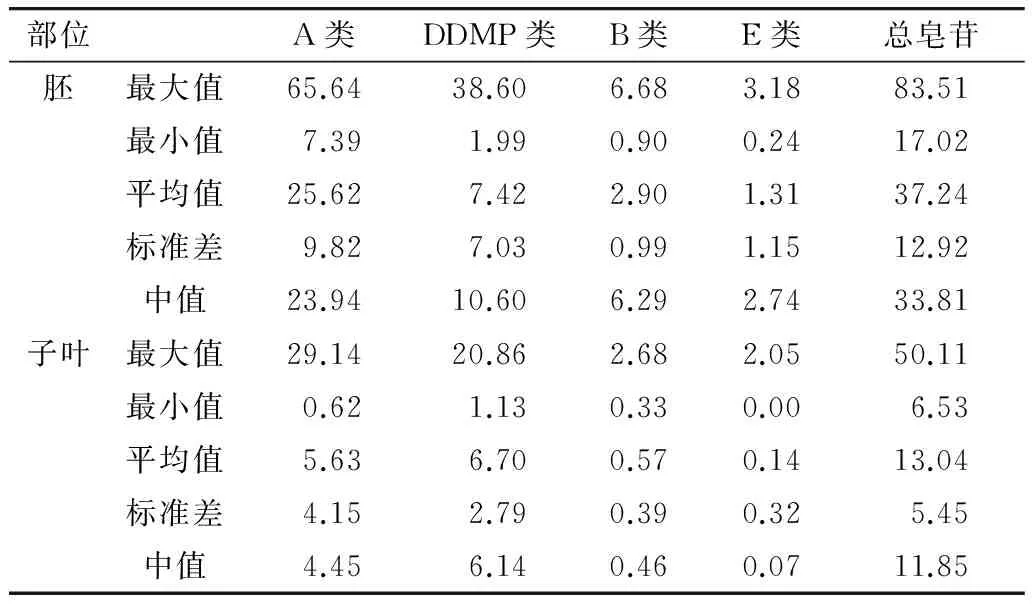
表2 大豆胚和子葉中皂苷含量分析/mg/g
2.2 大豆皂苷各組分含量分析
不同大豆材料胚和子葉A類、DDMP類、B類和E類皂苷含量也存在較大的變異。其中胚和子葉A類皂苷的變異范圍分別為7.39~65.64 mg/g、0.62~29.14 mg/g,DDMP類皂苷的變異范圍分別為1.99~38.60 mg/g、1.13~20.86 mg/g。B類和E類皂苷含量相對較低,但品種之間仍然存在較大的變異幅度(表2)。說明在大豆種質資源中可以篩選出低A類皂苷含量,高DDMP類、B類和E類皂苷含量的特用種質,從而有利于開展大豆皂苷的優質育種工作。胚和子葉中A類皂苷含量之比為4.6∶1,DDMP類、B類和E類皂苷含量總和在胚和子葉中的比值為1.5∶1。A類皂苷在胚和子葉中分別占總皂苷含量的68.78%、43.17%。DDMP類皂苷胚和子葉中分別占總皂苷含量19.92%、51.38%。
2.3 大豆皂苷含量的相關分析
分析大豆胚和子葉中各類皂苷含量及其與總含量的相關性,發現胚和子葉中,A類、DDMP類、B類和E類皂苷均與總皂苷含量呈極顯著正相關。其中胚和子葉中A類皂苷與總皂苷相關系數均達到0.8以上;胚和子葉中A類皂苷與DDMP類皂苷相關性均不顯著;胚中DDMP類皂苷與B類、E類皂苷相關性均不顯著,而子葉中呈極顯著相關(表3、表4)。
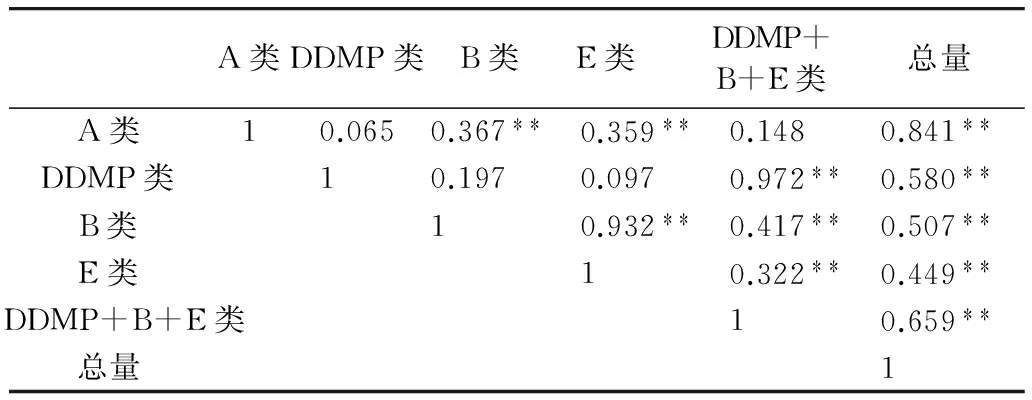
表3 大豆胚中各類皂苷含量與總量的相關分析
注:﹡表示差異達顯著水平(P<0.05);﹡﹡表示差異達極顯著水平(P<0.01);下同。

表4 大豆子葉中各類皂苷含量與總量的相關分析
2.4 不同粒重類型大豆材料中皂苷含量的比較分析
根據百粒重大小將參試材料分為小粒(<13 g)、中粒(13~24 g)和大粒(>24 g)3種類型。對不同類型胚和子葉大豆皂苷含量進行統計分析,發現小粒型大豆材料胚中B類、E類大豆皂苷含量平均值分別高達3.51、1.71 mg/g,顯著高于中粒和大粒型材料,不同粒重大豆材料胚DDMP類皂苷和總皂苷含量差異不顯著(表5)。而小粒型材料子葉總皂苷、DDMP類皂苷含量平均值分別高達15.10、8.21 mg/g,顯著高于中粒型和大粒型品種。不同粒重大豆材料胚和子葉A類皂苷含量均無顯著差異(表6)。
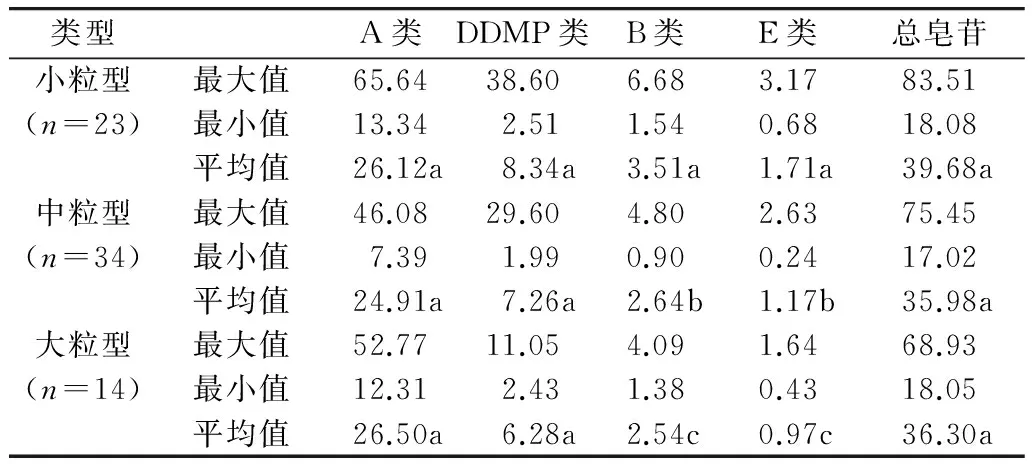
表5 不同粒重類型胚大豆皂苷含量比較分析/mg/g
注:不同小寫字母表示同列之間的顯著性差異(P<0.05),下同。

表6 不同粒重類型大豆材料子葉中皂苷含量比較分析/mg/g
2.5 野生、半野生、栽培大豆材料大豆皂苷含量的比較分析
對野生、半野生、栽培大豆材料子葉和胚中的大豆皂苷含量進行統計分析,發現野生、半野生大豆材料胚中B類、E類大豆皂苷含量顯著高于大豆栽培品種,而A類、DDMP類和總皂苷含量差異不顯著。野生大豆材料子葉中總皂苷、DDMP類皂苷含量平均值分別高達18.81、12.21 mg/g,顯著高于半野生和栽培大豆(表7、表8)。說明野生大豆材料是大豆皂苷含量遺傳改良的優質種質資源。
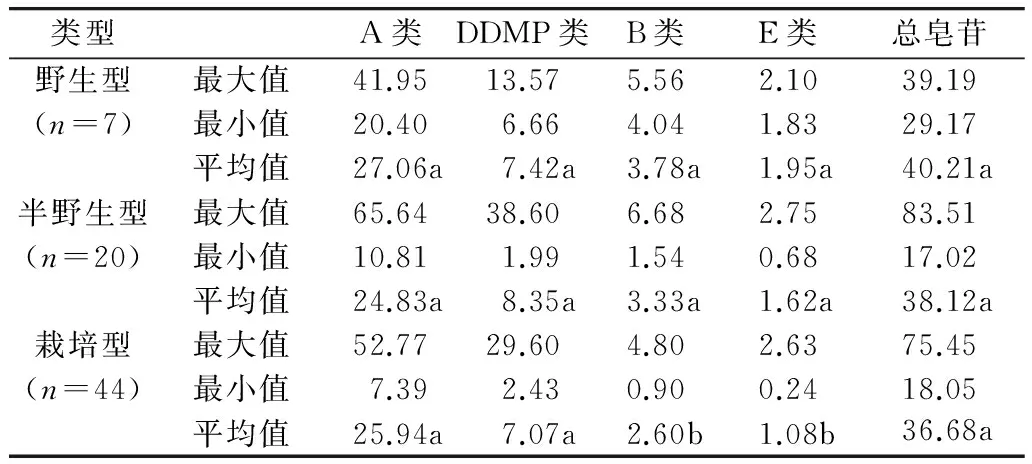
表7 野生、半野生和栽培大豆胚中大豆皂苷含量比較分析/mg/g
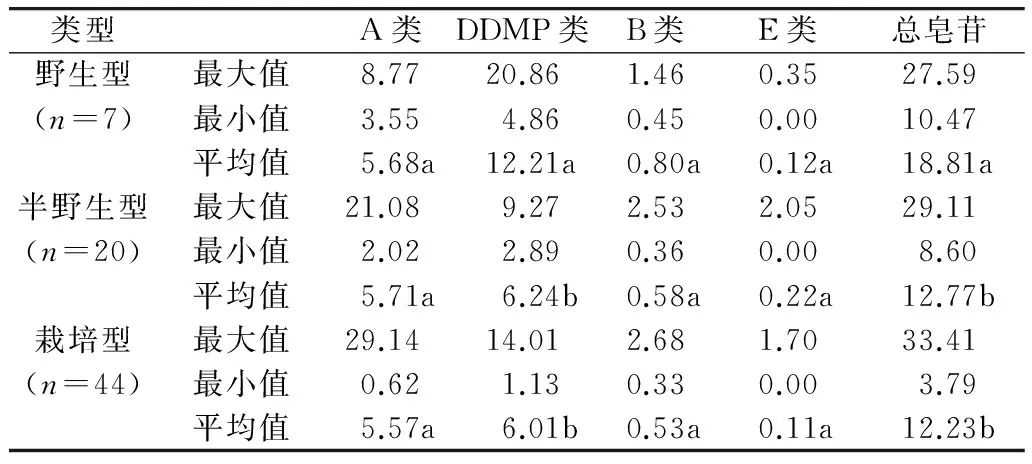
表8 野生、半野生和栽培大豆子葉中大豆皂苷含量比較分析/mg/g
3 討論
本研究采用HPLC-ESI-MS/MS分析山西大豆材料胚和子葉中大豆皂苷含量,變異范圍分別為17.02~83.51 mg/g和6.53~50.11 mg/g,平均值分別為37.24和13.04 mg/g 。皂苷組成和含量豐富的遺傳變異,有利于今后開展大豆皂苷品質育種工作。由于A類皂苷可引起大豆及其制品具有苦澀味[5],而DDMP類、B類和E類皂苷具有多種對人體有益的生理功能[6-10],因此富含DDMP類、B類和E類皂苷材料的利用價值高于富含A類皂苷的材料。本試驗條件下,胚和子葉A類皂苷的變異范圍分別為7.39~65.64 mg/g、0.62~29.14 mg/g,DDMP類皂苷的變異范圍分別為1.99~38.60 mg/g、1.13~20.86 mg/g。說明在大豆種質資源中可以篩選出低A類皂苷含量,高DDMP類、B類和E類皂苷含量的特用種質,從而有利于開展大豆皂苷的優質育種工作。
本研究表明胚和子葉中大豆皂苷組成和含量不同,胚中大豆皂苷總含量是子葉中的1.42~7.16倍。胚中A類皂苷占總皂苷含量的68.78%,DDMP類、B類和E類皂苷含量僅占31.22%;子葉中A類皂苷占總皂苷含量的43.15%,而DDMP類、B類和E類皂苷所占比例達56.85%。Kim等[16]研究表明,不同籽粒大小大豆皂醇A和B含量不同。Jang等[17]研究表明,小粒型整個籽粒大豆皂苷總含量高于中粒和大粒型大豆材料。本研究發現不同籽粒大小大豆材料胚中B類、E類大豆皂苷差異顯著,DDMP類和總皂苷含量差異不顯著;而子葉總皂苷和DDMP類皂苷含量差異顯著。這可能是由于胚和子葉中大豆皂苷具有不同積累和調控途徑,但關于胚和子葉中大豆皂苷積累機制還有待于進一步研究。
4 結論
通過研究發現,山西大豆材料胚和子葉中大豆皂苷組成和含量存在較大的變異范圍,可以為大豆皂苷含量的改良提供優質材料。A類、DDMP類、B類和E類皂苷含量均與總皂苷含量呈極顯著正相關。不同百粒重和生態類型大豆材料子葉中總皂苷含量差異顯著,胚中差異不顯著。小粒型大豆材料子葉總皂苷含量顯著高于中粒和大粒型材料,野生大豆子葉總皂苷含量顯著高于半野生和栽培大豆,而胚總皂苷含量差異不顯著。
[1]Kudou S, Tonomura M, Tsukamoto C, et al. Isolation and structural elucidation of the major genuine soybean saponin[J]. Bioscience Biotechnology and Biochemistry, 1992, 56: 142-143
[2]Shiraiwa M, Harada K, Okubo K. Composition and content of saponins in soybean seed according to variety, cultivation year and maturity[J]. Agricultural and Biological Chemistry, 1991, 55: 323-331
[3]Price K R, Fenwick G R, Jurzysta M. Soysapogenols separation, analysis and interconversions[J]. Journal of the Science of Food and Agriculture, 1986, 37: 1027-1034
[4]Yoshiki Y, Kudou S, Okubo K. Relationship between chemical structures and biological activities of triterpenoids saponins from soybean (review) [J]. Bioscience Biotechnology and Biochemistry, 1998, 62: 2291-2299
[5]Okubo K, Iijima M, Kobayashi Y, et al. Components responsible for the undesirable taste of soybean seeds[J]. Bioscience Biotechnology and Biochemistry, 1992, 56: 99-103
[6]Duffus C M, Duffus J H, D’Mello J P F. Toxic substances in crop plants[M]. England: Woodhead Publishing, 1991: 285-327
[7]Ellington A A, Berhow M, Singletary K W. Induction of macroautophagy in human colon cancer cells by soybean B-group triterpenoid saponins[J]. Carcinogenesis, 2005, 26: 159-167
[8]Ellington A A, Berhow M A, Singletary K W. Inhibition of Akt signaling and enhanced ERK1/2 activity are involved in induction of macroautophagy by triterpenoid B-group soyasaponins in colon cancer cells[J]. Carcinogenesis, 2006, 27: 298-306
[9]Ishii Y, Tanizawa H. Effects of soyasaponins on lipid peroxidation through the secretion of thyroid hormones[J]. Biological and Pharmaceutical Bulletin, 2006, 29: 1759-1763
[10]Zha L Y, Mao L M, Lu X C, et al. Anti-inflammatory effect of soyasaponins through suppressing nitric oxide production in LPS-stimulated RAW 264.7 cells by attenuation of NF-jB-mediated nitric oxide synthase expression[J]. Bioorganic and Medicinal Chemistry Letters, 2011, 21: 2415-2418
[11]Osbourn A. Saponins and plant defence-A soap story[J]. Trends in Plant Science, 1996(1): 4-9
[12]Papadopoulou K, Melton R E, Leggett M, et al. Compromised disease resistance in saponin deficient plants[J]. Proceedings of the National Academy of Sciences of United States of America, 1999, 96: 12923-12928
[13]Kuzina V, Ekstr?m C T, Andersen S B, et al. Identification of defense compounds in Barbarea vulgaris against the herbivore phyllotreta nemorum by an ecometabolomic approach[J]. Plant Physiology, 2009, 151: 1977-1990
[14]Hubert J, Berger M, Daydé J. Use of a simplified HPLC-UV analysis for soyasaponin B. determination: study of saponin and isoflavone variability in soybean cultivars and soy-based health food products[J]. Journal of Agricultural and Food Chemistry, 2005, 53: 3923-3930
[15]Tsukamoto C, Kikuchi A, Harada K, et al. Genetic and chemical polymorphisms of saponins in soybean seed[J]. Phytochemistry, 1993, 34: 1351-1356
[16]Kim E H, Ro H M, Kim S L, et al. Analysis of isoflavone, phenolic, soyasapogenol, and tocopherol compounds in soybean [Glycinemax(L.) Merrill]germplasms of different seed weights and origins[J]. Journal of Agricultural and Food Chemistry, 2012, 60: 6045-6055
[17]Jang E K, Piao X M, Hwang T Y, et al. Variation of saponin content in Korean native soybean landraces reintroduced from USA to Korea[J]. Korean Journal of Crop Science, 2012, 57(3): 286-295
[18]黃玉艾, 嚴明霞, 趙大云. 高速逆流色譜結合制備型高效液相色譜法分離制備大豆皂苷單體[J]. 食品科學, 2013, 34: 27-32 Huang Y A, Yan M X, Zhao D Y. Large-scale isolation and preparation of soybean saponin by high-speed countercurrent chromatography combined with preparative HPLC [J]. Food Science, 2013, 34: 27-32
[19]Zhao D Y, Yan M X, Huang Y, et al. Efficient protocol for isolation and purification of different soyasaponins from soy hypocotyls[J]. Journal of Separation Science, 2012, 35: 3281-3292
[20]Qiao N, Liu Q, Meng H,et al. Haemolytic activity and adjuvant effect of soyasaponins and some of their derivatives on the immune responses to ovalbumin in mice[J]. International immunopharmacology, 2014, 18: 333-339
[21]Huang S S, Han Y P, Li C S, et al. Identification of QTLs associated with total soyasaponin content in soybean (Glycinemax(L.) Merr.) [J]. Journal of Integrative Agriculture, 2012(11): 1976-1984.
Analysis of Soyasaponin Compounds in Different Soybean Varieties
Yue Aiqin1Wang Weidong2Xu Haijun2Wang Min1Guo Chunrong2Zhao Jinzhong2Du Weijun1
(College of Agronomy, Shanxi Agricultural University1, Taigu 030801)(College of Arts and Science, Shanxi Agricultural University2, Taigu 030801)
To understand soyasaponins content distribution in hypocotyls and cotyledons of soybean seeds in Shanxi, and to isolate specific resources in breeding application, we analyzed soyasaponins content in 71 varieties from Shanxi using high-performance liquid chromatography(HPLC)-electrospray ionization(ESI)-mass spectrometer(MS)/ MS. Results indicated that, the total content of soyasaponins among the soybeans varied from 17.02 to 83.51 mg/g in hypocotyls, from 6.53 to 50.11 mg/g in cotyledons. Group A, DDMP, B and E had a high positive correlation with the total soyasaponins content. Among the different-sized soybean seeds, the average Group B and E content of the hypocotyls, the total soyasaponins and Group DDMP content of the cotyledons in small seeds were higher than that in medium or large seeds. The hypocotyls of wild and semi-wild soybeans had higher concentration of average Group B and E soyasaponins than cultivated soybean, and the cotyledons of wild soybeans had higher total soyasaponins and Group DDMP content than that of semi-wild and cultivated soybeans.
soybean, soyasaponin, HPLC-ESI-MS/MS, hundred-grain weight
時間:2017-01-24
山西省科技攻關項目(20120311005-3),山西省高等學校科技創新項目(2015148),山西省自然科學基金(201601D011076)
2016-03-13
岳愛琴,女,1975年出生,副教授,大豆品質育種
杜維俊,女,1968年出生,教授,野生大豆資源鑒定、分子評價和種質創新
S565.1
A
1003-0174(2017)05-0038-05
網絡出版地址:http://www.cnki.net/kcms/detail/11.2864.TS.20170124.1049.002.html
猜你喜歡
農業科技通訊(2023年1期)2023-02-12 07:09:18
今日農業(2022年16期)2022-11-09 23:18:44
中國化肥信息(2022年7期)2022-08-31 01:29:28
中國化肥信息(2022年5期)2022-08-30 01:58:26
今日農業(2021年20期)2021-11-26 01:23:56
今日農業(2021年14期)2021-10-14 08:35:34
下一代英才(酷炫少年)(2018年6期)2018-07-09 03:17:44
農產品市場周刊(2017年4期)2017-03-03 19:40:05
兒童故事畫報·智力大王(2015年10期)2016-01-27 01:01:35
讀寫算(中)(2015年10期)2015-11-07 07:24:12
