
混合細胞樣本不同嵌合比例檢測的參考標準
2017-04-21 03:51:19邱詠陳大洋夏軍朱珠謝林史千玉劉萍董潔陳芳蔣慧
生殖醫學雜志 2017年4期
關鍵詞:檢測
邱詠,陳大洋,夏軍,朱珠,謝林,史千玉,劉萍,董潔,陳芳,蔣慧
(深圳華大基因,深圳 518083)
混合細胞樣本不同嵌合比例檢測的參考標準
邱詠,陳大洋,夏軍,朱珠,謝林,史千玉,劉萍*,董潔,陳芳,蔣慧
(深圳華大基因,深圳 518083)
目的 制定一個標準的嵌合比例檢測曲線,以用于植入前篩查(PGS)中更加精準地選擇健康的胚胎進行移植,進而提高臨床妊娠率及降低出生缺陷率。 方法 選用購買的5株商業化的CNV細胞系及2株正常男女性外周血細胞系,配置100%、70%、60%、40%、20%、0%的6個梯度嵌合比例;本批樣本采用華大基因開發的胚胎植入前檢測試劑盒(Embro-seq PGS kit)進行WGA擴增和文庫構建,采用BGISEQ-500測序儀進行全基因組低深度測序,采用自主開發的CNV分析軟件進行數據分析。 結果 5株細胞系的相應CNV在6個嵌合梯度的平均拷貝率分別是0.98、0.89、0.83、0.76、0.73和0.57。 結論 本研究繪制了一個不同嵌合比例的拷貝率曲線,為臨床PGS檢測中胚胎的嵌合性評估提供了一種相對準確的參考方法,進而可根據具體情況選擇更加健康的胚胎進行移植以提高臨床妊娠率及降低出生缺陷發生率。
植入前胚胎移植; 嵌合胚胎; 嵌合曲線; 混合細胞系
(JReprodMed2017,26(4):328-330)
在輔助生殖技術中,染色體非整倍性是引起移植失敗的重要原因[1-2]。目前新一代的植入前胚胎篩查技術(PGS)比較基因組雜交和新一代測序技術都能同時檢測胚胎的24條染色體的非整倍性情況[3-9]。另外,在PGS中也經常發現染色體嵌合現象[10]。
囊胚活檢時通常取3~10個外滋養層細胞,由于外滋養層細胞間的染色體核型異質現象,所以PGS檢測的細胞樣本中可能會有嵌合現象。然而,不同比例的嵌合的臨床意義不同,高比例的嵌合異常通常不建議進行移植。2016年的植入前胚胎診斷(PGD)指南定義20%以下的嵌合為正常核型,而80%以上的嵌合認為是非整倍體,建議實驗室對20%~80%之間的嵌合度進行檢測[11]。但目前尚無準確評估胚胎嵌合性的檢測技術。
本研究的目的是通過正常及異常核型的細胞系按不同比例混合,制定一個標準的嵌合比例檢測曲線,以期用于PGS中更加精準地檢測胚胎的嵌合性,進而選擇健康的胚胎進行移植,提高臨床妊娠率及降低出生缺陷率。
材料與方法
一、材料
選用購買的5株商業化的異常細胞系(Coriell Institute,美國),已知核型分別是del(7)-25.3M、del(10)-14.1M、del(13)-18.3M、del(15)-4.9M、del(17)-5.8M;以及2株正常核型男女性外周血細胞系,核型分別是46,XX和46,XY。
二、方法
1.嵌合胚胎模擬:用顯微操作儀(Eppendorf,美國),按比例挑選一定數量的異常核型細胞和正常核型細胞進行混合,模擬的細胞嵌合比例分別是10:0、7:3、6:4、4:6、2:8和0:10;每一個混合比例的總細胞數為10,配置100%、70%、60%、40%、20%、0%的6個梯度的嵌合比例(圖1)。
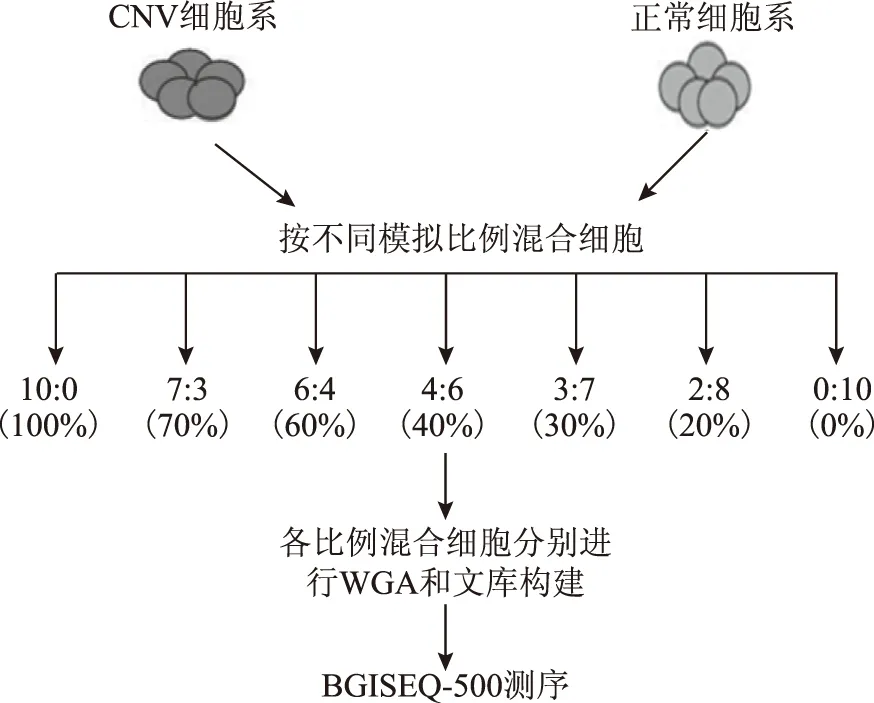
圖1 不同嵌合比例混合細胞樣本檢測流程圖
2.WGA擴增和文庫構建:本批樣本采用華大基因開發的胚胎植入前檢測試劑盒(Embro-seq PGS kit)進行WGA擴增和文庫構建[12-13]。
3.NGS測序和信息分析:本實驗采用華大自主開發的BGISEQ-500測序儀進行全基因組低深度測序,并采用自主開發的Embro-seq PGS kit 配套CNV分析軟件進行數據分析[12-13]。
結 果
結合不同的模擬嵌合度,計算每個樣本已知CNV的拷貝率:(1)細胞系del(7)-25.3M:嵌合比例從100%到0%,目標CNV的拷貝率分別是0.98、0.92、0.86、0.78、0.74、0.50;(2)細胞系del(10)-14.1M:嵌合比例從100%到0%,目標CNV的拷貝率分別是0.97、0.88、0.83、0.79、0.69、0.56;(3)細胞系del(13)-18.3M:嵌合比例從100%到0%,目標CNV的拷貝率分別是0.93、0.88、0.82、0.73、0.70、0.54;(4)細胞系del(15)-4.9M:嵌合比例從100%到0%,目標CNV的拷貝率分別是1.00、0.81、0.72、0.72、0.69、0.62;(5)細胞系del(17)-5.8M:嵌合比例從100%到0%,目標CNV的拷貝率分別是1.01、0.84、0.77、0.67、0.68、0.54(表1)。
綜上所述,5個細胞系嵌合比例從100%到0%,相對應目標CNV的平均拷貝率分別是0.98、0.89、0.83、0.76、0.73、0.57。
討 論
嵌合胚胎中同時存在整倍性細胞和非整倍性細胞,嵌合胚胎對表型的影響往往取決于三個方面:嵌合程度、所嵌合的染色體類型、嵌合細胞的分布[14]。本研究針對嵌合程度的檢測繪制了一個不同嵌合比例和拷貝率之間的相關曲線,6個不同嵌合比例樣本的拷貝率有明顯逐漸遞減的趨勢,相鄰梯度間可明顯區分,為PGS檢測中胚胎的嵌合性評估提供了一種相對準確的參考方法。
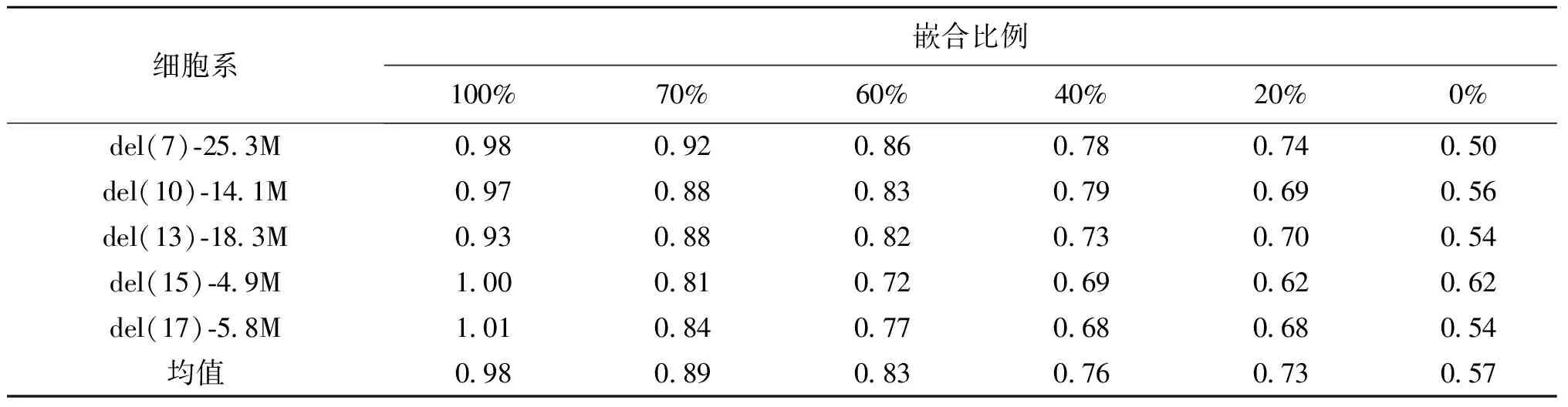
表1 不同比例嵌合度對應CNV的拷貝率
按照2016年的PGD指南定義,20%以下的嵌合可認為是正常核型可進行移植,而80%以上的嵌合則認為是非整倍體不建議移植,對20%~80%之間的嵌合度需結合實際情況考慮[11]。Greco等[15]收集了18個IVF家系,該18個家系胚胎的共同點是,所有胚胎均為非整倍性或嵌合胚胎,嵌合程度各不相同,在獲得受試者的知情同意后,選擇一些狀態較好、嵌合程度低(小于50%)的胚胎進行植入,18個家系中,6個家系出生正常核型的胎兒。該研究表明,在一些較極端的情況下如多個IVF周期均無完全正常的胚胎可用時,可以考慮嵌合胚胎進行移植。
綜上所述,雖然胚胎嵌合對移植后及胚胎發育的潛在影響尚不明確,但臨床上一般不考慮移植嵌合胚胎,通常認為嵌合胚胎會降低IVF的成功率。本研究提供了一個檢測胚胎嵌合程度的方法,若在極端情況下需要移植嵌合胚胎,應綜合考慮胚胎嵌合類型和嵌合程度等因素進行選擇,同等嵌合類型的條件下,優選選擇嵌合程度低的胚胎進行移植。本研究只是細胞系混合的模擬樣本,但我們已收集了一些臨床樣本進行檢測,正在追蹤收集臨床結果進行驗證。
[1] Munné S. Preimplantation genetic diagnosis and human implantation-a review[J]. Placenta,2003,24(Suppl B):S70-76.
[2] Farfalli VI,Magli MC,Ferraretti AP,et al. Role of aneuploidy on embryo implantation[J]. Gynecol Obstet Invest,2007,64:161-165.
[3] Munné S. Preimplantation genetic diagnosis for aneuploidy and translocations using array comparative genomic hybridization[J]. Curr Genomics,2012,13:463-470.
[4] Handyside AH. 24-chromosome copy number analysis:a comparison of available technologies[J]. Fertil Steril,2013,100:595-602.
[5] Wang L,Wang X,Zhang J,et al. Detection of chromosomal aneuploidy in human preimplantation embryos by next-generation sequencing[J]. Biol Reprod,2014,90:95.
[6] Wang L,Cram DS,Shen J,et al. Validation of copy number variation sequencing for detecting chromosome imbalances in human preimplantation embryos[J]. Biol Reprod,2014,91:37.
[7] Fiorentino F,Biricik A,Bono S,et al. Development and validation of a next-generation sequencing-based protocol for 24-chromosome aneuploidy screening of embryos[J]. Fertil Steril,2014,101:1375-1382.
[8] Huang J,Yan L,Fan W,et al. Validation of multiple annealing and looping-based amplification cycle sequencing for 24-chromosome aneuploidy screening of cleavage-stage embryos[J]. Fertil Steril,2014,102:1685-1691.
[9] Yin X,Tan K,Vajta G,et al. Massively parallel sequencing for chromosomal abnormality testing in trophectoderm cells of human blastocysts[J]. Biol Reprod,2013,88:69.
[10] Fragouli E,Alfarawati S,Daphnis DD,et al. Cytogenetic analysis of human blastocysts with the use of FISH,CGH and aCGH:scientific data and technical evaluation[J]. Hum Reprod,2011,26:480-490.
[11] PGDIS position statement on chromosome mosaicism and preimplantation aneuploidy testing at the blastocyst stage[C].Abstracts of the 15thInternational Conference on Preimplantation Genetic Diagnosis. (www.pgdis.org);RBMO,2016.
[12] http://www.seq500.com/portal/Seq-500.shtml.
[13] Fehlmann T,Reinheimer S,Geng C,et al. cPAS-based sequencing on the BGISEQ-500 to explore small non-coding RNAs[J]. Clin Epigenetics,2016,8:123.
[14] Novik V,Moulton EB,Sisson ME,et al. The accuracy of chromosomal microarray testing for identification of embryonic mosaicism in human blastocysts[J]. Mol Cytogenet,2014,7:18.
[15] Greco E,Minasi MG,Fiorentino F. Healthy babies after intrauterine transfer of mosaic aneuploid blastocysts[J]. N Engl J Med,2015,373:2089-2090.
[編輯:羅宏志]
Development of reference curve for different chimeric ratio by using mixed cell samples
QIUYong,CHENDa-yang,XIAJun,ZHUZhu,XIELin,SHIQian-yu,LIUPing*,DONGJie,CHENFang,JIANGHui
BeijingGenomicsInstituteinShenzhen,Shenzhen518083
Objective:To develop a standard curve of chimeric ratio for accurately selecting healthy embryos in preimplantation genetic screening (PGS) to improve clinical pregnancy rate and reduce the birth defect rate.Methods:The samples with six gradient chiming ratio of 100%,70%,60%,40%,20%,0% was configured by using 5 strains of commercial CNV cell lines and 2 strains of male and female normal peripheral blood cell lines. These samples were subjected to WGA amplification and library construction with BGI’s kit (Embro-seq PGS Kit) developed by the Beijing Genomics Institute. Whole genome sequencing was performed with BGISEQ-500 sequencer. Data were analyzed by self-developed CNV analysis software.Results:The average copy rates of the corresponding CNVs in the 6 samples with different gradient chimeric ratio were 0.98,0.89,0.83,0.76,0.73 and 0.57,respectivelyConclusions:A standard curve of chimeric ratio is developed,which can provide a relatively accurate reference method for assessment of embryo chimeric ratio in PGS. Therefore,the more healthy embryos can be chosen for transplantation in order to improve the clinical pregnancy rate and reduce the incidence of birth defects.
Preimplantation genetic screening; Chimeric embryo; Chimeric curve; Mixed cell lines
10.3969/j.issn.1004-3845.2017.04.007
2017-01-31;
2017-02-06
邱詠,女,湖北黃石人,碩士,生物化學與分子生物學專業.(*
)
猜你喜歡
中國設備工程(2022年12期)2022-07-11 04:33:00
中學生數理化·七年級數學人教版(2021年6期)2021-11-22 07:50:58
中學生數理化·七年級數學人教版(2021年6期)2021-11-22 07:50:58
中學生數理化·七年級數學人教版(2021年6期)2021-11-22 07:50:58
中學生數理化·七年級數學人教版(2020年12期)2021-01-18 06:57:46
中學生數理化·七年級數學人教版(2020年12期)2021-01-18 06:57:46
中學生數理化·七年級數學人教版(2019年9期)2019-11-25 07:34:36
中學生數理化·七年級數學人教版(2019年9期)2019-11-25 07:34:34
中學生數理化·七年級數學人教版(2019年12期)2019-05-21 02:53:50
中學生數理化·七年級數學人教版(2019年12期)2019-05-21 02:53:48
