幾種新現人體隱孢子蟲種和基因型流行現狀
2017-03-16 06:38:25楊子吟曹建平沈玉娟劉愛芹
中國人獸共患病學報 2017年2期
楊子吟,曹建平,沈玉娟,劉愛芹
幾種新現人體隱孢子蟲種和基因型流行現狀
楊子吟1,曹建平2,沈玉娟2,劉愛芹1
隱孢子蟲是一種寄生于宿主胃腸道上皮細胞內的原蟲。人感染后,免疫功能正常者,常引起自限性腹瀉;但在高危人群(如兒童、老人和免疫缺陷者等)中可發生嚴重腹瀉和腸外感染,尤其是艾滋病患者。目前,隱孢子蟲的分子流行病學研究已鑒定了30個有效種和40多種基因型,其中21個隱孢子蟲種和基因型在人體發現。人體隱孢子蟲病多數由人隱孢子蟲(C.hominis)和微小隱孢子蟲(C.parvum)引起。火雞隱孢子蟲(C.meleagridis)、泛在隱孢子蟲(C.ubiquitum)、貓隱孢子蟲(C.felis)和犬隱孢子蟲(C.canis)引起的隱孢子蟲病例也逐漸增多。除此之外,隨著人體隱孢子蟲病分子流行病學數據的增加,在人體內鑒定到一些新的隱孢子蟲和基因型。特對上述新現的人體隱孢子蟲種和基因型的流行現狀進行綜述。
隱孢子蟲;隱孢子蟲病;分子流行病學
隱孢子蟲(Cryptosporidium)是寄生于脊椎動物胃腸上皮細胞內的一種寄生蟲,由其感染引起的隱孢子蟲病(cryptosporidiosis)是一種新發的人獸共患原蟲病。在免疫功能正常的個體,常引起自限性腹瀉;在免疫功能缺陷者,尤其是艾滋病患者,可出現致死性腹瀉[1]。早在1986年世界衛生組織將隱孢子蟲病列為艾滋病懷疑指標之一。目前隱孢子蟲已成為人類腹瀉的第二大病因。
隱孢子蟲卵囊在自然界中廣泛存在,人通過攝入含有卵囊的食物、水以及接觸污染物等途徑感染該寄生蟲[1]。人體隱孢子蟲病是在1976年由Nime等首次報道[2],此后隱孢子蟲人體病例報道不斷出現,并逐漸得到人們的重視。其中最值得關注的是1993年發生在美國密爾沃基市水源性隱孢子蟲病暴發事件,該事件導致40多萬人感染,100多人死亡;同時,這一事件證實隱孢子蟲可耐受水處理,并通過飲用水傳播[3]。隱孢子蟲病呈世界性分布,已在90多個國家,至少300個地區發現了隱孢子蟲病;在歐洲和北美洲人群平均感染率為1%~3%,亞洲為5%,非洲高達10%;在發達國家,免疫功能正常人群糞便隱孢子蟲卵囊檢出率為1%;在發展中國家,人的糞便隱孢子蟲卵囊檢出率達5%~10%[4]。國內韓范于1987年在南京首先發現了人體隱孢子蟲病病例以來,目前有19個省出現人體隱孢子蟲感染的報道[5]。 隱孢子蟲是頂復門、孢子蟲綱、球蟲亞綱、真球蟲目、艾美耳亞目、隱孢子蟲科、隱孢子蟲屬的原生動物。自從1907年Tyzzer首次在實驗小鼠的胃腺黏膜上皮細胞內分離到隱孢子蟲以來[6],隨著基因分型技術在人體隱孢子蟲病流行病學調查中應用,到目前為止,已經在人和260多種動物體內鑒定出30個隱孢子蟲種和40多個基因型,其中在人體發現了21個種和基因型[1,7]。絕大多數人體隱孢子蟲病由微小隱孢子蟲(C.parvum)和人隱孢子蟲(C.hominis)引起[1]。近些年來,隨著人體分子流行病學調查的深入開展,由火雞隱孢子蟲(C.meleagridis)、泛在隱孢子蟲(C.ubiquitum)、貓隱孢子蟲(C.felis)、犬隱孢子蟲(C.canis)引起的隱孢子蟲病例也逐漸增多,且在某些國家和地區,個別蟲種呈現地區優勢性[1]。除此之外,近年來,在人體還分離到了安氏隱孢子蟲(C.andersoni)、兔隱孢子蟲(C.cuniculus)、鼠隱孢子蟲(C.muris)、牛隱孢子蟲(C.bovis)、旅行者隱孢子蟲(C.viatorum)、泰澤隱孢子蟲(C.tyzzeri)、豬隱孢子蟲(C.suis)、肖氏隱孢子蟲(C.xiaoi)、種母豬隱孢子蟲(C.scrofarum)、費氏隱孢子蟲(C.fayeri)、刺猬隱孢子蟲(C.erinacei)、隱孢子蟲馬基因型(Cryptosporidiumhorse genotype)、隱孢子蟲臭鼬基因型(Cryptosporidiumskunk genotype)、隱孢子蟲花栗鼠基因型Ⅰ(Cryptosporidiumchipmunk genotype I)和隱孢子蟲貂基因型(Cryptosporidiummink genotype)。目前,人們對這些新現的隱孢子蟲種和基因型的研究及認識相對缺乏,本文將對上述人體隱孢子蟲種和基因型的分子流行病學現狀進行綜述。
1 安氏隱孢子蟲
安氏隱孢子蟲是在2000年從鼠隱孢子蟲獨立出來的隱孢子蟲種[8]。牛是安氏隱孢子蟲的主要保蟲宿主,常見于成年牛和青年牛。此外,在倉鼠、駱駝、綿羊、山羊、馬、貂體內也分離到該蟲種[9-11]。安氏隱孢子蟲人體病例首次在英國發現[12]。此后馬拉維、澳大利亞和伊朗均出現1例安氏隱孢子蟲病例,其中伊朗的隱孢子蟲病患者同時感染了HIV病毒[13-15]。我國于2014年首次在上海的34個腹瀉患者糞便中檢出安氏隱孢子蟲[16]。同年,Jiang等在江蘇省的腹瀉患者體內檢測到21名安氏隱孢子蟲感染者,其中以嬰幼兒與老年人居多[17]。雖然近年來國內外已經出現人體安氏隱孢子蟲病例報告,但亞型水平的分子數據匱乏,其感染源和傳播動力學還不清楚。因此,開展人體安氏隱孢子蟲分離株多基因位點序列分型(Multilocus sequence typing,MLST)的研究是當前的主要工作。
2 兔隱孢子蟲
兔隱孢子蟲是在2010年正式命名的隱孢子蟲種,兔是兔隱孢子蟲主要自然感染宿主,因此在此之前一直被稱作隱孢子蟲兔基因型(Cryptosporidiumrabbit genotype)[18]。2014年在澳大利亞的袋鼠體內發現該種[19]。兔隱孢子蟲引起學者的重視源于2008年英國的水源性隱孢子蟲病暴發事件。當時在23名腹瀉患者的糞便樣本中鑒定到了兔隱孢子蟲;而對7份污染水樣、一只死兔以及9名患者兔隱孢子蟲分離株的亞型分型結果證實,所有兔隱孢子蟲分離株亞型均為VaA18,確認了水箱內的死兔是此次暴發事件的污染源[20]。此后,英國、法國、尼日利亞、澳大利亞和西班牙均出現了人體感染兔隱孢子蟲的報道[19,21-24]。兔隱孢子蟲有2個亞型家族,Va家族常見于人體,而Vb家族常見于兔體[7]。目前,人體發現的在20個隱孢子蟲亞型中Va家族中8個亞型,Vb家族中12個亞型[7]。其中有6個人獸共患的亞型(VaA18、VaA19、VbA28、VbA29、VbA32和VbA36)[7],兔隱孢子蟲人獸共患的可能性在亞型水平得到證實。因此,加強兔的糞便管理及兔的密切接觸者的安全衛生教育是十分必要的。
3 鼠隱孢子蟲
鼠隱孢子蟲是在1907年被發現和命名的隱孢子蟲有效種,主要自然宿主是嚙齒類動物[6]。近年,在鴕鳥、馬、豬以及蛇等爬行類動物體內也發現了該蟲種[1,25]。目前,鼠隱孢子蟲人體病例報道主要集中于免疫功能缺陷者,尤其是HIV病人:2001年至2012年間,在法國、泰國、肯尼亞、秘魯、印度和巴西均出現過HIV及免疫缺陷患者感染鼠隱孢子蟲的報道[26-31]。另外,斯洛伐克以及沙特阿拉伯兒童體內發現鼠隱孢子蟲[32-33]。同時,在印度尼西亞、伊朗和斯洛伐克免疫功能正常成人的體內檢測到鼠隱孢子蟲[34-36]。然而,鼠隱孢子蟲傳染源和傳播動力學的資料還很匱乏。Feng等在2011年通過對2個人源鼠隱孢子蟲分離株在MS1、MS2、MS3和MS16位點亞型分型,獲得了2個MLST亞型(M1, M2, M4, M5和M6, M4, M1, M2);而鼠體內的鼠隱孢子蟲分離株MLST亞型M1, M2, M4, M5的發現,在基因亞型水平證明了鼠隱孢子蟲動物性傳播的可能性[37]。
4 豬隱孢子蟲
豬隱孢子蟲是在2004年命名的一個隱孢子蟲種,以前稱其為隱孢子蟲豬基因型1(Cryptosporidiumpig genotype I)[38]。豬是豬隱孢子蟲主要保蟲宿主[1]。近些年來,在牛、嚙齒類動物、黑猩猩和羊體內也分離到了豬隱孢子蟲[1,39-40]。2002年首次在秘魯一名24歲HIV感染者的體內鑒定到豬隱孢子蟲[41]。在2007年和2013年分別在秘魯和我國發現1例HIV病毒合并豬隱孢子蟲感染病例[42-43]。此外,在英國和馬達加斯加有消化系統癥狀的患者體內發現豬隱孢子蟲感染[12,39]。目前,由于沒有治療隱孢子蟲病有效的藥物或預防疫苗,因此,開展豬隱孢子蟲流行病學調查,加強豬糞便的處理,避免其污染環境是預防人體豬隱孢子蟲感染主要措施之一。
5 旅行者隱孢子蟲
該隱孢子蟲是2012年首次在由印度返回英國的游客中發現的,因此將其命名為旅行者隱孢子蟲[44]。其后,2013年在瑞典的2名腹痛、腹瀉以及惡心等消化系統癥狀患者的糞便中檢測到該蟲體;2人在患病前均有國外旅游史,旅游地分別是危地馬拉和肯尼亞[45]。在2013年和2014年,分別在1名尼日利亞和10名埃塞俄比亞HIV/AIDS體內分離到該病原體[46-47]。亞型分型發現其種內有6個亞型(XVaA3f、XVaA3e、XVaA3d、XVaA3c、XVaA3b和XVaA3a)[48]。目前,旅行者隱孢子蟲種只在人體發現,該蟲種的傳染源和傳播途徑還不清楚,這是將來流行病學研究工作的重點。
6 牛隱孢子蟲
牛隱孢子蟲是2005年命名的隱孢子蟲種,在此之前,被稱作隱孢子蟲牛基因型B(Cryptosporidiumgenotype bovine B)[49]。牛是牛隱孢子蟲的主要感染宿主,猩猩和狍子體內也發現過該病原體[1,50]。2001年在法國的1名免疫功能正常者、2名HIV患者和2名淋巴瘤患者的體內鑒定到牛隱孢子蟲,這是牛隱孢子蟲在人體的首次發現[27]。2012年在澳大利亞,生活在奶牛農場內的1個兒童和1個成年人體內發現了牛隱孢子蟲[51]。2013年,埃及的10名腹瀉兒童感染牛隱孢子蟲[52]。雖然人體牛隱孢子蟲病例不多,但是其所引起的健康問題不能忽視,尤其是與牛密切接觸的兒童以及免疫力缺陷的人群。
7 泰澤隱孢子蟲
泰澤隱孢子蟲是在2012年正式命名的一個隱孢子蟲種,此前被稱為隱孢子蟲鼠基因型1(Cryptosporidiummouse genotype I)[53]。泰澤隱孢子蟲主要宿主是嚙齒類動物,馬和蛇體內也檢測到了該蟲種[25]。2005年泰澤隱孢子蟲首次在一名科威特兒童腹瀉便中檢出(當時被錯誤的報道為C.parvumIIf 亞型家族)[54]。2013年,在捷克的一名腹瀉成年女性體內檢測到泰澤隱孢子蟲,該患者還合并感染微小隱孢子蟲;經調查,這名患者曾用嚙齒類動物進行過實驗研究,通過gp60亞型分型,證實傳染源就是實驗用的野鼠[55]。鼠是自然界常見的嚙齒類動物,數量大,分布廣,繁殖快,適應性強,危害嚴重。目前,已證實鼠攜帶200多種病原體,其中57種是人獸共患的,包括隱孢子蟲[56]。因此,降低鼠密度、減少人與鼠的直接或間接接觸是預防泰澤隱孢子蟲感染的關鍵。
8 肖氏隱孢子蟲
肖氏隱孢子蟲以前被認為是類牛隱孢子蟲(C.bovis-like),主要見于羊體內,在2009年以美國華裔科學家肖立華的名字命名為一個隱孢子蟲種[57]。研究發現,綿羊和山羊是肖氏隱孢子蟲的主要宿主[1],另外,魚和袋鼠也可感染該蟲[1,58]。2014年,在對埃塞俄比亞520名HIV/AIDS患者隱孢子蟲分子流行病學調查時,發現了2例肖氏隱孢子蟲感染者,臨床癥狀主要表現為嘔吐[46]。由于人體肖氏隱孢子蟲病例較少,其與臨床表現的相關性還不清楚;傳染源和傳播途徑也有待研究。
9 種母豬隱孢子蟲
種母豬隱孢子蟲于2013年由Kvác等命名,以前被稱為隱孢子蟲豬基因型2(Cryptosporidiumpig genotype II)[59]。豬是種母豬隱孢子蟲主要宿主,但在羊、鼠甚至魚的體內也發現該蟲種[1,60]。目前,只有1例種母豬隱孢子蟲合并賈第蟲集聚體A人體感染,該病例報道于2009年[61]。根據病史,作者認為與接觸患病動物、食用被污染食物或者飲用被污染的水是該病的直接或間接原因[61]。該病例提示應改善豬的飼養管理,尤其是種母豬,避免仔豬的感染;同時,加強對豬糞便的處理,避免環境污染和人體感染。
10 費氏隱孢子蟲
費氏隱孢子蟲曾被稱為隱孢子蟲袋鼠基因型1(Cryptosporidiummarsupial genotype I),2008年Ryan等將其命名為費氏隱孢子蟲[62]。有袋類動物是其主要宿主,在綿羊體內也曾檢測到該寄生蟲[1]。2010年Waldron等報道了1例費氏隱孢子蟲人體感染,患者是一位澳大利亞29歲免疫功能正常女性,長期腹瀉;通過gp60基因分析,確定其亞型為IVaA9G4T1R1[63]。相同的亞型也在袋鼠體內鑒定[64],有袋類動物可能為人類費氏隱孢子蟲動病的傳染源。目前,費氏隱孢子蟲內發現6個亞型家族(IVa-IVf),其人獸共患性還有待探究。
11 刺猬隱孢子蟲
刺猬隱孢子蟲是在2014年由Kvac等命名的新種,它在2002年被首次發現,當時稱其為隱孢子蟲刺猬基因型(Cryptosporidiumhedgehog genotype)[65]。顧名思義,刺猬是主要宿主,在馬體內也發現該蟲種[66]。到目前為止,刺猬隱孢子蟲僅有1例人體病例報道,該患者為26歲青年男性,免疫功能正常,因腸胃炎伴腹痛入院就診;gp60基因序列分析,該分離株的亞型為XIIIaA20R10[67]。刺猬隱孢子蟲是新現的隱孢子蟲種,目前,僅發現1個亞型家族(XIIIa)內的2種基因亞型(XIIIa20R10和XIIIaA22R9)[1,66]。由于該蟲種分子數據較少,其傳染源和傳播途徑有待進一步研究。
12 隱孢子蟲馬基因型
該基因型首次在一匹普氏野馬(Equusferusssp.Przewalskii)體內發現[68]。馬是其主要的宿主,在驢、犢牛和刺猬的體內也有報道[11]。自從2008年Robinson等首次報道了人體感染隱孢子蟲馬基因型以來[69],2009年和2012年相繼在美國和英國分別發現1例和2例馬基因型感染者[70-71]。其中前者通過對gp60基因序列分析,獲得了VIbA13亞型[70],相同的基因亞型也在一個日本的刺猬體內發現[11]。目前,隱孢子蟲馬基因型內存在2個亞型家族。VIa主要發現于馬(VIaA15G4、VIaA11G3、VIaA14G2),還見于驢(VIaA15G4、VIaA11G3)以及犢牛(VIaA14G4),但至今未在人體發現,VIa亞型家族,它是否能夠感染人體有待將來的研究證實。而VIb主要見于人和刺猬[11],該結果表明了隱孢子蟲馬基因型VIb家族動物源性傳播的可能。
13 隱孢子蟲花栗鼠基因型
隱孢子蟲花栗鼠基因型主要宿主是花栗鼠,該基因型還在野生動物東方灰松鼠、鹿鼠和紅松鼠體內發現[72]。2006年Feltus等首次在美國威斯康星州發現了2例隱孢子蟲花栗鼠基因型1人體感染(當時命名為W17)[73]。后來,在法國的1名HIV病人、瑞典的1名2歲女童和1名56歲男性體內鑒定到該病原體[22,74]。2015年Guo等對25個人源和3個鼠源隱孢子蟲花栗鼠基因型1分離株gp60基因序列分析,發現了14個亞型:人體內12個;鼠體內2個[72]。此外,在水體中鑒定到隱孢子蟲花栗鼠基因型1新的亞型XIVaA15G2T1[72]。由于隱孢子蟲花栗鼠基因型1人體分離株和野生鼠分離株遺傳學上的相似性[72],提示其存在人獸共患的可能。
14 隱孢子蟲臭鼬基因型
隱孢子蟲臭鼬基因型比較罕見,動物宿主僅包括縞臭鼬、浣熊和松鼠[75]。目前,僅有2個隱孢子蟲臭鼬基因型人體感染病例,均來自于英國[69,71]。其中一名患者在發病前曾去過森林公園度假[69]。由于隱孢子蟲臭鼬基因型無論在基因型還是亞型水平的分子數據均比較缺乏,目前,僅在水體中鑒定到1個臭鼬基因型的亞型XVIa[72],因此,其人獸共患可能性以及與臨床表現的相關性還依賴于更多的分子流行病學調查來證實。
15 隱孢子蟲貂基因型
2008年首次在貂體內發現隱孢子蟲貂基因型[76]。至今,貂仍然是該病原體的唯一動物宿主。隱孢子蟲貂基因型僅有2個人體病例,均來自澳大利亞。其中,2013年報道的1例合并感染火雞隱孢子蟲和一個未確定隱孢子蟲種[79]。目前,該基因型內分為4個亞型家族,均來自于貂[77],由于缺乏人源隱孢子蟲貂基因型的亞型數據,其人獸共患性還有待查證。
上述15個新現人體隱孢子蟲種和基因型的宿主范圍和病例的國家分布情況總結于表1。
表1 人體新現隱孢子蟲種和基因型的宿主范圍和地理分布
Tab.1 The host range and geographical distribution of several emergingCryptosporidiumspecies and geno types in humans
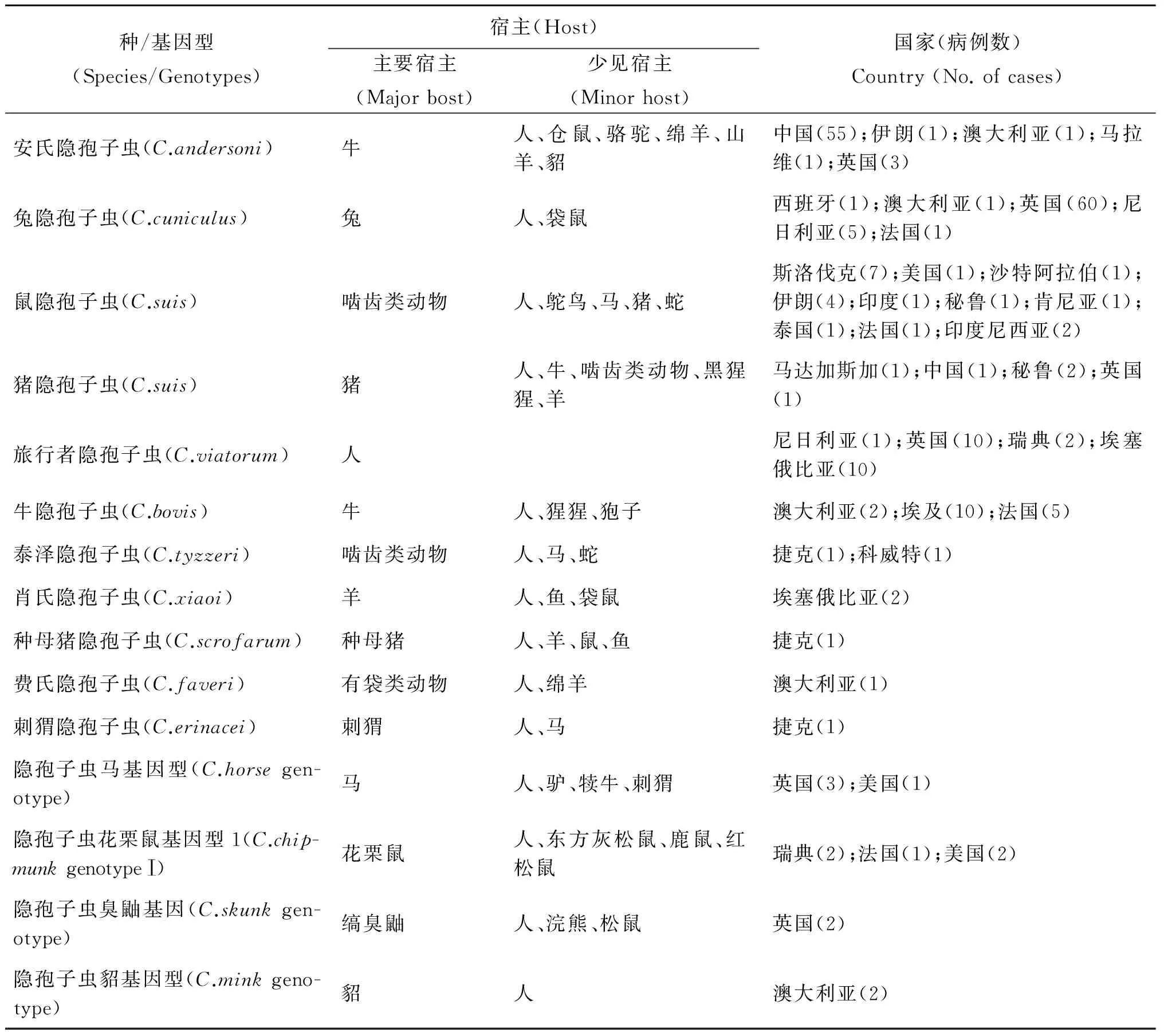
種/基因型(Species/Genotypes)宿主(Host)主要宿主(Majorbost)少見宿主(Minorhost)國家(病例數)Country(No.ofcases)安氏隱孢子蟲(C.andersoni)牛人、倉鼠、駱駝、綿羊、山羊、貂中國(55);伊朗(1);澳大利亞(1);馬拉維(1);英國(3)兔隱孢子蟲(C.cuniculus)兔人、袋鼠西班牙(1);澳大利亞(1);英國(60);尼日利亞(5);法國(1)鼠隱孢子蟲(C.suis)嚙齒類動物人、鴕鳥、馬、豬、蛇斯洛伐克(7);美國(1);沙特阿拉伯(1);伊朗(4);印度(1);秘魯(1);肯尼亞(1);泰國(1);法國(1);印度尼西亞(2)豬隱孢子蟲(C.suis)豬人、牛、嚙齒類動物、黑猩猩、羊馬達加斯加(1);中國(1);秘魯(2);英國(1)旅行者隱孢子蟲(C.viatorum)人尼日利亞(1);英國(10);瑞典(2);埃塞俄比亞(10)牛隱孢子蟲(C.bovis)牛人、猩猩、狍子澳大利亞(2);埃及(10);法國(5)泰澤隱孢子蟲(C.tyzzeri)嚙齒類動物人、馬、蛇捷克(1);科威特(1)肖氏隱孢子蟲(C.xiaoi)羊人、魚、袋鼠埃塞俄比亞(2)種母豬隱孢子蟲(C.scrofarum)種母豬人、羊、鼠、魚捷克(1)費氏隱孢子蟲(C.faveri)有袋類動物人、綿羊澳大利亞(1)刺猬隱孢子蟲(C.erinacei)刺猬人、馬捷克(1)隱孢子蟲馬基因型(C.horsegen-otype)馬人、驢、犢牛、刺猬英國(3);美國(1)隱孢子蟲花栗鼠基因型1(C.chip-munkgenotypeⅠ)花栗鼠人、東方灰松鼠、鹿鼠、紅松鼠瑞典(2);法國(1);美國(2)隱孢子蟲臭鼬基因(C.skunkgen-otype)縞臭鼬人、浣熊、松鼠英國(2)隱孢子蟲貂基因型(C.minkgeno-type)貂人澳大利亞(2)
從1907年首次發現隱孢子蟲至今,對隱孢子蟲分類及分子流行病學研究已經取得了重大的進展。隱孢子蟲gp60基因亞型分型技術已經廣泛用于人體隱孢子蟲病傳染源的追蹤和傳播動力學的研究等。目前,基于gp60基因序列分析,已有16個隱孢子蟲種和基因型成功地進行了亞型分型;其中有13個能夠感染人體,包括人隱孢子蟲、微小隱孢子蟲、火雞隱孢子蟲、費氏隱孢子蟲、兔隱孢子蟲、隱孢子蟲馬基因型、泰澤隱孢子蟲、隱孢子蟲貂基因型、泛在隱孢子蟲、刺猬隱孢子蟲、隱孢子蟲花栗鼠基因型、旅游者隱孢子蟲、隱孢子蟲臭鼬基因型[1,48,72]。用于鼠隱孢子蟲和安氏隱孢子蟲的MLST多位點序列亞型分型技術也已經建立[37]。然而,還有一些對人體具有感染性的隱孢子蟲種,如貓隱孢子蟲、犬隱孢子蟲、牛隱孢子蟲、豬隱孢子蟲、肖氏隱孢子蟲、種母豬隱孢子蟲,目前尚缺乏有效的亞型分型工具。構建通用的隱孢子蟲亞型分型工具應成為今后隱孢子蟲科學研究的重點。
人體隱孢子蟲病流行病學資料表明,隱孢子蟲不僅能夠感染免疫功能缺陷和免疫功能低下的人群,還可以感染免疫功能正常的成人。這些分子流行病學數據為我國隱孢子蟲病的預防有著重要的指導意義。為了控制這種疾病的廣泛傳播,需要加強公眾對隱孢子蟲病傳染源以及傳播途徑的了解。由于目前沒有有效的治療藥物和疫苗,因此,加強人和動物糞便的處理、避免環境污染、培養良好的衛生習慣是預防隱孢子蟲病的主要措施。
[1] Ryan U, Fayer R, Xiao L.Cryptosporidiumspecies in humans and animals: current understanding and research needs[J]. Parasitology, 2014, 141 (13) : 1667-1685. DOI: 10. 1017/S0031182014001085.
[2] Nime FA, Burek JD, Page DL, et al. Acute enterocolitis in a human being infected with the protozoanCryptosporidium[J]. Gastroenterology, 1976, 70 (4) : 592-598.
[3] Mac Kenzie WR, Hoxie NJ, Proctor ME, et al. A massive outbreak in Milwaukee ofCryptosporidiuminfection transmitted through the public water supply[J]. N Engl J Med, 1994, 331 (3) : 161-167.
[4] Checkley W, White AC Jr, Jaganath D, et al. A review of the global burden, novel diagnostics, therapeutics, and vaccine targets forCryptosporidium[J]. Lancet Infect Dis, 2015, 15 (1) : 85-94. DOI: 10. 1016/S1473-3099 (14) 70772-8.
[5] Shen YJ, Chen Q, Cao JP. Current situation and control strategy of cryptosporidiosis in China[J]. Int J Med Parasit Dis, 2009, 5 (36) : 294-298.(in Chinese)
沈玉娟, 陳勤, 曹建平. 我國隱孢子蟲病的現狀和防治對策[J]. 國際醫學寄生蟲病雜志, 2009, 5 (36) : 294-298.
[6] Tyzzer E. A sporozoon found in the peptic glands of the common mouse[J]. Proc Soc Exp Biol Med, 1907, 5: 12-13.
[7] Yang Z, Zhao W, Shen Y, et al. Subtyping ofCryptosporidiumcuniculusand genotyping ofEnterocytozoonbieneusiin rabbits in two farms in Heilongjiang Province, China[J]. Parasite, 2016,23: 52.
[8] Lindsay DS, Upton SJ, Owens DS, et al.Cryptosporidiumandersonin. sp. (Apicomplexa: Cryptosporiidae) from cattle, Bos taurus[J]. J Eukaryot Microbiol, 2000, 47 (1) : 91-95.
[9] Zhao W, Wang R, Zhang W, et al. MLST subtypes and population genetic structure ofCryptosporidiumandersonifrom dairy cattle and beef cattle in northeastern China's Heilongjiang Province[J]. PLoS One, 2014, 9 (7) : e102006. DOI: 10. 1371/journal.pone.0102006
[10] Stuart P, Golden O, Zintl A, et al. A coprological survey of parasites of wild carnivores in Ireland[J]. Parasitol Res, 2013, 112 (10) : 3587-3593. DOI: 10. 1007/s00436-013-3544-7
[11] Jian F, Liu A, Wang R, et al. Common occurrence ofCryptosporidiumhominisin horses and donkeys[J]. Infect Genet Evol, 2016, 43: 261-266. DOI: 10. 1016/j. meegid. 2016. 06. 004
[12] Leoni F, Amar C, Nichols G, et al. Genetic analysis ofCryptosporidiumfrom 2 414 humans with diarrhoea in England between 1985 and 2000[J]. J Med Microbiol, 2006, 55 (Pt 6) : 703-707. DOI: 10. 1099/jmm-0-46251-0
[13] Morse TD, Nichols RA, Grimason AM, et al. Incidence of cryptosporidiosis species in paediatric patients in Malawi[J]. Epidemiol Infect, 2007, 135 (8) : 1307-1315. DOI: 10. 1017/S0950268806007758
[14] Waldron LS, Dimeski B, Beggs PJ, et al. Molecular epidemiology, spatiotemporal analysis, and ecology of sporadic human cryptosporidiosis in Australia[J]. Appl Environ Microbiol, 2011, 77 (21) : 7757-7765. DOI: 10. 1128/AEM. 00615-11
[15] Agholi M, Hatam GR, Motazedian MH. HIV/AIDS-associated opportunistic protozoal diarrhea[J].AIDS Res Hum Retroviruses, 2013, 29 (1) : 35-41. DOI: 10. 1089/AID. 2012. 0119
[16] Liu H, Shen Y, Yin J, et al. Prevalence and genetic characterization ofCryptosporidium,Enterocytozoon,GiardiaandCyclosporain diarrheal outpatients in China[J]. BMC Infect Dis, 2014, 14: 25. DOI: 10. 1186/1471-2334-14-25
[17] Jiang Y, Ren J, Yuan Z, et al.Cryptosporidiumandersonias a novel predominantCryptosporidiumspecies in outpatients with diarrhea in Jiangsu Province, China[J]. BMC Infect Dis, 2014, 14: 555. DOI: 10. 1186/s12879-014-0555-7
[18] Robinson G, Wright S, Elwin K, et al. Re-description ofCryptosporidiumcuniculusInman and Takeuchi, 1979 (Apicomplexa: Cryptosporidiidae): morphology, biology and phylogeny[J]. Int J Parasitol, 2010, 40 (13) : 1539-1548. DOI: 10. 1016/j. ijpara. 2010. 05. 010
[19] Koehler AV, Whipp MJ, Haydon SR, et al.Cryptosporidiumcuniculus-new records in human and kangaroo in Australia[J]. Parasit Vectors, 2014, 7: 492. DOI: 10. 1186/s13071-014-0492-8
[20] Chalmers RM, Robinson G, Elwin K, et al.Cryptosporidiumsp. rabbit genotype, a newly identified human pathogen[J]. Emerg Infect Dis, 2009, 15 (5) : 829-830. DOI: 10. 3201/eid1505. 081419
[21] Molloy SF, Smith HV, Kirwan P, et al. Identification of a high diversity ofCryptosporidiumspecies genotypes and subtypes in a pediatric population in Nigeria[J]. Am J Trop Med Hyg, 2010, 82 (4) : 608-613. DOI: 10. 4269/ajtmh. 2010. 09-0624
[22] ANOFEL Cryptosporidium National Network. Laboratory-based surveillance forCryptosporidiumin France, 2006-2009[J]. Euro Surveill, 2010, 15 (33) : 19642.
[23] Chalmers RM, Elwin K, Hadfield SJ, et al. Sporadic human cryptosporidiosis caused byCryptosporidiumcuniculus, United Kingdom, 2007-2008[J]. Emerg Infect Dis, 2011, 17 (3) : 536-538. DOI: 10. 3201/eid1703. 100410
[24] Martínez-Ruiz R, de Lucio A, Fuentes I, et al. AutochthonousCryptosporidiumcuniculusinfection in Spain: First report in a symptomatic paediatric patient from Madrid[J]. Enferm Infecc Microbiol Clin, 2016, pii: S0213-005X (15) 00448-6. DOI: 10. 1016/j. eimc. 2015. 11. 012
[25] Wagnerová P, Sak B, McEvoy J, et al. Genetic diversity ofCryptosporidiumspp. including novel identification of theCryptosporidiummurisandCryptosporidiumtyzzeriin horses in the Czech Republic and Poland[J]. Parasitol Res, 2015, 114 (4) : 1619-1624. DOI: 10. 1007/s00436-015-4353-y
[26] Muthusamy D, Rao SS, Ramani S, et al. Multilocus genotyping ofCryptosporidiumsp. Isolates from human immunodeficiency virus-infected individuals in South India[J]. J Clin Microbiol, 2006, 44 (2) : 632-634. DOI: 10. 1128/JCM. 44. 2. 632-634.2006
[27] Guyot K, Follet-Dumoulin A, Lelièvre E, et al. Molecular characterization ofCryptosporidiumisolates obtained from humans in France[J]. J Clin Microbiol, 2001, 39 (10) : 3472-3480. DOI: 10. 1128/JCM. 39. 10. 3472-3480. 2001
[28] Tiangtip R, Jongwutiwes S. Molecular analysis ofCryptosporidiumspecies isolated from HIV-infected patients in Thailand[J]. Trop Med Int Health, 2002, 7 (4) : 357-364.
[29] Gatei W, Ashford RW, Beeching NJ, et al.Cryptosporidiummurisinfection in an HIV-infected adult, Kenya[J]. Emerg Infect Dis, 2002, 8 (2) :204-206. DOI: 10. 3201/eid0802. 010256
[30] Palmer CJ, Xiao L, Terashima A, et al.Cryptosporidiummuris, a rodent pathogen, recovered from a human in Perú[J]. Emerg Infect Dis, 2003, 9 (9) : 1174-1176. DOI: 10. 3201/eid0909. 030047
[31] Neira OP, Muoz SN, Wilson LG, et al.Cryptosporidiumspecies in immunodeficient and immunocompetent patients of Valparaíso: a descriptive study[J]. Rev Chilena Infectol, 2012, 29(1) : 63-71.DOI: 10.4067/S0716-10182012000100011[32] Al-Brikan FA, Salem HS, Beeching N, et al. Multilocus genetic analysis ofCryptosporidiumisolates from Saudi Arabia[J]. J Egypt Soc Parasitol, 2008, 38 (2) : 645-658.
[34] Katsumata T, Hosea D, Ranuh IG, et al. Short report: possibleCryptosporidiummurisinfection in humans[J]. Am J Trop Med Hyg, 2000, 62 (1): 70-72.
[35]Azami M, Moghaddam DD, Salehi R, et al. [The identification ofCryptosporidiumspecies (protozoa) in Ifsahan, Iran by PCR-RFLP analysis of the 18S rRNA gene][J]. Mol Biol (Mosk) , 2007, 41 (5) : 934-939.

[37] Feng Y, Yang W, Ryan U, et al. Development of a multilocus sequence tool for typingCryptosporidiummurisandCryptosporidiumandersoni[J]. J Clin Microbiol, 2011, 49 (1) : 34-41. DOI: 10. 1128/JCM. 01329-10
[38] Ryan UM, Monis P, Enemark HL, et al.Cryptosporidiumsuisn. sp. (Apicomplexa: Cryptosporidiidae) in pigs (Sus scrofa)[J]. J Parasitol, 2004, 90 (4) : 769-773. DOI: 10. 1645/GE-202R1
[39] Bodager JR, Parsons MB, Wright PC, et al. Complex epidemiology and zoonotic potential forCryptosporidiumsuisin rural Madagascar[J]. Vet Parasitol, 2015, 207 (1/2) : 140-143. DOI: 10.1016/j.vetpar. 2014.11.013
[40] Parsons MB, Travis D, Lonsdorf EV, et al. Epidemiology and molecular characterization ofCryptosporidiumspp. in humans, wild primates, and domesticated animals in the Greater Gombe Ecosystem, Tanzania[J/OL]. PLoS Negl Trop Dis, 2015, 9 (2) : e0003529. DOI: 10. 1371/journal. pntd. 0003529.
[41] Xiao L, Bern C, Arrowood M, et al. Identification of thecryptosporidiumpig genotype in a human patient[J]. J Infect Dis, 2002, 185 (12) : 1846-1848. DOI: 10.1086/340841
[42] Wang L, Zhang H, Zhao X, et al. ZoonoticCryptosporidiumspecies andEnterocytozoonbieneusigenotypes in HIV-positive patients on antiretroviral therapy[J]. J Clin Microbiol, 2013, 51 (2) : 557-563. DOI: 10.1128/JCM.02758-12
[43] Cama VA, Ross JM, Crawford S, et al. Differences in clinical manifestations amongCryptosporidiumspecies and subtypes in HIV-infected persons[J]. J Infect Dis, 2007, 196 (5) : 684-691. DOI: 10.1086/519842
[44] Elwin K, Hadfield SJ, Robinson G, et al.Cryptosporidiumviatorumn. sp. (Apicomplexa: Cryptosporidiidae) among travellers returning to Great Britain from the Indian subcontinent, 2007-2011[J]. Int J Parasitol, 2012, 42 (7) : 675-682. DOI:10.1016/j. ijpara. 2012. 04. 016
[45] Lebbad M, Beser J, Insulander M, et al. Unusual cryptosporidiosis cases in Swedish patients: extended molecular characterization ofCryptosporidiumviatorumandCryptosporidiumchipmunk genotype I[J]. Parasitology, 2013, 140 (14) : 1735-1740. DOI: 10. 1017/S003118201300084X
[46] Adamu H, Petros B, Zhang G, et al. Distribution and clinical manifestations ofCryptosporidiumspecies and subtypes in HIV/AIDS patients in Ethiopia[J/OL]. PLoS Negl Trop Dis, 2014, 8 (4) : e2831. DOI: 10. 1371/journal. pntd. 0002831
[47] Ayinmode AB, Zhang H, Dada-Adegbola HO, et al.Cryptosporidiumhominissubtypes and enterocytozoon bieneusi genotypes in HIV-infected persons in Ibadan, Nigeria[J]. Zoonoses Public Health, 2014, 61 (4) : 297-303. DOI: 10. 1111/zph. 12072
[48] Stensvold CR, Elwin K, Winiecka-Krusnell J, et al. Development and application of a gp60-Based Typing Assay forCryptosporidiumviatorum[J]. J Clin Microbiol, 2015, 53 (6) : 1891-1897. DOI: 10. 1128/JCM. 00313-15
[49] Fayer R, Santín M, Xiao L.Cryptosporidiumbovisn. sp. (Apicomplexa: Cryptosporidiidae) in cattle (Bos taurus)[J]. J Parasitol, 2005, 91 (3) : 624-629. DOI: 10. 1645/GE-3435
[50] Sak B, Petrzelkova KJ, Kvetonova D, et al. Long-term monitoring of microsporidia,CryptosporidiumandGiardiainfections in western Lowland Gorillas (Gorillagorillagorilla) at different stages of habituation in Dzanga Sangha Protected Areas, Central African Republic[J/OL]. PLoS One, 2013, 8(8): e71840. DOI: 10. 1371/journal. pone. 0071840
[51] Ng JS, Eastwood K, Walker B, et al. Evidence ofCryptosporidiumtransmission between cattle and humans in northern New South Wales[J]. Exp Parasitol, 2012, 130 (4) : 437-441. DOI: 10. 1016/j. exppara. 2012. 01. 014
[52] Helmy YA, Krücken J, N?ckler K, et al. Molecular epidemiology ofCryptosporidiumin livestock animals and humans in the Ismailia province of Egypt[J]. Vet Parasitol, 2013, 193 (1/3) : 15-24. DOI: 10. 1016/j. vetpar. 2012. 12. 015
[53] Ren X, Zhao J, Zhang L, et al.Cryptosporidiumtyzzerin. sp. (Apicomplexa: Cryptosporidiidae) in domestic mice (Mus musculus)[J]. Exp Parasitol, 2012, 130 (3): 274-281. DOI: 10. 1016/j. exppara. 2011. 07. 012
[54] Sulaiman IM, Hira PR, Zhou L, et al. Unique endemicity of cryptosporidiosis in children in Kuwait[J]. J Clin Microbiol, 2005, 43 (6) : 2805-2809. DOI: 10. 1128/JCM. 43. 6. 2805-2809. 2005
[55] Rasková V, Kvetonová D, Sak B, et al. Human cryptosporidiosis caused byCryptosporidiumtyzzeriandC.parvumisolates presumably transmitted from wild mice[J]. J Clin Microbiol, 2013, 51 (1) : 360-362. DOI: 10. 1128/JCM. 02346-12
[56] Zhao YQ, Cheng P, Gong MQ, et al. Summary of mouse-spread diseases and measures to control them[J]. J Parasit Biol, 5 (5) : 378-380. (in Chinese)
趙玉強等, 程鵬, 公茂慶, 等. 鼠傳播疾病及鼠類的防制概述[J]. 中國病原生物學雜志, 5 (5) : 378-380.
[57] Fayer R, Santín M.Cryptosporidiumxiaoin. sp. (Apicomplexa: Cryptosporidiidae) in sheep (Ovis aries)[J]. Vet Parasitol, 2009, 164 (2-4) : 192-200. DOI: 10. 1016/j. vetpar. 2009. 05. 011
[58] Yang R, Fenwick S, Potter A, et al. Identification of novelCryptosporidiumgenotypes in kangaroos from Western Australia[J]. Vet Parasitol, 2011, 179 (1-3) : 22-27. DOI: 10. 1016/j. vetpar. 2011. 02. 011
[59] Kvác M, Kestránová M, Pinková M, et al.Cryptosporidiumscrofarumn. sp. (Apicomplexa: Cryptosporidiidae) in domestic pigs (Sus scrofa)[J]. Vet Parasitol, 2013, 191 (3/4) : 218-227. DOI: 10. 1016/j. vetpar. 2012. 09. 005
[60] Ng-Hublin JS, Singleton GR, Ryan U. Molecular characterization ofCryptosporidiumspp. from wild rats and mice from rural communities in the Philippines[J]. Infect Genet Evol, 2013, 16: 5-12. DOI: 10. 1016/j. meegid. 2013. 01. 011
[61] Kvác M, Kvetonová D, Sak B, et al.Cryptosporidiumpig genotype II in immunocompetent man[J]. Emerg Infect Dis, 2009, 15 (6) : 982-983. DOI: 10. 3201/eid1506. 071621
[62] Ryan UM, Power M, Xiao L.Cryptosporidiumfayerin. sp. (Apicomplexa: Cryptosporidiidae) from the Red Kangaroo (Macropus rufus)[J]. J Eukaryot Microbiol, 2008, 55 (1) : 22-26. DOI: 10. 1111/j. 1550-7408. 2007. 00299. x
[63] Waldron LS, Cheung-Kwok-Sang C, Power ML. Wildlife-associatedCryptosporidiumfayeriin human, Australia[J]. Emerg Infect Dis, 2010, 16 (12) : 2006-2007. DOI: 10. 3201/eid1612. 100715
[64] Power ML, Cheung-Kwok-Sang C, Slade M, et al.Cryptosporidiumfayeri: diversity within the GP60 locus of isolates from different marsupial hosts[J]. Exp Parasitol, 2009, 121: 219-223. DOI: 10. 1016/j. exppara. 2008. 10. 016
[65] Kvác M, Hofmannová L, Hlásková L, et al.Cryptosporidiumerinacein. sp. (Apicomplexa: Cryptosporidiidae) in hedgehogs[J]. Vet Parasitol, 2014, 201 (1/2) : 9-17. DOI: 10. 1016/j. vetpar. 2014. 01. 014
[66] Laatamna AE, Wagnerová P, Sak B, et al. Equine cryptosporidial infection associated withCryptosporidiumhedgehog genotype in Algeria[J]. Vet Parasitol, 2013, 197 (1/2) : 350-353. DOI: 10. 1016/j. vetpar. 2013. 04. 041
[68] Ryan U, Xiao L, Read C, et al. Identification of novelCryptosporidiumgenotypes from the Czech Republic[J]. Appl Environ Microbiol, 2003, 69 (7) : 4302-4307.
[69] Robinson G, Elwin K, Chalmers RM. UnusualCryptosporidiumgenotypes in human cases of diarrhea[J]. Emerg Infect Dis, 2008, 14 (11) : 1800-1802. DOI: 10. 3201/eid1411. 080239
[70] Xiao L, Hlavsa MC, Yoder J, et al. Subtype analysis ofCryptosporidiumspecimens from sporadic cases in Colorado, Idaho, New Mexico, and Iowa in 2007: widespread occurrence of oneCryptosporidiumhominissubtype and case history of an infection with theCryptosporidiumhorse genotype[J]. J Clin Microbiol, 2009, 47 (9) : 3017-3020. DOI: 10. 1128/JCM. 00226-09
[71] Elwin K, Hadfield SJ, Robinson G, et al. The epidemiology of sporadic human infections with unusual cryptosporidia detected during routine typing in England and Wales, 2000-2008[J]. Epidemiol Infect, 2012, 140 (4) : 673-683. DOI: 10. 1017/S0950268811000860
[72] Guo Y, Cebelinski E, Matusevich C, et al. Subtyping novel zoonotic pathogenCryptosporidiumchipmunk genotype I[J]. J Clin Microbiol, 2015, 53 (5) : 1648-1654. DOI: 10. 1128/JCM. 03436-14
[73] Feltus DC, Giddings CW, Schneck BL, et al. Evidence supporting zoonotic transmission ofCryptosporidiumspp.in Wisconsin[J]. J Clin Microbiol, 2006, 44 (12) : 4303-4308. DOI: 10. 1128/JCM. 01067-06
[74] Insulander M, Silverlas C, Lebbad M, et al. Molecular epidemiology and clinical manifestations of human cryptosporidiosis in Sweden[J]. Epidemiol Infect, 2013, 141 (5) : 1009-1020. DOI: 10. 1017/S0950268812001665
[75] Stenger BL, Clark ME, Kvác M, et al. North American tree squirrels and ground squirrels with overlapping ranges host differentCryptosporidiumspecies and genotypes[J]. Infect Genet Evol, 2015, 36: 287-293. DOI: 10. 1016/j. meegid. 2015. 10. 002
[76] Wang R, Zhang L, Feng Y, et al. Molecular characterization of a new genotype ofCryptosporidiumfrom American minks (Mustela vison) in China[J]. Vet Parasitol, 2008, 154 (1-2) : 162-166. DOI: 10. 1016/j. vetpar. 2007. 12. 038
[77] Ebner J, Koehler AV, Robertson G, et al. Genetic analysis ofGiardiaandCryptosporidiumfrom people in Northern Australia using PCR-based tools[J]. Infect Genet Evol, 2015, 36: 389-395.
Epidemiology status of some new emergingCryptosporidiumspecies and genotypes in humans
YANG Zi-yin1,CAO Jian-ping2, SHEN Yu-juan2, LIU Ai-qin1
(1.DepartmentofParasitology,HarbinMedicalUniversity,Harbin150081,China;2.NationalInstituteofParasiticDiseases,ChineseCenterforDiseaseControlandPrevention,WHOCollaboratingCentreforMalaria,MinistryofHealth;NationalCenterforInternationalResearchonTropicalDiseases,MinistryofScienceandTechnology,SchistosomiasisandFilariasisKeyLaboratoryofParasiteandVectorBiology,Shanghai200025,China)
Cryptosporidiumspp. are protozoan parasites that infect the epithelial cells of the gstrointestinal tract of hosts. In humans, cryptosporidiosis is usually a self-limiting infection in immunocompetent individuals, but severe diarrhea and dissemination to extra-intestinal sites can occur in high-risk individuals, such as the very young, the elderly,immunedeficiency individuals,particularly in HIV-positive patients. So far, molecular epidemiological data have confirmed the presence of 30 species and over 40 genotypes with genusCryptosporidium, with 21 species and genotypes being found in humans. The majority of human cryptosporidiosis cases are responsible forC.hominisandC.parvum. Human cases caused byC.meleagridis,C.ubiquitum,C.felisandC.canishave been increasing. Besides that, with data accumulation of molecular epidemiology of human cryptosporidiosis, some moreCryptosporidiumspecies and genotypes were newly identified in humans. This paper mainly reviews epidemiology status of these new emergingCryptosporidiumspecies and genotypes in humans.
Cryptosporidium; cryptosporidiosis; molecular epidemiology; humans
Liu Ai-qin, Email: liuaiqin1128@126.com
10.3969/j.issn.1002-2694.2017.02.011
國家衛生和計劃生育委員會2015公益性行業科研專項(No. 201502021)和黑龍江省教育廳課題(No.12531266)聯合資助
劉愛芹,Email:liuaiqin1128@126.com
1.哈爾濱醫科大學寄生蟲學教研室,哈爾濱 150081; 2.中國疾病預防控制中心寄生蟲病預防控制所,世界衛生組織熱帶病合作中心,科技部國家級熱帶病國際聯合研究中心,衛生部寄生蟲病原與媒介生物學重點實驗室,上海 200025
R382
A
1002-2694(2017)02-0148-08
2016-07-21 編輯: 李友松
Supported partially by the Chinese Special Program for Scientific Research of Public Health (No. 201502021) and the Heilongjiang Province Education Bureau (No.12531266)