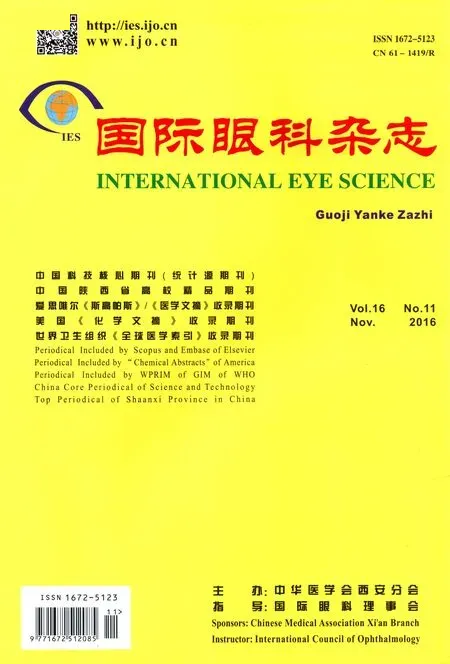
SMILE和FS-LASIK與LASIK矯正近視術后6mo的有效性和穩定性分析
2016-11-09 00:59:14燕振國
國際眼科雜志
2016年11期
孫 熠,曹 虹,燕振國
?
SMILE和FS-LASIK與LASIK矯正近視術后6mo的有效性和穩定性分析
孫熠,曹虹,燕振國
Department of Ophthalmology, General Hospital of Lanzhou Military Command, Lanzhou 730050, Gansu Province, China
?METHODS: A retrospective study, 42 cases (84 eyes) received SMILE, 37 cases (74 eyes) received FS-LASIK and 31cases (62 eyes) undergone LASIK in our hospital during Apr.2014 to Jun.2014 were involved. The follow-up data of 6mo was analyzed. The preoperative spherical equivalent was -5.91±1.83D, -5.89±1.96D, -5.88±1.68D in SMILE, FS-LASIK and LASIK group, respectively. The differences of preoperative best corrected visual acuity (BCVA), pupil diameter (PD) and central corneal thickness (CCT) had no statistically significant between three groups. The postoperative uncorrected visual acuity (UCVA), BCVA and diopter were comparative analyzed at 1wk, 1, 3 and 6m after surgery.
?RESULTS:1) No patients lost to follow-up of 1wk and 1mo. A total of 10 eyes (5 cases), 10 eyes (5 cases) and 8 eyes (4 cases) lost to follow-up of 3m in SMILE、FS-LASIK and LASIK group, respectively, and raised to 18 eyes (9 cases), 12 eyes (6 cases) and 14 eyes (7 cases) in follow-up of 6m. 2) At 1wk follow-up, the differences of UCVA between SMILE group, FS-LASIK groupvsLASIK group was statistically significant respectively (t=4.098,P=0.000;t=2.493,P=0.004). 3) In LASIK group, the differences of UCVA between 1wkvs3, 6m follow-up was statistically significant respectively (t=3.410,P=0.001;t=3.771,P=0.000), the differences of UCVA between 1m and 6m follow-up was statistically significant (t=2.283,P=0.026). 4) The differences of diopter were not statistically significant among three groups at 1wk, 1, 3 and 6mo follow-up respectively (χ2=0.119,P=0.942;χ2=1.504,P=0.471;χ2=0.949,P=0.622;χ2=0.277,P=0.871). 5) the differences of eyes with UCVA≥5.0 was statistically significant between SMILE groupvsFS-LASIK group, LASIK group at 1wk follow-up (χ2=9.249,P=0.002<0.05/3;χ2=12.906,P=0.000<0.05/3), there was no significant statistical difference between FS-LASIK group and LASIK group (χ2=0.500,P=0.604). 6) there was no significant statistical difference of eyes with SE (±0.50D) at any time post operation among three groups (χ2=0.809,P=0.697;χ2=1.176,P=0.634;χ2=0.871,P=0.736;χ2=0.683,P=0.770).
?CONCLUSION: All of SMILE, FS-LASIK and LASIK are effective and stable on treating myopia according to follow-up of 6mo. However, in this study, SMILE group shows more effective than FS-LASIK and LASIK at 1wk, which could enhance postoperative UCVA more rapidly.
目的:對比分析飛秒激光小切口角膜基質透鏡取出術、飛秒激光制瓣準分子激光原位角膜磨鑲術和準分子激光原位角膜磨鑲術后6mo的視力和屈光度,評價三種手術方式的有效性和穩定性。
方法:回顧性分析2014-04/06在我院行角膜屈光手術患者110例220眼術后6mo的隨訪資料,其中飛秒激光小切口角膜基質透鏡取出術(small incision lenticule extraction,SMILE)患者42例84眼,飛秒激光制瓣準分子激光原位角膜磨鑲術(femtosecond laserinsitukeratomileusis,FS-LASIK)37例74眼,準分子激光原位角膜磨鑲術(laserinsitukeratomileusis,LASIK)31例62眼。術前三組患者平均等效球鏡度分別為-5.91±1.83、-5.89±1.96、-5.88±1.68D,術前三組患者最佳矯正視力(best corrected visual acuity,BCVA)、瞳孔直徑差異及中央角膜厚度均無統計學差異(P>0.05)。對比分析三組患者術后1wk,1、3、6mo隨訪時裸眼視力(uncorrected visual acuity,UCVA)、最佳矯正視力(best corrected visual acuity,BCVA)、屈光度等。
結果:(1)術后1wk和1mo所有患者均按時隨訪,術后3mo時SMILE和FS-LASIK與LASIK組分別有5例10眼、5例10眼、4例8眼失訪,術后6mo隨訪SMILE和FS-LASIK與LASIK組分別有9例18眼、6例12眼、7例14眼失訪。(2)術后1wk,SMILE和FS-LASIK與LASIK組UCVA的差異具有統計學意義(t=4.098,P=0.000;t=2.493,P=0.004)。(3)LASIK組術后1wk與術后3、6mo的UCVA差異具有統計學意義(t=3.410,P=0.001;t=3.771,P=0.000),術后1mo與術后6mo的UCVA差異具有統計學意義(t=2.283,P=0.026)。(4)術后1wk,1、3、6mo三組患者屈光度的差異均無統計學意義(χ2=0.119,P=0.942;χ2=1.504,P=0.471;χ2=0.949,P=0.622;χ2=0.277,P=0.871)。(5)術后1wk,SMILE組和FS-LASIK組與LASIK組裸眼視力≥5.0的眼數差異具有統計學意義(χ2=9.249,P=0.002<0.016;χ2=12.906,P=0.000<0.0016),而FS-LASIK組與LASIK組裸眼視力≥5.0的眼數差異無統計學意義(χ2=0.500,P=0.604)。(6)三組患者術后1wk和1、3、6mo的等效球鏡度數在±0.50D范圍內的眼數差異無統計學意義(χ2=0.809,P=0.697;χ2=1.176,P=0.634;χ2=0.871,P=0.736;χ2=0.683,P=0.770)。
結論:在術后6mo內SMILE和FS-LASIK與LASIK矯正近視均具備有效性和穩定性,但SMILE在術后1wk的有效性優于FS-LASIK及LASIK,能夠在術后更快速地改善裸眼視力。
飛秒激光小切口角膜基質透鏡取出術;飛秒激光制瓣準分子激光原位角膜磨鑲術;準分子激光原位角膜磨鑲術
引用……
登錄APP查看全文
猜你喜歡
新少年(2022年9期)2022-09-17 07:10:54
音樂探索(2022年2期)2022-05-30 21:01:37
小天使·一年級語數英綜合(2020年6期)2020-12-16 02:56:41
河北畫報(2020年10期)2020-11-26 07:20:50
小天使·一年級語數英綜合(2019年8期)2019-08-27 02:23:00
小學科學(學生版)(2018年7期)2018-08-13 09:33:04
中國衛生標準管理(2015年3期)2016-01-14 03:41:47
北極光(2014年8期)2015-03-30 02:50:51
鄭州大學學報(醫學版)(2015年2期)2015-02-27 14:50:46
中國中醫藥現代遠程教育(2014年13期)2014-03-01 04:26:36