Application of Cooperative LearningMethod in Chinese Language Class in TraillInternational School, Bangkok
2016-05-12 21:18:51代閔
教師·中 2016年4期
Abstract:There have been a number of researches that investigated the effectiveness of using cooperative learning methods in second language learning. This research aimes to identify the improving reading proficiency of students in a class where the researcher applies a cooperative learning method on a group of students in learning Chinese as a second language in Traill International School.
Key words:cooperative learning; reading proficiency; effect
中圖分類號:G4241文獻標識碼:A文章編號:1674-120X(2016)11-0051-02收稿日期:2016-02-21
作者簡介:代閔(1982—),女,云南昆明人,云南師范大學文理學院助教,教育學碩士,2006年赴泰國易三倉大學研修,研究方向:課程與教學法。
1Introduction
Cooperative learning has a long history of many years in both theory and practice.[1]Sharan believes that cooperative learning is a class teaching method that organizes and promotes a series of methods to class teaching. All these methods are the basic characteristics in the learning process of cooperation. The main purpose of this study is to apply the cooperative learning for the improving reading proficiency of students in a class in learning Chinese as a foreign language in Traill International School.
2Sample
The study limited to students in Eighth Grade who had been learning Chinese as second language experience for 9 months. There were 13 students in this class, including 7 boys. The research used a true experimental design with experimental groups of the same level of students from Traill International School. In this study, researcher used the cooperative learning method in the classroom learning of experimental group. The research took 3 months as a cycle.
3Research Process
During the 3 months Chinese reading classes in the experimental group, the researcher observed students cooperative leaning processing in the class and after the class to know if the cooperative activities were suitable for the students. If it happened that the activities were not suitable, a different cooperative activity was to be implemented. It guaranteed the experimental group students were using cooperative learning method in Chinese reading.
(1)Preparation stage.The researcher covered four aspects: ①developed rational teaching plans and teaching activities based on the content of the material.②indoctrinated the concept and explicited rules of cooperative learning with students in outdoor works. ③took 4 principles to form cooprative groups. They were complementary by style, gender , and the class had to be divided into four groups with 3~4 students in one group.④Formulated scientific and rational evaluation system. It included the combination of self-evaluation and coevaluation and combination of the evaluation of cooperative learning process with the evaluation of cooperative learning outcome.
(2)Stages of implementation in cooperative learning. Each time before starting a new teaching lesson, the researcher explicitly assigned specific tasks or raised a few specific questions for each group to complete, such as previews, tasks which required students to look up words of a text and their corresponding meaning in the dictionary. Also, students were asked to access the internet to find relevant background of authors, the cultural knowledge for a lesson as well as summaries of a reading paragraph etc.
At the beginning of each class, the researcher stimulated the students interest through games and quizzes. The researcher checked whether students had carried out the necessary extra-curricular learning activity in addition to reproducing the task of pre-class layout. Then the groups presented the results that they had got through cooperative learning activities.
Second, after the new knowledge had been presented, depending on the learning tasks and contents, researcher in general applyed in several specific cooperative learning activities, Such as: group investigation, free combination of dialogue, group discussions. Those activities allowed students to actively participate in teaching activities. They mutually evaluated one another and they were given incentives to promote each other so as to complete the purpose of learning goals.
After class, a variety of tasks such as text repeat, role play, the continuation of the story, the reporter interviews, essay writing, debate, etc were assigned to help students to practice their Chinese language with the group when the class was over. The task was completed, then asked each group to hand out a report in the class. The answer should be checked and the mistakes should be corrected. The researcher gave the feedback and immediately provided the description and explanation for these mistakes for the students, and in accordance with the assignment sheet, the score of the team should be calculated.
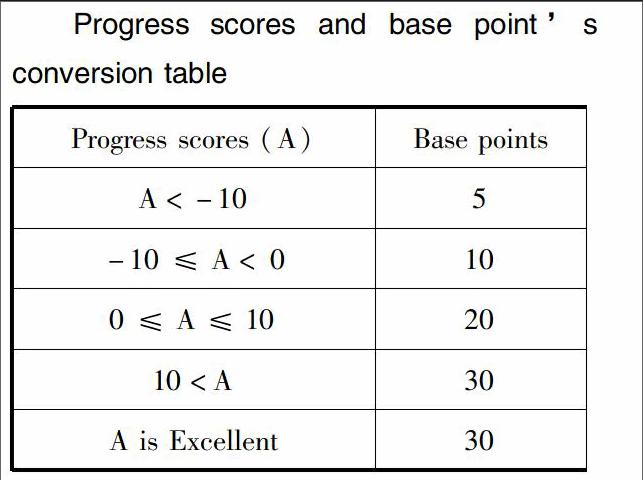
The researcher adopted the Assessment & Rubrics for Reading to evaluate the students' reading activities. To know about the personal progress of students——the score conversion, conversion tables were adopted in accordance with Slavin (1995)[2]as shown in Table 1 for the calculation. In this table, “base points” and “excellent” were used as standards. The group performance with 20 points was excellent and individual performance with 80 points. Less homework and beverages were used as rewards to encourage excellent performance in individual and groups which had high points.
Progress scores and base points conversion table Progress scores (A) Base pointsA<-105-10 ≤ A< 0100 ≤ A ≤ 102010 Taking 6 reading activities, the average scores for group progress showed 3 groups kept their average grades above 20 which meant they all reached the excellent level; one group was below 20.The average scores for students personal progress showed 8 students kept their average grades above 80 which meant they all reached the excellent level; 5 students had below 80, they still completed all reading activities in good level. 5Conclusion According to the results of this study, using cooperative learning to teach reading for students could enhance reading skills and it had a significant improvement of students reading proficiency. Using cooperative learning method to teach students how to read, placing more emphasis on interactive learning among peers, examination and reflection on the learning outcomes on regular basis and students teaching each other which were used in cooperative learning all had significant learning effects on the students. References: 〖1〗Slavin, RCooperative Learning and Academic Achievement〖J〗.Anales De Psicologia,2004,(3). 〖2〗Slavin, R Cooperative Learning: theory, research, and practice〖M〗New Jersey: Prentice Hall,1995.