
A List of Commonly Used Chinese Characters for Three Nations Jointly Issued
2016-03-18 06:27:14ByShuZi
文化交流 2016年2期
關(guān)鍵詞:研究
By Shu Zi
?
A List of Commonly Used Chinese Characters for Three Nations Jointly Issued
By Shu Zi
On November 30, 2015, a new book on 808 commonly used Chinese characters in China, Japan and South Korea was released during the 10th session of the Northeast Asia Trilateral Forum held in Seoul, marking one of the most important achievements of the forum in its ten-year history. A mega droplight at the forum showed all the 808 characters impressively.
European languages differ from each other in pronunciations even though these languages use similar letters. Some historians believe that’s exactly why Europe remained split for a long while. In contrast, China has remained unified by the common language even though people used to speak dialects which presumably varied every ten miles and which represented different lifestyles every 100 miles. In the vast country, Chinese characters have played this unifying role for more than 2,000 years. In the 20th century, some people tried in vain to replace the Chinese characters with an alphabetic writing system. This effort has been strongly criticized. Some people even go so far as to say that this proposed replacement was meant to cut us off with our cultural roots.
The core values of the cultures in East Asia have been written in Chinese charac-ters. During the Kingdom of Joseon (1392-1910) that held Korean Peninsula together, Chinese characters were universally used. The characters were considered the demarcation line between the intellectuals and the illiterate commoners. In history, Chinese was officially used on the peninsula. Korea was economically, politically and culturally influenced by China. Its close ties with China were cut off when it came under the colonial rule of Japan. After World War Two, Korea banned the use of Chinese characters. However, Chinese characters were still widely used. The education authorities changed its policy on Chinese characters several times. In 1968, the government demanded to delete all the Chinese characters from textbooks for primary and middle schools. In 1972, Chinese characters made a comeback into junior high school textbooks. In 1973, middle schools were instructed to use Chinese characters again in textbooks. In 1995, Chinese characters became a selected course. In 1999, a presidential decree approved the use of Chinese characters in government documents and road signs. The education authorities of South Korea have issued a list of 1,800 Chinese characters for general use and a list of commonly used 1,300 Chinese characters. In recent years, more and more Koreans are learning Chinese as economic and cultural ties between the two countries are becoming increasingly closer.
Compared to other nations in the world, Japan has deepest cultural roots in the Chinese culture, which has impacted the culture and national characteristics of Japan in an all round way. As soon as Japan became unified in the early fifth century, it copied China’s government system and absorbed technology from its giant neighbor. Japan was shaped by Chinese culture in many ways: Chinese language, Confucianism, law, Buddhism, architecture, tea, just to name a few.
Chinese characters are widely used in Japan. There are 1,945 Chinese characters in common use. Primary schoolers are supposed to master 500 essential Chinese characters and middle school students are required to master 1,300. Though these words are complex in writing, they convey information in a way no other words can do with ease. Japanese and Chinese can use Chinese characters to communicate with each other effectively. The best known example of this kind of communication happened between Dr. Sun Yat-sen and his Japanese friend when they chatted by writing Chinese words and worked out a way to raise funds in Japan for the revolutionary cause Dr. Sun was leading back in China.
Ji Baocheng, former president of Renmin University of China, is the man who has proposed to initiate the list of Chinese characters commonly used in the three Eastern Asian countries. He insists that people of the three countries can use the 808 words to communicate effectively without speaking the languages.
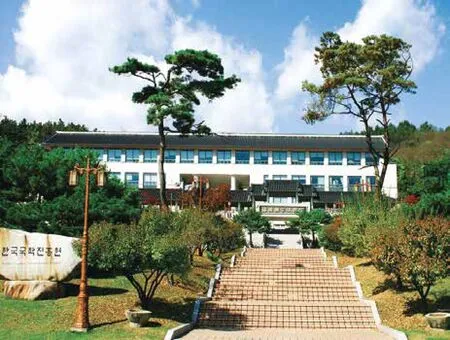
韓國(guó)國(guó)學(xué)進(jìn)興院(韓國(guó)朝鮮高級(jí)研究中心)有儒教雕版印刷木刻版。The Advanced Center for Korean Studies houses Confucian printing woodblocks.
Lee O-young, South Korea’s former Minister of Culture, said that the reason why the forum could be held in 10 consecutive years even in difficult times is the three countries’ shared culture. By promoting the application of the 808 characters like naming children, enterprises and road signs, Lee said the three countries could further enhance communication and lift barriers in other areas.
Atsuko Toyama, Japan’s former Minister of Education, Science, Sports and Culture said the release of the book is a milestone and we should see it as a starting point in promoting the development of the three countries in all areas in the coming decade.
The work for putting the list together went on for years. The commonly used characters were determined on the basis of historical literature and approval of experts. The list is composed of two parts: a general list and a comparison list. The characters on the general list are all ancient Chinese characters. The comparison list shows all the variations of these words used respectively used in China, Japan and South Korea. About 540 characters are written in the identical way in the three countries; another 200 characters are written in traditional and simplified ways respectively. As simplification has been going on in China for centuries and accelerated after 1949, China has officially simplified some characters and issued standardized list of commonly used characters.
猜你喜歡
體育科技文獻(xiàn)通報(bào)(2022年3期)2022-05-23 13:46:54
天津外國(guó)語(yǔ)大學(xué)學(xué)報(bào)(2021年3期)2021-08-13 08:32:18
遼金歷史與考古(2021年0期)2021-07-29 01:06:54
科技傳播(2019年22期)2020-01-14 03:06:54
遼金歷史與考古(2019年0期)2020-01-06 07:45:20
民用飛機(jī)設(shè)計(jì)與研究(2019年4期)2019-05-21 07:21:24
電子制作(2018年11期)2018-08-04 03:26:04
汽車工程學(xué)報(bào)(2017年2期)2017-07-05 08:13:02
國(guó)際商務(wù)財(cái)會(huì)(2017年8期)2017-06-21 06:14:14
電子制作(2017年23期)2017-02-02 07:17:19
