
REAL GAMERS DO IT WITH DICE
2015-12-28 11:05:23BYOLIVLABULLOCK
漢語世界 2015年1期
BY OLIVLA BULLOCK
REAL GAMERS DO IT WITH DICE
BY OLIVLA BULLOCK
A look at the rise of board games in the Middle Kingdom
在中國,桌游是舶來品,但本土桌游已悄然醞釀一個時代
The dragon didn’t go down without a fi ght. After 30 minutes of grueling combat, harried dice rolling, and good-natured yelling, the adventurers were triumphant. A cry of joy rose up, quickly followed by the ubiquitous shouts of “I loot the body!” Nearby, other parties of explorers, architects, and wizards joined in the cheer. “Wow, that combat took forever. I was sure you guys were gonna die.” After the initial excitement, the assembled players began to resume their undertakings: building cities, amassing treasure, and strategizing for magical duels. Beijing’s premiere tabletop gaming (桌游) convention was in full swing. An emerging subculture, tabletop games are niche, nerdy, newly beloved, and they’ve found a home in China.
While China plays host to some of the world’s oldest board games, today many see traditional games as an old folks’ hobby. In Europe and North America, tabletop games have gone through a quiet renaissance in geeky, gamer communities. Interest in these new games in China reached critical mass in the 2000s; the dam of censorship broke, and a fl ood of new games arrived in China. Western tabletop games are a young person’s world: new, complex, and imaginative. In a country where millions of 20- and 30-somethings move away from their home provinces, these games are beginning to fi ll a void that online games can’t touch—the fun of playing with friends face-to-face. China is dipping its tentative toe into the traditions of roleplaying and board games, and so far, the water is warm.
Enter Khan Kon (可汗游戲大會). This fl edgling convention brands itself as “by gamers, for gamers”, and it’s the only meet-up of its kind in China. While they started small, today, Khan Kon’s organizers have an ambitious dream: to pave the way for tabletop gaming culture in China. In many ways, the convention is a microcosm of the Chinese gaming world—an Eastmeets-West melting pot of geeky fun, where players compete savagely in tournaments, shout over each other for their game masters’ attention, and laugh through translations of in-jokes.
Khan Kon began with a far-fl ung group of friends who wanted to get together to game. “We went from ‘gaming retreat’,” says Khan Kon President Dan Bass, “to a full gaming convention. We doubled in size after our fi rst year.” And doubled again after that. 2014 was the fi rst Khan Kon to take place across two cities, with a weekend in Shanghai with 250 attendees and a weekend in Beijing with nearly 450. Bass explains, “[The enthusiasm] left us realizing there was a huge niche here that needed fi lling; a convention where gamers can have fun, play games, and meet other like-minded people.” While most of the founders were Beijing-based expats, most of the growth in attendance came from Chinese players.
Today, Khan Kon works to bridge the gap between hardcore nerds and newbies, so they organize events at a variety of levels for a variety of languages. Many of their games are billed as specifi cally bilingual, encouraging both Chinese-speaking and English-speaking players to join the fray.
The majority of tabletop games are published in English, but the language barrier rarely deters monolingual Chinese players. Since tabletop communities are niche in the extreme, most players fi nd their fi rst games through friends; rules and strategy are all passed on by word-of-mouth. As the gaming community evolves in China, more and more events are tailor-made for Chinese players. One of Khan Kon’s centerpiece events was a bilingual live-action role-play called “Like Blood from Jade”. Set in a world of vampires and intrigue, Chinese and expat players took on the characters from warring clans of vampires, bargaining for territory via hardworking storytellers-turned-translators.
Tabletop games are diverse, so the appeal is different for each player. To the initiated, it’s shocking how immersive roleplaying games can be. “When I was young, I loved wuxia stories,” says Shaiw-ling Lai, a Chinese-American expat and long-time gamer. “When I fi rst discovered D&D, I thought, ‘I get to be these characters I used to read about!’” Clover Tan, a Beijing resident whose fi rst tabletop experience was at Khan Kon, had simpler reasons to love the game. “I took a goblin as prisoner!” she enthuses, “I got to decide if we would kill him! I was really badass.”When players describe their experiences in character, they always say, “I did this”, rarely “my character did this.”Players recount past adventures like war stories and look forward to honing their martial skills.
“Younger players love the storytelling,” explains Zhang Hao, one of Khan Kon’s founders. “Older players are infl uenced by 1990s computer RPGs, as well as fantasy novels like the Dragonlance series.” He believes that Chinese and Western players are both drawn to tabletop games for the same reasons, but the genre’s novelty in China means that Chinese gamers mostly copy Western styles—new innovation will still take time. China’s gaming world is a melting pot, but the pot has yet to be stirred and heat is still on low. Zhang emphasizes that tabletop games are only possible in China thanks to globalization.
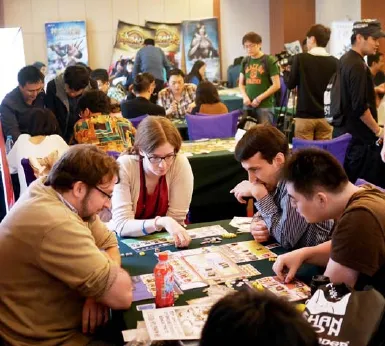
Gamers enjoy the camaraderie of Khan Kon

Many tabletop games are exceedingly niche and complex
The fi rst tabletop games arrived in China during the Reform and Opening Up in the 1980s. For Westerners, it’s hard to imagine how unusual and transgressive these fi rst games must have been—even games as pedestrian as Monopoly were surrounded by hushed fervor, since it espoused virtues antithetical to the Communist Party doctrine of the time. The fi rst role-playing game only arrived on the Chinese mainland in 2000: the third edition of Dungeons & Dragons. Unoffi cially translated, D&D became “Dragons and Underground Cities” (龍與地下城). In the small world of Chinese gamers, Zhang worked with some of the fi rst translators. In his own words, “D&D opened a whole new world for Chinese players. We’d never seen anything like it.”
Interest in other tabletop games took off around 2004 and 2005, when the Internet made it possible to buy box games directly from Western publishers. At that time, most players were university students, playing in cafeterias and shuiba (cafeterias with soft drinks and water). Social party games gained popularity, until they reached a tipping point with Sanguosha (三國殺, literally“Three Kingdoms Kill”).
Sanguosha is based on a Western party game called Bang!, where outlaw players kill townsfolk and sheriff players try to deduce the killers. To win, players lie, cajole, and strategize their way to dominating the group dialogue. While the game’s premise is an old one, Sanguosha’s re-theming around the Romance of the Three Kingdoms sparked popularity with Chinese gamers. By the late 2000s, the spark had grown into a wildfi re, and no gaming get-together was complete without a murder or two. It’s enduringly popular, even achieving a few knockoffs. Many call Sanguosha the fi rst truly“Chinese” innovation in tabletop gaming.
Gaming culture in China is still very new. Its myths still draw heavily from the sword-and-sorcery legacy left by Tolkien, and its gameplay is limited to the most popular titles from Western companies. That said, China is setting itself apart in unexpected ways. A major difference geeks will fi nd when gaming in China is the lack of social stigma—simply put, don’t expect to be made fun of if you say you play D&D. In China, non-gamers are likely to be confused or genuinely interested. China’s tabletop gamers aren’t stereotypical losers or loners; unlike the quiet of seedy internet bars, the social interactivity central to tabletop games means that even the shyest need to speak up. China has even escaped some of Western gamers’ pervasive sexism; if Khan Kon is any indication, the gender ratio of players is considerably more balanced.
China is poised to be the perfect market for tabletop games; its arbitrary 14-year ban on console video games was lifted in January of 2014. Chinese gamers have proven their dedication to PC gaming, from the battle arenas of League of Legends to digital card games like Hearthstone. Tabletop games may not have the advertising power to compete with digital giants, but this works to their advantage. The players like these games artisanal and niche—designers rarely work to appeal to advertisers or the general public, only the most dedicated fans. So be they a towering giant or merely a halfl ing, it would seem these tabletop avatars have an exciting future ahead.
猜你喜歡
陽光(2020年6期)2020-06-01 07:48:36
陽光(2020年5期)2020-05-06 13:29:18
現(xiàn)代家庭·生活版(2017年3期)2017-03-15 18:45:43
初中生學習·低(2016年10期)2016-11-25 04:51:34
飛碟探索(2016年11期)2016-11-14 19:34:47
足球周刊(2016年14期)2016-11-02 10:56:23
足球周刊(2016年15期)2016-11-02 10:55:36
足球周刊(2016年10期)2016-10-08 10:54:55
作文大王·笑話大王(2016年8期)2016-08-08 11:28:22
小學科學(2015年7期)2015-07-29 22:29:00
