
SCRAP EMPIRE
2015-12-28 11:30:41BYROBERTFOYLEHUNWICK
漢語(yǔ)世界 2015年1期
關(guān)鍵詞:經(jīng)濟(jì)
BY ROBERT FOYLE HUNWICK
SCRAP EMPIRE
BY ROBERT FOYLE HUNWICK
Sifting through the garbage industry to understand China’s recycling economics
個(gè)體廢品回收者用一個(gè)個(gè)廢紙箱、汽水瓶支撐起了家庭的生計(jì)、一套半地下的經(jīng)濟(jì)和城市龐大的再循環(huán)系統(tǒng)
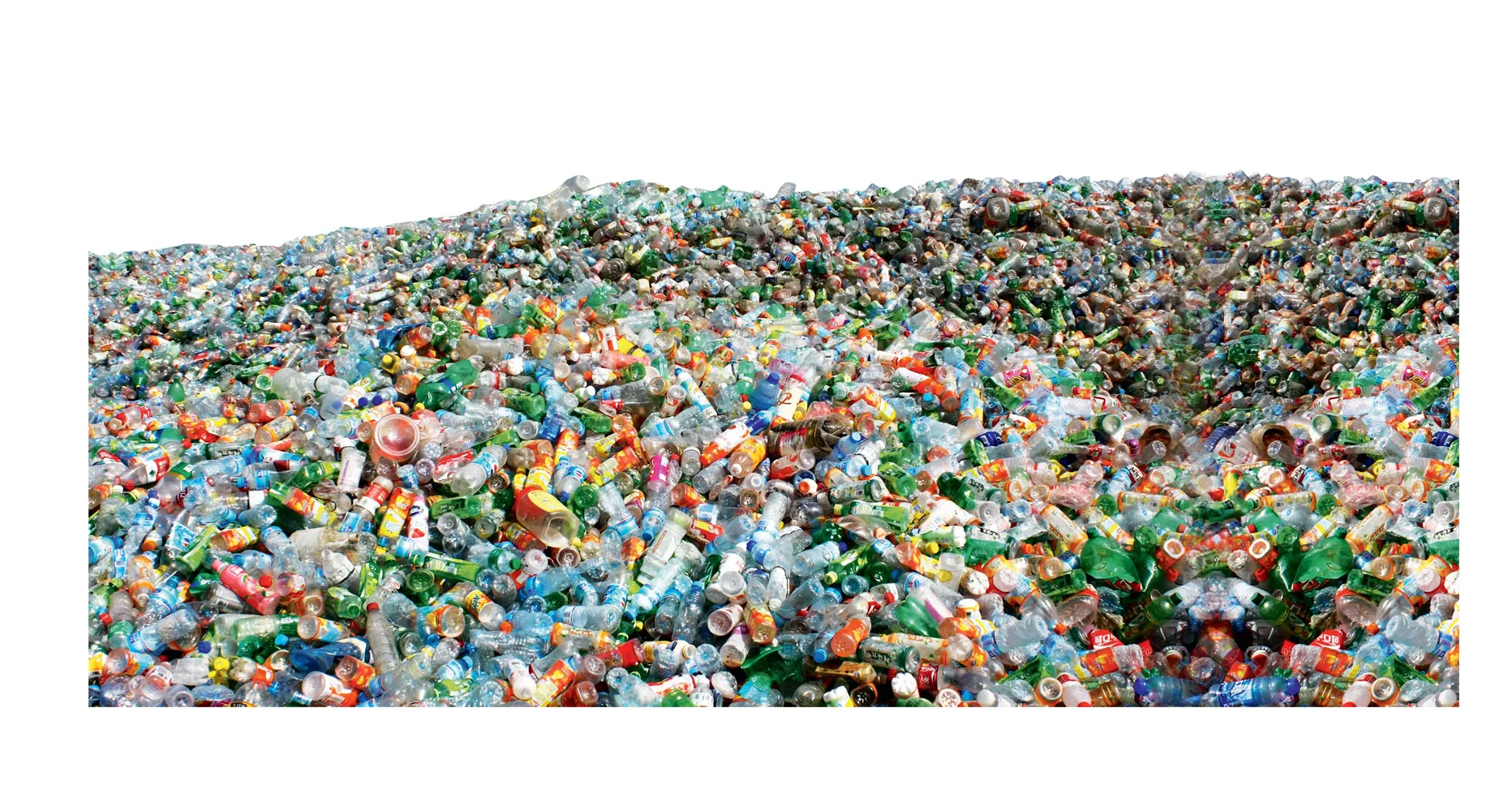
They seem ubiquitous—picking through trash, panning for gold in scrap metals—yet few pay much or any attention to them. He might be pulling a rickshaw piled precipitously high with fl attened cardboard, bound with string. She might be with her children, sifting through rubbish bags looking for empty cans, plastic bottles, bags, anything with resale value. Or it’s someone going door-to-door picking up off-cuts of everyday consumerism: six month’s accumulation of glossy magazines or the discarded cardboard packaging of a new computer.
Indeed, even your computer could eventually make its way to one of South or North China’s many “electronics graveyards”, villages often surrounded by industrialized towns where unskilled men, women, and children strip wires, dismantle plastics, and pick apart motherboards for just a few dollars a day.
They are just some of China’s estimated ten-million strong recycling army, unlicensed workers who help keep the streets free of waste and power an enormous semi-underground recycling industry.
Hard numbers are always diffi cult to come by in China, though the size of the informal industry is clear from the sheer number of people seen doing it. Whether it’s cans, cardboard, bottles, or broken appliances, chances are virtually everything you throw away will have been pored over and inspected for resale value, reducing landfi ll and powering a miniature economy.
Despite this valuable service and the work it provides to millions just above the poverty line, the duties they perform are not much valued by society, except for the few yuan they scrape together for their wares.
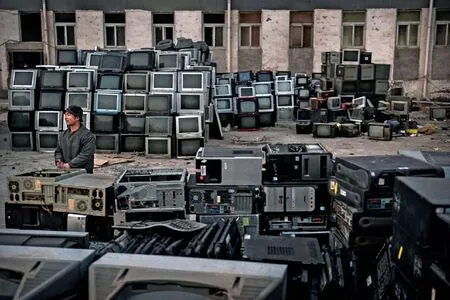
Electronics graveyards like this one outside Beijing are a lifeline for Beijing's recyclers
“Driven at the lowest level by poverty, the informal industry has a remarkable dynamism,” says Jonathan Watts, former Guardian Asia correspondent on environmental affairs and China and author of the excellent (if gloomy) account on these subjects, When A Billion Chinese Jump: How China Will Save Mankind—Or Destroy It. “The collectors face many of the risks associated with poverty and dwelling on the street: dirty conditions, exposure to the elements, occasional violence, and low levels of nutrition. But their situation would be worse if they were stripped of the income that comes from selling other people’s trash.”
The year 2008, for example, was a particularly harsh one, as a global credit crisis coincided with the tail end of the momentum initiated by the announcement of the Olympic Games. Many of these migrants faced penury when the price of recyclables—such as plastic, paper, and aluminium—plummeted by as much as 66 percent in a single month; global prices for some types, such as steel, fell by 80 percent in only a few weeks. These trends may be set to worsen, if newspaper readers turn to computers, tablets, and e-readers for their consumption and the availability of newsprint for recycling—which is worth more than junk mail—declines.
The trade in trash is one of the bellwethers of the global economy; when manufacturing is up or down, the producers and recyclers of its raw materials, which includes scrap, are often the fi rst to feel the benefi ts or the pinch.
Of course, the majority of those on the lower rungs of the recycling industry don’t tend to livein the neighborhoods they work and collect from. In Beijing, this means living outside the “Five Rings”, the ever-expanding network of circular roads that encircle the city. A seventh—a 940-kilometer concrete noose around Beijing, Tianjin and Hebei, incorporating second-tier cities like Langfang, Chengde, and Pinggu—is planned for 2017. But some environmentalists have already coined the term “seventh ring” for the belted wastelands between the fi fth and sixth roads, where a sprawling and unsightly mix of state-run and illegal rubbish sites have sprung up. It is within this suburban landscape of discarded consumer culture that, ironically, many of the recyclers live.
Yang Yunjun, 47, for example, rides in all the way each morning from Changping to Dongsi, crossing half the city every day. A tricycle like the one ridden by him or Zhai Xuegui—another peddler who usually leaves the suburbs at dawn to provide food and rent for his family—will cost around 2,000 RMB. It is their only vehicle and sole means of making a living. A traffi c accident, say, or entanglement with an over-zealous urban management offi cer could easily cost Zhai his livelihood, yet he is more concerned about his children’s education and futures. He has a son, 12, and daughter, nine, and in time they will need to marry. What does he worry about most? “Property prices.”
Ma Shaodong seems unusually lucky—his job at a depot enables him to live in the city, thus avoiding a daily commute of at least two hours. But Ma, 36, doesn’t really consider himself fortunate. Unhappy with the type of work he has been doing for the last six years, Ma avoided eye contact and was reluctant to talk. It was only when asked about his children back home that he became animated. “I have a daughter of 17,” Ma says proudly.“She’s good in school.”
Ma lives and works at a small, makeshift trash depot in the hutongs, presided over by the warm, personable Wang Xiuyuan who has been running her little station for the last four years. Unlike some of her workers, she didn’t mind taking pictures or chatting. Wang seems relatively content with life—both her children, 18 and 24, are grown up. “Most of us are from Henan,” she says, referring to the Beijing’s street recyclers.
Those who make the journey from poorer provinces to the big city for this work do so at the risk that their migrant status disallows them from the social support they might enjoy back home, whether that be access to education and healthcare, or a network of family. Yet some do well and prosper, like Hu Xuedao, 46, who’s living the classic migrant dream: his adult children have just started a clothing business in Beijing, where the family live in the eastern outskirts of Tongzhou, while his newhome back in Henan is under construction.
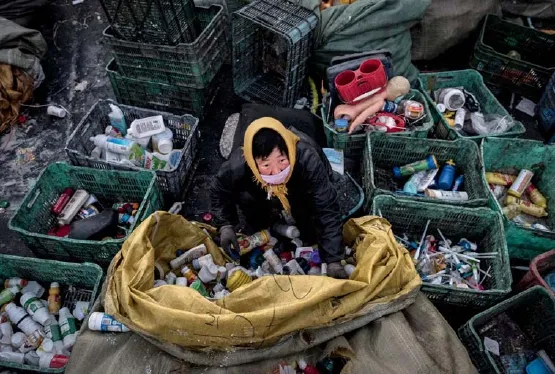
One of Beijing's tens of thousands of recyclers sorts through plastic
Hu is one of those who buy from the scrap collectors, sorting their wares to send to the big plants out in the suburbs. On a wall behind, he lists the current market prices, updated every day, for different materials, earning as much as 10,000 RMB a month by his count (others in the same area near Dongsishitiao appear to have less success, with most saying they pull in around 4,000 RMB). Like any Chinese peasant, though, housing and children are now his biggest concern.
The offi cial position toward such workers and their stations is usually to ignore them; when they are noticed, they are deemed an eyesore. In the months leading up to the 2008 Games, scrap peddlers were forced to leave the capital, along with beggars and petitioners, or stay at home, their depots shut as part of the city’s image clean up; the alleys, meanwhile, were soon piled with rubbish. The same thing happened over the Expo 2010 in Shanghai, despite its offi cial theme of “Green Cities”. On a daily basis, peddlers face suspicion and hassle from ever-present baoan or security guards, patrolling for thieves, vandals, and outsiders. Their scrutiny is not without justifi cation: “Overzealous or illegal collectors sometimes pick up ‘waste’ before it has been discarded,” Watts points out. “Hence stories in the past of manhole covers and telephone lines disappearing.”
Meanwhile, there’s little interest in any of their knock-on environmental benefi ts, such as reducing landfi ll and thus helping prevent social unrest, since burning overfl ow is unpopular with residents and is one of many factors contributing to the intense problem of air pollution.
Without work, these people are also a potential social problem at risk of being permanently unemployed, as Adam Minter, the formerly Shanghai-based author of Junkyard Planet: Travels in the Billion-Dollar Trash Trade and an expert in the global recycling industry, explains.
“It’s the rare person who aspires to be a picker. Rather, it’s something you do when you can’t do anything else,” says Minter of the limited employment opportunities available to those who choose this line of work. “The various levels of the Chinese government who look at this problem don’t tend to look at it in unemployment terms, but in terms of how much revenue and resources can be derived from trash if handled by other means.”
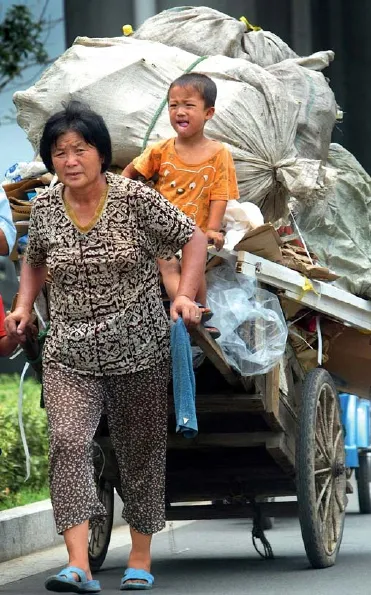
A woman pulls a cart of recyclables by hand through the streets of Nanjing
In big cities like Beijing and Shanghai, this involvesmaking municipal plans because “There’s a widespread perception in governments everywhere, not just in China, that peddlers are less effi cient and dirtier than‘real recyclers’ who use green and blue bins and giant, high-tech recycling factories. That’s wrong on most levels,” Minter says. But, as Watts says, the system that depends on these peddlers is far from being an adequate replacement for institutionalized recycling: “Visit the many landfi lls on the outskirts of the city and you’ll fi nd vast quantities of material that could be re-used.”
One idea involves encouraging residents to store recyclables for monthly collection, for example, in exchange for points that can be redeemed for gifts online. There are other, existing regulations—Beijing has licensed nearly 100 waste collectors since 2005, for example—but few members of the public have been alerted to these changes or are even aware of the difference. “The effect [of licensing] has been somewhere between zero and nothing,” observes Minter.
For much inner-city recycling, then, the burden falls on the poorest, because they are the ones prepared to do what’s necessary. At the very lowest levels, that involves small groups paying a few kuai for an attendant to look the other way while they comb through housing compounds’ nightly garbage in the dead of night, looking for recyclables. It’s the last stage in a process that begins with the likes of Wang Xiuyuan, with her depot and weighing scales. Although most bins claim to have two sections, one for non-recyclables and one for recyclables, a quick look at any of the latter’s grimy contents reveals the casual level of inattention paid to any of these directives.
Beijing is expected to dispose of 23,000 tons of rubbish daily by 2015, according to offi cial statistics, a fi gure rising by as much as ten percent annually; most people rely as much on low-paid workers to do their casual recycling as the peddlers depend on their laziness.
This work can be demeaning and dangerous; workers slit open garbage bags to sift with their bare hands through food waste, broken bottles, and sharp cans. In December, 2014, on a bitterly cold early morning grocery-run-cum-dog-walk, I witnessed a small group of three, one woman and two children, do just this, afterwards cleaning up what was left to stay on the good side of the baoan.
Those who do similar jobs working through e-waste face worse: Unlicensed recyclers stripping electronic goods for scrap discard waste that is toxic to them, others, and the soil. “TV sets, computer consoles, and circuit boards contain a number of toxic chemicals, including cadmium, chromium, polyvinyl chlorides, mercury, lead, and brominated fi re retardants,” explains Watts.“Studies of children in Guiyu (貴嶼, in Guangdong Province, South China) found levels of lead in the blood that were 50 percent higher than limits set by the US Centre of Disease Control. This can result in mental retardation.”
And it’s not just their health that e-recyclers are gambling with: “The fi nancial risk is that much of the business is semi-legal or illegal,” says Watts,“which means it may be closed down without notice or compensation—as happened in Guangzhou after a series of international news reports (including a November 2008 report on Guiyu by 60 Minutes) about the poor conditions of e-waste recyclers.”
Legitimizing a recycling business doesn’t always help.“Ironically, in many cases, the areas where that work is performed are approved by local government units in a position to offer health, safety and environmental protections, and choose not to,” says Minter. “For example, Guiyu, China’s largest electronics re-use and recycling zone, is approved by the National Reform and Development Commission. They could do more.”
Some also say the government should focus on monitoring the business, rather than individual pickers, many of whom are old and lack the education needed for a license. Instead, a better idea might be training pickers in spotting and selling recyclables and, moreover, collecting them safely. This, though, is unlikely to happen soon. “At this point, they just don’t register as a big enough problem compared to other environmental and health issues, to be worth the massive human and fi nancial investment that such licensing and subsequent monitoring would require,”Minter explains.
Not everyone is so disinterested in the lives of these unsung service providers. No less a personage than Pope Francis has singled out scrap-pickers across the world for particular praise. The ascetic Francis described the work of his native Argentina’s cartoneros (“cardboard people”), who pick through the city’s garbage every day for recyclable or reusable goods, as both “dignifi ed”and “good for the environment” and criticized what he called a “throw-away culture”. In Argentina, along with Colombia and Brazil, there are social organizations for “excluded workers”, aimed at mobilizing members for better conditions, rights and incentives, politically impossible in China.
Indeed, for the moment, the cartoneros of China can only look forward to the day when a similarly high-minded offi cial offers the same sort of recognition to them.
猜你喜歡
今日農(nóng)業(yè)(2022年14期)2022-09-15 01:44:56
民生周刊(2020年13期)2020-07-04 02:49:22
商周刊(2019年18期)2019-10-12 08:51:16
商周刊(2019年18期)2019-10-12 08:51:10
中國(guó)外匯(2019年23期)2019-05-25 07:06:20
華人時(shí)刊(2018年23期)2018-03-21 06:26:00
西部大開(kāi)發(fā)(2017年7期)2017-06-26 03:14:00
中國(guó)工程咨詢(2017年5期)2017-01-25 15:22:24
大社會(huì)(2016年6期)2016-05-04 03:42:05
金色年華(2016年13期)2016-02-28 01:43:33
