
Recent Progress in Heavy Fuel Aviation Piston Engine
2015-11-21 07:08:56ChenWei陳偉ZhouJianhao周健豪HeXiaoming何小明
Chen Wei(陳偉),Zhou Jianhao(周健豪),He Xiaoming(何小明)
Recent Progress in Heavy Fuel Aviation Piston Engine
Chen Wei(陳偉)*,Zhou Jianhao(周健豪),He Xiaoming(何小明)
College of Energy and Power Engineering,Nanjing University of Aeronautics and Astronautics,Nanjing 210016,P.R.China
Heavy fuel aviation piston engines(HE-APEs)refer to the engine using fuels with high flash point,such as kerosene or light diesel.Here technique specifications of some classical foreign HE-APEs(Hirth3503,Zanzottera 498)are introduced.Recent progress and trend of fuel injection,fuel ignition,working cycle,intake charging,thermal management and electronic control of HE-APE are compared and summarized.Emphases are put on the technological difficulties,solutions and development tendency in the design,retrofitting and manufacturing of HE-APE aiming to provide
for the research of related area and the development of prototype HE-APE in China.
heavy fuel;aviation piston engine;direct injection;electronic control
0 Introduction
Aviation piston engines(APE)generally consists of two ignition types:spark-ignited and compression-ignited.The former employs gasoline and kerosene as fuels with the assistance of a spark plug to provide ignition energy.The later enables compression ignition for fuels by increasing the compression ratio.
Compared with gasoline,heavy fuel(aviation kerosene)has lower volatility,higher flash point and lower flame propagation speed which is hard to be ignited[1].Meanwhile,for turbo-charged HE-APE which requires more fuel supply during each working cycle at high engine speed and load,higher requirements are put forward to mixture formation and ignition in terms of fuel spray and ignition energy due to the limited duration for fuel evaporation.Therefore,the breakthroughs of heavy fuel injection,ignition and super(turbo)charging technologies,etc,are key factors for research and development of HE-APE.
With concerns of safety,simplicity of logistics and cost-effective,abundant works were conducted on HE-APE which were vigorously promoted in UAV in foreign countries around 1990.In 1988,the development guideline of aviation piston engine issued by NASA and Department of Defense(DoD)pointed out that the fuel of piston engine for military use should be single heavy fuel(″Single Euel on the Battlefield″).Eurthermore,EAA published in 1994 regulated that general aviation must use heavy fuels[2].Under such circumstance,more efforts were put on the research of HE-APE during the last decades and series of breakthroughs were made.Spark-ignited and compression-ignited HE-APE were successfully developed and gradually expanded in aircraft application.
1 Significance of Developing HFAPE
With the rapid development of industrial technology and the acceleration of military revolution,great attention is paid on the development of HE-APE,especially for the world′s premier military power,US.There are mainly two reasons:for one thing,JP-5,JP-8 and other heavy fuels have higher flash point which is not easy to be ignited in order to fulfill the requirement of single fuel on battle;for another,gasoline is hard to transport and easy to explode.However,due to the technology limits,the development of HEAPE is disturbed for a long time until 1989[3].To date,HE-APE has been successfully applied to UAVs in US,such as MQ-5B Hunter,Warrior,ScanEagle and Killer Bee[4].
1.1 Variation of aviation fuel for US army
The serial number of aviation kerosene is EXX and JP-XX for North Atlantic Treaty Organization(NATO)and US air force,respectively.
Aviation kerosene,JP-4(E-40)and JP-8(E-34),were firstly used to avoid catching fire which occurred in the Vietnam War.The superiority of JP-8 refers to its low volatility and condensation temperature.The aviation kerosene was changed from JP-4(E-40)to JP-8(E-34)for USAE based in UK in 1979.JP-8 was also applied by USAE in EU in 1988,as well as in Japan and South Korea in 1991[5].
The aviation kerosene used in EU,Jet A-1(NATO E-35)can transfer to JP-8(E-34)by adding frozen-inhibitor,corrosion-inhibitorand lubricant.Jet A aviation kerosene was used by continental US which is similar to NATO E-35. Compared with JP-8(E-34),Jet-A has higher condensation temperature and high flash point range,leading to denser fuel spray and higher evaporation temperature[6].
The flash point(35℃,100℉)is low for Jet A,E-34 and E-35.E-40 consists of 60%naphtha and 40%kerosene and its flash point is between -23℃and-12℃(-10—+10℉),therefore,it is easy to vaporize.JP-5(NATO E-44)is the main fuel for navy which has low flash point(60℃,140℉)and low volatility[7].
1.2 Development program of HF-APE in US
In the early 1990s,US proposed the development program of HE-APE requiring the technique targets as shown in Table 1.
Based on the feature of HE-APE,the advanced technologies consist of the following aspects:
(1)Advanced in-cylinder direct injection
In order to combine the superiority of lean burnmechanism and fuel-efficiency of diesel engine,a direct injection technology is applied.

Table 1 Technique target of HF-APE
(2)Stratified lean-burn combustion
The knocking of piston engine has a bad effect on indicated thermal efficiency and also limits the compression ratio.Therefore,high intense turbulence and stratified lean-burn technology are developed.The lean-burn technology reduces the knocking tendency which enables the increase of compression ratio to 12—14.In addition,at part of full engine load,the engine combustion can be adjusted like diesel engines,which contributes to an increase of thermal efficiency by 15—20%. The lean-burn technology is also coupled with turbo-charging and applied to piston engine.
(3)Euel additives can change the physical properties of fuel,eg.flash point.
(4)The research and test of reliability of engine structure is critically important at the premise of R&D period.
(5)The design consists of computer simulation,assembling and testing experiment,including sea-level and high-altitude experiments[8].
The design of engine satisfying the requirement of navy needs to have low weight and high fuel efficiency.The combustion mode of shaft turbine is continuous and has high fuel consumption.Compared with shaft turbine,the combustion mode of HE-APE is intermittent.Due to thetechnology reason,the program of HE-APE is delayed.Until the late 1990s,US navy had been increasingly interested in developing HE-APE with low weight and high fuel efficiency which can work stably at 40 000 feet high.The program is then carried out competitive biddings domestically.After that,13 competitive bidding were received and three proposals were finally chosen as shown in Table 2.
In April,1992 and January,1993,the USnavy chose the prototype engines for bench test. The results are shown in Table 3.Erom Table 3,it can be found that the three prototype engines cannot fulfill the requirement of US navy[9].
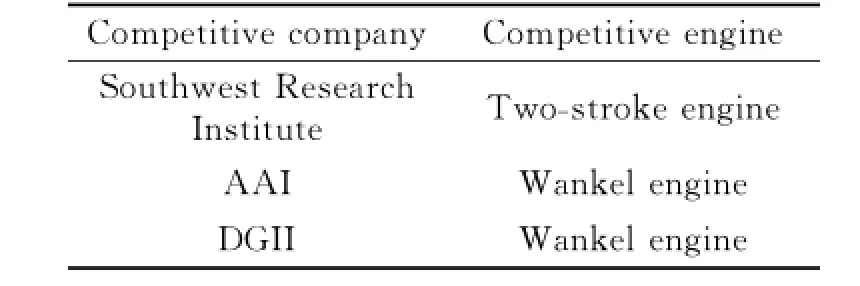
Table 2 Proposals of three competitive companies

Table 3 Experimental results

Table4 Difference between spark ignited and compression ignited HF-APE
1.3 Summary of experience
The way to realize heavy fuel combustion can be summarized as follows(differences are listed in Table 4):
(1)Compression ignition aviation piston engine,such as diesel engine
The engine parts need to have high strength and stiffness since the in-cylinder gas pressure is high and aluminum cannot be used.Meanwhile,due to the different mixture preparation method,engine speed is limited.Therefore,the size and weight/power ratio of compression ignition engine is higher than that of spark ignition engine.
The compression ignition piston engine needs high compression ratio and hence heavier crankshaft.Therefore,it needs more metal and accordingly increases the fabricating cost.
The density of heavy fuel is higher than that of gasoline such that the fuel tank can store more diesel fuel.
However,due to the requirements of high power per liter,high power/weight ratio,low vibration,the diesel fuel piston engine is hard to be realized.Therefore,spark ignited kerosene piston engine was widely proposed.It is now reportedthat there is still no four-stroke spark ignited HEAPE application in UAV.
(2)Spark ignited HE-APE
There are two methods for fuel evaporation. The fuel can be vaporized outside the cylinder by a carburetor and can also be directly injected into the cylinder[10].
In foreign countries,the development of HEAPE was based on the prototype engine,such as Hirth(Germany)and Orbital(Australia).Based on Hirth 3503E,the first military-used 45 k W inline two-stroke HE-APE and the technique specification are shown in Table 5.Zanzottera(Italy) developed the horizontally-opposed two-stroke HE-APE based on 498 prototype.
Due to the bad fuel spray,low evaporation,low ignitability,low antiknocking quality and low reaction rate and flame propagation speed,the development of HE-APE in China encountered many problems,for instance,difficulty in coldstarting,spark plug submerging,unstable working condition at low engine speed and load,scuffing of cylinder bore,etc.It is pointed out that fuel spray improvement,increased ignition energy,optimization of heavy fuel combustion can solve these aforementioned problems[11].
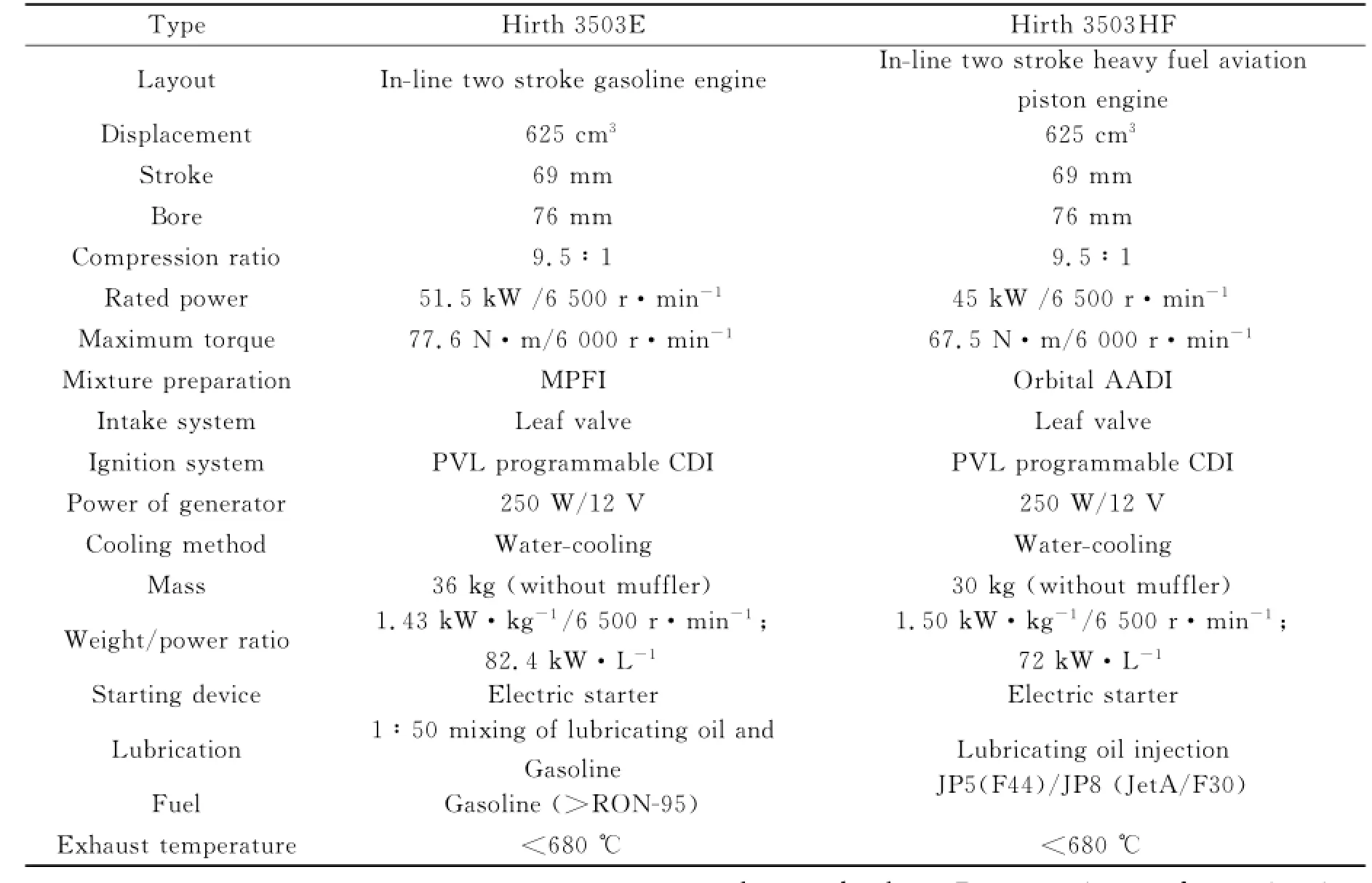
Table 5 Technical specification of Hirth3503E/3503HF engine
2 Recent Progress of HF-APE
2.1 Stratified fuel injection and combustion
The direct fuel injection and combustion were developed from wall guided,charge motion guided modes to fuel spray guided mode,as shown in Eig.1.
Eor wall guided and charge motion guided direct injection methods,the injector is not close to the spark plug.In case of submerging of the spark plug,the fuel spray needs to avoid touching the spark plug.Proper mixture formation is necessary so as to fulfill the ignition requirement of the spark plug.Therefore,high intense tumble and turbulence is indispensable.However,the engine cannot keep stable when engine speed is varied[12].
Eor fuel spray guided direct injection method,the injector is close to spark plug,which is benefit for the ignition of heavy fuel.The wall wetting effect can be avoided when the injector is located at central of the combustion chamber. Low tumble ratio and intake port without generating turbulence is necessary to limit the influenceof charge motion on the fuel-air mixture.To date,fuel spray guided direct injection and combustion technology has been widely adoped in foreign countries for HE-APE,for instance,the OCP technology proposed by Orbital[13].

Eig.1 Three combustion modes of in-cylinder direct injection
2.2 Heavy fuel injection system
The electronic heavy fuel injection control system consists of fuel tank,fuel pump,pipeline,injector and control unit,where the injector and the control unit are the key parts affecting the heavy fuel spray.According to the foreign heavy fuel injection system,the electronic injection control systems can be classified two categories:the high pressure common rail injection system and the air assisted direct injection system[14].The latter is shown in Eig.2.

Eig.2 Air-assisted fuel injector
Eor compression ignition engine,the compression ratio is high,as well as the load of the engine parts.However,the compression ratio has to be low for spark ignition in an engine with the direct injection system.Hence one should contemplate the compromise.Eurthermore,the problem of igniter oscillation is to be solved too.
2.3 Heavy fuel ignition system
The companies,such as Hirth,Orbital and XRDi,use the ignition system of gasoline aviation piston engine as basis.After retrofit and re-calibration of the system,especially the combination and optimization of the best ignition angle and the combustion characteristics of heavy fuel,it can fulfill the requirement of heavy fuel ignition[15-16].
2.4 Supercharging system
The supercharging system is vital for APE which consists of intake system,supercharger,intercooler,etc.Multi-stage supercharging technology is successfully adopted in APE in US.Numerous research programs are conducted by NASA to investigate the effect of Reynold number on the supercharger performance,the design techniques and the matching among multi-stage superchargers,as well as between supercharger and APE[17].
2.5 Thermal control of key parts
The HE-APE designed by Hirth and Zanzottera choose the water-cooled cylinder and cylinder head of prototype as retrofit targets since the slow combustion rate of heavy fuel that accelerates the temperature increase of cylinder wall may result in cylinder bore scuffing and gluing.
To solve the problem mentioned above,the analysis of both heat transfer and design of highefficiency cooling system are important to the thermal load control of the key parts.In addition,new type of heat-resisting,thermal insulating and wear-resisting materials can be adopted,such as ceramic(SiC)piston,cylinder,etc[18].
3 Trend of HF-APE
The trend of HE-APE can be summarized as follows:(1)Multi heavy fuel adaptability is required,such as kerosene,JP-5,JP-8 and Jet-A.(2)Low compression ratio is preferable.It is depending on the ignition system of gasoline and diesel fuel.(3)Euel additives should be developed to make the heavy fuel easily ignited.(4)Separated use of Gasoline and heavy fuel is expected.Due to the variation of flash point of gasoline and heavy fuel,the heavy fuel is hard to be applied to spark ignition engine.Generally,heavy fuel is applied to compression ignition engine but hardly used in spark ignition engine.It is proposed that gasoline can be used at the engine start and when the in-cylinder gas temperature reaches the flash point of kerosene and the fuel is thus switched to kerosene fuel.(5)Pre-heating system is also needed.Heavy fuel is hard to be ignited compared with gasoline.Meanwhile,heavy fuel spray is likly to coagulate,thus forming big droplets when encountered cool air.It is unfavorable to combustion and will easily cause carbon deposits.Therefore,pre-heating system is necessary to enable smooth cold-starting and complete combustion.
In brief,the requirements for modern HEAPE involve heavy-fuel,spark ignition,low compression ratio,high efficiency,low weight and compact.However,in China,urgent action is needed to fill the gap in four-stroke APE and the following technologies have to be developed.
3.1 Four-stoke operation
Super-charged engine usually equipped by medium/high-altitude,high-endurance UAV is featured by its high power,low fuel consumption,excellent altitude performance and high reliability.So far,the power of APE in China has been in a range of 11.025—40.425 k W,always generated by two-stroke natural aspirated aviation piston engines.It can only fulfill the requirement of low-altitude,short-endurance UAV[19].
Due to the limit of cylinder number and engine cooling condition,it is hard to further improve the engine power.Meanwhile,according to the characteristics of intake and outtake systems,turbo charging is also difficult to be realized and thus cannot meet the requirement of long endurance.
Therefore,the four-stroke aviation piston engine,especially the small-sized APE(58.8—117.6 k W)needs to be developed.
3.2 Electronic control
Electronic fuel injection technology can accurately control the air-fuel ratio under various engine working conditions in order to keep the engine operating with best performance.Power,fuel efficiency and working stability are improved to fulfill the requirement of aviation reliability and boost the endurance.Meanwhile,the electronic fuel injection system employs a micro-computer to implement intelligent control which may increase the flexibility of working and operating mode.In foreign countries,the electronic control technology is applied to small-sized aviation piston engine.However,for engine in UAVs,especially the small-displacement engine,electronic control technology still faces such problems as the weight and size of electronic devices,the minimization and integration of the assembles,etc.
3.3 Supercharging and turbocharging systems
Turbocharging is wildly applied in foreign countries and also investigated in China.Many problems still exist when turbocharging is used in small-displacement typed UAV engine,for instance,the weight,size and wearing during high speed rotation of turbine,and the transient response of turbo-charged engine.
4 Conclusions
To meet the requirement of fuel unification for navy and air force,this paper gives a full picture of the recent progress and trend of heavy-fuel aviation piston engine.The development of HEAPE is usually based on the original APE.The retrofit is focused on the re-design and re-construction of fuel injection and ignition,intakecharging systems and electronic control unit.It is urgent to develop fuel injection and ignition system which is particularly suitable for heavy fuel. Ai-assisted fuel injector,high pressure direct injector,high energy spark plug are good references.The fuel injector and ignition systems need to be coupled with appropriate mixture formation strategy,such as wall-guided,charge motion guided,etc.To adapt severe environment(high altitude,low pressure/oxygen content),intake gas heating,supercharging and turbocharging are necessary for HE-APE to maintain the engine output power and avoid misfiring.
[1] Chen X,Zhai W,Zhao W.New development and performance analysis of U.S.and Chinese military UAV[J].Ship Electronic Engineering,2011(7):26-28.(in Chinese)
[2] Department of Defense.Unmanned aerial vehicles roadmap[R]2002—2027.Washington:[s.n.],2002.
[3] Su X,Luo J.New development of U.S.military UAV[J].Winged Missiles Journal,2007(5):27-30.(in Chinese)
[4] Zeng W,Chen X,Liu J,et al.Ignition and combustion characteristics of a surrogate fuel for jet A-1 kerosene[J].Journal of Combustion Science and Technology,2012(6):515-520.(in Chinese)
[5] Obodeh O,Akhere N C.Experimental study on the effects of kerosene doped gasoline on gasoline-powered engine performance characteristics[J].Journal of Petroleum and Gas Engineering,2010(1):37-40.
[6] Zhang Q,Du E.Small aero-piston engine heavy fuel technology development summary[J].Small Internal Combustion Engine and Vehicle Technique,2014(4):81-84.(in Chinese)
[7] Larry A.The history and future of flight control simulation[C]∥AIAA Modeling and Simulation technologies Conference and Exhibit.Providence,Rhode Island:AIAA,2004.
[8] Dagaut P,Cathonnet M.The ignition oxidation and combustion of kerosene:A review of experimental and kinetic modeling[J].Progress in Energy and Combustion Science,2006,32(1):48-92.
[9] NW UAV propulsion systems,UAV fuel injection system[DB/OL].[2013-05-07].http:∥www. nwuav.com/uav-development/fuel-injection-systems. html.
[10]Hu C,Li J,Baih Ren L,et al.Experiment of in-cylinder mixture formation process los-pressure GDI engine[J].Journal of Aerospace Power,2012(9): 1921-1927.(in Chinese)
[11]Patterson P M,Kyne A G,Pourkashanian M,et al. Combustion of kerosene in counterflow diffusion flames[J].Journal of Propulsion and Power,2000,16(2):453-460.
[12]Kuwahara K,Ueda K,Ando H.Mixing control strategy for engine performance improvement in a gasoline direct injection engine[EB/OL].(1998-02-23).http:∥papers.sae.org/980158.
[13]Orbital Australia Pty.Ltd.Lightweight heavy fuel engine technology[EB/OL].[2014-10-15].http:∥www.naita.org/docs/Orbital%20-%20Engine% 20Technology.ppt.
[14]Wei C,Guo X,Eeng Z,et al.Current application situations and development trend of gasoline direct injection engine[J].Small Internal Combustion Engine and Vehicle Technique,2014(10):78-81.(in Chinese)
[15]Nathan L,Tim B,Bryan W.Design of a direct injection retrofit kit for small two-stroke engines[EB/ OL].(2005-10-12).http://papers.sae.org/2005-32-0095/.
[16]Yan g G,Wei M,Hou X.Development of ignition control system for electronic controlled kerosene piston engines[J].Agricultural Equipment&Vehicle Engineering,2013(3):26-29.(in Chinese)
[17]Xu B,Lian Z.Research into the restoration method for high-altitude piston engine[J].Journal of Aerospace Power,2009,24(8):1736-174.(in Chinese)
[18]Huang X Y,Liu C M,LüX J.Aluminum alloy pistons re-inforced with SiC fabricated by centrifugal casting[J].Journal of Materials Processing Technology,2011,211(9):1540-1546.
[19]Yin Z,Li S,Li G.Current state and development of the unmanned aerial vehicle powerplants[J].Aeroengine,2007,33(1):10-15.(in Chinese)
(Executive editor:Zhang Tong)
V231.2 Document code:A Article ID:1005-1120(2014)06-0022-07
*Corresponding author:Chen Wei,Professor,E-mail:chenwei@nuaa.edu.cn.
How to cite this article:Chen Wei,Zhou Jianhao,He Xiaoming.Recent progress in heavy fuel aviation piston engine[J]. Trans.Nanjing U.Aero.Astro.,2015,32(1):22-28.
http://dx.doi.org/10.16356/j.1005-1120.2015.01.022
(Received 4 November 2014;revised 24 December 2014;accepted 12 January 2015)
 Transactions of Nanjing University of Aeronautics and Astronautics2015年1期
- Transactions of Nanjing University of Aeronautics and Astronautics的其它文章
- Trim Drag Prediction for Blended-Wing-Body UAV Configuration
- Beamforming of Whole Airspace Phased Array TT&C System Based on Linear Subarrays
- High Velocity Impact Experiment on Ti/CFRP/Ti Sandwich Structure
- CRB for 2-D DOA Estimation in MIMO Radar with UCA
- Improved Shuffled Frog Leaping Algorithm Optimizing Integral Separated PID Control for Unmanned Hypersonic Vehicle
- Tradeoff Analysis of Factors Affecting Longitudinal Carrier Landing Performance for Small UAV Based on Backstepping Controller