
?In this issue?
2014-04-03 06:15:41
上海精神醫學 2014年1期
?In this issue?
We are pleased to announce that beginning with this issue all materials in each issue of theShanghai Archives of Psychiatrywill be translated into Chinese and a translated version of the complete issue will be made available (free of charge) on the journal’s website (www. saponline.org) within one month of the publication of the English version. Having dual-language content available for the full journal should help us achieve the goal of being a platform for communication between Chinese and international clinicians, researchers and policy makers. Chinese authors who want their work seen by international colleagues are able to submit manuscripts in Chinese which are sent to our content expert reviewers and, if accepted, translated into English and edited; the final English version is then translated back into Chinese and placed on the website. Conversely, international authors who want their work seen by Chinese colleagues can submit Englishlanguage manuscripts which will be reviewed and, if accepted, fi rst edited and published in English and then subsequently translated into Chinese and distributed around China. We are the first – and only – mental health journal to do this in China. If authors have any questions about this process, please contact our editorial offi ce at: shtougao3296@163.com
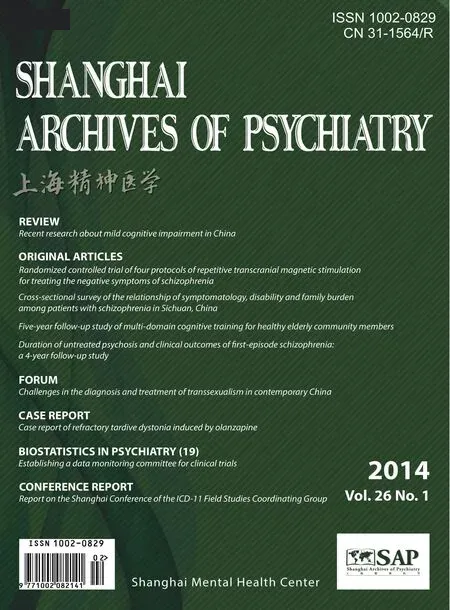
The review article in this issue by Cheng and Xiao[1]addresses an issue that is of intense interest both in China and globally: mild cognitive impairment (MCI). The downside of the spectacular improvements in China’s overall health has been that with rapidly increasing life expectancy the proportion of elderly in the community has also increased rapidly. This trend has been accelerated by China’s one child per family policy, which is only now being gradually relaxed. The result of this demographic transion is that the old-age dependency ratio (i.e., number of persons 65 years of age or older for every 100 persons 15 to 64 years of age) in large urban centers like Shanghai is approaching –and in some cases surpassing – the rao in high-income countries. The prevalence of Alzheimer’s Disease and other demenng illnesses increases in stepwise fashion with age, so the ageing of China’s population is being accompanied by a dramac increase in the prevalence of demena. Given the much smaller families, there is a serious concern about how the community will provide the support services needed by this rapidly growing cohort of disabled elderly. In this environment it is not surprising that China has focused substantial research talent and resources on understanding and prevenng MCI – the precursor condion for Alzheimer’s Disease. The review discusses Chinese researchers’ mulfaceted efforts in this field over the last decade, which have focused on the epidemiology, neuropsychological characteriscs, diagnosis, genec eology, neuroimaging and electrophysiological changes, and treatment of MCI. To date this work has provided some new insights but few breakthroughs. China can contribute most to the international efforts to address the global issue of dementing illnesses by using its relative advantage of a large, stable populaon of elderly and focusing more research resources on conducting multi-disciplinary prospecve studies that use internaonally standardized methods of assessing cognitive functioning with large, representave samples.
The first original research article in the issue by Zhao and colleagues[2]is a randomized controlled, double blind trial that compares different methods of administering repetitive transcranial magnetic stimulation (rTMS) to treat the negative symptoms of schizophrenia. The negave symptoms of schizophrenia– which are closely related to the level of disability of the condition – have largely remained resistant to neuroleptic treatment so a number of different approaches are being evaluated, including rTMS. In this study 96 patients were randomly assigned to four groups: three active rTMS conditions using different stimulation methods (10 Hz, 20 Hz and theta burst stimulation) and one mock rTMS group (the control group). rTMS was administered five times per week for four weeks to the left dorsolateral prefrontal cortex of the patients, all of whom remained on a stable dosage of medication. The four-week trial convincingly demonstrated that rTMS is a safe and e ff ecve treatment for reducing the severity of negave symptoms. Among the three smulaon methods, the theta burst stimulation method proved more effective than the 10 Hz and 20 Hz stimulation methods but all three methods were significantly better than the control condion (mock rTMS). More work is certainly needed to refine the rTMS treatment protocols and, most importantly, to determine the treatment interval that will best ensure a sustained treatment e ff ect. But this study confirms the importance of this exciting new approach to addressing the negave symptoms of schizophrenia and, potenally, of substanally reducing the social dysfuncon and disability that so frequently occurs in individuals with the disorder.
The second original research article by Zhang and colleagues[3]reports on the relationship of psychotic symptoms, disability and family burden in schizophrenia. Unlike many high-income countries, the over 90% of individuals with schizophrenia in China live with family members. Family members are typically the most important long-term care givers for persons with schizophrenia and, thus, a substanal component of the social burden associated with the condition is borne by families – a component that is not considered in the Global Burden Diseases estimates of the healthburden associated with different health conditions. This cross-sectional study assessed 101 individuals with schizophrenia with a median duration of illness of 5 years who were clinically stable at the time of assessment. Patient’s symptoms were assessed using the Posive and Negave Syndrome Scale (PANSS) and their level of disability was assessed using the WHO Disability Assessment Scale (WHODAS II), and the family burden was assessed by interviewing the primary family care-giver for the patient using the Family Burden Interview Schedule (FBIS). They found that after adjusting for a number of demographic and illnessrelated variables both the level of current symptoms and, independently, the level of social disability were signi fi cantly associated with the level of family burden. The correlation of patient disability and family burden is not surprising, but its independence from symptom severity is surprising. This result highlights the point that treatments for individuals with schizophrenia must focus both on the symptoms of psychosis and on disability. The conventional assumption that treating symptoms will automacally improve disability is only parally the case; there is a substanal residual level of disability that is both resistant to standard symptomatic treatment and a core component of the burden experienced by families.
The last original article by Qin and colleagues[5]addresses an issue that is a perennial favorite of schizophrenia researchers – the relationship of the duration of untreated psychosis (DUP) to subsequent outcomes. The reason for this interest is related to the theoretical model of schizophrenia: if schizophrenia is the final outcome of aprogressiveneurological injury that starts at the onset of the condition (i.e., when psychotic symptoms first appear) and if neuroleptic medication halts this ongoing injury, then early identification and treatment with neuroleptic medication can limit the severity of the condition. Based on this thinking, the longer the DUP the greater the neurological damage and, thus, the more severe and chronic the illness. Decades of research have not definitively resolved this issue. The current study identified 43 first-episode patients with schizophrenia who had a late age of onset (mean age of onset was 33), classified them into a short DUP group (<24 weeks) or a long DUP group (>24 weeks) and followed the two groups of patients for 3.2 years and 3.9 years, respectively. The long DUP group had less severe psychotic symptoms (as measured by the Brief Psychiatric Rang Scale) at theme of fi rst diagnosis –which may have been one of the reasons that it took family members longer to bring them in for psychiatric treatment. Unlike previous studies, during the follow-up period there were no di ff erences in the levels of posive psychotic symptoms or in the rate of relapse between the two groups. However, despite a similar paern of positive psychotic symptoms and relapses, patients in the long DUP group were more than twice as likely to require re-hospitalization during the first two years of treatment than paents in the short DUP group (67% v. 32%), and at the end of follow-up they had signi fi cantly poorer social functioning (as assessed by the Social Disability Screening Schedule). The increased number of hospitalizations in the long DUP group despite the similar level of positive symptoms is an interesting fi nding that has not been reported elsewhere: this could be an artifact of the small sample size or of the late age of onset in this sample (which occurred because all patients were working, not students, at the time of first diagnosis).This study identifies another factor that may influence the relationship between DUP and subsequent outcomes —age of onset. It is certainly theorecally possible that age of onset could in fl uence the progression of the neurological damage initiated by a psychotic illness. Larger studies that compare the relationship of DUP and subsequent outcomes in subgroups of fi rst-onset paents with early or late age of onset will be needed to determine whether or not age of onset is an important independent factor in the causal pathways that link DUP and outcome.
The Forum by Liu and Lu[6]discusses the current situation regarding transsexualism in China. Prior to 1990 the stigma related to the condition effectively suppressed its identification and treatment but the gradual lifting of sexual taboos that has accompanied the rapid opening of the country has changed things dramatically. There are now more the 100,000individuals who have requested sex change operation and over 1000 individuals who have completed sex reassignment surgeries. The post-surgery transition to a new social role and the requirement of long-term use of immunosuppressants and sex hormones can result in serious physical and psychological consequences that the individual may or may not be psychologically prepared to deal with. Thus extensive educaon of the paent and his or her family members is needed before the operation and regular psychological evaluation and, if needed, support should be provided for years after the surgery. However, the intense demand for the surgery has encouraged the opening of small private plasc surgery centers that do not conduct the extensive pre-surgery evaluation and follow-up that is needed. To minimize these problems the authors recommend developing national standards for the evaluation, diagnosis and treatment of transsexualism and the creation of an integrated network of state-ofthe-art treatment centers around the country.
The case report by Sun and Wang[7]present a case of severe, intractable tardive dystonia in a 22-year-old male with schizophrenia that was initially triggered by treatment with olanzapine. The patient developed lip puckering, persistent torticollis, pain, axial dystonia and unstable gait after one year of treatment with olanzapine. Olanzapine-induced tardive dystonia is rare, but it has been reported previously. The paent’s family members did not recognize the importance of these symptoms for 18 months and inial treatment at a local hospital was inappropriate, so it took two years before the condion was recognized and aggressively treated. Conversion to clozapine and adjunctive treatment with magnesium valproate, vitamin E, tiapride and loranzepam for four months did not improve the condition; so the patient remained severely disabled. There is no guarantee that earlier recognition and treatment can result in improved outcomes for paents who develop tardive dystonia, but the case highlights the importance of teaching patients, family members and medical professionals about the occurrence and management of all types of adverse responses to anpsychoc medicaons, including the rare but severe side e ff ects like tardive dystonia.
This issue also includes a Biostascs in Psychiatry piece by Lin and Lu[8](two of our three Biostatistical Editors) about establishing data monitoring commiees for clinical trials. In the United States the Food and Drug Administration requires the formation of these datamonitoring groups in all studies of new interventions and they are strongly recommended for studies that have substantial concerns about safety or that are expected to have an important effect on clinical care. Such committees provide additional protection for paents and enhance the scienfi c validity and integrity of clinical studies. The paper describes the formation, membership, activities and responsibilities of datamonitoring commiees.
The issue concludes with a brief report on the meeting of the ICD-11 Field Trial Coordinating Group recently held in Shanghai,[9]and an updated version of our Instrucons to Authors.
1. Cheng Y, Xiao S. Recent research about mild cognitive impairment in China.Shanghai Archives of Psychiatry.2014; 26(1): 4-14. doi: http://dx.doi.org/10.3969/ j.issn.1002-0829.2014.01.002
2. Zhao SH, Kong JH, Li SL, Tong ZS, Yang CJ, Zhong HQ, et al. Randomized controlled trial of four protocols of repetitive transcranial magnetic stimulation for treating the negative symptoms of schizophrenia.Shanghai Archives of Psychiatry.2014; 26(1): 15-21. doi: http://dx.doi.org/10.3969/ j.issn.1002-0829.2014.01.003
3. Zhang ZQ, Deng H, Chen Y, Li SY, Zhou Q, Lai H, et al. Crosssectional survey of the relationship of symptomatology, disability and family burden among patients with schizophrenia in Sichuan, China.Shanghai Archives of Psychiatry.2014; 26(1): 22-29. doi: http://dx.doi. org/10.3969/j.issn.1002-0829.2014.01.004
4. Feng W, Li CB, Chen Y, Cheng Y, Wu WY. Five-year follow-up study of mul-domain cognive training for healthy elderly community members.Shanghai Archives of Psychiatry.2014; 26(1): 30-41. doi: http://dx.doi.org/10.3969/ j.issn.1002-0829.2014.01.005
5. Qin HY, Zhang J, Wang ZP, Min HY, Yan CY, Chen FZ, et al. Duraon of untreated psychosis and clinical outcome of fi rstepisode schizophrenia: a 4-year follow-up study.Shanghai Archives of Psychiatry.2014; 26(1): 42-48. doi: hp://dx.doi. org/10.3969/j.issn.1002-0829.2014.01.006
6. Liu N, Lu Z. Challenges in the diagnosis and treatment of transsexualism in contemporary China.Shanghai Archives of Psychiatry.2014; 26(1): 49-50. doi: http://dx.doi. org/10.3969/j.issn.1002-0829.2014.01.007
7. Sun ZX, Wang XL. Case report of refractory tardive dystonia induced by olanzapine.Shanghai Archives of Psychiatry.2014; 26(1): 51-53. doi: http://dx.doi.org/10.3969/ j.issn.1002-0829.2014.01.008
8. Lin JY, Lu Y. Establishing a data monitoring committee for clinical trials.Shanghai Archives of Psychiatry.2014; 26(1): 54-56. doi: http://dx.doi.org/10.3969/ j.issn.1002-0829.2014.01.009
9. Anonymous. Report on the Shanghai Conference of the ICD-11 Field Studies Coordinaon Group.Shanghai Archives of Psychiatry.2014; 26(1): 57. doi: hp://dx.doi.org/10.3969/ j.issn.1002-0829.2014.01.010
hp://dx.doi.org/10.3969/j.issn.1002-0829.2014.01.001
A full-text Chinese translaon will be available at www.saponline.org from April 15, 2014.
- 上海精神醫學的其它文章
- Establishing a data monitoring committee for clinical trials
- Challenges in the diagnosis and treatment of transsexualism in contemporary China
- Case report of refractory tardive dystonia induced by olanzapine
- Duration of untreated psychosis and clinical outcomes of firstepisode schizophrenia: a 4-year follow-up study
- Five-year follow-up study of multi-domain cognitive training for healthy elderly community members
- Cross-sectional survey of the relationship of symptomatology,disability and family burden among patients with schizophrenia in Sichuan, China