
Establishing a data monitoring committee for clinical trials
2014-12-09 03:44:08JuliaLINYingLU
上海精神醫學 2014年1期
Julia Y. LIN*, Ying LU,2
?Biostatistics in Psychiatry (19)?
Establishing a data monitoring committee for clinical trials
Julia Y. LIN1*, Ying LU1,2
data monitoring committee, clinical trials, interim analysis, biostatistics
1. What is a data monitoring committee?
According to the Food and Drug Administration (FDA)Guidance for Clinical Trial Sponsors – Establishment and Operation of Clinical Trial Data Monitoring Committees(DMC)[1], ‘A clinical trial DMC is a group of individuals with pertinent expertise that reviews on a regular basis accumulating data from one or more ongoing clinical trials’. The FDA guidance further explains that ‘The DMC advises the sponsor regarding the continuing safety of trial subjects and those yet to be recruited to the trial,as well as the continuing validity and scientif i c merit of the trial’.
The International Conference on Harmonisation’s(ICH) guidance on good clinical practice[2]and on statistical principles for clinical trials[3]defines a DMC(also called Data and Safety Monitoring Board or Monitoring Committee) as ‘an independent data monitoring committee that may be established by the sponsor to assess at intervals the progress of a clinical trial, the safety data, and the critical efficacy endpoints,and to recommend to the sponsor whether to continue,modify, or stop a trial’. It is important to note that the DMC has an advisory role to the sponsor of the trial,not an executive role. It is up to the sponsor to decide whether or not to accept the recommendations of the DMC.
As highlighted in the above definition, the DMC should be independent from the study sponsor. This independence allows the DMC to make credible and objective recommendations to the sponsors and allows sponsors to make study decisions without bias from having knowledge of interim study results. In addition to monitoring for trial safety, the DMC is also expected to assess the continuing validity and scientif i c merit of the trial, to ensure that clinical equipoise is maintained during the trial, and to monitor participant recruitment,protocol compliance and data quality.
2. When should a study include a data monitoring committee?
For studies evaluating new drugs, biologics and devices in the United States sponsors are required to monitor the study according to the 21 Code of Federal Regulations (21 CFR 312.50 and 312.56 for drugs and biologicals, and 21 CRF 812.40 and 21 CRF 812.46 for devices). For other types of studies the FDA recommends considering the following issues when determining whether or not a DMC should be formed:the level of safety concerns in the study; the practicality of having DMC reviews of the study; and whether or not a DMC could help assure the scientif i c validity of the study.
A literature review conducted by Sydes and colleagues[4]found that DMC are recommended when trials have any of the following features: trials on highprofile topics that are a focus of community concern,that will be used to seek regulatory approval or that are likely to profoundly affect clinical practice; trials with serious safety concerns, unknown risks or that are implemented in vulnerable populations; and trials where independent monitoring is needed because of double-blind treatment assignment or long-term follow-up or because the sponsoring company does not have standard operating procedures. DMC may not be needed for trials that are of short duration (where it may not be feasible to convene a DMC in a timely fashion to review the data), for trials with known risks that are minimal, for trials in which the objective is to demonstrate biological principles (such as in early phase clinical trials), or for trials on behavioral or administrative issues.
Most psychiatric patients meet FDA standards for a vulnerable or high-risk population, so based on the above recommendations most studies involving psychiatric patients should have DMC. Carandang and colleagues[5]recommend that psychiatric researchers consider the following issues related to the potential risk to participants when deciding whether or not to appoint a DMC for a study: the symptomatology of the psychiatric disorders being studied (e.g., suicide ideation in depression); the features of the treatment(e.g., pharmacodynamic effect of the medication); the research environment (e.g., inexperienced researchers);the lack of information on the study population (e.g.,potential comorbid substance abuse); and the lack of information on the treatment (e.g., when using novel interventions).
3. The difference in the responsibilities of data monitoring committees and institutional review boards
Institutional review boards (IRBs) also have responsibility for monitoring the safety of trial participants at their institutions. The sponsors of clinical trials are required to regularly submit reports to the institution’s IRB listing serious adverse events (SAEs) that occur in trial participants. However, these SAE reports often do not contain information about the treatment group to which the participants who experience adverse events are assigned. Furthermore, IRBs usually lack the data management and statistical support needed to compare adverse events between treatment arms of the trial, so they may not be able to assess the safety risks associated with the specific treatment being assessed in the trial. Most IRBs do not receive outcome data or have adequate statistical expertise to perform proper interim analysis to adequately weigh the risk and benefits of the trials.[6]DMC can, thus, provide important supplementary information on the safety and effectiveness of an intervention.
4. The composition of data monitoring committees
The ability of DMC to make appropriate recommendations on participant safety and trial integrity depends on the members of DMC – who are typically appointed by the trial sponsor or the steering committee for the trial.The following factors are important to consider in DMC member selection: relevant expertise in related clinical trials, experience in serving on other DMC and absence of financial or intellectual conflicts of interests (e.g.,having a strong opinion about the study intervention).Depending on the needs of the trials, DMC members typically include clinicians and at least one biostatistician with expertise in clinical trial and interim data analysis.The size of the DMC also varies – there are usually at least three members but there can be many more DMC members for large studies or for studies that require detailed monitoring and interim analyses.
5. Operational aspects of data monitoring committees
The FDA recommends that each DMC establishes a trialspecific charter with clear operating procedures.[2,3]A DMC charter typically includes information on the schedule and format of DMC meetings, on the format and presentation of trial data, on who will have access to the interim data, on who may attend all or part of the DMC meetings, on the procedures for assessing conflict of interest, and on the schedule for the presentation of the interim reports. The contents of the charter should depend on the needs and circumstances of the trial.For example, the frequency of DMC meetings could depend on the expected rate of participant accrual or the expected event rate but there must be enough fl exibility in the schedule to allow for ad hoc meetings when safety issues emerge. Both the trial sponsor and members of the DMC should agree on the content of the DMC charter. The FDA also recommends maintaining records of all DMC meetings, including the analysis reports.
At times it may be beneficial to include representatives of the trial sponsors in the DMC meetings so that DMC members can obtain information from individuals who have intimate knowledge about the progress of the trial. To maintain conf i dentiality of interim analysis results, DMC meetings may need to be divided into‘open’ and ‘closed’ sessions. Sponsor attendance is allowed in the open sessions during which nonconf i dential results are discussed (e.g., recruitment rate,participant baseline characteristics, etc.) but sponsor attendance is discouraged in the closed sessions during which conf i dential interim results are discussed(e.g., unblinded treatment comparisons). If sponsor representatives are present during the closed sessions,then the DMC should have ‘executive’ sessions where only DMC members attend.
It is important to have prior agreement about the format of the analytic reports that are provided to the DMC by the sponsor. The sponsor can propose a template for the presentation of data at the initial DMC meeting and then, after discussion with DMC members,the revised format can be formalized as part of the DMC charter. However, report templates may change during the progress of the trial depending on the needs of the study and requests of DMC members. The DMC should have access to the unblinded treatment assignments,because safety decisions may be dependent on whether observed adverse effects are in the intervention group or the control group.
6. Role of statisticians and the interim analyses they conduct in data monitoring committees
Ideally, independent statisticians who are not involved in the trial management and who are not employed by the trial sponsor should perform the interim analysis.However, in most cases, resource and personnel limitations make it impossible to realize this ideal. The statisticians conducting the interim analysis are often the primary statisticians involved in the design and management of the trial. While familiarity with the trial is advantageous in interpreting the data, knowledge of the interim analysis results could potentially affect trial management decisions. Another concern is that the statisticians performing the interim analysis,regardless of whether or not they are the primary statisticians of the trial, are usually employed by the sponsor. However, if the DMC rigorously implements well-defined operating procedures for conducting the interim monitoring that ensures the confidentiality of the interim results within the sponsor organization, this can mitigate possible bias and preserve trial integrity.
Study protocols typically include descriptions of planned interim analyses. To reduce potential bias,the plan for the time and content of the interim analysis should be finalized before the first analysis of unblinded results is conducted. Interim analysis plans typically contain descriptions of when analyses will be conducted –based on the rate of information accrual, on chronological time, or on other criteria. It is important to consider potential inflated Type I error(the error of concluding a significant finding where there is none) when multiple ‘peeks’ of the treatment effects are planned; one way to correct for this is to make an a priori estimate of the magnitude of the effect needed to justify stopping the trial early because the trial is showing strong treatment effects. If appropriate,the interim analysis plan could also contain criteria for stopping the trial early because of futility (i.e., if the interim analysis concludes that the treatment effect the trial seeks to establish is very unlikely to occur).
7. Summary and conclusion
Establishing an appropriately qualified DMC can help ensure the safety of trial participants and uphold equipoise of the trial by continuing review of the safety data. It can also help assure the scientific validity and integrity of the trial.
Conflict of Interest
The author reports no conflict of interest related to this manuscript.
Funding
This work was supported by the the US Department of Veterans Affairs, Veterans Health Administration, Office of Research and Development, Clinical Science Research and Development Service, Cooperative Studies Program,Study #574.
1. Food and Drug Administration. Guidance for clinical trial sponsors: Establishment and operation of clinical trial data monitoring committees. March, 2006
2. European Agency for the Evaluation of Medicinal Products(EMEA). ICH Topic E6: good clinical practice. London:European Agency for the Evaluation of Medicinal Products;1996 Jul. Reference No.: CPMP/ICH/135/95
3. European Agency for the Evaluation of Medicinal Products(EMEA). ICH Topic E9: statistical principles for clinical trials.London: European Agency for the Evaluation of Medicinal Products; 1998 Feb. Reference No.: CPMP/ICH/363/96
4. Sydes MR, Spiegelhalter DJ, Altman DG, Babiker AB, Parmar MK, DMOCLES Group. Systematic qualitative review of the literature on data monitoring committees for randomized controlled trials. Clin Trials. 2004;1(1): 60-79. doi: http://dx.doi.org/10.1191/1740774504cn004rr
5. Carandang C, Santor D, Gardner DM, Carrey N, Kutcher S. Data safety monitoring boards and other study methodologies that address subject safety in ‘high-risk’ therapeutic trials in youths. J Am Acad Child Adolesc Psychiatry. 2007;46(4): 489-492. doi: http://dx.doi.org/10.1097/chi.0b013e31802f5f54
6. DeMets DL, Fost N, Powers M. An Institutional Review Board dilemma: responsible for safety monitoring but not in control. Clin Trials. 2006;3(2): 142-148. doi: http://dx.doi.org/10.1191/1740774506cn137oa
建立臨床試驗的數據監測委員會
Julia Y. LIN, Ying LU
數據監測委員會是由研究贊助者指定的一組臨床醫生和生物統計學家,對臨床試驗的安全性、科學有效性和完整性進行獨立評估。在美國,食品和藥物管理局要求在評估所有新的干預時在要成立數據監測委員會。在其他臨床研究中,如果存在重大的安全問題、實施雙盲治療分配或者預期對臨床實踐會產生重大影響,也強烈建議成立數據監測委員會。因為數據監測委員會對經常參加此類研究的弱勢群體提供了一層額外的保護,所以他們在精神病學臨床研究中是非常重要的。本報告描述了數據監測委員會的作用,組建和運作。
數據監測委員會、臨床試驗、中期分析、生物統計學
A data monitoring committee (DMC) is a group of clinicians and biostatisticians appointed by study sponsors who provide independent assessment of the safety, scientific validity and integrity of clinical trials. In the United States, the Food and Drug Administration requires the formation of DMC in all trials that assess new interventions. DMC are also strongly recommended in other clinical studies that have substantial safety issues,that have double-blind treatment assignment or that are expected to have a major impact on clinical practice.They are important in clinical research in psychiatry because they provide an added layer of protection for the vulnerable populations that are often enrolled in such studies. This report describes the role, formation and operation of DMC.
http://dx.doi.org/10.3969/j.issn.1002-0829.2014.01.009
1US Department of Veterans Affairs Cooperative Studies Program Coordinating Center, Palo Alto VA Health Care System, Palo Alto, CA, USA2Department of Health Research and Policy, Stanford University School of Medicine, Stanford, CA, USA
*correspondence: Julia.Lin@va.gov
A full-text Chinese translation will be available at www.saponline.org on April 15, 2014.

Julia Lin is a biostatistician at the US Department of Veterans Affairs Cooperative Studies Program Coordinating Center at the Palo Alto VA Health Care System. Her research interests include design and analysis of clinical trials and causal modeling methods, with particular interest in the area of psychiatry. She has been involved in clinical trials, observational studies, and survey research advising on methodological and statistical issues, providing statistical analytical support and documentation of research findings, and managing complex datasets. Her recent research projects are in the areas of psychiatry, critical care, and health services research.
猜你喜歡
天天愛科學(2022年9期)2022-09-15 01:12:54
體育科技文獻通報(2022年3期)2022-05-23 13:46:54
天天愛科學(2022年4期)2022-05-23 12:41:48
當代水產(2022年3期)2022-04-26 14:26:56
天津外國語大學學報(2021年3期)2021-08-13 08:32:18
遼金歷史與考古(2021年0期)2021-07-29 01:06:54
科學大眾(2021年9期)2021-07-16 07:02:54
軍事文摘(2020年20期)2020-11-28 11:42:50
航空世界(2020年10期)2020-01-19 14:36:20
科技傳播(2019年22期)2020-01-14 03:06:54
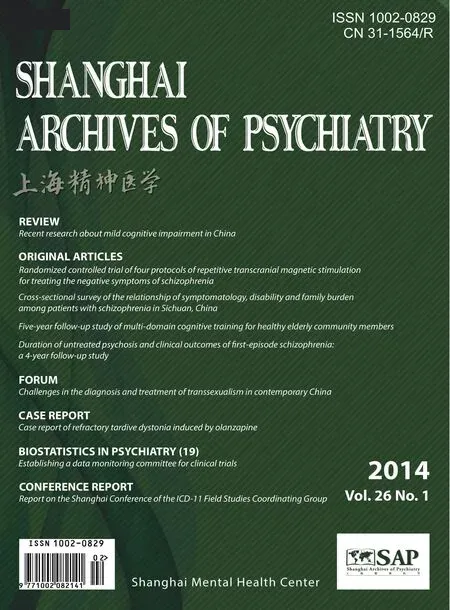
- 上海精神醫學的其它文章
- Challenges in the diagnosis and treatment of transsexualism in contemporary China
- Case report of refractory tardive dystonia induced by olanzapine
- Duration of untreated psychosis and clinical outcomes of firstepisode schizophrenia: a 4-year follow-up study
- Five-year follow-up study of multi-domain cognitive training for healthy elderly community members
- Cross-sectional survey of the relationship of symptomatology,disability and family burden among patients with schizophrenia in Sichuan, China
- Randomized controlled trial of four protocols of repetitive transcranial magnetic stimulation for treating the negative symptoms of schizophrenia