
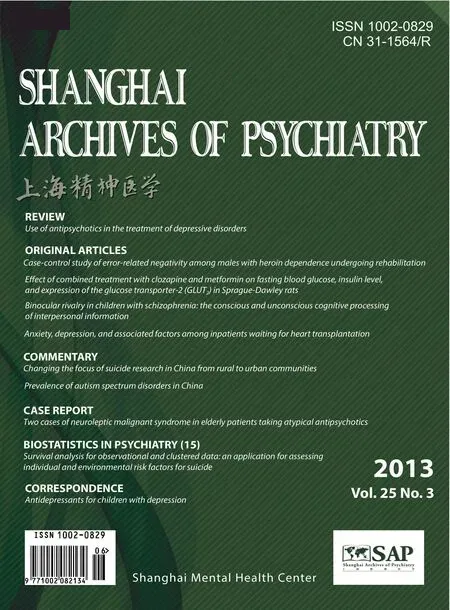
Two cases of neurolepc malignant syndrome in elderly paents taking atypical anpsychocs
2013-04-07 17:03:46YuhuiFENGXianhongYANGYanyanHUANG
上海精神醫(yī)學(xué) 2013年3期
Yuhui FENG, Xianhong YANG, Yanyan HUANG*
Yuhui FENG1, Xianhong YANG2, Yanyan HUANG3*
Summary:Neurolepc malignant syndrome (NMS) is a rare, life-threatening adverse reacon to anpsychoc medicaon that typically includes high-fever, extrapyramidal symptoms, autonomic nervous system dysfuncon and disturbances in consciousness. Though reported to be more common following use of the older, first generaon anpsychoc medicaons, it can also occur in paents taking the newer, second generaon anpsychoc medicaons. This report discusses the clinical presentaon, possible eology, pathogenesis and treatment of two cases of NMS that occurred in elderly paents aer taking atypical anpsychocs. With the increasing use of atypical anpsychoc medicaon in elderly paents - who may be more suscepble to this adverse reacon - there is a need to increase clinical vigilance about this condion, parcularly among internists and gerontologists who may be unfamiliar with this rare complicaon to anpsychoc medicaon.
1. Case 1
An 81-year-old male was found unconscious in his home by family members and taken to the emergency department of a general hospital. On admission he was comatose with equal pupils (1mm in diameter), a slow light-reflex, and no reacon to orbital pressure. His temperature was 37 degrees Celsius, pulse was 70 beats per min, respiratory rate was 18 per min, and blood pressure was 140/180 mmHg. The paent’s lips were slightly cyanoc and he had sobbing-like breathing, but there were no other abnormalies found on clinical exam of the heart and lungs. His neck was supple and his abdomen was so. The muscle tension in the limbs was elevated and there was no spontaneous movement of the limbs. There was no response to touch in the limbs though the lower right leg did respond to painful smuli.
There was no recent history of trauma, allergies, or infecons. His previous medical history included: (a) a 30-year history of hypertension that had been controlled at about 140/90 mmHg with amlodipine 5mg/d; (b) a 4-year history of type II diabetes treated with 50 mg acarbosed (keeping the blood sugar to about 7.8 mmol/L); (c) a 2-year history of Parkinson’s disease treated with 125mg benserazided; and (d) a 2-month history of visual hallucinaons that were being controlled with 1.25 mg olanzapine bid.
Emergency CT head scan on admission showed lacunar lesions in the basal ganglia and brain atrophy. ECG results showed small Q-wave on the third electrode and T-wave changes. Results of the blood-gas analysis was normal, and fasng blood glucose was 6 mmol/L. Laboratory studies idenfied several abnormalies: troponin T (cTnT) was 0.102 ng/ml (normal: 0.013 to 0.025 ng/ml), myoglobin was >3000 ng/ml (normal for males is 28 to 72 ng/ml), creane kinase (CPK) was 9986 U/L (normal: 35 to 174 U/L), creane kinase isoenzyme (CK-MB) was 243 U/L (normal: 0 to 25 U/L); and lactate dehydrogenase (LDH) was 191 U/L (normal: 106 to 211 U/L).
When the case was reviewed by a liaison psychiatrist on the second day of admission, the diagnosis was changed to probable NMS. The paent was provided fluids and diurecs and other measures were undertaken to prevent kidney damage (treatment with glutathione and α-keto acid). On the third day of admission, the paent gradually regained consciousness and his body temperature decreased; over the following two weeks his vital signs, temperature and biochemical measures all returned to normal levels. However, soon aer he regained consciousness he became emoonally labile with fluctuang depressive and manic symptoms. At one point he experienced hallucinaons that were disrupve for other paents so he was given a single intramuscular injecon of haloperidol (2.5 mg). Aer his physical status stabilized (18 days aer admission) he made an apparent suicide aempt using scissors so he was transferred to an inpaent psychiatric ward. Aer one month of treatment on the psychiatric ward he was discharged to his home. The last follow-up of the paent was more than one year aer the index discharge; at thatme he was being treated with 2.5 mg olanzapine qn and citalopram 20 mg qd (in addion to his hypertensive and diabetes medicaons). He reported no recurrence of his emoonal lability, hallucinaons or other symptoms. His medicaons were being directly managed by his son to decrease the risk of an intenonal or unintenonal overdose.
2. Case 2
An 85-year-old male came to the emergency department of a general hospital aer experiencingghtness in his chest, which his family members had treated with sublingual nitroglycerin. The paent had a history of primary hypertension, severe mitral regurgitaon with valve prolapse, and chronic heart failure. In 2002 he had had a dual chamber pacemaker implanted for sick sinus syndrome; this was replaced in January 2010. Immediately before coming to the general hospital, he had been discharged from a psychiatric hospital following 35 days of treatment for Alzheimer’s Disease with risperidone (oral soluon, 1.4 mg in the morning and 1.2 mg at night). There was no history of trauma, drug allergies, or infecous diseases.
On admission his temperature was 37 degrees Celsius, pulse was 80 beats per min, respiratory was 20 breaths per min, and blood pressure was 105/60 mmHg. The paent was conscious and coherent. His bilateral pupils were of equal size and roundness; he had a reflex to light; he had no cyanosis in his lips and his neck was so. He had coarse breathing sounds in both lungs without wet or dry rales. Heart rhythm was normal but a holosystolic blowing murmur with grade III intensity and a mid-to-late systole clicking murmur were readily audible in the apical region of the heart. His abdomen was so. There was no edema in his lower limbs. He had strength in his limbs and his muscle tone was normal. His blood sample showed a leukocyte level of 14.25x10⁹/L, with a neutrophil percentage of 80.6%.
A psychiatric liaison consultant on the fih day of admission suggested that the low blood pressure was due to the risperidone and recommended stopping the anpsychoc. Two days aer his last dose of risperidone the paent’s temperature increased to a maximum of 39.1 degrees Celsius. The paent became confused, was uncooperave with a physical examinaon, had profuse sweang and had twitching of his limbs. His heart rate was 130 beats per min; blood pressure was 98/55 mmHg; coarse sounds without wet or dry rales were heard in the lungs; muscle tension was significantly heightened and the limbs reacted to pain. ECG results showed depressed ST segments similar to the earlier ECG results. Blood tests at thatme showed that leukocyte count was 24.42x10⁹/L with a neutrophil percentage of 90%. Blood biochemical tests showed cTnT=0.649 ng/ml, myoglobin=1258 ng/ml (normal <73 ng/ml), CPK=195 U/L, CK-MB=6.42 U/L, LDH=419 U/L, and creanine=281μmol / L. Three days aer his last day of risperidone the paent lapsed into unconsciousness and experienced a rapid drop in blood pressure; despite resuscitave measures his breathing stopped, he wentinto cardiac arrest and he died. The diagnosis of ‘possible NMS’ was considered because, in the absence of X-ray or ECG changes, it was the most probable explanaon for the high temperature, profuse sweang, increased muscle tension, and elevated myoglobin.
3. Discussion
3.1 Were these cases of NMS?
The two cases in this report were older men with mulple illnesses taking a variety of medicaons, who were being treated with atypical anpsychocs prior to the onset of NMS. In both cases, their medical condion and current medicaons could have slowed the metabolism of anpsychoc medicaons and, thus, lead to an accumulaon of anpsychocs in the body. Case 1 had been taking 1.25 mg of olanzapine twice a day for over two months without apparent problem, but aer he took an overdose of 50mg of olanzapine he developed a high fever, loss of consciousness, a drop in blood pressure, a significant elevaon in CPK, increased muscle tension, and other symptoms. This paent met all the NMS criteria (see below) and, thus, definitely merited the diagnosis. The paent’s sudden increase in dosage with the overdose and the simultaneous interrupon in his an-Parkinson’s medicaon could have precipitated the NMS symptoms.
The diagnosis of NMS in case 2 is somewhat less certain. The paent had been receiving a total daily dose of risperidone of 2.6mg for about a month prior to admission. On admission he had a slightly elevated leukocyte count and a CT scan that showed intersal post-inflammaon changes in his lung. Broad-spectrum anbiocs appeared to resolve the presumed lung infecon but the paent subsequently experienced a drop in blood pressure and a brief loss of consciousness so the risperidone was stopped because of the possibility that this was a prelude to a full episode of NMS. However, 24 hours aer stopping the risperidone and in the absence of any other changes in the treatment regimen the paent developed a high fever, muscle twitching and fluctuang consciousness. He had a concomitant rise in white blood cell counts and in the blood levels of myoglobin and CPK. The paent’s symptoms worsened rapidly over the next day; he subsequently entered a coma and died. This paent had reduced cardiac funcon, a history of kidney problems (70% of risperidone is metabolized through the kidney), and was regularly taking convenonal oral diurecs, so it is certainly possible that his relavely high dose of 2.6mg/d would have accumulated. NMS remains the most likely explanaon for his rapid deterioraon, despite the terminaon of risperidone three days before his death.
NMS was first reported in 1960 by the French psychiatrist Delay.[1,2]Almost all of the dopamine antagonists can cause NMS, but the risk of NMS is greater for the typical anpsychocs than for the atypical anpsychocs.[3,4]The reported incidence is less than 0.5% of individuals taking anpsychoc medicaon.[5]There is a lack of consensus about the diagnosc criteria for NMS but the most commonly used criteria are those provided in DSMIV:[6]
A) The development of severe muscle rigidity and elevated temperature associated with the use of neurolepc medicaon;
B) Two or more of the following: 1) diaphoresis, 2) dysphagia, 3) tremor, 4) inconnence, 5) changes in level of consciousness ranging from confusion to coma, 6) musm, 7) tachychardia, 8) elevated or labile blood pressure, 9) leukocytosis, 10) laboratory evidence of muscle injury (e.g., elevated CPK);
C) The symptoms in Criteria A and B are not due to another substance (e.g. phencyclidine) or a neurological or other general medical condion (e.g., viral encephalis);
D) The symptoms in Criteria A and B are not beer accounted for by a mental disorder (e.g., mood disorder with catatonic features).
NMS can be divided into three different types depending on theme interval between the iniaon of medicaon and the onset of symptoms:sudden-onset(24 to 48 hours aer start of medicaon),early-onset(5 to 15 days aer start of medicaon), andlate-onset(aer prolonged usage of medicaon). NMS can occur at any stage of medicaon usage, but early-onset NMS is more common with typical anpsychocs and late-onset NMS is more common with atypical anpsychocs; the lateonset type is more difficult to confirm.[7]
There are two main theories about the pathogenesis of NMS. (a) Thehypothesizes that anpsychoc-induced blockage of dopamine receptors of the hypothalamic pathways, substana nigra striatal pathways, and midbrain corcal pathways result in altered mental status, high fever, increased muscle tension, sweang, tremors, urinary inconnence, altered consciousness, loss of speech, tachycardia, increased or unstable blood pressure, elevated white blood cell counts and a number of other clinical symptoms.[3]The removal of dopaminergic drugs or lesions to the central dopamine pathway can induce a similar malignant syndrome to NMS. (b) Theskeletal muscle cell metabolism theory[8]considers the eology of NMS to be similar to that of malignant hyperthermia; the primary cause is thought to be pathological defects in skeletal muscle such as excessive calcium release by the sarcoplasmic reculum.
Given the rarity of this condion, it is quite difficult to conduct genec studies on NMS. There is, however, one study that found an associaon between NMS andthe cytochrome P450 2D6 enzyme and the D2 receptor gene TaqIA polymorphism.[9]
The basic treatment recommendaons for confirmed and presumed cases of NMS are to stop anpsychoc medicaon, closely monitor vital signs, reduce extreme temperatures, infuse fluids, correct electrolyte imbalances, and provide other supporve measures as indicated. NMS is a self-liming disease, so in most cases the cessaon of anpsychocs with symptomac treatment and supporve care can improve symptoms. Several adjuncve pharmacological and other treatments have been recommended in the treatment of NMS, but there is no general consensus about their effecveness:[3,13]oral or parental benzodiazepines may promote a more rapid recovery, parcularly in paents with mild NMS; dopamine receptor agonists can improve symptoms and shorten recoveryme in paents with Parkinson’s disease who develop NMS; the muscle relaxant dantrolene can be used to improve fever and muscle rigidity during the acute phase of NMS; and electroconvulsive therapy (ECT) may be effecve in paents with NMS who do not respond to medicaon or supporve treatment.
3.4 Take-home message
Conflict of interest
The authors report no conflict of interest related to this manuscript.
Funding
1. Ochi S, Kawasoe K, Abe M, Fukuhara R, Sonobe K, Kawabe K, et al. A case study: neurolepc malignant syndrome with risperidone and CYP2D6 gene variaon.Gen Hosp Psychiatry2011; 33(6): 640.e1-640.e2.
2. Delay J, Pichot P, Lemperiere T, Elissalde B, Peigne F. A non-phenothiazine and non-reserpine major neurolepc, haloperidol, in the treatment of psychoses.Ann Med Psychol (Paris)1960; 118(1): 145-152.
3. Strawn JR, Keck PE Jr, Caroff SN. Neurolepc malignant syndrome.Am J Psychiatry2007; 164(6): 870-876.
4. Neuhut R, Lindenmayer JP, Silva R. Neurolepc malignant syndrome in children and adolescents on atypical anpsychoc medicaon: a review.J Child Adolesc Psychopharmacol2009; 19(4): 415-422.
5. Uquz F,Sonmez EO. Neurolepc malignant syndrome following combinaon of sertraline and paroxene: a case report.Gen Hosp Psychiatry2013; 35: 327.
6. American Psychiatric Associaon.Washington D.C.: American Psychiatric Press, 1995: 757-760.
7. Yin MS. Possible cases of malignant syndrome in 10 paents.Foreign Medical Science: Secon of Psychiatry1989; 3:169. (in Chinese)
8. Chandran GJ, Mikler JR, Keegan DL. Neurolepc malignant syndrome: case report and discussion.CMAJ2003; 169 (5): 439 -444.
9. Zivkovi? M, Mihaljevi?-Peles A, Sagud M, Sili? A, Mihanovi? M. The role of CYP2D6 and TaqI A polymorphisms in malignant neurolepc syndrome: two case reports with three episodes.Psychiatr Danub2010; 22(1): 112-116.
10. Wang Y. Risk factors and pathogenesis of neurolepc malignant syndrome.Medical Journal of Chinese People's Health2011; 23(15): 1905-1096,1920. (in Chinese)
12. Moscovich M, Nóvak FT, Fernandes AF, Bruch T, Tomelin T, Nóvak EM, et al.Neurolepc malignant syndrome.Arq Neuropsiquiatr2011; 69(5): 751-755.
13. Reulbach U, Dütsch C, Biermann T, Sperling W, Thuerauf N, Kornhuber J, et al. Managing an effecve treatment for neurolepc malignant syndrome.Crit Care2007; 11 (1): R4.

Dr. Yuhui Feng graduated with a bachelor's degree in medicine from the Suzhou Medical College in 2007 and is currently a resident in general internal medicine at the Huashan Hospital of Fudan University. She entered a master's-degree program in 2011. Her research interest is in the relaonship of medicaons and psychiatric illness in elderly paents.
10.3969/j.issn.1002-0829.2013.03.009
1Department of General Pracce, Huashan Hospital, Fudan University, Shanghai, China
2VIP ward, Shanghai Mental Health Center, Shanghai Jiao Tong University School of Medicine, Shanghai, China
3Department of Geriatrics, Department of General Pracce, Huashan Hospital, Fudan University, Shanghai, China
*correspondence: sugar_0729@yahoo.com
- 上海精神醫(yī)學(xué)的其它文章
- Antidepressants for children with depression
- Should repeve Transcranial Magnec Smulaon (rTMS)be considered an effecve adjuncve treatment for auditory hallucinaons in paents with schizophrenia?
- Survival analysis for observational and clustered data: an application for assessing individual and environmental risk factors for suicide
- Prevalence of ausm spectrum disorders in China
- Changing the focus of suicide research in China from rural to urban communities
- Two cases of neuroleptic malignant syndrome in elderly patients taking atypical antipsychotics