
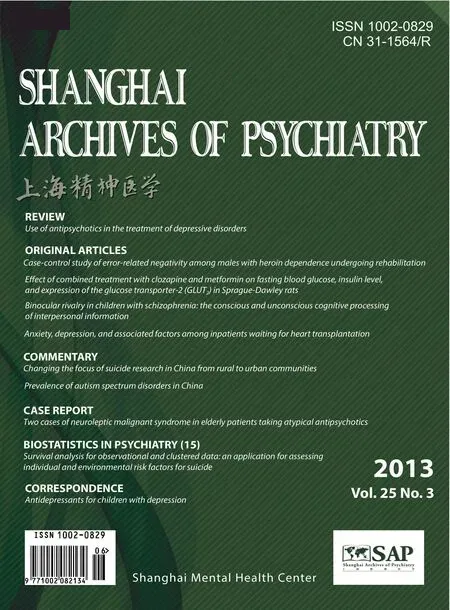
Changing the focus of suicide research in China from rural to urban communities
2013-12-09 03:28:38EricCAINE
上海精神醫(yī)學(xué) 2013年3期
Eric D. CAINE
·Commentary·
Changing the focus of suicide research in China from rural to urban communities
Eric D. CAINE
The recent paper by Jiang and colleagues[1]regarding the characteristics of persons who made medically serious suicide attempts in rural Shandong Province from August 1998 to August 2000 reaffirmed observations reported by Phillips and his colleagues from the mid-1990s to the middle of the first decade of the 21stcentury.[2-5]Specifically, the characteristics of suicide decedents and of near-fatal suicide attempters were different from what has been encountered in the United States,European Union, Australia, and other economically developed countries. More were women, fewer had major diagnosed psychopathology, and many more had near-term stressful life events preceding relatively sudden, often unplanned (or low-planned) suicides.
These findings by Jiang and colleagues again invite two key questions raised by the original reports. Is suicide different in China? Is suicidal behavior different in China?These are overlapping but not identical issues. The prevalence and outcome of suicidal behavior depends on the interaction of multiple factors including (but not limited to) gender, age, life circumstances, mental state, and the method chosen.[6]The most striking feature of suicidal behavior in rural China - at least until recently - has been the great preference for using highly lethal, readily available pesticides. I have often wondered whether the unique demographic and other characteristics of suicide in China would be different if pesticides were not so easily available.
Let me explain. Suicidal behaviors that result from relatively sudden, unplanned acts among individuals with low levels of psychopathology are common in the United States and elsewhere (especially in adolescent girls and younger women) - but they rarely lead to fatal outcomes. The available medications and chemicals that are ingested in high-income countries are not agricultural poisons but, rather, the much less toxic compounds that are typically found in a person’s bathroom medicine cabinet. In essence, for this subgroup of low-planned suicidal behaviors, there is little overall difference in the circumstances of the suicidal acts when comparing China and high-income countries, but there are extraordinary differences in the outcomes because of the very different case-fatality ratios. A recently reported community survey from rural Sichuan Province in China found that attempts occurred at a rate similar to other countries and regions, which suggests that it is less the behavior than the chosen method that makes a difference.[7]Moreover,limited access to high-quality emergency medical interventions may be another reason for the higher casefatality ratios in China, particularly in rural China, than in nations with extensively developed medical systems.
To answer the two questions noted above, I would say that suicide in China, as it was described epidemiologically from the 1990s into the 21stcentury, was very different from suicide as described epidemiologically in other countries. But that does not mean that the patterns of suicidal behavior are different.In fact, I suspect that many of the behaviors are quite similar, but the fatal nature of attempts is a direct result of the lethality of the method rather than what occurred before the intentional ingestion.[8]
It is intriguing that the data presented by Jiang and colleagues are more than a decade old. I suspect that suicide (epidemiologically speaking) is changing as rapidly as the rest of China. China’s phenomenal economic transformation, as well as public policies arising from the dangers of early-generation pesticides,may have been transforming the ‘suicide picture’ in as yet unstudied directions. Moreover, there are few papers published in the international literature about the demographic pattern and characteristics of suicide in urban China - which already constitutes more than half of the population - although this will be a future priority.[9]I anticipate that subsequent research will identify the following trends.
A) Suicide in rural regions will decline. Close scrutiny will reveal that this is less a reflection of fewer attempts and more the result of a lower case-fatality ratio due to a decline in the use of the most lethal pesticides. Other broad contextual factors related to this decline may include the improving economic status ofrural families and their greater access to health services.
B) The pattern of suicide in urban areas will also change. I would anticipated that in major metropolitan regions there will be a combination of an ‘urban pattern’ among long-time residents and a ‘rural pattern’ (perhaps including the use of pesticides) among migrant workers and their families. Over the course of time, however, I would expect that there will be a gradual shift among the rural-urban migrants to patterns and methods of suicide that are common to other urban environments, such as jumping, hanging, charcoal burning (i.e., carbon monoxide poisoning), and the use of other gases. The proportion of suicides by pesticide ingestion will decrease accordingly.
Note that I am not predicting that suicidal behaviors will change. Rather, I am suggesting a focus for future epidemiological studies on suicide in China: the role that changing access to methods in the context of rapid urbanization can have on the prevalence, demographic characteristics and methods of fatal suicidal behavior. In parallel with this focus, it is clearly time for the systematic development of urban suicide research in China. Urbancentered studies can, among other things, monitor the role of massive internal migration (that has served as the workforce engine supporting the country’s rapid economic growth) on patterns of suicide by identifying the location of death, the location of birth, and the location of formal residence (i.e., hukou) of all suicide decedents.
Conflict of interest
The author reports no conflict of interest related to this manuscript.
1. Jiang CL, Li XY, Phillips MR, Xu YC. Matched case-control study of medically serious attempted suicides in rural China.Shanghai Archives of Psychiatry, 2013; 25(1): 22-31.
2. Phillips MR, Li XY, Zhang YP. Suicide rates in China, 1995-99.Lancet 2002; 359(9309): 835-840. [Erratum appears in Lancet 2002; 360(9329): 344].
3. Li XY, Phillips MR, Zhang YP, Xu D, Yang GH. Risk factors for suicide in China’s youth: a case-control study. Psychol Med 2008; 38(3): 397-406.
4. Conner KR, Phillips MR, Meldrum S, Knox KL, Zhang Y, Yang G. Low-planned suicides in China. Psychol Med 2005; 35(8):1197-1204.
5. Conner KR, Phillips MR, Meldrum SC. Predictors of low-intent and high-intent suicide attempts in rural China. Am J Public Health 2007; 97(10): 1842-1846.
6. Yip PS, Caine ED, Kwok RC, Chen YY. A decompositional analysis of the relative contribution of age, sex and methods of suicide to the changing patterns of suicide in Taipei City,2004-2006. Inj Prev 2012; 18(3): 187-192.
7. Dai J, Chiu HF, Conner KR, Chan SS, Hou ZJ, Yu X. Suicidal ideation and attempts among rural Chinese aged 16-34 years--socio-demographic correlates in the context of a transforming China. J Affect Disord 2011; 130(3): 438-446.
8. Yip PS, Caine E, Yousuf S, Chang SS, Wu KC, Chen YY. Means restriction for suicide prevention. Lancet 2012; 379(9834):2393-2399.
9. Yip PS, Liu KY. The ecological fallacy and the gender ratio of suicide in China. Br J Psychiatry 2006; 189: 465-466.
10.3969/j.issn.1002-0829.2013.03.007
Department of Psychiatry, University of Rochester Medical Center, Rochester, NY, USA
correspondence: Eric_Caine@urmc.rochester.edu

Dr. Caine has served as John Romano Professor and Chair of the Department of Psychiatry at the University of Rochester Medical Center since 1996. Joining the department in 1978, up until the mid-1990s, his clinical work involved inpatient general psychiatry and neuropsychiatry, general outpatient psychiatry and psychopharmacology consultation, and specialty work in geriatrics and neuropsychiatry.His research evolved from a focus on the relationships between organized brain functioning and behavioral disorders to conditions arising in later life. This work rekindled earlier interests in suicide and suicide prevention, ultimately involving the entire life span. His recent work aims to integrate biological, psychological, pathological, social, cultural, public health, and international perspectives into a single problem focus. The goal of this work, which is an entry point for the new field of public health and preventive psychiatry, is to reduce the mortality and morbidity of suicide.
- 上海精神醫(yī)學(xué)的其它文章
- Antidepressants for children with depression
- Should repeve Transcranial Magnec Smulaon (rTMS)be considered an effecve adjuncve treatment for auditory hallucinaons in paents with schizophrenia?
- Survival analysis for observational and clustered data: an application for assessing individual and environmental risk factors for suicide
- Prevalence of ausm spectrum disorders in China
- Two cases of neuroleptic malignant syndrome in elderly patients taking atypical antipsychotics
- Anxiety, depression, and associated factors among inpatients waiting for heart transplantation