
Use of anpsychocs in the treatment of depressive disorders
2013-04-07 17:03:46PingWANGTianmeiSI
上海精神醫學 2013年3期
Ping WANG, Tianmei SI*
Ping WANG1, Tianmei SI2*
Summary:There is a long history of using anpsychoc medicaons in the treatment of depressive disorders. Atypical anpsychocs, which have fewer side effects than tradional anpsychocs, have been used as monotherapy or adjuncvely with andepressants to treat depressive disorders with or without psychoc symptoms. The andepressant effect of atypical anpsychocs involves regulaon of monoamine, glutamate, gamma-aminobutyric acid (GABA), corsol, and neurotrophic factors. To date, the United States Food and Drug Administraon (USFDA) has approved aripiprazole and queapine slow-release tablets as adjuncve treatment for depressive disorders, and the combinaon of olanzapine and fluoxene for the treatment of treatmentresistant depression. When using atypical anpsychocs in the treatment of depressed paents, clinicians need to monitor paents for the emergence of adverse effects including extrapyramidal symptoms (EPS), weight gain, and hyperglycemia.
1. Introducon
Depressive disorders cause substanal disability, oen exceeding that resulng from other chronic condions such as heart disease and diabetes.[1]Many andepressant medicaons have been developed over the last couple of decades but the mechanism of acon of these drugs remains unclear and the proporon of paents who are not helped by these medicaons remains high. The complete resoluon of all the symptoms of depression may require the use of mulple medicaons that have different mechanisms of acon.[2]Some authors believe that concurrent treatment with andepressants and anpsychocs (including tradional anpsychocs, such as sulpiride, or atypical anpsychocs, such as clozapine, olanzapine, queapine, aripiprazole, risperidone, and ziprasidone) are more effecve than monotherapy with andepressants because this approach acts on mulple receptor systems.[2]Based on this raonale, the use of atypical (second generaon) anpsychocs has become one of the main strategies to boost the efficacy of treatment for depression.[3]This review will discuss the current use of anpsychocs in the treatment of depressive disorders, consider the pharmacological mechanisms involved in this combined treatment approach, highlight the warning signs to watch for during this type of treatment, and consider future trends of this therapeuc pracce.
2. The history of the use of anpsychocs in the treatment of depressive disorders
There is abundant evidence of the andepressant effect of some of the atypical anpsychocs.[3]The United States Food and Drug Administraon (USFDA) has approved the use of aripiprazole (5-10 mg/d, maximum dosage 15 mg/d) as an adjuncve medicaon in the treatment of depressive disorders. Combined treatment with olanzapine and fluoxene has been approved by the USFDA for the treatment of treatmentresistant depression (olanzapine 5-20 mg/d, fluoxene 20-50 mg/d).[10]Slow-release queapine (150-300 mg/d) has also been approved by the USFDA as an adjuncve treatment for depressive disorders; this is the only atypical anpsychoc approved in Europe as an adjuncve treatment for depression and in Australia it has been approved both as an auxiliary treatment and as a primary treatment for depression.
Meta-analyses have assessed the effecveness and side effects associated with the use of various atypical anpsychocs as adjuncve or primary treatment for depressive disorders and dysthymia.[11]Slow-release queapine: pooled results from seven double-blind RCTs (n=3414) found improved depressive symptoms when used alone or when used jointly with andepressants, but it also had a clear sedave effect. Olanzapine: pooled results from seven double-blind RCTs (n=1754) found that adjuncve treatment with olanzapine improved paent adherence to treatment but it was not associated with improved treatment effects and it was associated with weight gain and increased prolacn levels. Aripiprazole (3 studies,n=1092) and risperidone (4 studies,n=637): when used as adjuncve treatment to andepressants both medicaons improved the outcomes, but they were associated with weight gain and increased prolacn levels.[11]No significant differences have been found in the andepressant effects of the different atypical anpsychoc medicaons assessed.[3]
Some studies have also shown benefits of anpsychoc treatment during the maintenance phase of treatment for depression. A 52-week follow-up study reported that relapses were fewer among individuals with depressive disorders who received monotherapy with slow-release queapine (50-300 mg/d) during the maintenance phase of treatment than in those given placebos.[12]Another study found that the relapses were delayed among those who received adjuncve treatment with risperidone or amisulpride compared to those who received placebos as adjuncve treatment.[3]
There is also evidence suggesng an augmentaon of andepressant treatment effects in treatmentresistant paents who receive adjuncve ziprasidone. An open-label randomized trial of individuals with treatment-resistant depression on high-dosage sertraline found that the paents had beer scores on the Clinical Global Impression-Severity (CGI-S) scale aer receiving adjuncve treatment with ziprasidone 160 mg/d compared with those who received adjuncve treatment with ziprasidone 80 mg/d. But this was a small-sample study so these results need to be verified.[13]A retrospecve study also found that ziprasidone was effecve for treatment-resistant depression, though there was no difference in effecveness between ziprasidone and other atypical anpsychocs.[14]
No RCTs about the usefulness of clozapine or paliperidone as adjuncve treatments in the management of depressed paents have been idenfied.
4. Pharmacological mechanisms of anpsychocs in the treatment of depressive disorders
4.1 Dopamine (DA)
4.2 5-hydroxytryptamine (5-HT)
5-HT2C receptors are located in GABA, GA, and DA neurons. They funcon as cellular dendrite isoreceptors.[18]In vivo neurochemical studies found that the acvaon of 5-HT2C receptors can inhibit the release of DA and NE in the cortex.[18]A study found that 5-HT2C receptormutated mice did not show obvious anxiety induced by 5-HT2C receptor smulants,[18]which suggests that these receptors influence emoons and behavior.
Experimental data suggests that the 5-HT7 receptor is the key mediator for the andepressant effect of aripiprazole.[24]The combinaon of SSRIs and 5-HT7 receptor antagonists can increase the treatment effects of SSRIs.[25]Animal studies have also found that 5-HT6 receptor antagonists can enhance the effects of andepressants.[26]
4.3 Norepinephrine (NE)
NE is located in many brain areas. It is the main monoamine neurotransmier that regulates arousal and stress reacons. Reduced acvies in the prefrontal cortex regulated by NE may be related to decline in cognive funconing (e.g., aenon) and movaon. Since noradrenergic descending fibers from the nucleus ceruleus also go to brain areas that regulate motor funconing (i.e., the striatum and cerebellum), NE may also be related to the regulaon of physical fague. N-desalkylqueapine, the metabolite of queapine, can block the NE transporter and promote the delivery of NE; the binding of queapine to the NE transporter is almost negligible.[12]
NE and NE neurons as well as the α2 receptor on the presynapc membrane of the 5-HT neuron can block the release of NE and 5-HT. Antagonists of the α2 receptor can relieve this inhibion and increase the release of 5-HT and NE, producing an andepressant effect. Addionally, the α1 receptor on the postsynapc membrane of the NE and 5-HT neurons can enhance the release of 5-HT. Thus, when NE inhibion is blocked, the α1 receptor is acvated, which leads to a magnified release of 5-HT.[2]Preclinical neurological data show that the andepressant mechanism of risperidone is due to the inhibion of the α2 receptor;[27]some researchers believe the andepressant effect of queapine is also moderated by the inhibion of the α2 receptor.
SSRIs increase the transmission of 5-HT in the cerebrum and nucleus ceruleus, and thus, decrease the discharge of NE neurons. Atypical anpsychocs increase the discharge of NE neurons via the inhibion of 5-HT2A, α2, or NE transporters. This may be the reason that second-generaon anpsychocs are effecve among depressed paents who get limited benefit from SSRI treatment.[28]
4.4 Glutamate (GA)
4.5gamma-aminobutyric acid (GABA)
Preclinical and clinical studies found that inhibion of the γ-GABA system is related to the pathophysiology of depression. The regulaon of extra-cellular concentraons of NE and DA in the prefrontal cortex by the administraon of queapine is regulated by NMDA which is moderated by AMPA and GABA.[29]Joint use of fluvoxamine and haloperidol led to changes in GABA receptors and signal delivery systems in some brain regions in rats; this change was not observed when fluvoxamine or haloperidol were used alone.[32]Similar observaons have been reported among paents with schizophrenia; some studies suggest that combined treatment may lead to a beer improvement of negave symptoms.[32]There has been no study on this topic among paents with depressive disorders.
4.6 Hypothalamic-Pituitary-Adrenal (HPA) axis
Mood disorders are related to changes in the stress response system. Convincing evidence has been found for increased corsol levels among paents with depressive disorders.[33]Unlike haloperidol, low-dose queapine and olanzapine can decrease corsol levels among healthy volunteers.[34]However, there has been no study about changes in corsol levels aer the use of anpsychocs among paents with depressive disorders,[12]so its unclear whether or not the HPA axis plays a role in the andepressant effect of anpsychoc medicaons.[12]
4.7 Brain-derived neurotrophic factor (BDNF)
Pre-clinical and clinical studies have found that the increase of neurotrophic factors, especially BDNF, is a common characterisc in the mechanisms of acon of andepressant medicaons. A meta-analysis summarizing 11 studies found decreased BDNF levels in untreated depression and a return of BDNF levels to the normal aer andepressant treatment.[35]These findings have led some researchers to propose using BDNF concentraon as a biomarker for disease severity and treatment effects.[35]Aer the use of second-generaon anpsychocs such as olanzapine, plasma BDNF levels increase.[36]Moreover, one relavely small study found that the increase in BDNF levels of depressedpaents treated with a variety of anpsychocs and andepressants was greater in paents considered responsive to the combined treatment;[37]this suggesve study needs to be repeated with a larger sample that would allow differenaon of the results for different combinaons of medicaons.
5. Adverse reacons when using anpsychocs in the treatment of depressive disorders
In the mid-1980s, two studies observed a high prevalence of tardive dyskinesia aer long-term use of typical anpsychocs in individuals with mood disorders.[38,39]Subsequent studies[40,41]reported that the prevalence of tardive dyskinesia in paents with mood disorders who were treated with anpsychoc medicaon ranged from 9 to 64%. Among these studies, only one study included paents with schizophrenia;[40]this study reported that the occurrence of tardive dyskinesia was higher among mood disorder paents (42%) than in paents with schizophrenia (25%).
In general, the occurrence of EPS is lower for atypical anpsychocs compared to typical anpsychocs (except for aripiprazole). With the excepons of risperidone and paliperidone, the influence of atypical anpsychocs on the level of prolacn is also smaller than that of typical anpsychocs.
6. Future direcons
Currently, side-effects are more predicable than treatment efficacy, so the relave risk of different types of side-effects is the most important factor to consider when choosing an adjuncve anpsychoc medicaon for the treatment of depressed paents who are currently receiving andepressants. Future studies need to idenfy subgroups of depressive paents - categorized by genecs, neurophysiological markers, or family history - who would benefit from specific types of anpsychoc medicaons or specific combinaons of andepressant and anpsychoc medicaons. And more detailed studies on the appropriate dosages and duraon of treatment with adjuncve anpsychoc medicaon will help increase the effecveness of combined treatment while decreasing the adverse reacons associated with combined treatment, thus enhancing the cost-benefit for this important form of treatment for persons with depressive disorders.
Conflict of interest
The author reports no conflict of interest related to this manuscript. The authors did not receive any financial support for the preparaon of this review.
2. Si T, Huang J, Yu X (translated edion).. 3rdEdied by Stephen M. Stahl. Beijing: Peking University Medical Press, 2011. (in Chinese)
3. Chen J, Gao K, Kemp D E. Second-generaon anpsychocs in major depressive disorder: update and clinical perspecve.Curr Opin Psychiatry2011; 24(1): 10-17.
4. Robertson MM, Trimble MR. Major tranquillisers used as andepressants. A review.J Affect Disord1982; 4(3): 173-193.
5. Schatzberg AF, Rothschild AJ. Psychoc (delusional) major depression: should it be included as a disnct syndrome in DSM-IV?Am J Psychiatry1992; 149(6): 733-745.
6. Jc N.. New York: PMA Publishing Corp., 1987.
7. Kennedy SH, Lam RW, Cohen NL, Ravindran AV, CANMAT Depression Work Group. Clinical guidelines for the treatment of depressive disorders. IV. Medicaons and other biological treatments.Can J Psychiatry2001; 46 (Suppl 1): 38S-58S.
8. Goodwin G, Fleischhacker W, Arango C, Baumann P, Davidson M, de Hert M, et al. Advantages and disadvantages of combinaon treatment with anpsychocs ECNP Consensus Meeng, March 2008, Nice.Eur Neuropsychopharmacol2009; 19(7): 520-532.
10. Maher AR, Theodore G. Summary of the comparave effecveness review on off-label use of atypical anpsychocs.J Manag Care Pharm2012; 18(5 Suppl B): S1-S20.
11. Komossa K, Depping AM, Gaudchau A, Kissling W, Leucht S. Second-generaon anpsychocs for major depressive disorder and dysthymia.Cochrane Database Syst Rev2010; (12): D8121.
12. Sagud M, Mihaljevic-Peles A, Begic D, Vuksan-Cusa B, Kramaric M, Zivkovic M, et al. Anpsychocs as andepressants: what is the mechanism?Psychiatr Danub2011; 23(3): 302-307.
13. Dunner DL, Amsterdam JD, Shelton RC, Loebel A, Romano SJ. Efficacy and tolerability of adjuncve ziprasidone in treatment-resistant depression: a randomized, open-label, pilot study.J Clin Psychiatry2007; 68(7): 1071-1077.
14. Barbee JG, Conrad EJ, Jamhour NJ. The effecveness of olanzapine, risperidone, queapine, and ziprasidone as augmentaon agents in treatment-resistant major depressive disorder.J Clin Psychiatry2004; 65(7): 975-981.
15. Schwartz TL, Stahl SM. Treatment strategies for dosing the second generaon anpsychocs.CNS Neurosci Ther2011; 17(2): 110-117.
16. Lavergne F, Jay TM. A new strategy for andepressant prescripon.Front Neurosci2010; 4: 192.
17. De Sousa A, Kurvey A. An evidence based clinical review on the role of atypical anpsychocs in depression.Journal of Mental Health and Human Behaviour2012; 1(17): 38-45.
18. Filip M, Bader M. Overview on 5-HT receptors and their role in physiology and pathology of the central nervous system.Pharmacol Rep2009; 61(5): 761-777.
19. Begi? D, Mahnik-Milos M, Grubisin J. EEG characteriscs in depression, “negave” and “posive” schizophrena.Psychiatr Danub2009; 21(4): 579-584.
20. Gimenez S, Clos S, Romero S, Grasa E, Morte A, Barbanoj MJ. Effects of olanzapine, risperidone and haloperidol on sleep aer a single oral morning dose in healthy volunteers.Psychopharmacology(Berl) 2007; 190(4): 507-516.
22. Gedge L, Lazowski L, Murray D, Jokic R, Milev R. Effects of queapine on sleep architecture in paents with unipolar or bipolar depression.Neuropsychiatr Dis Treat2010; 6: 501-508.
23. Jensen NH, Rodriguiz RM, Caron MG, Wetsel WC, Rothman RB, Roth BL. N-desalkylqueapine, a potent norepinephrine reuptake inhibitor and paral 5-HT1A agonist, as a putave mediator of queapine’s andepressant acvity.Neuropsychopharmacology2008; 33(10): 2303-2312.
24. Abbas AI, Hedlund PB, Huang XP, Tran TB, Meltzer HY, Roth BL. Amisulpride is a potent 5-HT7 antagonist: relevance for andepressant acons in vivo.Psychopharmacology(Berl) 2009; 205(1): 119-128.
25. Hedlund PB. The 5-HT7 receptor and disorders of the nervous system: an overview.Psychopharmacology(Berl) 2009; 206(3): 345-354.
27. Dhir A, Kulkarni SK. Risperidone, an atypical anpsychoc enhances the andepressant-like effect of venlafaxine or fluoxene: possible involvement of alpha-2 adrenergic receptors.2008; 445(1): 83-88.
28. Blier P, Szabo ST. Potenal mechanisms of acon of atypical anpsychoc medicaons in treatment-resistant depression and anxiety.J Clin Psychiatry2005; 66 (Suppl 8): 30-40.
30. Tokita K, Yamaji T, Hashimoto K. Roles of glutamate signaling in preclinical and/or mechanisc models of depression.Pharmacol Biochem Behav2012; 100(4): 688-704.
31. Porcelli S, Drago A, Fabbri C, SerreA. Mechanisms of andepressant acon: an integrated dopaminergic perspecve.Prog Neuropsychopharmacol Biol Psychiatry2011; 35(7): 1532-1543.
32. Silver H, Susser E, Danovich L, Bilker W, Youdim M, Goldin V, et al. SSRI augmentaon of anpsychoc alters expression of GABAA receptor and related genes in PMC of schizophrenia paents.Int J Neuropsychopharmacol2011; 14(5): 573-584.
33. Stetler C, Miller GE. Depression and hypothalamic-pituitaryadrenal acvaon: a quantave summary of four decades of research.Psychosom Med2011; 73(2): 114-126.
34. Cohrs S, Roher C, Jordan W, Meier A, Huether G, Wuke W, et al. The atypical anpsychocs olanzapine and queapine, but not haloperidol, reduce ACTH and corsol secreon in healthy subjects.Psychopharmacology(Berl) 2006; 185(1): 11-18.
35. Sen S, Duman R, Sanacora G. Serum brain-derived neurotrophic factor, depression, and andepressant medicaons: meta-analyses and implicaons.Biol Psychiatry2008; 64(6): 527-532.
36. González-Pinto A, Mosquera F, Palomino A, Alberich S, Guérrez A, Haidar K, et al. Increase in brain-derived neurotrophic factor in first episode psychoc paents aer treatment with atypical anpsychocs.Int Clin Psychopharmacol2010; 25(4): 241-245.
37. Yoshimura R, Ikenouchi-Sugita A, Hori H, Umene-Nakano W, Katsuki A, Hayashi K, et al. Adding a low dose atypical anpsychoc drug to an andepressant induced a rapid increase of plasma brain-derived neurotrophic factor levels in paents with treatment-resistant depression.Prog Neuropsychopharmacol Biol Psychiatry2010; 34(2): 308-312.
38. Baldessarini RJ. A summary of current knowledge of tardive dyskinesia.Encephale1988; 14(9): 263-268.
40. Keck PE Jr, McElroy SL, Strakowski SM, Soutullo CA. Anpsychocs in the treatment of mood disorders and risk of tardive dyskinesia.J Clin Psychiatry2000; 61(suppl 4): 33-38.
41. Vacheron-Trystram MN, Braitman A, Cheref S, Auffray L. Anpsychocs in bipolar disorders.Encephale2004; 30(5): 417-424.
42. Hasnain M, Vieweg WV, HolleB. Weight gain and glucose dysregulaon with second-generaon anpsychocs and andepressants: a review for primary care physicians.Postgrad Med2012; 124(4): 154-167.
43. Zuddas A, Zanni R, Usala T. Second generaon anpsychocs (SGAs) for non-psychoc disorders in children and adolescents: a review of the randomized controlled studies.Eur Neuropsychopharmacol2011; 21(8): 600-620.
44. Morrato EH, Newcomer JW, Kamat S, HarneJ, Cuffel B. Metabolic screening aer the American Diabetes Associaon’s Consensus Statement on Anpsychoc Drugs and Diabetes.Diabetes Care2009; 32(6): 1037-1042.

Dr. Ping Wang graduated with an MD from the Beijing University Medical School in 2010. Aer graduaon she worked as a psychiatric resident in the psychiatry department of the Shougang Hospital of Beijing University and subsequently in the neurology and psychiatry department at the Shijitan Hospital of Capital University of medical Sciences in Beijing. Her research interests are in clinical psychopharmacology.
10.3969/j.issn.1002-0829.2013.03.002
1Beijing Shijitan Hospital, Capital University of Medical Sciences, Beijing, China
2Peking University Instute of Mental Health, Naonal Key Laboratory of China, Beijing, China
*correspondence: si.an-mei@163.com
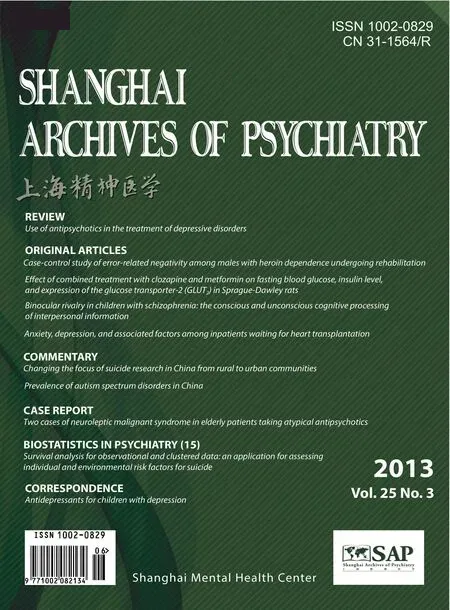
- 上海精神醫學的其它文章
- Antidepressants for children with depression
- Should repeve Transcranial Magnec Smulaon (rTMS)be considered an effecve adjuncve treatment for auditory hallucinaons in paents with schizophrenia?
- Survival analysis for observational and clustered data: an application for assessing individual and environmental risk factors for suicide
- Prevalence of ausm spectrum disorders in China
- Changing the focus of suicide research in China from rural to urban communities
- Two cases of neuroleptic malignant syndrome in elderly patients taking atypical antipsychotics