
? In this issue ?
2013-04-06 14:04:51
上海精神醫學 2013年1期
? In this issue ?
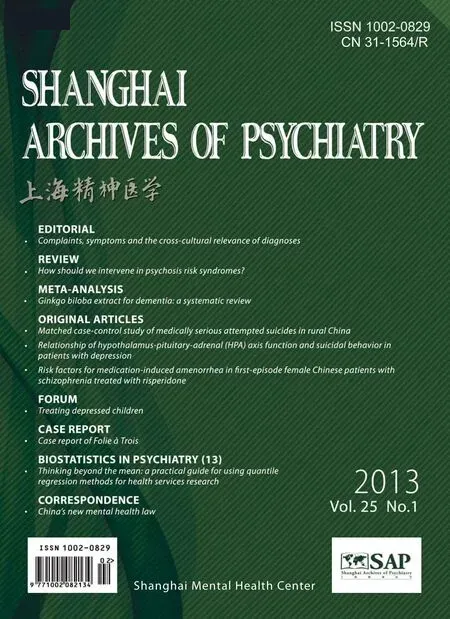
The lead-off for this issue is an editorial by one of our associate editors, Professor John Cooper,[1]that highlights problems caused by the dominant role of biological approaches in psychiatric research which have eclipsed other, equally important, approaches. There is a need to re-focus more intellectual effort on long-term clinical studies that address fundamental conceptual issues about diagnoses. As an example of the needed work, Cooper discusses the differences between the complaints that are recorded by lay interviewers in psychiatric epidemiological studies (such as the World Mental Health Survey[2]) and the symptoms that are solicited by trained psychiatrists. Despite knowing about these differences for decades, no study has systematically assessed the relative predictive power of complaints versus symptoms in terms of need for treatment, response to treatment, or disability. Another example is the relative lack of interest in culture-specific characteristics of mental disorders. The homogenization of the diagnostic criteria for mental disorders imposed by the World Health Organization’s International Classification of Diseases (ICD) and the American Psychiatric Association’s Diagnostic and Statistical Manual of Mental Disorders (DSM-IV) are necessary for international communication, but they may be missing important cultural-specific components of disorders that are of central importance to the disability, treatment and prognosis of these conditions.
The review paper[3]addresses the controversial issue about the appropriate treatment of individuals at highrisk of developing a chronic psychotic illness, a topic that was also discussed in the forum of our previous issue.[4]There are two main problems with the current state of knowledge. Current methods of detecting high-risk individuals still have more false positives than true positives, so treating all individuals screened as positive means that many who do not need preventative interventions would be labeled as ‘at-risk’ and receive unnecessary treatment. Second, the available studies about the efficacy of different approaches have small samples and follow patients for relatively short time periods, so they cannot provide definitive answers about their relative benefits of different treatment approaches. Until larger, better, and longer studies are completed, the authors recommend a conservative,stepped approach to treatment that is based on close follow-up and high-quality case management.
The meta-analysis paper[5]pools results from randomized controlled trials about the potential benefit of ginkgo biloba extract (GbE) in the treatment of dementia. Given the importance of dementia as a public health problem and the lack of effective treatments, several countries have already recommended using GbE despite inconsistent findings about its efficacy. This metaanalysis identified nine placebo-controlled studies that treated patients with GbE for a minimum of 24 weeks.The analysis found improvement with GbE treatment in both cognitive functioning and activities of daily living in individuals with dementia who are under 75 years of age,but the low quality of the studies and the high potential for bias (most were supported by pharmaceutical firms)raises serious doubts about the validity of these results.Interestingly, none of the studies included in the metaanalysis came from mainland China, where the studies are usually of short duration and where GbE is typically used in combination with other medications.
The first original article[6]is a large match-control study of medically serious suicide attempters sequentially admitted to the emergency department of a single hospital in rural China. As has been shown in other reports, the characteristics of these individuals were very different from those reported for persons who attempt suicide in high-income countries: 80% had ingested pesticides, 57% reported considering suicide for less than 5 minutes before acting, and only 38% had a diagnosable mental illness. However, most of the risk factors identified – prominent depressive symptoms,family dysfunction, negative life events, and knowing associates with suicidal behavior – were similar to those reported from other countries. The one possible exception is that impulsive and aggressive personality traits appear to play a more important role in suicidal behavior in China than in other countries.
The second original article[7]focuses on the identification of potential biological markers of high-risk for suicide among individuals who have depression. It compares the functioning of the hypothalamus-pituitaryadrenal (HPA) axis between depressed inpatients with and without suicidal ‘behavior’ (including suicidal ideation and suicide attempt) in the two months prior to admission, both before and after 6 weeks of treatment.The diurnal fluctuations in cortisol were similar in the two groups, but the dexamethasone suppression test (DST) was more likely to be positive (i.e., nonsuppression) in depressed patients with recent suicidal behavior than in those without recent suicidal behavior.There are, however, many potential confounding factors,so larger studies of inception cohorts of depressed patients that are followed over prolonged periods are needed to confirm the value of the DST or any other HPA axis measure as a biomarker for suicide risk in depressed subjects.
The third original article[8]is about potential risk factors for the development of amenorrhea in women treated with antipsychotic medication, a common adverse reaction to this class of drugs. The authors conducted a prospective, nested case-control study of first-episode, drug-naive female patients with schizophrenia treated for 12 weeks with risperidone.Despite confirming previous findings of a dramatic increase in prolactin levels with antipsychotic treatment in all patients – including those that did and did not develop amenorrhea with treatment – the findings did not support previous suggestions that amenorrhea is the result of hyperprolactinemia. They found that pretreatment levels of estradiol were associated with the subsequent development of amenorrhea. If confirmed in larger studies, this finding could potentially help clinicians in the selection of antipsychotic medication for female patients with schizophrenia.
The forum[9,10]re-visits the issue of treating childhood depression in the aftermath of the heated debates about the potential risk of suicidal behavior in children and adolescents who are treated with antidepressant medication. Despite a reported remission rate of only 23 to 41%, selective serotonin reuptake inhibitors(SSRIs) remain the most frequently used treatment for children and adolescents with depression. In China,non-psychiatric clinicians almost never diagnose or treat depression in children and there are few psychiatrists who treat children, so a very small proportion of children and adolescents with depression ever get treated. Thus the widely publicized US FDA ‘black box warnings’on package inserts for SSRIs are unlikely to result in a significant change in treatment practices, though it may increase the monitoring and follow-up of the few children in China who are prescribed antidepressants.The newer cognitive-behavioral interventions aimed at preventing a first full-criteria episode of depression in at-risk youth that are becoming popular in high-income countries[10]have not yet been assessed in China.
This issue also includes a case report of Folie à Trois[11]in which a man’s 25-year delusional system was shared by his wife and son, a discussion of the uses of quantile regression in health services research[12]when the role of predictor variables may be different in different subgroups of the population of interest, and two letters[13,14]that provide additional commentary on China’s new mental health law[15]in the build-up to its formal implementation on 1 May 2013.
1. Cooper JE. Complaints, symptoms and the cross-cultural relevance of diagnoses (Editorial). Shanghai Archives of Psychiatry 2013;25(1): 3-5.
2. The World Mental Health Survey Initiative. Available at: http://www.hcp.med.harvard.edu/wmh/ (accessed December 27, 2012
3. Wang JJ, Jiang KD, Zhang TZ, Li HJ, Woodberry K, Seidman L.How should we intervene in psychosis risk syndromes? Shanghai Archives of Psychiatry 2013; 25(1): 6-9.
4. Zhao JP, Lu HL, Guo XF. Is pharmacological intervention necessary in prodromal schizophrenia? Shanghai Archives of Psychiatry 2012; 24(6): 347-349.
5. Jiang LJ, Su LJ, Cui HR, Ren JJ, Li CB. Ginkgo biloba extract for dementia: a systematic review. Shanghai Archives of Psychiatry 2013; 25(1): 10-21.
6. Jiang CL, Li XY, Phillips MR, Xu YC. Matched case-control study of medically serious attempted suicides in rural China. Shanghai Archives of Psychiatry 2013; 25(1): 22-31.
7. Li HW, Gao ZS, Wu Q, Huang PS, Lin CH, Chen GY. Relationship of hypothalamus-pituitary-adrenal (HPA) axis function and suicidal behaviour in patients with depression. Shanghai Archives of Psychiatry 2013; 25(1): 32-39.
8. Chen HZ, Qian MC, Shen XH, Yang SL, Yang JH, Song JF, et al.Risk factors for medication-induced amenorrhea in first-episode female Chinese patients with schizophrenia treated with risperidone. Shanghai Archives of Psychiatry 2013; 25(1): 40-47.
9. Du YS. Should antidepressants be used to treat childhood depression? Shanghai Archives of Psychiatry 2013; 25(1): 48-49.
10. Craighead WE. Interventions for childhood depression. Shanghai Archives of Psychiatry 2013; 25(1): 50-51
11. Yang ZL, Xu JN, Lu M, Liu DT, Xu YF, Jiang KD. Case report of Folie à Trois. Shanghai Archives of Psychiatry 2013; 25(1): 52-54.
12. Lê Cook B, Manning WG. Thinking beyond the mean: a practical guide for using quantile regression methods for health services research. Shanghai Archives of Psychiatry 2013; 25(1): 55-59.
13. Xie B. Detailed operational regulations are needed to implement China’s new mental health law. Shanghai Archives of Psychiatry 2013; 25(1): 60-62.
14. Bertolote JM. Rehabilitation in the Mental Health Law of the People’s Republic of China. Shanghai Archives of Psychiatry 2013;25(1): 63-64.
15. Chen HH, Phillips MR, Cheng H, Chen QQ, Chen XD, Fralick D, et al. Mental health law of the People’s Republic of China (English translation with annotations). Shanghai Archives of Psychiatry 2012; 24(6): 305-321.
10.3969/j.issn.1002-0829.2013.01.004
- 上海精神醫學的其它文章
- SHANGHAI ARCHIVES OF PSYCHIATRY INSTRUCTIONS TO AUTHORS
- Detailed operational regulations are needed to implement the mental health law
- Thinking beyond the mean: a practical guide for using quantile regression methods for health services research
- Case report of Folie à Trois
- Interventions for childhood depression
- Should antidepressants be used to treat childhood depression?