
Should antidepressants be used to treat childhood depression?
2013-12-11 01:52:27YasongDU
上海精神醫(yī)學(xué) 2013年1期
Yasong DU
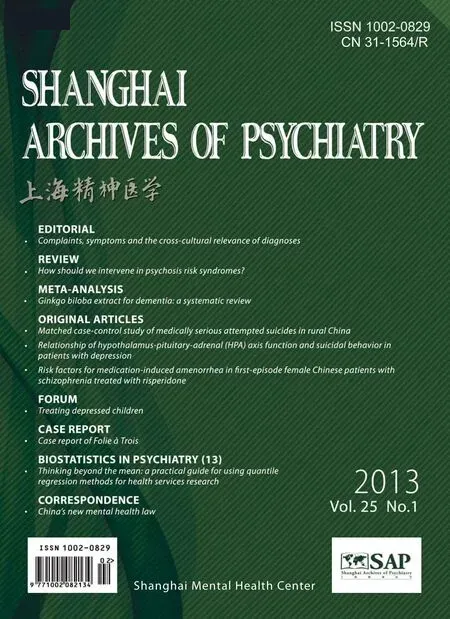
? Forum ?Treating depressed children
Should antidepressants be used to treat childhood depression?
Yasong DU
Childhood depression is a serious psychiatric disorder that is usually manifested as a low mood accompanied by a variety of other symptoms including attention deficit,irritability, restlessness, fidgeting, aggressive behavior,academic burnout, truancy and (in some cases) suicidal behavior. Depression can seriously impact a child’s academic achievement, social interactions and other aspects of their daily lives.[1]The reported prevalence of depression is 1 to 2% in prepubescent children, 3 to 8%in younger teenagers and 14% in teenagers aged 15 to 18; overall, it is estimated that 20% of the population will experience at least one episode of depression prior to the age of 18.[2]During childhood there is no significant gender difference in the prevalence of depression, but after puberty female rates of depression become higher than those for males.[3]The etiology of childhood depression remains unclear: it may be caused by the interaction of various risk factors and protective factors including genetic predisposition, abnormalities of the structure and function of the brain, psychological and physiological stressors, poor parental relationships,and so forth.[4-6]
The typical clinical presentation of childhood depression varies by age group. Depressed preschoolers are less interested in play activities, have a decreased overall activity level, appear anxious and may have self-harming behaviors. Depressed children aged 6 to 8 are often irritable, angry, uninterested in what goes on around them, and have trouble concentrating in classes.Depressed children aged 9 to 12 may run away from home, have low self-esteem, and feel bored, guilty or in despair. Adolescents aged 12 to 17 with depression may have sleep or eating disorders, impulsive behaviors,delusions, suicidal ideation, decreased energy and psychomotor retardation, or decreased functioning in all aspects of their lives. The main symptom in childhood depression is a low mood but it can manifest as aggressiveness, academic burnout, truancy or hyperactivity.[4,7]
Cognitive behavioral therapy (CBT) and interpersonal therapy (IPT) have been shown to be effective in the treatment of adolescent depression,[4,8,9]but treatment with antidepressants, primarily selective serotonin reuptake inhibitors (SSRIs), is the most common method of treating childhood and adolescent depression.Fluoxetine is the only drug approved by the Food and Drug Administration (FDA) in USA for the treatment of depression in children and adolescents; it is 41 to 61% effective, has a remission rate of 23 to 41%, and is considered most effective for individuals with retarded depression (i.e., with loss of interest, lack of energy and fatigue, and social isolation).[10]Though not formally approved for use in depression, fluvoxamine (for children over 8 years old) and sertraline (for children over 6 years old) have been approved by the FDA for treating children with obsessive-compulsive disorder and several doubleblind randomized controlled trials (RCTs) have shown that both of these medications are also effective and safe in the treatment of childhood depression.[11]Newer antidepressants, including venlafaxine and duloxetine,have not yet been adequately tested in children, but they can be considered when other antidepressants are not effective.[12-14]A meta-analysis from 1995 found older tricyclic antidepressants (TCAs) were not superior to placebo in the treatment of childhood depression;[15]so these medications are not recommended for children under the age of 16, but they can be used (with careful monitoring of cardiac toxicity) if SSRIs prove ineffective.[16]If children or adolescents being treated for depression have severe anxiety or sleep problems during the first two weeks of antidepressant therapy, antianxiety agents such as lorazepam, alprazolam, and estazolam may be administered to control these symptoms for a maximum of two weeks.[16]
Over the last decade the pharmacological treatment of childhood depression has become quite controversial because of reports of increased risk of suicide among children and adolescents taking antidepressant medication. A 2004 study in the USA found that paroxetine use was associated with suicidal ideation in adolescents, so the FDA recommends that it not be used in persons under the age of 18. The FDA also requires the use of ‘black box warnings’ on the package inserts for SSRIs, that warn of the increased risk of suicidality when administered to children and adolescents.[10,16]This warning has the potential effect of making clinicians less willing to use antidepressants in children and adolescents, and, thus, of reducing the use of antidepressants in children and adolescents with serious depression who really need them.
As is the case for all treatments, clinicians treating depressed children and adolescents need to carefully assess the potential benefits and risks of pharmacological and psychological treatment in each individual patient and regularly assess changes in the status of the patient over time to decide whether or not to make alterations in the treatment plan.
Conflict of interest
The author reports no conflict of interest with this manuscript.
1. Hetrick S, Cox GR, Merry SN. Treatment-resistant depression in adolescents: is the addition of cognitive behavioral therapy of benefit? Psychol Res Behav Manag 2011; 4: 97-112.
2. Vitiello B. Prevention and treatment of child and adolescent depression: challenges and opportunities. Epidemiol Psychiatr Sci 2011; 20(1): 37-43.
3. Tao GT. Child and Adolescent Psychiatry. Nanjing: Jiangsu Science and Technology Press; 2008: 298-308. (in Chinese)
4. Du YS. Childhood Depression. Shanghai: Shanghai Popular Science Press; 2010: 5-27. (in Chinese)
5. Gong Y, Xiao ZP, Du YS. Recent development in imaging studies of child and adolescent depression. International Psychiatry 2011;38(1): 23-27. (in Chinese)
6. Zhang X, Du YS, Gong Y, Li HL, Zhao Y, Jiang LH. Executive functioning among adolescents with major depressive disorder.Journal of Applied Clinical Pediatrics 2012; 27(13): 1016-1018. (in Chinese).
7. Tuisku V, Pelkonen M, Karlsson L, Kiviruusu O, Holi M, Tuuttu T, et al. Suicidal ideation, deliberate self-harm behaviour and suicide attempts among adolescent outpatients with depressive mood disorders and comorbid axis I disorders. Eur Child Adolesc Psychiatry 2006; 15(4):199-206.
8. Jacobs RH,Reinecke MA, Gollan JK, Kane P. Empirical evidence of cognitive vulnerability for depression among children and adolescents: a cognitive science and developmental perspective.Clin Psychol Rev 2008; 28(5): 759-782.
9. Hughes CW, Emslie GJ, Crimson ML, Posner K, Birmaher B, Ryan N,et al. Texas Children’s Medication Algorithm Project: update from Texas Consensus Conference Panel on Medication Treatment of Childhood Major Depressive Disorder. J Am Acad Child Adolesc Psychiatry 2007; 46(6): 667-686.
10. Stone M, Laughren T, Jones ML, Levenson M, Holland PC, Hughes A, et al. Risk of suicidality in clinical trials of antidepressants in adults: analysis of proprietary data submitted to US Food and Drug Administration. BMJ 2009; 339: b2880.
11. Brent DA, Emslie GJ, Clarke GN, Asarnow J, Spirito A, Ritz L, et al.Predictors of spontaneous and systematically assessed suicidal adverse events in the treatment of SSRI-resistant depression in adolescents (TORDIA) study. Am J Psychiatry 2009; 166(4): 418-426.
12. Brent D, Emslie G, Clarke G, Wagner KD, Asarnow JR, Keller M, et al. Switching to another SSRI or to venlafaxine with or without cognitive behavioral therapy for adolescents with SSRI-resistant depression: the TORDIA randomized controlled trial. JAMA 2008;299(8): 901-113.
13. Delgado SV, Salda?a SN, Barzman DH, Coffery B. Response to duloxetine in a depressed, treatment-resistant adolescent female. J Child Adolesc Psychopharmacol 2007; 17(6): 889-894.
14. Guan XB, Lu Z. Drug interactions of new antidepressants. World Clinical Drugs 2012; 33(7): 395-400. (in Chinese)
15. Hazell P, O’Connell D, Healthcote D, Robertson J, Henry D. Efficacy of tricyclic drugs in treating child and adolescent depression: a meta-analysis. BMJ 1995; 310 (684): 897-901.
16. Du YS. Clinical Psychopharmacology of Children and Adolescents.Beijing: People’s Medical Publishing House; 2011: 200-254. (in Chinese).
10.3969/j.issn.1002-0829.2013.01.001
Shanghai Mental Health Center, Shanghai Jiao Tong University School of Medicine, Shanghai, China correspondence:yasongdu@yahoo.com.cn

Professor Yasong Du graduated from Xin Xiang Medical College in 1983 and received his Ph.D. in medical sciences from Hunan Medical University (now the Xiangya Medical School of South-Central University) in 1996. He is currently the head of the Department of Child and Adolescent Psychiatry at the Shanghai Mental Health Center and head of the Research Center of Childhood Behavior Disorders. He is also vice-chairman of the Chinese Society of Psychiatry’s Child Psychiatry Group and vice-chairman of the National Mental Health Association’s Children’s Mental Health Committee. His research interests include ADHD, autism and childhood depression.
- 上海精神醫(yī)學(xué)的其它文章
- SHANGHAI ARCHIVES OF PSYCHIATRY INSTRUCTIONS TO AUTHORS
- Detailed operational regulations are needed to implement the mental health law
- Thinking beyond the mean: a practical guide for using quantile regression methods for health services research
- Case report of Folie à Trois
- Interventions for childhood depression
- Risk factors for medication-induced amenorrhea in first-episode female Chinese patients with schizophrenia treated with risperidone