
Detailed operational regulations are needed to implement the mental health law
2013-12-11 01:52:29BinXIE
上海精神醫(yī)學(xué) 2013年1期
Bin XIE
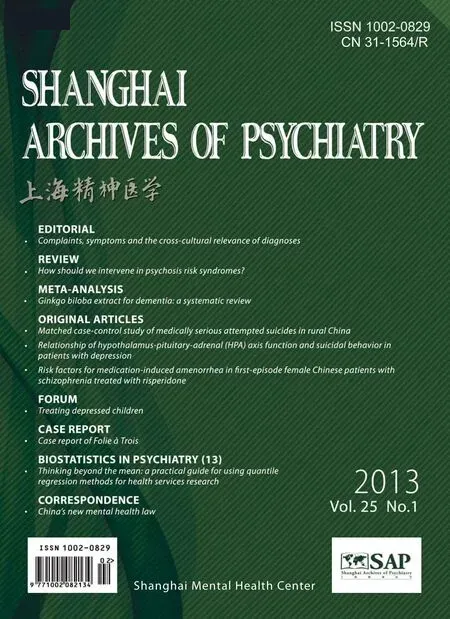
? Correspondence ?China’s new mental health law
Detailed operational regulations are needed to implement the mental health law
Bin XIE
China’s new mental health law, which was passed by the Standing Committee of the National People’s Congress on 26 October 2012, will take effect on 1 May 2013.[1]The primary goals of the law are to develop the field of mental health, to standardize mental health services and to protect the legal rights and interests of persons with mental disorders. Despite having a common goal of addressing the complicated problem of mental disorders, drafting the law was a long and tortuous process because of the competing interests of the various stakeholders: patients, family members of patients, community members, mental health care providers, human rights activists, governmental agencies, and legislators. The focus of successive drafts of the law swung between rigorously protecting patients’rights and interests to rigorously ensuring the safety of community members from potential risks of having mentally ill individuals living in the community.[2]The final law has included legal restrictions on the clinical practice of psychiatry that exceed those in some high-income countries. Thus, it is necessary to draw attention to some possible negative consequences of implementing the law and to consider potential regulations to clarify components of the law in ways that will decrease the likelihood or severity of these negative consequences.It is particularly important that health professionals,administrative departments, judicial authorities, and other related parties reach a consensus on the interpretation of the law and collectively formulate regulations to facilitate the implementation of the law.
The most contentious issue is the determination of the conditions for involuntary treatment. There is no internationally accepted ‘right’ way to do this. The standards and procedures for legally mandating involuntary treatment for persons with mental disorders varies widely around the world, depending on cultural factors, public attitudes about the rights of patients,concerns about public security, and the availability of different types of mental health services. For example,in the United States the determination of the need for involuntary treatment focuses on ‘dangerousness’ while in some European countries the focus is on ‘the ability to make appropriate judgments’ or ‘loss of insight’. In some countries the determination about involuntary inpatient treatment is made by non-medical agencies while in others the main decision is made by physicians.In most high-income countries with comprehensive mental health services there are a range of options for involuntary treatment, from the least restrictive treatment in outpatient services to the most restrictive treatment on locked inpatient forensic wards.[3,4]
Thus the regulations for involuntary treatment in China must be consistent with cultural expectations,with the historical trajectory of mental health services,and with available judicial resources. The lack of a comprehensive community mental health system has,for the time being, limited involuntary treatments to inpatient psychiatric care. The primary responsibility for the management and care of individuals with serious mental disorders (and for those with other serious medical conditions) is traditionally with the family. This central role of the family was highlighted in a 2011 survey of 8547 psychiatric inpatients in Shanghai (in press)which found that only 92 (1.1%) of the patients were admitted voluntarily; 7641 (89.4%) were involuntarily admitted with the approval of a family member, 510(6.0%) were involuntarily admitted for 72 hours by civil authorities for assessment for a possible mental illness, and 185 (2.2%) were involuntarily admitted by judicial authorities for compulsory treatment following a forensic assessment related to the commission of a crime. The new mental health law intends to make almost all psychiatric admissions voluntary, which means that the 89% of admissions currently sanctioned by family members will now only be possible if the patient himself or herself voluntarily agrees to the admission. Itis unclear how many patients in this situation will agree to admission, but it is doubtful that more than onethird will agree. Thus, if the current law is implemented as written, this will result in a major transition of the mental health delivery system.
There are also concerns about the lack of clarity in the criteria for involuntary admission specified in the law. According to the law an individual can be involuntarily admitted if they have a ‘severe mental disorder’and are a danger to the safety others. They can also be involuntarily admitted if they have a severe mental disorder and are in danger of self-harm if the patient’s legal guardian consents to involuntary admission. The implementation of these criteria will require establishing clear operational definitions of the three key terms:‘severe mental disorder’, ‘danger to self or others’ and‘guardian’.
The law provides a conceptual definition of ‘severe mental disorder’ but it leaves several details unresolved.The definition could be restricted to specific diagnoses or it could be used to refer to the severity of impairment of any diagnosable mental illness. If limited to specific diagnoses such as schizophrenia and bipolar disorder,this would exclude patients with severe forms of other mental disorders (e.g., borderline personality disorder,impulse control disorder, anorexia nervosa, etc.) who may be in need of inpatient treatment because they pose a danger to self or others; and categorization of these conditions as ‘severe’ mental illnesses would risk increasing the stigma associated with these disorders.The alternative method of defining ‘severe mental disorder’ based on the current severity of the dysfunction related to any diagnosable mental illness would require development of a uniform method of assessing severity that could be used across all mental disorders.No such measure currently exists.
The law is also vague about what constitutes ‘danger to self or others’. If it is limited to actual acts of injuring others or of self-harm, then many patients with severe mental disorders who are at risk of such behaviors but have not yet acted would need to wait until they acted before they could be required to have treatment. But predicting future aggressive behavior or self-harm in individuals with mental disorders is quite difficult, so it would not be easy to develop a fair and reliable method for identify those who were really at ‘high-risk’ of such behaviors. There are also problems of limiting the concept of ‘self-harm’ to intentional suicidal behavior.At present most patients involuntarily treated in China are not actively threatening others or in danger of selfharm; lacking insight into their condition they are more likely to present with behavior that is potentially harmful to their health, such as refusal of food, exposure to cold temperature without proper clothing, and so forth. Such patients almost always refuse treatment, so involuntary treatment is the only way for them to recover. In many countries, the presence of these behaviors is enough to impose inpatient treatment;[3]including them within the umbrella of ‘a(chǎn)t risk of self-harm’ in the Chinese regulations will require development of detailed criteria.
The law specifies several responsibilities of the guardians of persons with mental disorders, so it is important that a clear functional definition of ‘guardian’be provided in the regulations that will supplement the law. At present the identification of a legal guardian in China is determined according to civil law: this involves a complicated legal process that includes forensic evaluation of the patient to determine their competency and formal notification of the employer, local governmental agencies, and judicial authorities.[5,6]Very few patients with severe mental illnesses have formally assigned legal guardians; if legally designated guardians are required for inpatient treatment (as specified in the law) over 80% of patients would not receive treatment in time. Thus, the requirement of having legal guardians approve the inpatient treatment of persons with mental disorders would unnecessarily delay needed treatment,consume tremendous judicial resources, and excessively limit the rights of patients (guardians also manage the property of the patients). It is not necessary to sacrifice other civil rights of the patient in order to secure their rights to medical treatment and rehabilitation. In most countries the rights to immediate medical treatment and care of the patient are facilitated through ‘conservators’(i.e., care-givers) with ‘durable power of attorney’(DPOA)whose can be designated without a formal court hearing.When developing the follow-up regulations for China’s mental health law, the possibility of re-defining the term‘guardian’ in a way the simplifies the designation of such individuals should be considered.
In summary, efforts will be needed to clarify specific aspects of the law both before and after its formal rollout on 1 May 2013. Implementation of the law will fundamentally change the mental health delivery system in China so it is expected that there will be stresses to the system as the transition to the new system proceeds. As fewer mentally ill individuals are involuntarily admitted for inpatient treatment there will be increased pressure on families, community health clinics, and psychiatric outpatient services to provide them with communitybased care. There could be increased numbers of homeless mentally ill and some of these individuals may enter the correctional system (e.g., jails and prisons).There is also the possibility of more legal disputes about involuntary admission between hospitals, families and patients and of higher rates of patient-on-clinician violence. Close monitoring of these changes and the rapid development and implementation of directed policies to address the problems that arise will be needed to ensure that China arrives at a reasonable balance between the need to care for and the need to control its mentally ill citizens.
1. Mental Health Law of the People’s Republic of China. Beijing: Law Press, 2012. (in Chinese)
2. Xie B. Balancing patients’ right and public safety: rethinking‘deinstitutionalization’ and ‘reinstitutionalization’. Shanghai Arch Psychiatry 2011; 23(2): 48-52.
3. World Health Organization. WHO Resource Book on Mental Health, Human Rights and Legislation. Geneva: WHO, 2005.
4. Shao Y, Xie B. Legal standards and procedures of involuntary admission in mental health care. Journal of Neuroscience and Mental Health 2011; 11(4): 325-328. (in Chinese)
5. Xie B. Challenges for mental health services in China and investigation of primary legislation countermeasures. Shanghai Arch Psychiatry 2010; 22(4): 193-199. (in Chinese)
6. Wu ZG, Xie B. The views and exploration on involuntary mental health care in China. Chinese Journal of Health Policy 2011; 4(9):10-15. (in Chinese)
10.3969/j.issn.1002-0829.2013.01.012
Shanghai Mental Health Center, Shanghai Jiao Tong University School of Medicine, Shanghai, China correspondence: binxie64@gmail.com

Professor Bin Xie is Vice-Director of the Shanghai Mental Health Center at Shanghai Jiao Tong University. He is the vice-chairman of the China Association for Mental Health; vice-chairman of the Mental Health Society, Chinese Preventive Medicine Association; vice-chairman of the Chinese Psychiatrists’ Association; and chairman of the Division of Forensic Psychiatry, Chinese Society of Psychiatry. He is also a consultant on mental illness prevention and control for the Ministry of Health, and has testified in front of China’s Supreme Court as an expert forensic evaluator. His main fields of research are forensic psychiatry, mental health policy and legislation,and adolescent behavioral issues.
- 上海精神醫(yī)學(xué)的其它文章
- SHANGHAI ARCHIVES OF PSYCHIATRY INSTRUCTIONS TO AUTHORS
- Thinking beyond the mean: a practical guide for using quantile regression methods for health services research
- Case report of Folie à Trois
- Interventions for childhood depression
- Should antidepressants be used to treat childhood depression?
- Risk factors for medication-induced amenorrhea in first-episode female Chinese patients with schizophrenia treated with risperidone