高溫光纖傳感器在熱結構溫度和應變測試中的應用
2013-01-16 01:48:22孟松鶴解維華霍施宇矯利闖宋樂穎
固體火箭技術 2013年5期
孟松鶴,杜 翀,解維華,霍施宇,矯利闖,金 華,宋樂穎
(哈爾濱工業大學復合材料與結構研究所,哈爾濱 150080)
0 Introduction
Study on optical fiber sensor has taken the center stage due to its well-know resistance to electromagnetic interference,small size,temperature tolerance,reusability,and long transmission distance.Application of high-temperature optical fiber sensors has demonstrated its great potential in the area of aerospace.The thermal structural components,especially used in solid rocket motor and the hypersonic aircraft nose cone,require high temperature tolerance,smaller weight and size of the sensors due to high-temperature environment and limited structural space[13].
Even though low-temperature sensing technology is relatively mature,the practical application of Fiber Grating Sensor(FGS)under high-temperature environment remains a technical problem.NASA and the U.S.Department of Defense have carried out a series of programs(including Airframe Health Monitoring and Materials and Structures Program)to support the development of hightemperature optical fiber measurement technology.The most-know institutions are Dayton Research Center,NASA's Langley Research Center,United States Air Force Base,Fiber& Electro-Optics Research Center,Fiber and Sensor Technologies Inc.,and Lambda Instruments Inc.Sweden,Canada and Morocco also joined the United States to carry out research on high-temperature optical fiber technology[1,3,5].
Under the guidance of test principle for high-temperature fiber sensor,the studies of high temperature fiber sensor fall into two major categories.One is intrinsic optical fiber grating sensor,which is usually made of quartz optical fiber material with test range below 1 000 ℃[6-7].Another is extrinsic optical fiber Fabry-Pérot sensor,which is generally made of sapphire fiber materials with test temperature above 1 000 ℃ and 1 650 ℃ at its highest[8-10].Despite its high test temperature,the raw material of sapphire fiber optic sensor is considerably expensive.
The advantage of the quartz FGS is to test the temperature and strain simultaneously.Although quartz material itself can tolerate temperature of 1 000℃,the connection technology with the actual hot structure has been plaguing its practical applications.From the practical point,with the quartz optical fiber sensor,550 ℃ is the maximum temperature for simultaneous test of structural temperature and strain[11].
The study uses a chemical composition FGS to examine the problems arising during sensor's application in thermal-dynamic response test of high-temperature hot structure[12-14].The study focuses on connection technology for high temperature fiber grating.It also determines the best choice of adhesive agent and adhesive technique through comparison,as well as completed the temperature and strain monitoring tests under 700 ℃ environment.
1 High-temperature connecting method
In 2008,NASA's Defense Report had classified sensors according to the difficulty of installation,difficulty of application,and the operating temperature,pointing out that the operating temperature of quartz optical fiber and sapphire optical fiber sensor is relatively high while the application difficulty rests at middle.However,they are both difficult to be installed due to the brittleness of the optical fiber material.
In applications,fiber grating is divided into two types.One type shall be firstly armored to form sealed protection,and then the armored item will be bonded with the to-be-tested structure.Another type would be directly bonded with the structure surface through gluing or plasma thermal spray.Among these methods,gluing is the most simple and practical.
The high-temperature treatment makes fiber grating brittle,therefore it's necessary to adopt simple bonding technique when using high-temperature adhesive on fiber gratings to reduce potential damage.Ideal high-temperature adhesive is characterized by good liquidity before curing and no crack or other defects under high temperature environment after curing.Before experiment on bonded fiber grating,the grating shall be heated to 800 ℃ and subject to evaluation.We have completed encapsulation testing experiment at 500 ℃[11]with the high-temperature adhesive HS-176.However,because of the poor performance of the adhesive agent at higher temperature,cracks appear in the adhesive surface which combine by the complex curing way,may easily cause damage to fiber grating.Therefore more adhesives come under scrutiny to meet the needs.
1.1 Choosing high-temperature grating adhesive agent
The excellent high temperature resistance at about 2 000℃,the resistance to oxidation and the non-ablative characteristics of ultra-high temperature ceramics(UHTC)make it a preferred choice for making engine and hot end components of hypersonic aircraft.The present study places high requirement on adhesive agent to form ideal adhesion with the UHTC,in order to ensure the grating not to be damaged by the cured adhesive and make good paste on the surface of the structure for generation of accurate strain response.To verify the applicability of various hightemperature adhesive agent,and to ensure the efficacy of fiber-specimen bonding formed through the agent,the study firstly experiments on the property of different agents with bonding simulation.
Put prepared four kinds of high-temperature adhesive respectively in four syringes,and select the same UHTC surface.Squeeze the adhesive out on the structural surface,forming 1.5 cm to 2.0 cm-long bar enough to cover the length and width of the fiber.Put the cured agents into the muffle furnace and heat them from room temperature to 800℃.Maintain the bars at 800℃ for 30 minutes,and then cool them to room temperature.Observe the bonding state after high-temperature treatment as shown in Table 1.
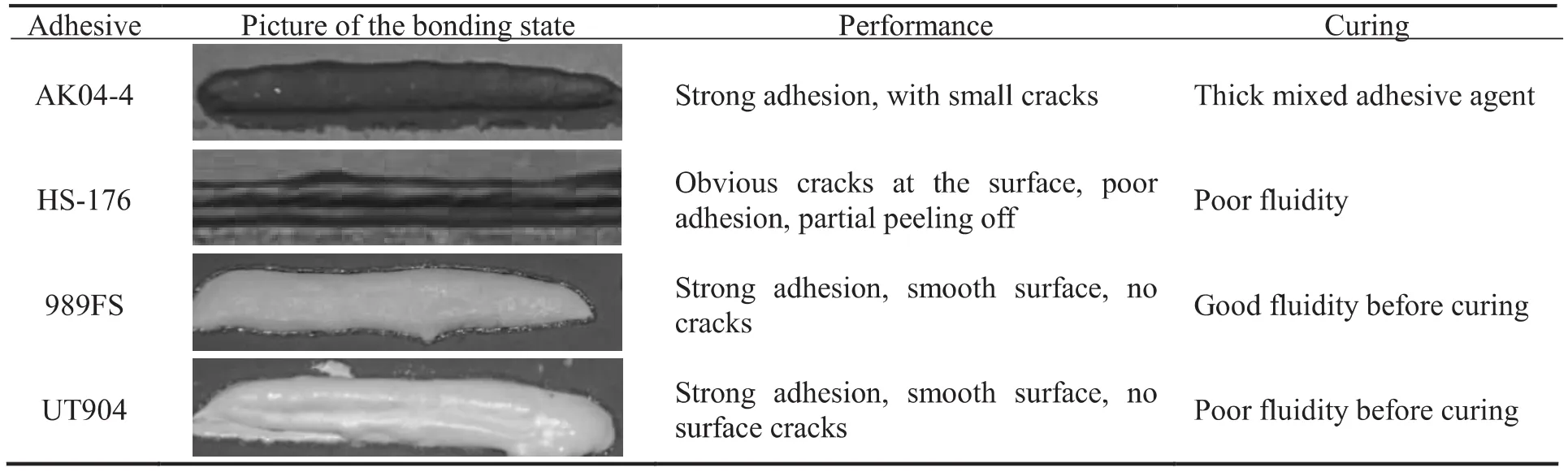
Table 1 Evaluation of adhesive agent after 800℃treatment
The test results indicate that the last two types of adhesive demonstrate better performance.However,because of the poor fluidity of Ultra Temp 904 zirconium oxide adhesive,before curing and the operation,trouble hence may come,the study chooses Respond 989,the high purity alumina ceramic bonding agent of COTRONICS.The main component of this adhesive is a high purity alumina ceramic which only needs curing at room temperature,not only greatly reducing the difficulty of fiber grating curing,but also avoiding the damage caused by high-temperature curing process.Its highest working temperature can reach 1 650℃.
1.2 High-temperatureoptical fiberconnecting method
Discussion will be made on the bonding technique for the selected adhesive agent Respond 989FS,in order to determine the appropriate way of bonding and curing.Bonding methods shall observe the following standards:
(1)As the intermediate between specimens and fiber grating,adhesive agent shall be in good contact with the specimen to ensure bonding strength and avoid degumming.
(2)Adhesive shall have full contact with fiber grating to avoid unsynchronized deformation,the likelihood of which is caused by fiber grating's smooth surface and small size.The full contact is also important for protecting the fiber grating from being damaged by the outside force.
(3)Adhesive agent needs to be smeared uniformly,so as to avoid fracture of the bar under high temperature,which will damage fiber grating.
(4)Adhesion process shall be simple to minimize possibility of potential damage.
We need sandblasting process(3#type of sand)for UHTC thermal parts before adhesion,which will increase the contact area and improve the bonding effect.Clear the specimen after sandblasting and remove attachments on the surface.Smear the adhesive on the specimen and dry it in the air for about 4 hours to reach the ideal bonding strength.
2 Evaluation of high-temperature hot structure
2.1 High-temperature test device
The specimen for hot structure test is L-shape UHTC part.Three fiber gratings and three thermocouples are placed on the horizontal part of the specimen,one thermocouple monitoring one fiber grating correspondingly,with the purpose of decoupling the wavelength signal.The experiment starts with the bonding of fiber grating and the specimen.After curing,bond one thermocouple to one fi-ber grating.Due to that adhesive agent is mostly alumina ceramic,which is thin and a good heat conductor,the temperature measured by each thermocouple can accurately represent the temperature load at that specific location of the fiber grating.The sensor connection and layout are shown in Fig.1.
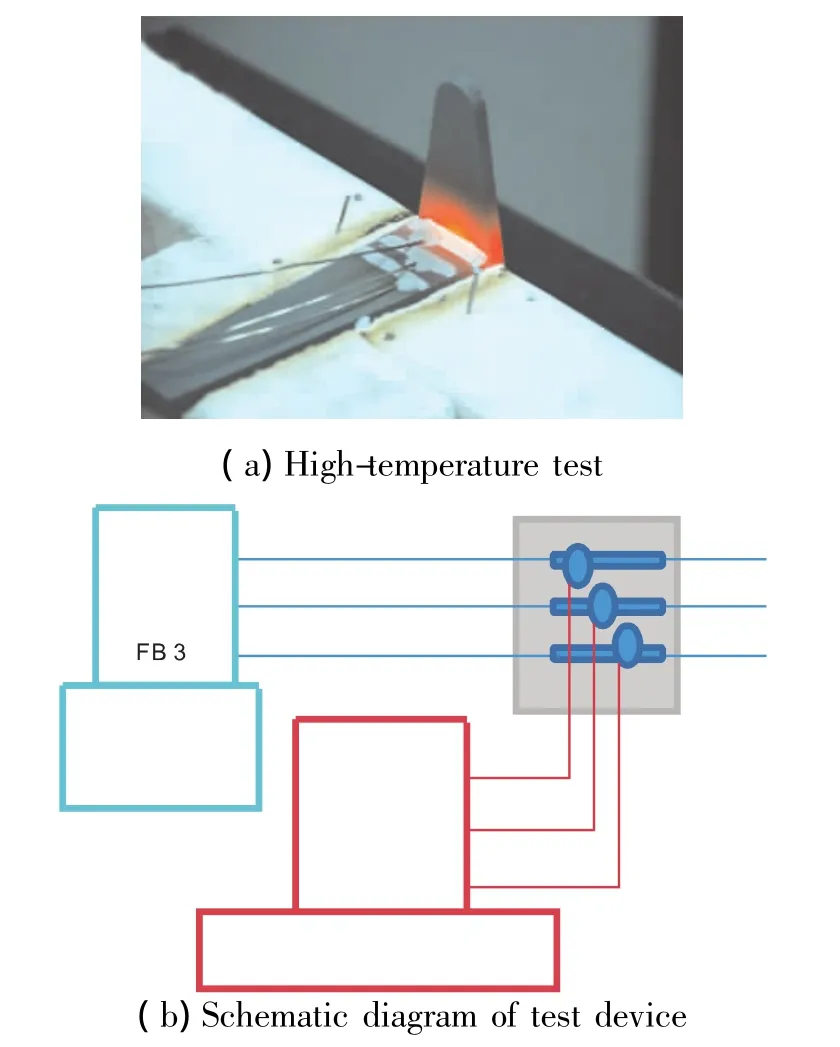
Fig.1 Connection of fiber grating(FB)and thermocouple(TC)
Experiments adopt high power optical fiber coupled laser for heating the bottom area of the vertical section of the test pieces in Fig.1,with heat spot of φ20 mm and lens-specimen distance of 1 500 mm.Due to high thermal conductivity of the UHTC,the heat will reach the bottom rapidly.The test adopts fiber grating demodulator for three-way fiber-coupled signal acquisition,and uses multiple temperature signal acquisition instrument recording thermocouple temperature response.
2.2 High-temperature test
Connect thermocouple and fiber optic sensor to data acquisition equipment respectively.Before heating,the structural surface temperature of the three thermocouples are 24℃.The reflection wavelengths of three optical fibers are 1 540.177,1 539.982 and 1 539.882 nm respectively.During the heating,adjust the power of laser heating equipment,and strengthen the power by 20 W each time.Through step-by-step heating,record the temperature acquired by each thermocouple and the wavelength signals by fiber grating under different laser power.Test finds that one of the optical fiber signals disappeared after reaching 417℃,and the other two disappeared when temperature were above 700℃.The wavelengths corresponding to the each temperature point are shown in Fig.2.
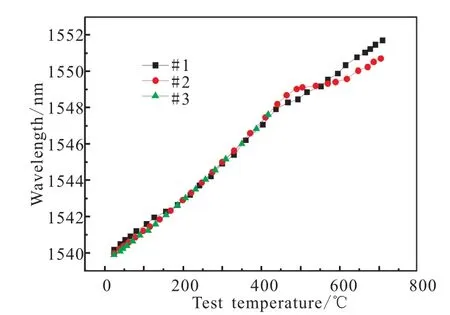
Fig.2 Wavelength versus temperature for fiber Bragg grating sensors
3 Result analysis
Grating reflection wavelength change is mainly affected by two factors,temperature and the deformation of the structure.The measured signal in this experiment is the superposition of both,which can be expressed in formula(1).

Where ΔλBis the variation measured by grating signal;ΔλT,Δλεare respectively the wavelength variations caused by the temperature and strain.
Temperature's influence on the reflected wavelength can be expressed as temperature sensitivity coefficient,as shown in formula(2).Temperature change caused by thermal expansion will change the grating period,and at the same time thermo-optical effect leads to the change of the effective refractive index of the fiber.

Where α,ζ represent respectively thermal expansion coefficient and thermo-optical coefficient of the fiber Bragg grating.
The pre-test measurement on the temperature sensitivity coefficient of the bare grating shows that the temperature has a good linear relationship with the reflection wavelength of bare grating,with temperature sensitive coefficient being 0.009 6 nm/℃.
The expansion and elastic-optic effect conduced by strain can lead to the change of grating period and effective refractive index,as shown in formula(3).

Where Kεis strain sensitivity coefficient,reflecting relations between the wavelength relative drift ΔλBand the strain variations Δε.
Once the material is confirmed,Kεis the constant related to the coefficient of material,and it is mainly associated with the effective elastic-optic coefficient of material.Formula(1),(2),and(3)can help to judge the situation how the UHTC structure thermal strain influences the reflected wavelength,as shown in Fig.3.
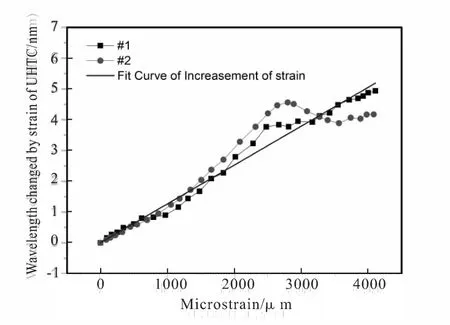
Fig.3 Wavelength changes versus microstrain of UHTC structures
Fig.3 shows that the wavelength changes caused by the structure thermal strain demonstrate approximate linear relationship;The result after line-shape fitting treatment,which leads to an effective strain sensitivity coefficient of 0.001 26 nm/με.
4 Conclusions
(1)Comparison of adhesive agents shows that alumina ceramic adhesive agent is suitable for the high temperature bonding of quartz optical fiber sensor and UHTC materials,with its peak test temperature at 709℃.
(2)High-temperature test results show that quartz optical fiber grating sensor can achieve concurrent monitoring of temperature and strain,and the wavelength change caused by structural thermal strain and by structural strain have approximate linear relationship.
(3)The test results indicate that the strain sensitivity coefficient of the quartz optical fiber sensor is 0.001 26 nm/με,namely for 1 με microstrain increase on UHTC material,reflected wavelength shall increase by 0.001 26 nm correspondingly.
Reference:
[1] Latini V,Striano V,Coppola G,et al.Fiber optic sensors system for high-temperature monitoring of aerospace structures[C]//Proceedings of SPIE.2007,6593:65930S1-65930S9.
[2] Latini V,Striano V,Monteverde F,et al.DEDALO:DEDALO:Application of structural health monitoring systems on UHTC structures[J].Open Aerospace Engineering Journal,2010,3(2):32-40.
[3] Greene J,Paye C,Belcher M,et al.Optical fiber sensors for high-temperature characterization of ceramic-matrix composites[C]//Proceedings of SPIE.2005,5767:340-343.
[4] Glass D E,Merski N R,and Glass CE.Airframe research and technology for hypersonic airbreathing vehicles[R].AIAA 2002-5137.
[5] Greene J A,Wavering T A,Bailey T A,et al.Installation and testing of high-temperature optical fiber sensors[C]//Society of Photo-Optical Instrumentation Engineers(SPIE)Conference Series.1998,3330:194-199.
[6] John C,Micheal S,Sommath B,et al.Extreme silica optical fibre gratings[J].Sensors,2008,8:6448-6452.
[7] Rao Y J.Applications of advanced optical fiber sensors at UESTC[C]//Society of Photo-Optical Instrumentation Engineers(SPIE)Conference Series.2012,8351:1.
[8] David B,Vittoria F,Joel V,et al.On the use of optical fiber sensors(CCGs and PCFI)for harsh environments[J].Waves,2010,1889(8297):128-133.
[9] Bhatia V,Vengsarkar A M.Optical fiber long-period grating sensors[J].Optics Letters,1996,21(9):692-694.
[10] Grobnic D,Mihailov S,Smelser C,et al.Sapphire fiber Bragg grating sensor made using femtosecond laser radiation for ultrahigh temperature applications[J].Photonics Technology Letters,IEEE,2004,16(11):2505-2507.
[11] Du C,Xie W H,Meng S H,et al.The connection technology based on high temperature silica fiber optic sensor[C]//Proceedings of SPIE.2012,8345:83452X.
[12] Mihailov SJ.Fiber Bragg grating sensors for harsh environments[J].Sensors,2012,12:1898-1918.
[13] Zhu Y.Miniature fiber-optic sensors for high-temperature harsh environments[D].Virginia Polytechnic Institute and State University,2007.
[14] Reddy P S,Prasad R L N S,Srimannarayana K,et al.A novel method for high temperature measurements using fiber Bragg grating sensor[J].Optica Applicata,2010,40(3):685-692.
猜你喜歡
建材發展導向(2021年14期)2021-08-23 00:56:16
哲學評論(2021年2期)2021-08-22 01:53:34
紡織科技進展(2021年3期)2021-06-09 08:07:14
中華詩詞(2019年7期)2019-11-25 01:43:04
模具制造(2019年3期)2019-06-06 02:10:54
纖維復合材料(2018年3期)2018-04-25 07:22:58
電子測試(2017年11期)2017-12-15 08:57:13
影視與戲劇評論(2016年0期)2016-11-23 05:26:01
現代企業(2015年9期)2015-02-28 18:56:50
應用化工(2014年10期)2014-08-16 13:11:29