日本西南部四國增生復(fù)合體中的錳礦分布
2012-09-20 00:46:42MASAHARUNAKAGAWA
地球?qū)W報(bào) 2012年1期
日本西南部四國增生復(fù)合體中的錳礦分布
E-mail: mnakagaw@kochi-u.ac.jp.
0 Introduction
Many bedded manganese and iron-manganese ore deposits occur in the accretionary complexes of the Japanese Islands. These deposits are closely associated with chert beds and accompanied by greenstone. Many workers studied the ore deposits in the 1950-1970’s(e.g. Yoshimura, 1952, 1969; Watanabe et al., 1970;Miyahisa and Sawamura, 1973; Nambu, 1980), and considered that these were formed by hydrothermal alteration accompanied by greenstone volcanism, or were deposited accompanied by basic volcanism in geosynclines. Recently, based on the new concepts on accretion tectonics, we proposed a new model for the genesis of the Mn-bearing ore deposits in Japan (Nakagawa et al., 2011). In the Shikoku region of SW Japan, several accretionary belts are distributed and characterized by different grades of regional metamorphism. Manganese ore deposits occur in many localities within the accretionary belts. In the present study, the ore deposits have been re-examined based on new field and laboratory investigations.
1 Accretionary belts of Shikoku
The locations of the manganese and iron-manganese ore deposits are shown together with the geotectonic subdivision of Shikoku in Fig. 1. The Shikoku Island is composed of several accretionary belts which display various grades of regional metamorphism. Many geologic studies were carried out on the accretionary complexes (e.g. Suyari et al., 1991;Matsuoka et al., 1998; Isozaki et al., 2010). The Ryoke metamorphic belt is distributed on the north of the Median Tectonic Line (MTL) and is occupied by Cretaceous granite and low-P/T type gneiss. The Sanbagawa metamorphic belt, on the south of MTL, is a high-P/T type regional metamorphic belt. It is composed of basic, quartz, pelitic and psammitic schists of the greenschist to eclogite facies. The southernmost part of the Sanbagawa belt, which was once called Mikabu belt, is composed mainly of greenstone (metabasalt). The Chichibu belt is divided into the North Chichibu, Kurosegawa and South Chichibu belts. The North Chichibu belt comprises the Early-Middle Jurassic accretionary complexes and has been subjected to low-grade metamorphism of the prehnite-pumpellyite to pumpellyite-actinolite facies. The South Chichibu belt comprises the Middle Jurassic to Early Cretaceous accretionary complexes. These complexes of North and South Chichibu belts are composed of terrigenous clastic rocks containing older oceanic blocks of chert, limestone and greenstone. The southernmost region of the Shikoku is occupied by the Shimanto belt which comprises the clastics-dominated accretionary complexes. The Shimanto belt is divided into the Cretaceous North Shimanto and Tertiary South Shimanto belts.
2 Distribution, occurrence and age of manganese deposits

Fig. 1 Distribution of manganese, iron-manganese and Besshi-type cupriferous deposits shown within the generalized geological framework of Shikoku, SW Japan (modified from Nakagawa et al., 2009). ●: manganese deposit. ●: iron-manganese deposit. ■: Besshi-type cupriferous deposit. 1-14: the mine number mentioned in Table 1. MTL: Median Tectonic Line. BTL:Butsuzo Tectonic Line. Ryoke: Ryoke metamorphic belt. Sanbagawa: Sanbagawa metamorphic belt. Mk: Mikabu greenstone.N. Chichibu: North Chichibu belt. Kr: Kurosegawa belt. S. Chichibu: South Chichibu belt. N. Shimanto: North Shimanto belt.S. Shimanto: South Shimanto belt. The geological subdivision is based on Suyari et al. (1991), Matsuoka et al. (1998) and GSJ (2010)

Fig. 2 Plate tectonic model for the origin and accretion of Mn-formations along the Pacific-type consuming plate boundary(after Nakgawa et al., 2011)
The bedded manganese and iron-manganese deposits are distributed in the Sanbagawa, Mikabu, North Chichibu and South Chichibu belts (Fig. 1). The deposits are abundant especially in the Chichibu belts which contain abundant chert beds. Some manganiferous iron deposits of small scale occur in the North Shimanto belt. Besshi-type cupriferous iron sulfide deposits are abundant in the Sanbagawa belt.
The manganese deposits occur mostly in bedded chert or its metamorphosed equivalent. Most of the deposits occur as small conformable, lenticular or irregular lenses. Some of the ores show layer structure.Several biostratigraphic studies were carried out in the accretionary belts. In the Chichibu belts, the microfossil ages of the chert are Permian to Triassic around the deposits, whereas the ages of the clastic matrix of olistostrome are Jurassic. In the North Shimanto belt,the ages of the chert are Early to Middle Cretaceous,whereas those of the matrix sediments are Late Cretaceous.
3 Mineralogy of manganese deposits
The mineral constituents of the ores in the representative manganese and iron-manganese deposits have been examined by XRD and EPMA analyses. The results together with the wall rock characteristics and available fossil age data are summarized in Table 1.Piemontite-quartz schist is widely distributed in the Sanbagawa metamorphic belt. In some small mines(No. 1), quartz-piemontite-braunite ore occurs in the schist. In the Mikabu belt, manganese ores consisting mainly of pyroxmangite, rhodonite, rhodochrosite,ganophyllite and spessartine occur in quartz schist in several mines (No. 2). In the North Chichibu belt,many manganese deposits occur in bedded chert,whereas iron-manganese deposits and some manganese deposits occur between greenstone and red chert.The manganese ores sandwiched between greenstone and chert in the Ananai mines (Nos. 5, 6) contain caryopilite, rhodochrosite, ganophyllite, strontiopiemontite, braunite, manganaxinite, barite, aegirine,hematite, Mn-bearing calcite, andradite and Ba-bearing orthoclase. The manganese ores embedded within chert in many mines (Nos. 3, 4, 8, 9) consist mainly of rhodochrosite, caryopilite, rhodonite,braunite and quartz. Iron-manganese ore deposits consisting of hematite, magnetite, Fe-rich caryopilite,Mn-bearing calcite and Mn-rich chlorite occur between greenstone and chert (No. 7). In the South Chichibu belt, many small manganese deposits occur in bedded chert. The manganese dioxide ore is abundant in this belt (Nos. 10, 11, 12). The ore consists of quartz,todorokite, pyrolusite, cryptomelane and nsutite.Manganese carbonate ore consisting mainly of fine-grained rhodochrosite also occur in several mines(No. 10) in this belt. In the North Shimanto belt, some small deposits of manganiferous iron ore occur in red chert (No. 13). The ore consists mainly of quartz,hematite and calcite with accessories of todorokite.
On modern ocean floor, manganese and ferromanganese nodules and crusts are known to occur and are considered to have formed by hydrogenetic precipitation from cold seawater. They are generally composed of hydrous manganese oxide minerals such as vernadite, birnessite, todorokite and X-ray amorphous Mn-bearing ferric oxyhydroxides (Hein et al.,1997).
4 Genesis of manganese deposits
A schematic plate tectonic model for the origin and accretion of manganese formations is shown in Fig.2. In the Shikoku region, the manganese deposits can be classified into two types based on the geological setting, mineralogy and genetic characteristics. Themanganese deposits occur mostly in bedded chert. In these deposits classified as Type I, the ores consist mainly of rhodochrosite, braunite, caryopilite and rhodonite. Radiolarian remains were found in some ores suggesting the submarine origin of the manganese deposits. These chert-hosted manganese ores are con-sidered to have been manganese nodule/crust-bearing siliceous sediments on deep-sea floor and have been converted to manganese ores by low-grade metamorphism through subduction-accretion process. The mineral assemblages of the ores reflect the metamorphic grade of the accretionary complexes. Some manganese deposits were metamorphosed at the deeper levels.
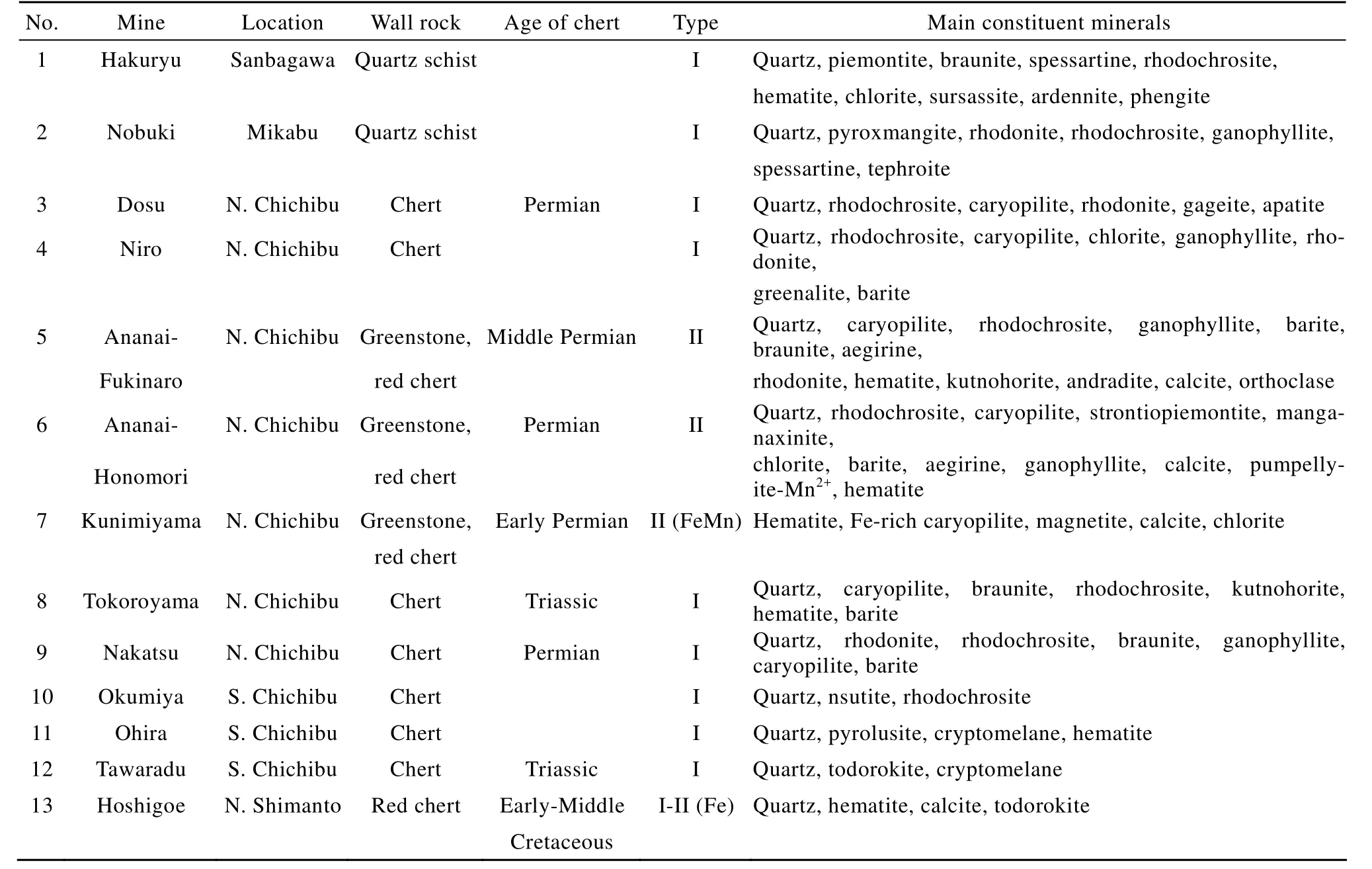
Table 1 Mineral constituents, wall rock characteristics and fossil age data of manganese and iron-manganese deposits in Shikoku
Iron-manganese deposits and some manganese deposits, classified as Type II, are associated with greenstone and red chert. The mineralogy and texture of these ores are different from those of the chert-hosted manganese ores. Geochemical similarities of these ores to those of modern submarine hydrothermal deposits were noted by Kato et al. (2005) and Fujinaga et al. (2006). These deposits occur directly over basalt and are considered to have been the hydrothermal precipitates associated with the mid-oceanic ridge or oceanic island volcanism.
The mineral assemblage of the chert-hosted manganese deposits in Shikoku shows a progressive change that can be correlated with the metamorphic grades of the accretionary complexes. Manganese dioxide minerals such as todorokite and pyrolusite occur in the low-grade metamorphic terrane of South Chichibu belt. Manganese silicate minerals such as caryopilite (serpentine group), braunite and rhodonite(pyroxenoid group) occur in the higher-grade metamorphic terrane of North Chichibu belt. Manganese alumino-silicate minerals such as piemontite and spessartine (garnet group) occur in the high-grade metamorphic Sanbagawa and Mikabu belts. These manganese silicates and alumino-silicates are considered to have formed by the reactions of deep-sea manganese oxides, siliceous sediments and pelagic clays.
FUJINAGA K, KATO Y. 2005. Radiolarian age of red chert from the Kunimiyama ferromanganese deposit in the northern Chichibu Belt, central Shikoku, Japan. Resource Geology, 55:353-356.
FUJINAGA K, NOZAKI T, NISHIUCHI T, KUWAHARA K,KATO Y. 2006. Geochemistry and origin of Ananai stratiform manganese deposit in the northern Chichibu belt, central Shikoku, Japan. Resource Geology, 56: 399-414.
Geological Survey of Japan. 2010. Seamless digital geological map of Japan (1:200,000).
HEIN J R, KOSCHINSKY A, HALBACH P, MANHEIM F T, BAU M, KANG J K, LUBICK N. 1997. Iron and manganese oxide mineralization in the Pacific. In: NICHOLSON K, HEIN J R,BUHN B, DASGUPTA S (Eds.). Manganese Mineralization:Geochemistry and Mineralogy of Terrestrial and Marine Deposits. Geological Society Special Publication, 119: 123-138.
ISHIDA K. 1998. Lithostratigraphy and radiolarian ages of the Shimanto Supergroup, East Shikoku. News of Osaka Micropaleontologists, 11: 189-209 (in Japanese with English abstract).
ISOZAKI Y, MARUYAMA S, AOKI K, NAKAMA T, MIYASHITA A, OTOH S. 2010. Geotectonic subdivision of the Japanese Islands revisited: categorization and definition of elements and boundaries of Pacific-type (Miyashiro-type) orogen. Journal of Geography, 119: 999-1053(in Japanese with English abstract).KATO Y, FUJINAGA K, NOZAKI T, OSAWA H, NAKAMURA K,ONO R. 2005a. Rare earth, major and trace elements in the Kunimiyama ferromanganese deposit in the northern Chichibu Belt, central Shikoku, Japan. Resource Geology, 55: 291-299.
MATSUOKA A, YAMAKITA S, SAKAKIBARA M, HISADA K.1998. Unit division for the Chichibu Composite Belt from a view point of accretionary tectonics and geology of western Shikoku, Japan. Journal of Geological Society of Japan, 104:634-653(in Japanese with English abstract).
MIYAHISA M, SAWAMURA T. 1973. Manganese ore. In:WATANABE T, SAWAMURA T, MIYAHISA M (Eds.). Mineral deposits of Japan – the Shikoku district-. Asakura, Tokyo,202-248(in Japanese).
MOMOI H, ISHIDA K, YAMASAKI T. 1992. Radiolarian geologic ages of some host cherts of bedded manganese ore deposits in the Chichibu belt of Ehime Prefecture, Japan. Memoirs of the Faculty of Science, Ehime University, 1: 71-89(in Japanese with English abstract).
NAKAGAWA M, SANTOSH M, MARUYAMA S. 2009. Distribution and mineral assemblages of bedded manganese deposits in Shikoku, Southwest Japan: Implications for accretion tectonics.Gondwana Research, 16: 609-621.
NAKAGAWA M, SANTOSH M, MARUYAMA S. (2011)Manganese formations in the accretionary belts of Japan:Implications for subduction-accretion process in an active convergent margin. Journal of Asian Earth Sciences, 42:208-222.
NAMBU M. 1980. Genesis and problems of the bedded manganese deposits and the bedded manganiferous iron deposits in the Kitakami mountainland, northeastern Japan. Mining Geology,30: 323-343(in Japanese with English abstract).
SUYARI K., IWASAKI M., SUZUKI T(Eds.). 1991. Regional Geology of Japan, Part 8 Shikoku. Kyoritsu Shuppan, Tokyo,266(in Japanese).
SUYARI K, KUWANO Y, ISHIDA K. 1982. Stratigraphy and geological structure of the Mikabu Greenrock terrain and its environs – II. Some informations about the Mesozoic stratigraphy of the North Subbelt of the Chichibu Belt -. Journal of Science, University of Tokushima, 15: 51-71 (in Japanese with English abstract).
SUYARI K, KUWANO Y, ISHIDA K. 1983. Biostratigraphic study of the North Subbelt of the Chichibu Belt in central Shikoku.Journal of Science, University of Tokushima, 16: 143-167(in Japanese with English abstract).
WATANABE T, YUI S, KATO A. 1970. Bedded manganese deposits in Japan, a review. In: Tatsumi, T. (ed.), Volcanism and Ore Genesis. University of Tokyo Press, Tokyo, 119-141.
YOSHIMURA T. 1952. Manganese deposits of Japan. Mangan-Kenkyukai, 567(in Japanese).
YOSHIMURA T. 1969. Supplement to “Manganese Ore Deposits of Japan”, Part II. The Science Reports of the Faculty of Science,Kyushu University, Geol., 9, Spec. Iss. 2, 487-1004(in Japanese).
Manganese Deposits Distributed in the Accretionary Complexes of Shikoku, Southwest Japan
Masaharu NAKAGAWA
Department of Natural Science, Faculty of Science, Kochi University, Kochi780-8520,Japan
Bedded manganese ore deposits occur in many localities within the accretionary belts of the Shikoku region, SW Japan. The deposits occur mostly in bedded chert or its metamorphosed equivalent. These chert-hosted manganese deposits are considered to have been manganese nodule/crust-bearing siliceous sediments on deep-sea floor and have been converted to manganese ores by low-grade metamorphism through subduction-accretion process. The mineral assemblages of the ores reflect the metamorphic grade of the accretionary complexes. On the other hand, iron-manganese deposits and some manganese deposits occurring directly over basalt are considered to have been the hydrothermal precipitates associated with submarine volcanism.
Manganese deposit; Accretionary complex; Shikoku; Metamorphism; Deep-sea manganese nodule/crust
10.3975/cagsb.2012.s1.25