應召反潛區域封鎖聲吶浮標布放規劃
2025-02-09 00:00:00許文琛羅煦瓊喬士東
指揮控制與仿真 2025年1期
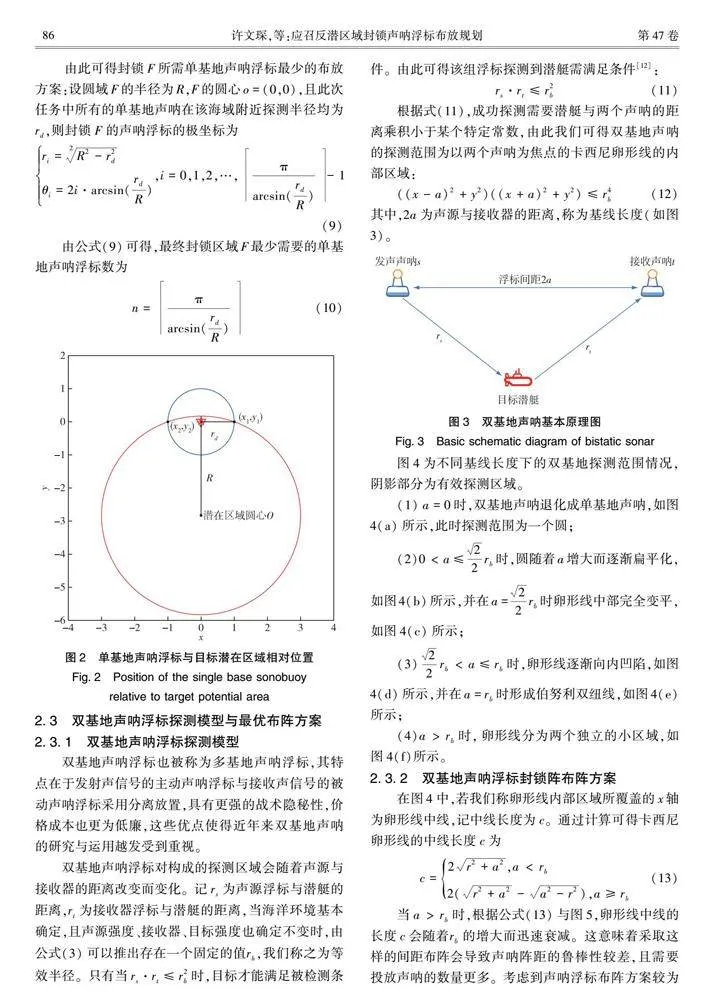

摘 要:針對投放式單基地聲吶與雙基地聲吶浮標在應召反潛任務中,對目標潛艇潛在區域進行封鎖時所需聲吶數最少的布陣方案進行研究。在理想海況下,當單基地聲吶探測區域與目標區域的交點連線為探測區域的直徑時,所需聲吶數量最少。由此提出了一種雙基地最優布陣方案,在等效半徑相同時,該方案與單基地聲吶最優布陣所需聲吶數量差距僅在-1到1個之間。最后通過實驗模擬驗證了布陣方案的有效性,計算了封鎖不同半徑區域所需的聲吶數量,對應召反潛區域封鎖布陣與兵力裝備需求評估具有指導價值。
關鍵詞:區域封鎖;主動聲吶浮標;多基地聲吶;陣型優化
中圖分類號:E925 文獻標志碼:A DOI:10.3969/j.issn.1673-3819.2025.01.011
Project on deployment of active sonobuoys for anti-submarine area blockade
XU Wenchen, LUO Xuqiong, QIAO Shidong
(School of Mathematics and Statistics, Changsha University of Science amp; Technology, Changsha 410114,China)
Abstract:This paper mainly studies the deployment scheme of the single base sonar and bistatic sonobuoys with the least number of sonars when blocking the potential area of the target submarine. Under ideal sea conditions, the minimum amount of sonar is required when the intersection line between the detection area and the target area is the diameter of the detection area. Therefore, a bistatic optimal array scheme is proposed in this paper. In the same equivalent radius, the difference between the number of sonars required by this scheme and the optimal array of single-base sonar is only -1 to 1. Finally, this paper verifies the effectiveness of the deployment scheme through experimental simulation, and calculates the number of sonar required for each scheme, which has guiding value for the anti-submarine area blockade.
Key words:area blockade; active sonobuoys; multi-base sonar; formation optimization
在應召搜索中,通過封鎖目標潛在區域從而限制目標的活動空間,是一種常用的反潛手段[1]。在封鎖區域時,通常采用投放式聲吶浮標構造反潛探測柵欄,從而保證在作戰地點長時間維持對目標的檢測。目前的反潛聲吶浮標可根據搭載性能分為單基地聲吶與多基地聲吶,多基地聲吶較單基地聲吶具有更強的戰術隱秘性與更低的造價成本,但由于系統復雜設計雙基地聲吶的布陣方案更為困難[2]。
在應召反潛任務中能夠前往目標區域的反潛力量往往是有限的,因此,計算封鎖目標區域所需聲吶數量并采取最優的聲吶布陣方案對反潛作戰有著重要意義[3-5]。盡管目前已有部分文獻就如何利用單、雙基地反潛聲吶或雷達構造探測區域或柵欄覆蓋展開研究,但應召反潛柵欄覆蓋聲吶布放方案通常將可布置點位固定在特定的點或線上,這限制了對聲吶浮標最優布置點的探索[6-11]。
本文通過幾何方法與最優化方法,探討在二維情形下單基地聲吶與雙基地聲吶浮標封鎖不同大小的目標潛在區域的最優布陣方法及其所需的最少聲吶個數。
1 應召搜索任務建模
1.1 搜索區域模型
1.2 區域封鎖模型
2 二維聲吶浮標探測建模
2.1 主動聲吶浮標探測原理
2.2 單基地聲吶浮標探測模型與最優布陣方案
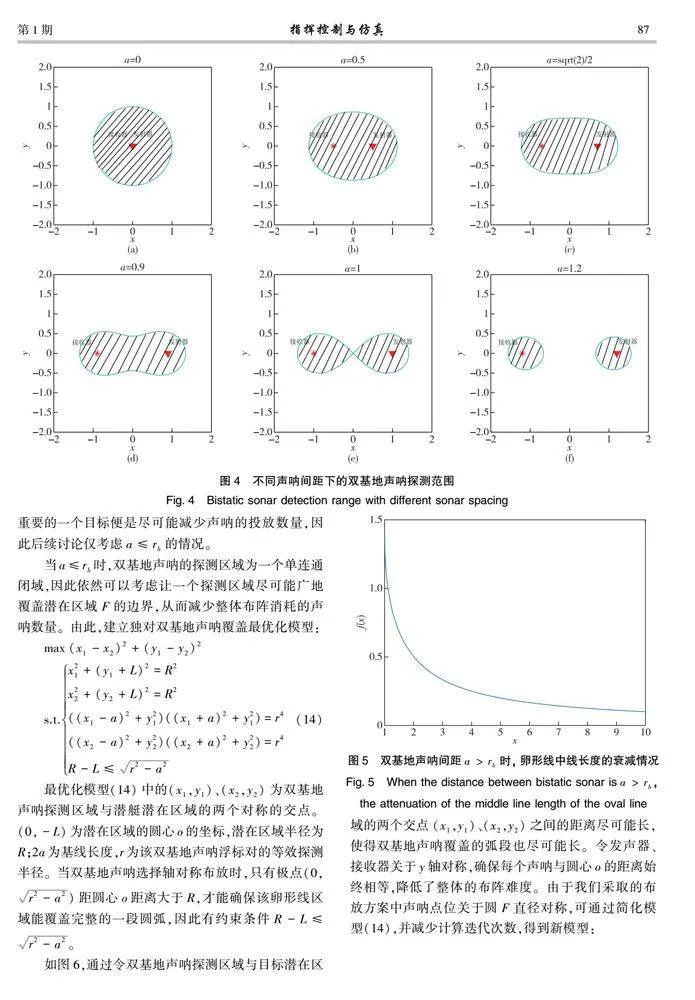
2.3 雙基地聲吶浮標探測模型與最優布陣方案
2.3.1 雙基地聲吶浮標探測模型
2.3.2 雙基地聲吶浮標封鎖陣布陣方案
3 實驗模擬
為驗證本文布陣方案的有效性,本文使用Matlab編程對第2大節中的布陣方案和策略進行模擬并計算在理想海況下,封鎖不同半徑的目標潛在區域F所需的聲吶數量n的變化情況。
為體現本文布陣方案的優點,本文將使用三種不同布陣方案并進行對比:
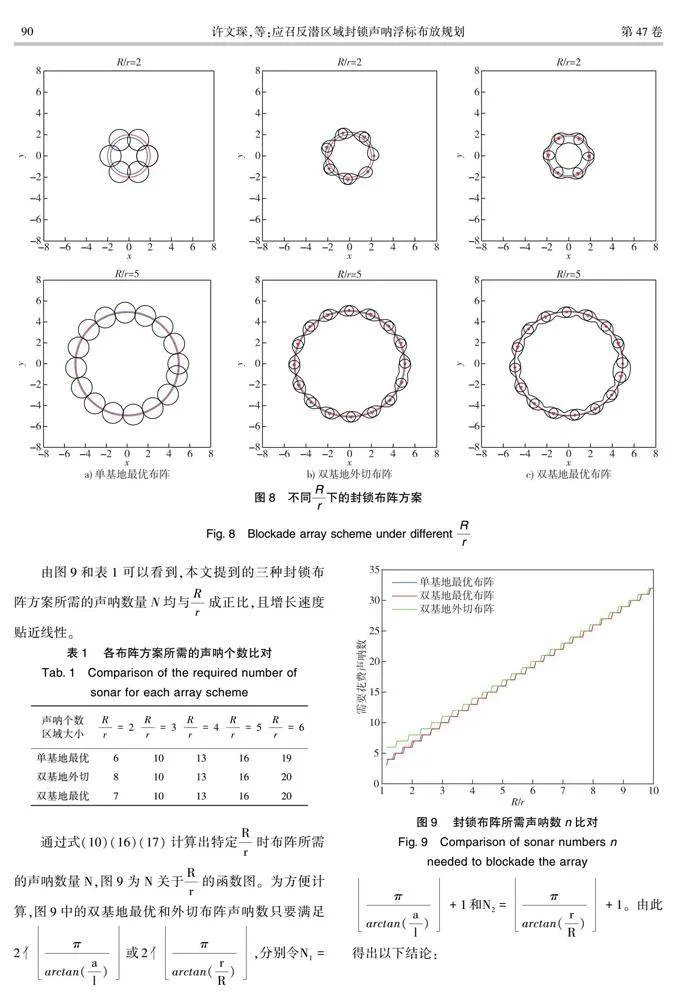
(1)單基地最優布陣:采用本文2.2節的布陣方案,方案中的單基地聲吶半徑均為r。
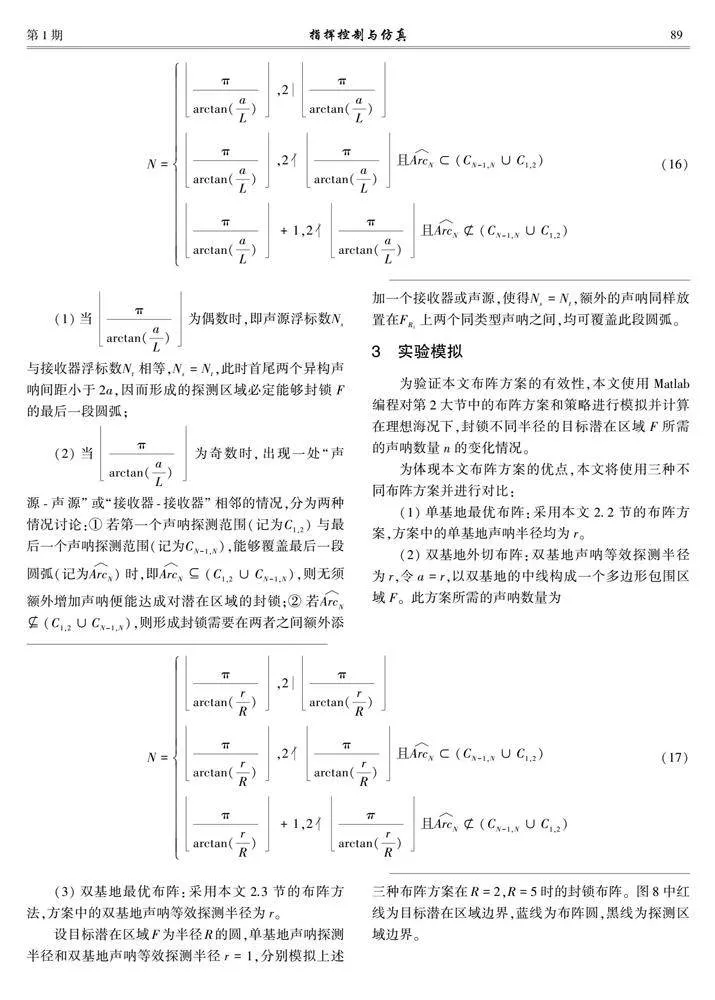
(2)雙基地外切布陣:雙基地聲吶等效探測半徑為r,令a=r,以雙基地的中線構成一個多邊形包圍區域F。此方案所需的聲吶數量為
(3)雙基地最優布陣:采用本文2.3節的布陣方法,方案中的雙基地聲吶等效探測半徑為r。
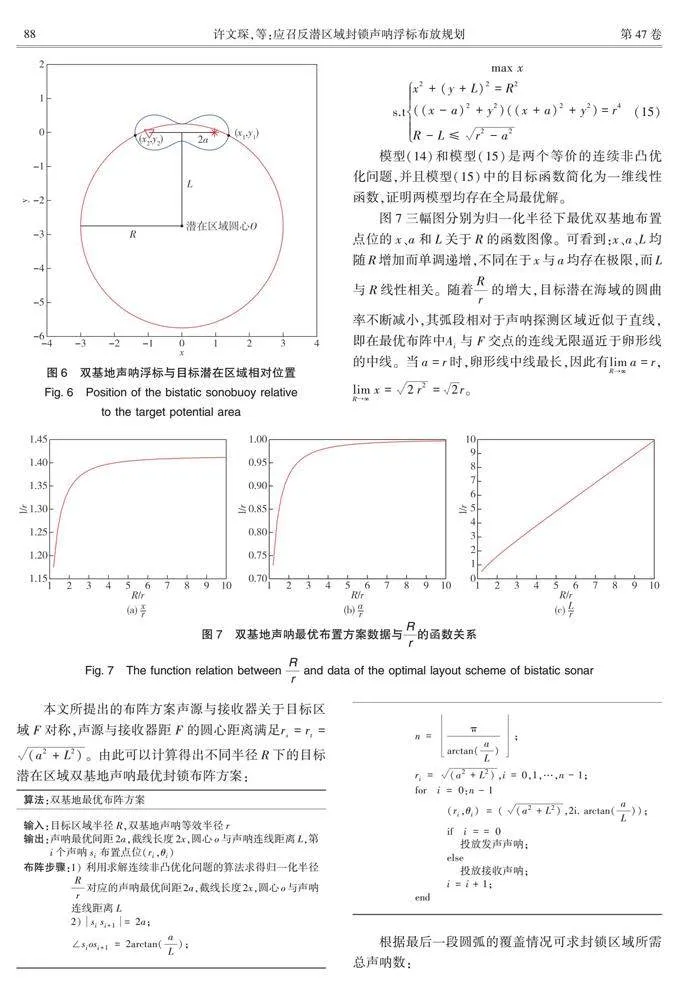
設目標潛在區域F為半徑R的圓,單基地聲吶探測半徑和雙基地聲吶等效探測半徑r=1,分別模擬上述三種布陣方案在R=2,R=5時的封鎖布陣。圖8中紅線為目標潛在區域邊界,藍線為布陣圓,黑線為探測區域邊界。
4 結束語
針對圓形應召反潛區域的封鎖問題,本文提出的雙基地最優布陣方案在大部分的情況下,比單基地最優布陣能達到的最優效果僅存在-1~1個聲吶的數量差距。考慮雙基地聲吶在成本以及戰術隱蔽性上的優勢遠超單基地聲吶,因此本文所提出的雙基地最優布陣方案較單基地最優布陣方案在整體上有更高的效費比與反偵測能力,較雙基地外切布陣在Rr較小時有明顯的數量優勢。此外本文通過兩種最優布陣方案推導出了封鎖不同半徑的目標區域大致需要的聲吶數量,對反潛作戰具有一定參考價值。
本文的研究仍有不足之處:(1)本文根據優化模型(14)提出了一種雙基地最優方案,但并未證明該方案為全局最優解;(2)本文的研究主要針對理想海況,但在現實反潛作戰中海況往往會隨時空而發生變化,目標地點的歷史海況數據乃至實時海況數據對布陣方案都有巨大的影響[13-14]。因此,后續研究工作可對如何在動態海洋環境下進行靜態聲吶浮標布放或進行多裝備協同反潛方向上開展研究。
參考文獻:
[1] 屈也頻, 廖瑛. 潛艇位置散布規律與搜潛效能評估模型研究[J]. 系統仿真學報, 2008, 20(12): 3 280-3 283, 3 289.QU Y P, LIAO Y.Research on modeling of submarines position distribution and search probability in antisubmarine warfare[J]. Journal of System Simulation, 2008, 20(12): 3 280-3 283, 3 289.
[2] 胡平, 顧雪峰, 劉凱, 等. 國外航空反潛裝備現狀及發展趨勢[J]. 艦船電子工程, 2022, 42(9): 10-12, 86.HU P, GU X F, LIU K, et al. Current situation and development trend of foreign aviation anti-submarine equipment[J]. Ship Electronic Engineering, 2022, 42(9):10-12,86.
[3] 龍露瑩, 趙海潮, 李迪. 多基地聲吶浮標系統的布陣設計分析[J]. 聲學與電子工程, 2022(1): 6-9.LONG L Y, ZHAO H C, LI D. Analysis of array design of multi-base sonobuoy system[J]. Acoustics and electrical Engineering, 2022(1): 6-9.
[4] 陳立綱. 聲吶浮標多基地探測綜合效能分析方法研究[J]. 聲學與電子工程, 2022(2): 7-9,32.CHEN L G. Research on comprehensive efficiency analysis method of sonobuoy multi-base detection[J].Acoustics and electrical Engineering, 2022(2): 7-9,32.
[5] 敬玉平, 鞏健文, 范趙鵬, 等. 應召反潛條件下浮標陣型規劃研究[J]. 火力與指揮控制, 2020, 45(3): 59-63.JING Y P, GONG J W, FAN Z P, et al. Research on sonobuoy array in call "searching submarine[J]. Fire Controlamp;Command Control, 2020, 45(3): 59-63.
[6] 譚安勝. 反潛巡邏機聲吶浮標應召搜索研究——態勢分析與包圍陣參數確定[J]. 電光與控制, 2019, 26(12): 1-5.TAN A S. On-call search of anti-submarine patrol aircraft using sonobuoys—situation analysis and determination of bounding array parameters[J]. Electronics Optics amp; Control 2019, 26(12): 1-5.
[7] 李海鵬, 馮大政, 周永偉, 等. 收發分置雷達圓周柵欄覆蓋的優化布站方法[J].系統工程與電子技術, 2022, 44(3): 786-794.LI H P, FENG D Z, ZHOU Y W, et al. Optimal placement method for bistatic radar on perimeter barrier coverage[J]. Systems Engineering and Electronics, 2022, 44 (3): 786-794.
[8] 鞠建波, 郁紅波, 單志超, 等. 艦機雙基地協同主動聲探測范圍分析[J]. 指揮控制與仿真, 2021, 43(1): 19-23.JU J B, YU H B, SHAN Z C, et al. Cooperative active acoustic detection range analysis of ship and aircraft bases[J]. Command Control amp; Simulation, 2021, 43(1): 19-23.
[9] 鞠建波, 李沛宗, 周燁, 等. 基于反潛直升機平臺的吊放聲吶與浮標多基地模式應召搜潛概率仿真研究[J]. 航空兵器, 2020, 27(4): 74-79.JU J B, LI P Z, ZHOU Y, et al. Research on the probability simulation of lifting sonar and buoy based on anti-submarine helicopter platform[J]. Aero Weaponry, 2020, 27(4): 74-79.
[10]KARATAS M, CRAPARO E, AKMAN G. Bistatic sonobuoy deployment strategies for detecting stationary and mobile underwater targets[J]. Naval Research Logistics, 2018, 65(4): 331-346.
[11]XU X H, ZHAO C W, YE T C, et al. Minimum cost deployment of bistatic radar sensor for perimeter barrier coverage[J]. Sensors, 2019, 19(2): 225.
[12]李嶷, 孫長瑜, 余華兵, 等. 多基地聲吶配置策略研究[J]. 兵工學報, 2009, 30(6): 844-848.LI Y, SUN C Y, YU H B, et al. Research on the deployment strategy of multistatic sonar[J]. Acta Armamentii, 2009, 30(6): 844-848.
[13]劉伯勝, 黃益旺, 陳文劍, 等. 水聲學原理(第三版)[M]. 北京: 科學出版社, 2019: 54-62.LIU B S, HUANG Y W, CHEN W J, et al. Principles of underwater acoustics (The third edition)[M]. Beijing: Science Press, 2019: 54-62.
[14]吳芳, 吳銘, 高青偉. 海洋環境對吊放聲吶工作深度優化選擇分析[J]. 艦船電子工程, 2019, 39(8): 25-29.WU F, WU M, GAO Q W. Analysis of optimal selection of operating depth of lifting sonar in marine environment[J]. Ship Electronic Engineering, 2019, 39 (8): 25-29.
(責任編輯:李楠)