一種AHP權重修正方法及在地下空間開發難度評估中的應用
2024-12-31 00:00:00楊奎陸殿梅彭江英陳浩峰
科技創新與應用
2024年20期

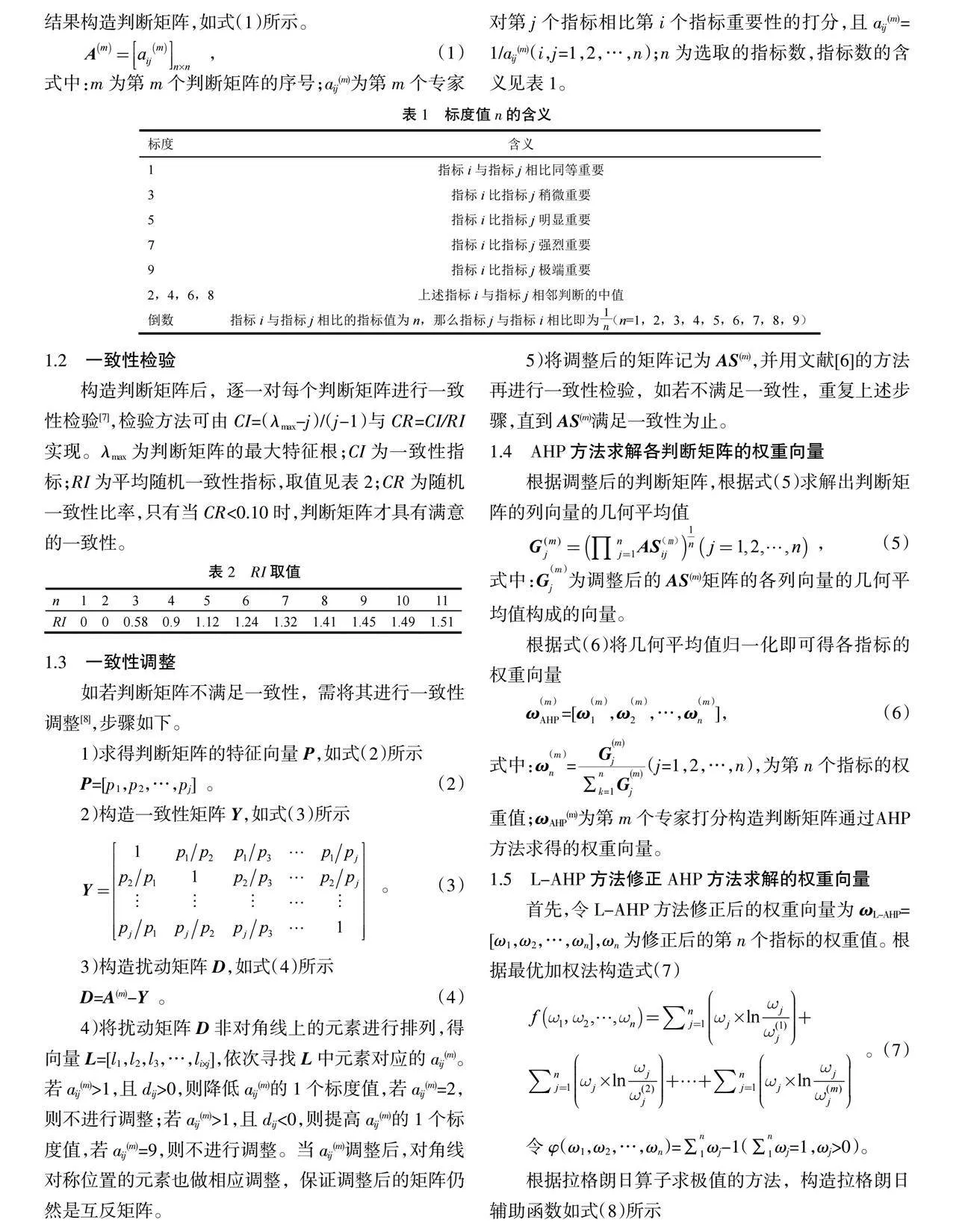
摘 "要:層次分析法(AHP)在地下空間開發難度評估中被廣泛使用,該方法是通過對各影響指標進行打分構造判斷矩陣進行權重求解,但是在對指標進行打分的過程中,存在很強的主觀性,對評估結果造成不可避免的誤差。鑒于此,該文提出一種AHP權重修正的方法,用于消除判斷矩陣的主觀性,獲得更準確的權重向量。并以江蘇省某城市地下空間開發難度評估為例,應用該方法修正AHP方法獲得的權重向量,與未修正的各個權重向量進行對比。結果表明,該方法能夠有效地消除各個判斷矩陣的主觀因素,能更準確地獲得地下空間開發難度的各個影響指標的權重。
關鍵詞:層次分析法;地下空間;修正;權重;對比
中圖分類號:TU990.3 " " "文獻標志碼:A " " " " "文章編號:2095-2945(2024)20-0017-04
Abstract: The Analytic Hierarchy Process(AHP) is widely used in the difficulty assessment of underground space development. This method calculates the weight of each influence index by scoring the judgment matrix, but there is a strong subjectivity in the process of scoring the index, which causes inevitable errors to the evaluation results. In view of this, this paper proposes a method of AHP weight correction, which is used to eliminate the subjectivity of the judgment matrix and obtain more accurate weight vectors. Taking the evaluation of the difficulty of underground space development in a city in Jiangsu Province as an example, this method is used to modify the weight vector obtained by AHP method, and compared with each unmodified weight vector. The results show that this method can effectively eliminate the subjective factors of each judgment matrix and obtain the weight of each index of the difficulty of underground space development more accurately.
Keywords: analytic hierarchy process; Underground Space; revision; weight; comparison
在城市化進程加快的今天,城市用地緊張、交通堵塞、環境污染也逐漸加劇。因此,城市地下空間資源[1]成為了治療城市病的一個極其重要的角色。地下空間開發過程中受到地質、水文、生態等方面的制約。那么在開發地下空間資源時,對其開發難度的評價就顯得非常重要。國內外學者在對地下空間開發難度評價時,層次分析法(AHP)被廣泛使用,此方法是Saaty[2]于20世紀70年代初提出,是通過選取若干指標,邀請權威的專家對各指標進行打分構造判斷矩陣,然后通過對構造矩陣的一致性檢查,采用列向量求和法獲取各指標權重。但是由于各專家專業背景與研究方向的不同,構造的判斷矩陣存在不可避免的主觀性,那么在地下空間開發難度評估時會造成不可避免的誤差。……
登錄APP查看全文
猜你喜歡
公民與法治(2022年5期)2022-07-29 00:47:28
教學考試(高考物理)(2021年5期)2021-11-08 10:31:22
歷史教學問題(2021年4期)2021-11-05 07:02:34
中醫眼耳鼻喉雜志(2021年1期)2021-07-22 07:38:14
兒童故事畫報(2019年5期)2019-05-26 14:26:14
中國公共安全(2017年11期)2017-02-06 05:28:08
Coco薇(2016年2期)2016-03-22 02:42:52
燕山大學學報(2015年4期)2015-12-25 02:19:49
Coco薇(2015年1期)2015-08-13 02:47:34
小雪花·成長指南(2015年7期)2015-08-11 15:03:12