綁鞋帶技術聯合VSD技術治療創傷性四肢皮膚軟組織缺損創面的效果
2024-05-19 03:56:43易廣田
醫學美學美容 2024年8期
易廣田

[摘 要]目的 研究綁鞋帶技術聯合負壓封閉引流(VSD)技術治療創傷性四肢皮膚軟組織缺損創面的效果。方法 選取2021年8月-2022年12月我院診治的40例創傷性四肢皮膚軟組織缺損創面患者為研究對象,采用隨機數字表法分為對照組和試驗組,各組20例。對照組采用VSD技術治療,試驗組在對照組基礎上應用綁鞋帶技術,比較兩組一期愈合率、臨床手術指標、植皮率、換藥次數、并發癥發生率。結果 試驗組一期愈合率為95.00%,高于對照組的75.00%(P<0.05);試驗組手術時間、術中出血量與對照組比較,差異無統計學意義(P>0.05),但試驗組創傷愈合時間、住院時間均短于對照組(P<0.05);試驗組植皮率高于對照組,換藥次數少于對照組(P<0.05);試驗組并發癥發生率為10.00%,低于對照組的25.00%(P<0.05)。結論 創傷性四肢皮膚軟組織缺損創面患者應用綁鞋帶技術聯合VSD技術治療可實現良好的治療效果,不僅可提高一期愈合率,縮短創傷愈合和住院時間,還能提高植皮率,減少換藥次數,降低并發癥發生率,是一種有效、可行的治療方法。
[關鍵詞] 綁鞋帶技術;VSD技術;創傷性四肢皮膚軟組織缺損創面;一期愈合率
[中圖分類號] R658 [文獻標識碼] A [文章編號] 1004-4949(2024)08-0052-04
基金項目:欽州市科學研究與技術開發計劃項目(編號:20213718)
Effect of Shoelace Technique Combined with VSD Technique in the Treatment of Traumatic Limb Skin and Soft Tissue Defect Wound
YI Guang-tian
(Orthopaedics Department of Qinzhou Second Peoples Hospital, Qinzhou 535099, Guangxi, China)
[Abstract]Objective To study the effect of shoelace technique combined with vacuum sealing drainage (VSD) in the treatment of traumatic limb skin and soft tissue defect wound. Methods A total of 40 patients with traumatic limb skin and soft tissue defect wound diagnosed and treated in our hospital from August 2021 to December 2022 were selected as the research objects. They were divided into control group and experimental group by random number table method, with 20 patients in each group. The control group was treated with VSD technique, and the experimental group was treated with shoelace technique on the basis of the control group. The primary healing rate, clinical operation index, skin grafting rate, dressing change times and complication rate were compared between the two groups. Results The primary healing rate of the experimental group was 95.00%, which was higher than 75.00% of the control group (P<0.05). There was no significant difference in operation time and intraoperative blood loss between the experimental group and the control group (P>0.05), but the wound healing time and hospitalization time of the experimental group were shorter than those of the control group (P<0.05). The skin grafting rate of the experimental group was higher than that of the control group, and the number of dressing changes was less than that of the control group (P<0.05). The incidence of complications in the experimental group was 10.00%, which was lower than 25.00% in the control group (P<0.05). Conclusion The application of shoelace technique combined with VSD technique in the treatment of patients with traumatic limb skin and soft tissue defect wound can achieve good therapeutic effect. It can not only improve the primary healing rate, shorten the wound healing and hospitalization time, but also improve the skin grafting rate, reduce the number of dressing changes, and reduce the incidence of complications. It is an effective and feasible treatment method.
[Key words] Shoelace technique; VSD technique; Traumatic limb skin and soft tissue defect wound; Primary healing rate
隨著我國經濟的日益發展,各行業技術快速發展,創傷性四肢皮膚軟組織缺損發生率不斷上升[1]。軟組織缺損是指患者的皮膚、皮下組織出現創傷性損傷,同時伴有肌肉或神經血管的缺損[2]。創傷性四肢皮膚軟組織缺損如果治療不及時,會出現不同程度創面感染,不利于患者預后恢復,嚴重時會威脅患者生命安全[3,4]。目前對于該類患者,臨床多運用負壓封閉引流技術(vacuum sealing drainage,VSD)進行治療,該方法可刺激肉芽組織生長、改善血液循環、抑制細菌感染,對患者的創面愈合和恢復具有積極的影響[5]。隨著臨床對創傷性四肢皮膚軟組織缺損的深入研究,綁鞋帶技術應運而生。該技術利用橡皮筋與皮膚的彈性,可促進皮膚逐漸牽張閉合創面[6]。基于此,該方法在軟組織損傷患者的治療中同樣可起到一定的治療效果。但目前關于綁鞋帶技術在四肢創傷軟組織缺損治療中的研究較少,具體的應用效果尚未完全明確[7]。本研究結合2021年8月-2022年12月我院診治的40例創傷性四肢皮膚軟組織缺損創面患者臨床資料,觀察綁鞋帶技術的應用效果,現報道如下。
1 資料與方法
1.1 一般資料 選取2021年8月-2022年12月欽州市第二人民醫院診治的40例創傷性四肢皮膚軟組織缺損創面患者為研究對象,采用隨機數字表法分為對照組和試驗組,各組20例。對照組男12例,女8例;年齡18~65歲,平均年齡(41.56±6.31)歲。試驗組男11例,女9例;年齡18~64歲,平均年齡(41.52±6.25)歲。兩組性別、年齡比較,差異無統計學意義(P>0.05),具有可比性。
1.2 納入及排除標準 納入標準:①患者與家屬同意開展本研究,并簽署知情同意書;②因創傷損傷因素誘發的四肢軟組織缺損患者;③皮膚軟組織缺損面積較大,不能直接縫合者;④精神狀態良好,能配合研究者。排除標準:①合并嚴重內科疾病,不能耐受手術者;②中途退出研究者。
1.3 方法 兩組患者先接受常規的創面清創,檢查創面,對創面邊緣皮膚進行修整,建立微循環并重視血運情況,刺激肉芽組織的生長。
1.3.1對照組 行VSD技術治療:①使用VSD技術對患者進行全身治療,并對造成創面感染的物質進行細菌培養[8],依據培養結果,實施符合患者實際的抗菌治療;②及時清除創面的失活組織,并盡快將患者的損傷部位修復,剔除創面的壞死組織與分泌物;③依據患者的實際創面情況,針對性地裁剪VSD材料,并在必要時將其縫合;將裁剪好的VSD敷料覆蓋于患者創面上,再次清潔創面的周圍皮膚;④連接VSD治療專用吸引機或中性負壓,將負壓源調節至-40~-55 kPa[9],持續負壓,按壓VSD材料,使用負壓吸出創面滲液,每7 d更換1次VSD,在治療過程中更換不超過3次,直至創面干凈。監測創面肉芽的生長情況,在確保其生長飽滿后,再予以拆除。
1.3.2試驗組 在對照組基礎上應用綁鞋帶技術:VSD操作同對照組一致,在創面皮緣用皮膚吻合器充當扣環,并運用硅橡膠袢,發揮縛帶的作用,類似綁鞋帶,最后形成具有彈性的穩定結構。之后在創面處覆蓋VSD敷料,保持引流通暢,治療的負壓值在-40~-55 kPa,持續負壓。7 d更換1次VSD,并對軟組織創面進行觀察,適當收緊橡皮筋。
1.4 觀察指標
1.4.1記錄兩組一期愈合率[10,11] 完全愈合:創口完全愈合,并且恢復情況良好,無感染發生;基本愈合:創口基本愈合,恢復和預后較好,基本無感染情況發生;未愈合:創口愈合不佳,甚至有惡化與感染的趨向。一期愈合率=(完全愈合+基本愈合)/總例數×100%。
1.4.2比較兩組臨床手術指標 包括手術時間、術中出血量、創傷愈合時間、住院時間。
1.4.3記錄兩組植皮率、換藥次數。
1.4.4記錄兩組并發癥發生率 包括感染、創面紅腫、竇道。
1.5 統計學方法 采用SPSS 24.0統計學軟件進行數據分析,符合正態分布的計量資料采用(x±s)表示,組間比較采用t檢驗;計數資料采用[n(%)]表示,組間比較采用χ2檢驗;P<0.05說明差異有統計學意義。
2 結果
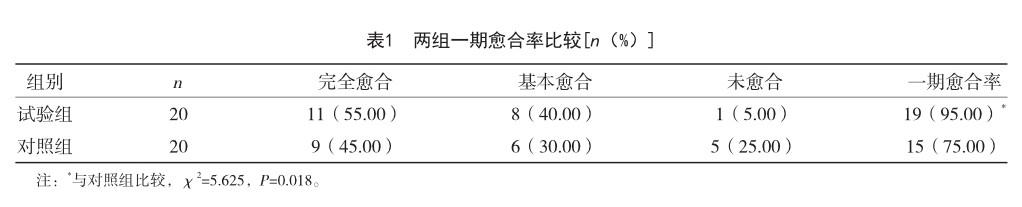
2.1 兩組一期愈合率比較 試驗組一期愈合率高于對照組(P<0.05),見表1。
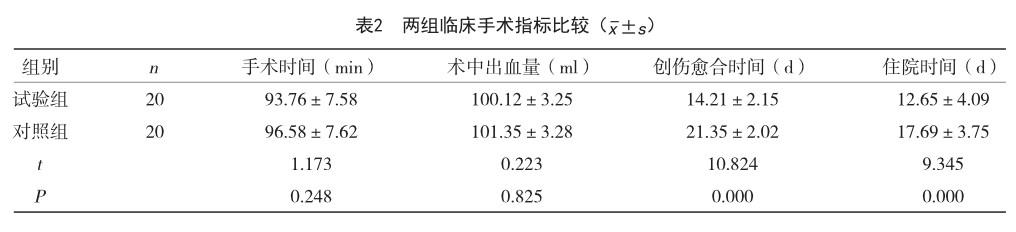
2.2 兩組臨床手術指標比較 試驗組手術時間、術中出血量與對照組比較,差異無統計學意義(P>0.05);而試驗組創傷愈合時間、住院時間均短于對照組(P<0.05),見表2。
2.3 兩組植皮率、換藥次數比較 試驗組植皮率為90.00%(18/20),高于對照組的70.00%(14/20)(χ2=22.896,P=0.000);試驗組換藥次數為(2.66±0.80)次,少于對照組的(5.73±1.20)次(t=6.208,P=0.020)。
2.4 兩組并發癥發生率比較 試驗組并發癥發生率低于對照組(P<0.05),見表3。