發(fā)現(xiàn)伏筆,捕捉續(xù)寫(xiě)點(diǎn)
2024-04-11 07:31:16廣東吳娟娟
瘋狂英語(yǔ)·新悅讀 2024年3期
廣東 吳娟娟
【問(wèn)題導(dǎo)讀】
讀后續(xù)寫(xiě)的命題材料往往源于一篇完整的文章。在命題時(shí),命題者會(huì)故意刪除其中可續(xù)寫(xiě)段落的內(nèi)容來(lái)考查考生的思維能力和對(duì)所學(xué)語(yǔ)言知識(shí)的實(shí)際運(yùn)用能力。在一個(gè)完整的故事中,作者通常會(huì)圍繞某個(gè)主題,在篇首或篇中埋下一些伏筆,并在篇尾進(jìn)行合理照應(yīng)。在讀后續(xù)寫(xiě)中,伏筆暗示故事的發(fā)展方向,往往出現(xiàn)在原文和所給的兩個(gè)段首句中。發(fā)現(xiàn)伏筆并在續(xù)寫(xiě)中照應(yīng)伏筆可以增強(qiáng)文章的邏輯性。
【名師導(dǎo)學(xué)】
伏筆是文學(xué)作品中在上文看似無(wú)關(guān)緊要的事或物,但對(duì)下文將要出現(xiàn)的人物或事件預(yù)先做出的某種提示或暗示,以求前后呼應(yīng)達(dá)到結(jié)構(gòu)嚴(yán)謹(jǐn)、情節(jié)合理的效果。伏筆為故事的展開(kāi)服務(wù),經(jīng)常零星散落在文中,不易發(fā)覺(jué)。因此,考生在閱讀時(shí)應(yīng)站在作者的角度解讀原文,從文本中發(fā)現(xiàn)伏筆,續(xù)寫(xiě)時(shí)及時(shí)照應(yīng),從而確保續(xù)寫(xiě)情節(jié)與原文保持邏輯一致。考生如何才能精準(zhǔn)地找出“潛伏”在文中的伏筆呢?以下是幾種常見(jiàn)的方式。
1.把握故事背景與故事情節(jié),捕捉可續(xù)寫(xiě)點(diǎn)
讀后續(xù)寫(xiě)文本以記敘文為主,考生可以通過(guò)列表格清單的方式把握故事的基本要素:時(shí)間、地點(diǎn)、人物、事件。基本要素所反映的特定背景和基本情況制約著故事的情節(jié)發(fā)展和走向。因此,通過(guò)分析故事或人物背景捕捉續(xù)寫(xiě)點(diǎn),考生可以找到故事情節(jié)發(fā)展的大致方向。
2.提煉原文主題,捕捉可續(xù)寫(xiě)點(diǎn)
主題是文章的靈魂,是對(duì)寫(xiě)人、記事、寫(xiě)景、狀物等內(nèi)容的概括和提煉,同時(shí)也是續(xù)寫(xiě)的伏筆。考生可以用“何人何時(shí)何地做了何事,結(jié)果如何,為什么”的句式概括主題,緊扣原文思想。續(xù)寫(xiě)時(shí)照應(yīng)主題,結(jié)尾時(shí)升華主題。
3.抓住高頻詞,捕捉可續(xù)寫(xiě)點(diǎn)
高頻詞指在原文中多次出現(xiàn)并與情節(jié)相關(guān)聯(lián)的詞。原文中的高頻詞通常直指特定物品或場(chǎng)景,看似無(wú)關(guān)緊要,有時(shí)卻能對(duì)助推情節(jié)起到畫(huà)龍點(diǎn)睛的作用。考生可以通過(guò)做標(biāo)注留意高頻詞,并在續(xù)寫(xiě)時(shí)適時(shí)照應(yīng),使續(xù)寫(xiě)段落在內(nèi)容和邏輯上與原文更融洽。
4.留意細(xì)節(jié)描寫(xiě),捕捉可續(xù)寫(xiě)點(diǎn)
續(xù)寫(xiě)中可用作伏筆的細(xì)節(jié)描寫(xiě)主要有語(yǔ)言描寫(xiě)、動(dòng)作描寫(xiě)、心理描寫(xiě)、環(huán)境描寫(xiě)、情感描寫(xiě)等。描寫(xiě)對(duì)象可以是人,也可以是物或場(chǎng)景。細(xì)節(jié)蘊(yùn)藏玄機(jī),能做鋪墊,推動(dòng)故事情節(jié)的發(fā)展。考生在閱讀原文時(shí)要善于體會(huì)細(xì)節(jié)背后的用意,捕捉特定細(xì)節(jié)并在續(xù)寫(xiě)時(shí)予以照應(yīng)。
5.品讀續(xù)寫(xiě)段首句,捕捉可續(xù)寫(xiě)點(diǎn)
讀后續(xù)寫(xiě)并不是任由考生隨心所欲地發(fā)揮想象力,而是要在續(xù)寫(xiě)段落開(kāi)頭語(yǔ)的約束下完成創(chuàng)作,因此段首句必有伏筆。考生可以通過(guò)仔細(xì)研讀兩個(gè)段首句,捕捉關(guān)鍵詞作為續(xù)寫(xiě)點(diǎn),推動(dòng)情節(jié)發(fā)展,建構(gòu)首尾呼應(yīng)的完整的故事情節(jié)。
【案例導(dǎo)引】
閱讀下面短文,根據(jù)所給情節(jié)進(jìn)行續(xù)寫(xiě),使之構(gòu)成一個(gè)完整的故事。
Music has always been an essential part of my family.As a little girl, I often watched my mom singing with others in the church.As I grew older, she and I would sing while we did the dishes or hung clothes.My brother Dean was also a musical soul.In good time or in bad, there was always music in our house.It shaped us, comforted us, and gave us a way to express feelings that might otherwise have gone unspoken.
After Dean became a father, we learned that his oldest son was on the autism (孤獨(dú)癥)spectrum.My nephew Dj did not handle social situations well, and sometimes it was even a struggle for him to speak aloud outside the family.He worked very hard to overcome his fears so that he decided he wanted to be part of a music program with the other children in his Sunday school class when he was eight years old.The part he had been offered was one that required him to sing a verse all on his own—a solo.
My brother carefully explained to him that this would mean singing in front of the audience.There would be no one singing with him.Dj considered this very carefully.After a couple of days, he decided that he would accept the part.He explained to us that he believed he could do it because it was a very special occasion, and he would practice until he was as perfect as he could be.He said he knew his daddy would help him to be the best singer possible.
For over a month, he and his father practiced together.Every evening would find them locked away in the music room, my brother on guitar, and my nephew's small voice coming from somewhere deep down inside his little body.He gained confidence, and when the day of the concert arrived, he was certain all would go well.My brother waited backstage, giving Dj double thumbs-up, and he came out to sit with the rest of the family to watch and take photos.
注意:續(xù)寫(xiě)詞數(shù)應(yīng)為150左右。
Paragraph 1:
When it was finally time for Dj to sing,the music played on,and he froze.____________
__________________________________________
__________________________________________
__________________________________________
__________________________________________
Paragraph 2:
Everyone turned to see who was singing,while I knew it was my brother._____________
__________________________________________
__________________________________________
__________________________________________
__________________________________________
一、梳理故事背景
作者的侄子Dj 自幼患有孤獨(dú)癥,不善于社交,有時(shí)甚至害怕在家庭之外的地方大聲說(shuō)話(huà)。但他在爸爸的鼓勵(lì)和陪伴下,努力克服自己的恐懼,終于決定在音樂(lè)會(huì)進(jìn)行個(gè)人表演。
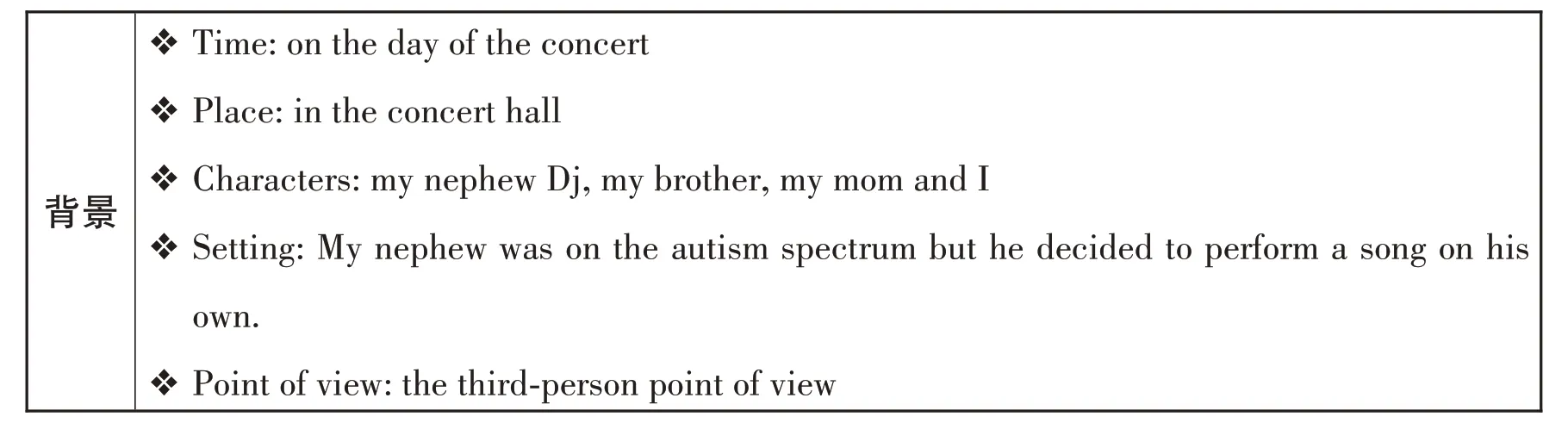
背景? Time: on the day of the concert? Place: in the concert hall? Characters: my nephew Dj, my brother, my mom and I? Setting: My nephew was on the autism spectrum but he decided to perform a song on his own._______? Point of view: the third-person point____________________________________________of_view
二、厘清故事情節(jié)
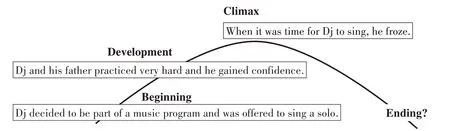
三、捕捉續(xù)寫(xiě)點(diǎn)
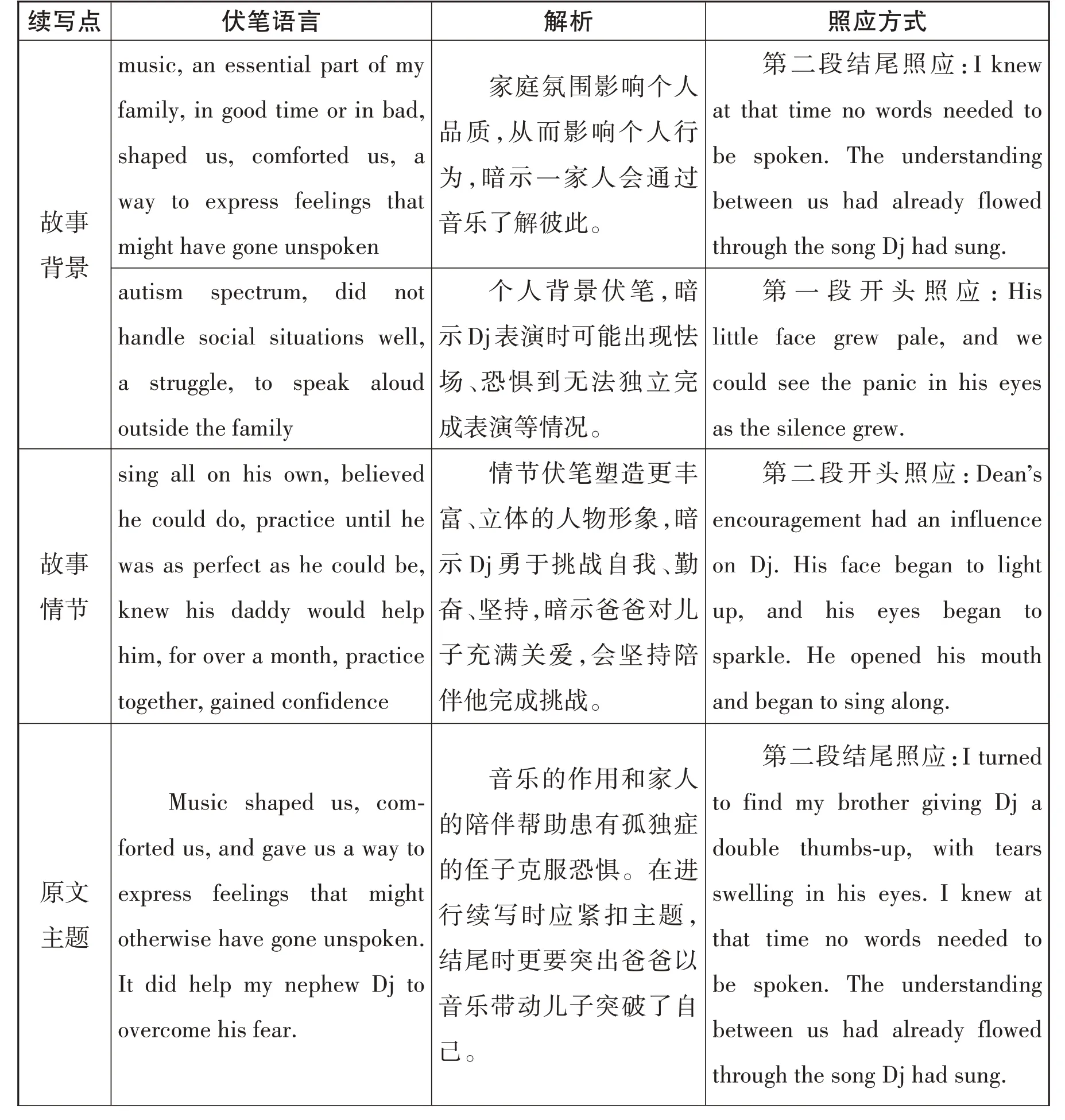
續(xù)寫(xiě)點(diǎn) 伏筆語(yǔ)言 解析 照應(yīng)方式__________故事背景家庭氛圍影響個(gè)人品質(zhì),從而影響個(gè)人行為,暗示一家人會(huì)通過(guò)音樂(lè)了解彼此。故事情節(jié)music, an essential part of my family, in good time or in bad,shaped us, comforted us, a way to express feelings that might have gone unspoken___________________________autism spectrum, did not handle social situations well,a struggle, to speak aloud________outside the family sing all on his own, believed he could do, practice until he was as perfect as he could be,knew his daddy would help him, for over a month, practice________together, gained confidence個(gè)人背景伏筆,暗示Dj 表演時(shí)可能出現(xiàn)怯場(chǎng)、恐懼到無(wú)法獨(dú)立完成表演等情況。________情節(jié)伏筆塑造更豐富、立體的人物形象,暗示Dj 勇于挑戰(zhàn)自我、勤奮、堅(jiān)持,暗示爸爸對(duì)兒子充滿(mǎn)關(guān)愛(ài),會(huì)堅(jiān)持陪伴他完成挑戰(zhàn)。________原文主題Music shaped us, comforted us, and gave us a way to express feelings that might otherwise have gone unspoken.It did help my nephew Dj to overcome his fear.音樂(lè)的作用和家人的陪伴幫助患有孤獨(dú)癥的侄子克服恐懼。在進(jìn)行續(xù)寫(xiě)時(shí)應(yīng)緊扣主題,結(jié)尾時(shí)更要突出爸爸以音樂(lè)帶動(dòng)兒子突破了自己。第二段結(jié)尾照應(yīng):I knew at that time no words needed to be spoken.The understanding between us had already flowed through the song Dj had sung.___第一段開(kāi)頭照應(yīng):His little face grew pale, and we could see the panic in his eyes as the silence grew.___________第二段開(kāi)頭照應(yīng):Dean's encouragement had an influence on Dj.His face began to light up, and his eyes began to sparkle.He opened his mouth and began to sing along.________第二段結(jié)尾照應(yīng):I turned to find my brother giving Dj a double thumbs-up, with tears swelling in his eyes.I knew at that time no words needed to be spoken.The understanding between us had already flowed through the song Dj had sung.
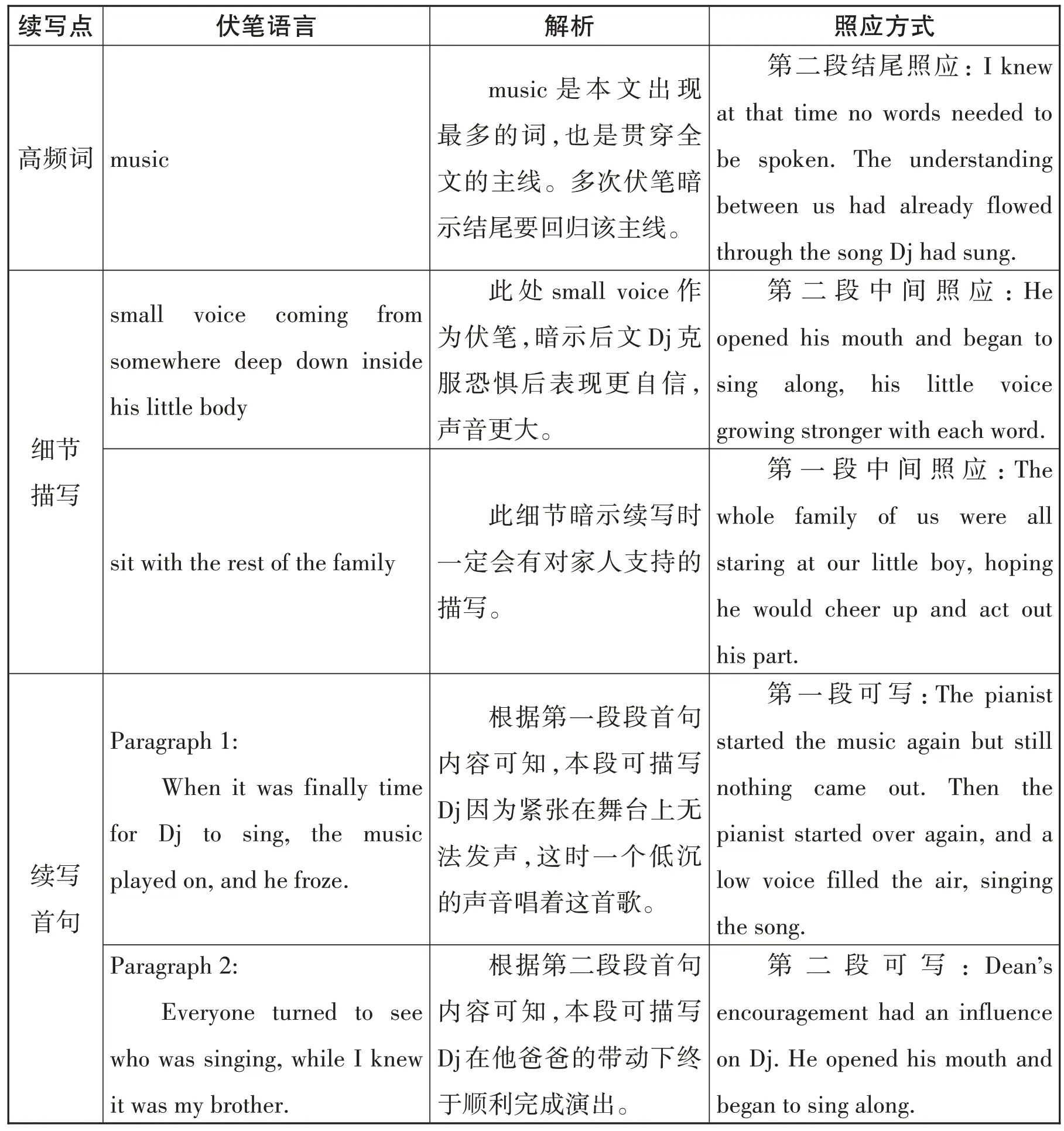
(續(xù)表)
參考范文
Paragraph 1:
When it was finally time for Dj to sing,the music played on,and he froze.His little face grew pale, and we could see the panic in his eyes as the silence grew.The pianist started the music again but still nothing came out.The entire audience seemed to lean forward in expectation.The silence seemed enormous.The whole family of us were all staring at our little boy, hoping he would cheer up and act out his part.Then the pianist started over again, and a low voice filled the air, singing the song.Paragraph 2:
Everyone turned to see who was singing,while I knew it was my brother.Dean's encouragement had an influence on Dj.His face began to light up, and his eyes began to sparkle.He opened his mouth and began to sing along, his little voice growing stronger with each word.The show ended with thunderous applause, with the kids bowing dramatically,accepting their praise for a job well done.I turned to find my brother giving Dj a double thumbs-up, with tears swelling in his eyes.I knew at that time no words needed to be spoken.The understanding between us had already flowed through the song Dj had sung.
【模擬導(dǎo)練】
閱讀下面短文,根據(jù)所給情節(jié)進(jìn)行續(xù)寫(xiě),使之構(gòu)成一個(gè)完整的故事。
During my school days, whenever I was asked to write an essay (文章) about brave people and their brave deeds, I always focused on heroes in news reports risking their lives to save others.But from that day on, I could write how my mom, in her determined way,saved our elderly neighbor.
The event that stands out in my memory happened one morning when I was only 10 years old.I was doing my homework when I heard raised voices.At first, I thought nothing of it since customers in the motorcycle shop directly below our flat often became loud, but I soon realized this time it was different.
“Quick! Quick! Remove the motorcycles from the shop,” someone yelled.Then a thick burning smell filled the air.When I opened the front door of our flat to have a look outside,a thick cloud of smoke, billowing (涌出) up from the ground floor, greeted me.It hit me that the motorcycle shop had caught fire.
My mom, who had been working in the kitchen, hurried to the living room.We rushed out of the door and along the corridor (走廊) through the smoke.We were heading towards the stairway at the far end of the corridor when Mom stopped and thought for a while.She turned around and headed back the way we came.Puzzled but having no idea what she was doing, I followed her.
It became clear soon that Mom had remembered the Korean lady in her 70s living next door to us whom we called Jane.Mom began banging on the door, but got no answer.As the smoke thickened around us, I could see many of our neighbors—some still in their pyjamas(睡衣)—running for safety.The thought of fear crossed my mind.
“She must have already run for safety like everyone else! Let's rush downstairs!” I begged.But Mom refused to give up.“I know Jane's still inside.” She said she was familiar with Jane's daily routine and was certain she would still be sleeping.
注意:續(xù)寫(xiě)詞數(shù)應(yīng)為150左右。
Paragraph 1:
I noticed the flame was reaching up._________________________________________
__________________________________________
__________________________________________
__________________________________________
__________________________________________
Paragraph 2:
Luckily,some neighbors passing by stopped and offered help.______________________
__________________________________________
__________________________________________
__________________________________________
__________________________________________
【評(píng)價(jià)導(dǎo)思】
1.你續(xù)寫(xiě)的內(nèi)容是否緊扣文章主題?你又是如何回應(yīng)主題的?
__________________________________________
__________________________________________
2.續(xù)寫(xiě)這篇文章的時(shí)候,你找到了哪些可續(xù)寫(xiě)點(diǎn)?你是如何照應(yīng)這些可續(xù)寫(xiě)點(diǎn)的?
__________________________________________
__________________________________________
3.在結(jié)尾升華時(shí),你有沒(méi)有寫(xiě)出讓人感動(dòng)的帶有哲理性的句子?
__________________________________________
__________________________________________
猜你喜歡
汽車(chē)工程師(2021年12期)2022-01-17 02:29:54
當(dāng)代陜西(2020年14期)2021-01-08 09:30:42
家庭影院技術(shù)(2020年10期)2020-12-14 07:53:50
小學(xué)生優(yōu)秀作文(低年級(jí))(2018年10期)2018-10-13 01:56:50
電影文學(xué)(2016年19期)2016-12-07 20:06:50
貴州師范學(xué)院學(xué)報(bào)(2016年4期)2016-12-01 03:54:07
Coco薇(2016年10期)2016-11-29 19:59:58
文學(xué)教育·中旬版(2016年10期)2016-11-21 04:17:00
世界文學(xué)評(píng)論(2014年2期)2014-04-12 06:23:30
新課程學(xué)習(xí)·中(2013年2期)2013-05-28 07:59:54