
Stimulated brillouin scattering in double-clad thulium-doped fiber amplifier
2024-02-05 09:07:02LIUQingminSUNHuijieHOUShanglinLEIJingliWUGangYANZuyong
中國光學 2024年1期
LIU Qing-min,SUN Hui-jie,HOU Shang-lin ,LEI Jing-li,WU Gang,YAN Zu-yong
(1.College of Electrical and Information Engineering, Lanzhou University of Technology, Lanzhou 730050, China;2.School of Science, Lanzhou University of Technology, Lanzhou 730050, China)
Abstract: In this paper,the effect of Stimulated Brillouin Scattering(SBS) on the laser output performance in a 2 μm thulium-doped fiber amplifier was analyzed theoretically.The optical mode distribution,the effective refractive index,the effective mode field area,and the normalized frequency of the double-clad thuliumdoped fiber at 793 nm pump wavelength and 1.9-2.1 μm laser waveband were studied.The stimulated Brillouin scattering characteristics,including the Brillouin frequency shift and the Brillouin gain spectrum,in the double-clad thulium-doped fiber were numerically simulated in the laser waveband of 1.9-2.1 μm.The influence of stimulated Brillouin scattering on the laser output performance of thulium-doped fiber amplifiers was investigated using the theoretical model of stimulated Brillouin scattering in gain fibers.In the DTDF-10/130 double-clad thulium-doped fiber,a continuous wave with power of 100 W and wavelength of 793 nm is used as a pump to amplify a continuous signal wave with wavelength of 2 μm and power of 0.01 W.The maximum output powers of the signal wave are 25.27 W,31.08 W and 34.06 W when the pump power filling factors are 0.01,0.02 and 0.03,respectively.The corresponding optimal double-clad fiber lengths are 2.66 m,2.02 m and 1.75 m.Additionally,the Stokes optical powers generated by the stimulated Brillouin scattering are 1.68 W,1.39 W and 1.14 W,respectively.The results show that the double-clad fiber with large pump power filling factor in the thulium-doped fiber amplifier can effectively reduce the fiber length,thus to minimize the influence of stimulated Brillouin scattering on the output power of the signal laser.The numerical model can optimize the fiber length of the fiber amplifier,which is of great significance to improve experimental efficiency and reduce experimental costs.
Key words: stimulated brillouin scattering;double-clad;thulium-doped fiber;amplifier
1 Introduction
Fiber lasers are one of the earliest types of realized laser.Initially,most fiber lasers used a singleclad fiber as the laser medium,but it is difficult to effectively couple high power pump wave into the fiber core due to the geometry of the fiber core.Consequently,fiber lasers were formerly regarded as a weak wave source with low output power[1-3].In 1988,Snitzeret al.[4]reported a double-clad fiber,in which,the pump wave is transmitted in the inner cladding,providing a new solution for increasing fiber laser output power,while successfully coupling high-power pump waves into a single-mode core.Double-clad fiber lasers are highly favored by researchers due to their high efficiency,superior mode quality,compact structure,and easy to dissipate heat[5-8].
In recent years,the performance requirements of fiber lasers have increased with the development of fiber optic communication technology.Currently,researchers primarily focus on achieving high power output,narrow linewidth spectrum,and high beam quality in fiber lasers[9-10].Thulium-doped fiber lasers in the 2 μm band are widely used in laser medicine[11-12],laser active remote sensing[13-14]and military science and technology[15]due to their advantages including human eye safety and wide tunable range.As a result,they have garnered significant attention in the optical society.In recent years,there has been a growing interest in ultrashort pulse and multi-wavelength fiber laser light sources in the 2.0 μm[16-19].In addition,thulium-doped fiber lasers offer great advantages in terms of a narrow linewidth and high-power laser output[20].To further improve the laser output wave’s beam quality,a Master Oscillation Power Amplification (MOPA)structure is usually used[21].However,in the highpower fiber amplifiers,the small core cross-sectional area and high transmission power can easily cause nonlinear effects.The Stimulated Brillouin Scattering (SBS) effect[22]can convert part of the signal wave in the amplifer into a Stokes wave,thus affects the efficiency of the amplifier and leads to a significant reduction in the output power[23].Therefore,the suppression of SBS in fiber lasers or amplifiers is a very important research topic.For example,Yang Let al.[24]broadened the pump wave by using white noise as the RF signal to reduce the Brillouin scattering gain coefficient.As a result,the SBS threshold was increased,and a continuous laser output with an average power of 90 W was achieved.Liu Y Ket al.[25]reduced the Brillouin gain peak by broadening the linewidth of the seed laser by using phase modulation to suppress SBS.Harishet al.[26]suppressed stimulated Brillouin scattering in an erbium-doped optical fiber amplifier for 50-ns-long transform limited signal pulses by employing counter-directional pumping with a pulse burst.Furthermore,the effect of SBS can be reduced by increasing the mode field area of the fiber[27]and increasing the doping concentration of the gain fiber[28].
Numerical modeling was conducted on the double-clad thulium-doped fiber,with reference to GB/T 28 504.2-2021[29].An investigation was carried out on the optical field distribution,Brillouin gain coefficient,and Brillouin gain spectrum,along with other characteristics of the double-clad thulium-doped fiber at the pump wavelength of 793 nm and the laser waveband of 1.9~2.1 μm.Subsequently,the numeric solution for the laser output characteristics of the thulium-doped fiber amplifier is obtained,considering the effect of SBS on the output power of the signal wave.The results show that the effect of SBS on the signal laser output can be reduced by choosing a shorter fiber in the fiber amplifier,while a double-clad fiber with a larger pump optical power filling factor can be used to guarantee the laser output power.
2 Models and theory
A Double-Clad Thulium-Doped Fiber (DCTDF) has a four-layer structure.The core portion is made of Tm3+-doped silica,with an inner cladding layer of pure silica,an outer cladding layer of a lowrefractive index polymer,and a coating layer of a common polymer[29].For its geometry,optical properties,mechanical properties,and other parameters,please refer to GB/T 28 504.2-2021.The DTDFs can be categorized as DTDF-10/130 and DTDF-25/400 according to the size of their core and inner cladding.Table 1 gives their respective geometry and optical properties.
The refractive index of silica is determined using the Sellmeier equation[30]
whereλrepresents the wavelength in microns andrepresents the refractive index of silica.
Figs.1 and 2 depict the structure and refractive index distribution of DTDF-10/130 and DTDF-25/400 DCTDFs,respectively.In these diagrams,n1,n2andn3represent the refractive indices of the core,inner cladding,and outer cladding.It is worth noting that in both fibers,n2represents the refractive index of silica,whilen1andn3can be calculated from the numerical apertures of the core and inner cladding.
3 Results and discussion
3.1 Analyses of optical properties of double-clad thulium-doped fiber
Analytical calculations were performed using the finite element method for both DTDF-10/130 and DTDF-25/400 DCTDFs.This study focuses on the operating waveband of thulium-doped fiber lasers at 1.9~2.1 μm.The coupling intensity of the optical wave in the Tm3+doped region is quantitatively expressed through the power filling factor shown in the following equation[31-32]where the integration region of the numerator term is the doping region of Tm3+,while the integration region of the denominator term covers the entire fiber cross section,andkrepresents various optical modes.
Figs.3 and 4 show the optical field distributions of the two fibers for the signal wave with a wavelength of 2 μm.As the refractive index of the core-doped region is greater than that of the inner cladding,the signal wave at 2 μm wavelength can be effectively confined in the core-doped region.Fig.5 (color online) illustrates the normalized frequencies of the two fibers within the signal wave wavelength range of 1.9~2.1 μm.It can be seen from Fig.5 that the normalized frequency of DTDF-25/400 DCTDF is consistently above 2.405 in this range,indicating that it is a few-mode fiber allowing LP01and LP11modes existence in the core.On the other hand,the normalized frequency of DTDF-10/130 DCTDF surpasses 2.405 only at wavelengths lower than 1.96 μm,suggesting that it maintains single-mode transmission with only LP01mode in the core.
Figs.6(a) and (b) (color online) demonstrate the effective refractive index and effective mode field area for LP01mode of DTDF-10/130 DCTDF and LP11mode of DTDF-25/400 DCTDF in the 1.9~2.1 μm signal wave.The plots clearly indicate a positive correlation between the effective mode field area and wavelength.When the signal wave has a wavelength of 2 μm,the effective mode field area for LP01mode in DTDF-10/130 DCTDF is 94.8 μm2.For DTDF-25/400 DCTDF,the LP01and LP11modes have effective mode filed areas of 415.5 μm2and 677.4 μm2,respectively.To calculate the power filling factors for both fibers,equation (2) can be used assuming that Tm3+is uniformly doped in the core region.The results are shown in Fig.7.
In DTDF-10/130 DCTDF,analysis is limited to only the optical power filling factor of LP01mode due to the cutoff of LP11mode for signal wave with wavelength above 1.96 μm.As the wavelength increases from 1.9 μm to 2.1 μm,the optical power filling factor of LP01mode decreases from 0.838 to 0.797.In DTDF-25/400 DCTDF,both LP01and LP11modes exist within the 1.9~2.1 μm signal waveband.As the wavelength increases from 1.9 μm to 2.1 μm,the optical power filling factor of LP01mode decreases from 0.939 to 0.922,while that of LP11mode decreases from 0.815 to 0.754.It is worth noting that the optical power filling factor of LP01mode remains consistently larger than that of LP11mode.Therefore,LP01mode has a stronger Tm3+doping gain capability than LP11mode.This advantages allowed LP01mode to persevere in the mode competition with LP11mode.
The 793 nm pump wave can be transmitted in the core and cladding.Hence,in this paper,the coupling capability of the 793 nm pump wave in the core region and its transmission characteristics in the inner cladding of DTDF-10/130 and DTDF-25/400 DCTDFs are numerically investigated.
The distribution of the optical modes with higher power filling factors in both fibers at a pump wave wavelength of 793 nm are shown in Fig.8.Power filling factors of optical modes corresponding to 8(a) to 8(d) are 5.11×10-4,2.28×10-3,4.90×10-3,and 3.11×10⁻³,respectively,while those corresponding to 8(e) to 8(h) are 5.64×10-4,2.46×10-3,5.17×10-3,and 7.90×10⁻³,respectively.These optical modes are generally radially symmetric.The number of optical modes which can be accommodated in the inner cladding of the fiber is much greater than those found in Fig.8.Additionally,optical modes with lower power filling factor in DTDF-10/130 DCTDF can be seen in Fig.9,with optical modes in Figs.9(a) to (c) corresponding to power filling factors of 8.98×10-6,6.84×10-7,and 7.00×10⁻⁸,respectively.These are over two orders of magnitude less than those shown in Fig.8.
3.2 Stimulated Brillouin scattering in double-clad thulium-doped fibers
In double-clad thulium-doped fiber application,a 793 nm pump wave is pumped through the cladding,while a laser with a wavelength of 2 μm is amplified and transmitted in the core.The Brillouin scattering threshold is proportional to the effective mode field area,the effective mode field area of the pump wave transmitted in the cladding is significantly greater than that of the laser transmitted in the core.For example,the effective mode field area of the optical wave corresponding to the 793 nm pump wave,as shown in Fig.8(a),is 8.11×10⁻⁹m2,while that of the LP01mode shown in Fig.3 at a laser wavelength of 2 μm transmitted in the core is only 9.48×10⁻¹¹m2.Consequently,the effective mode field area of the optical mode of the laser is two orders of magnitude smaller than that of the pump wave.Thus,the Brillouin threshold of the pump wave is significantly higher than that of the laser.In the proceeding discussion,we only consider the SBS effect arising in the laser.
The different Brillouin frequency shifts of the two fibers in the laser waveband,ranging from 1.9 to 2.1 μm,can be calculated by equation (2).Fig.10 depicts a decrease in the Brillouin frequency shift of LP01-LP01intra-mode Brillouin scattering in DTDF-10/130 DCTDF from 8.867 GHz to 8.176 GHz as the laser wavelength increases from 1.9 μm to 2.1 μm.The Brillouin frequency shifts for intramode and inter-mode Brillouin scattering in DTDF-25/40 DCTDF have decreased.Specially,the shifts for LP01-LP01intra-mode were from 8.258 GHz to 8.166 GHz,the shifts for LP11-LP11intra-mode were from 8.251 GHz to 8.159 GHz,and the shifts for LP01-LP11inter-mode were from 8.255 GHz to 8.162 GHz.

Fig.2 Structure and refractive index distribution of DTDF-25/400 double-clad thulium-doped fiber
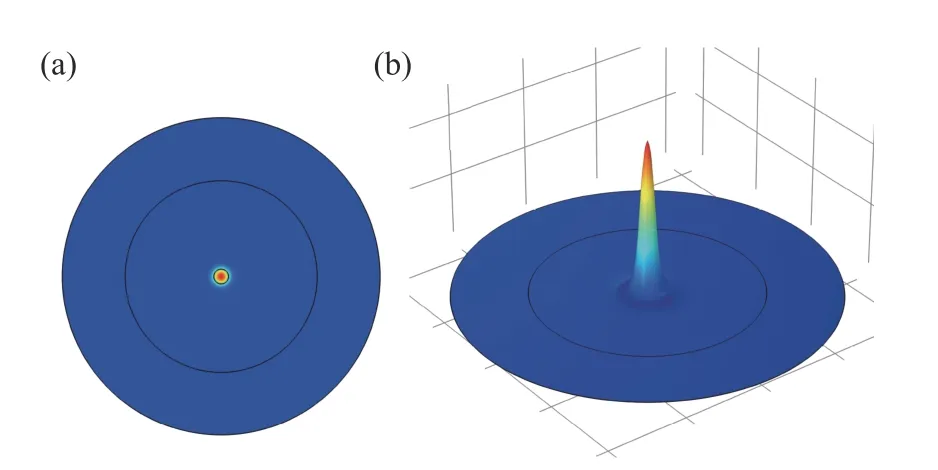
Fig.3 Schematic diagrams of the (a) two-dimensional and(b) three-dimensional optical field distributions of the LP01 mode of the DTDF-10/130 double-clad thulium-doped fiber at 2 μm wavelength,respectively
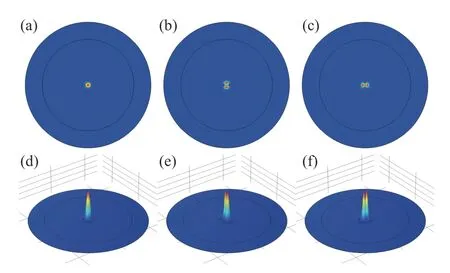
Fig.4 Optical field distribution of DTDF-25/400 doubleclad thulium-doped fiber at 2 μm wavelength.(a)-(c) Schematic diagrams of the two-dimensional optical field distributions for LP01,LP11 (o) and LP11(e);(d)-(f) schematic diagrams of three-dimensional optical field distributions for LP01,LP11 (o) and LP11 (e)
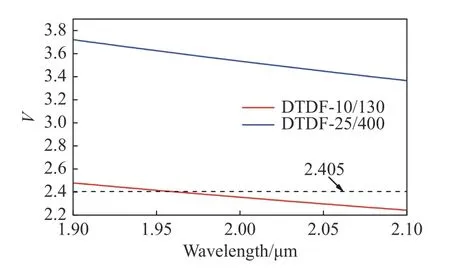
Fig.5 Schematic diagram of the normalized frequency with signal wave wavelength for DTDF-10/130 and DTDF-25/400 double-clad thulium-doped fibers
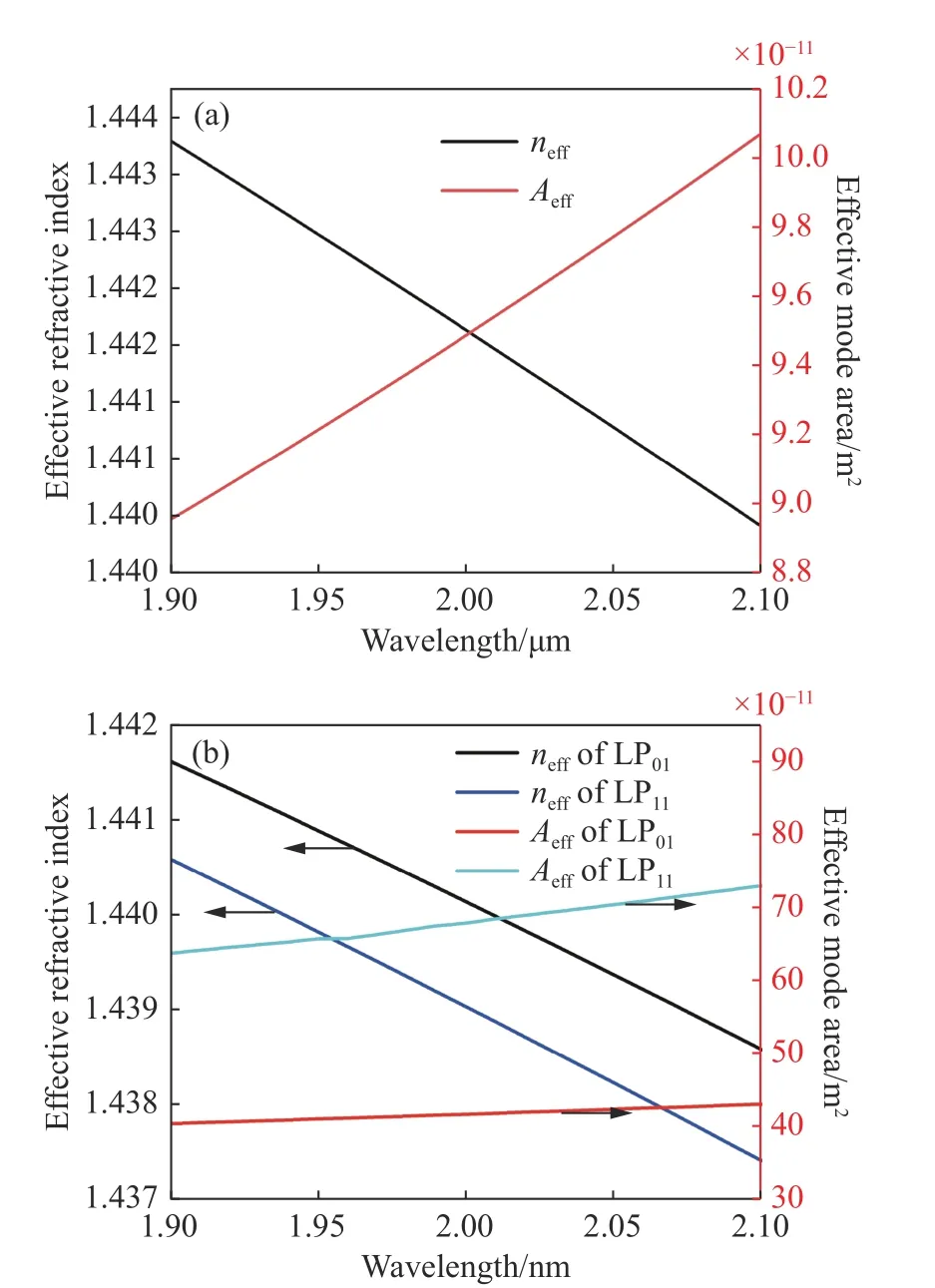
Fig.6 Effective refractive index and effective mode field area of different optical wave modes in two fibers in the 1.9~2.1 μm band.(a) LP01 mode in DTDF-10/130 double-clad thulium-doped fiber;(b) LP01 and LP11 modes in DTDF-25/400 double-clad thulium-doped fiber
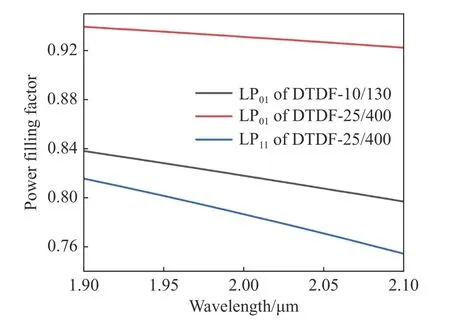
Fig.7 Variation of power filling factor with wavelength in double-clad thulium-doped fibers DTDF-10/130 and DTDF-25/400
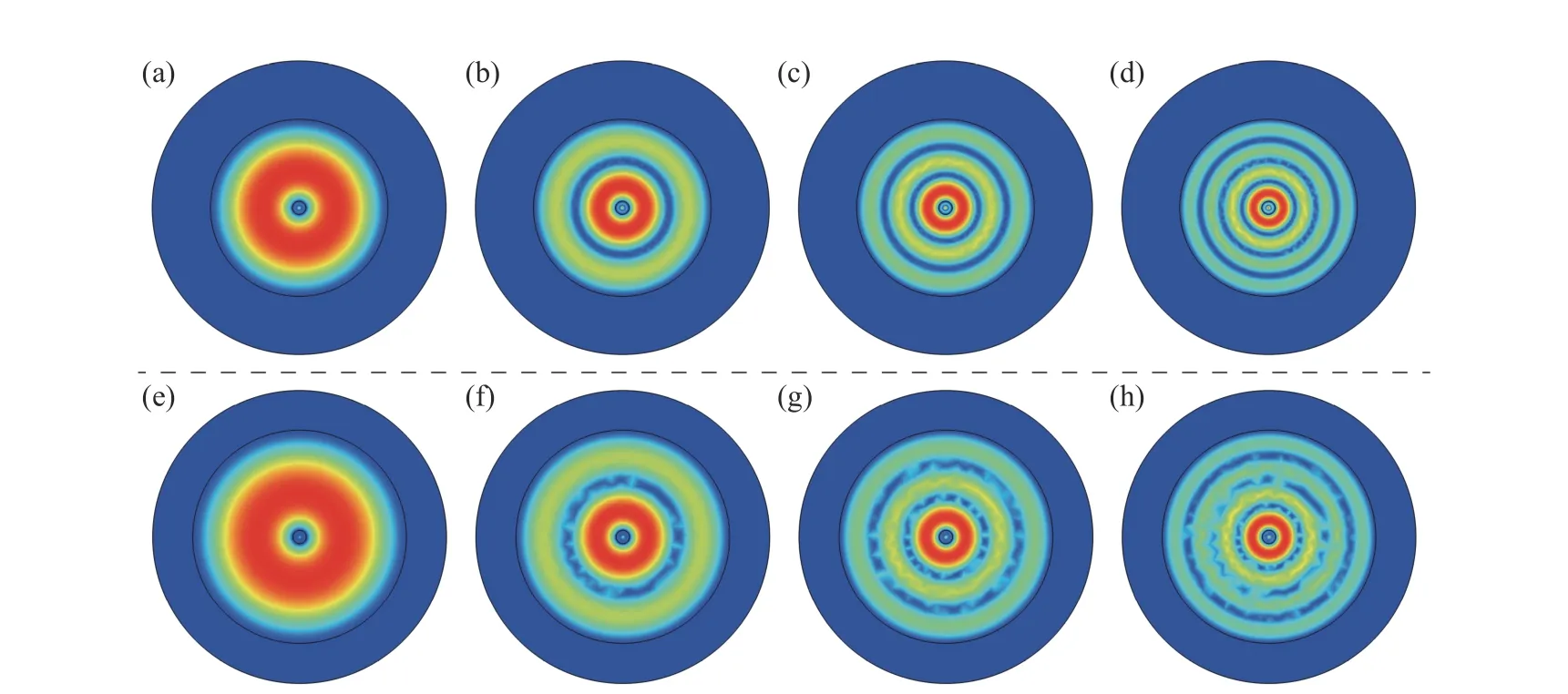
Fig.8 Optical wave modes of 793 nm pump wave in different fibers.(a)-(d) DTDF-10/130;(e)-(h) DTDF-25/400 double-clad thulium-doped fiber
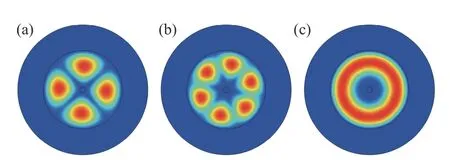
Fig.9 Optical modes corresponding to small power filling factor in the inner cladding at a wavelength of 793 nm for the pump wave
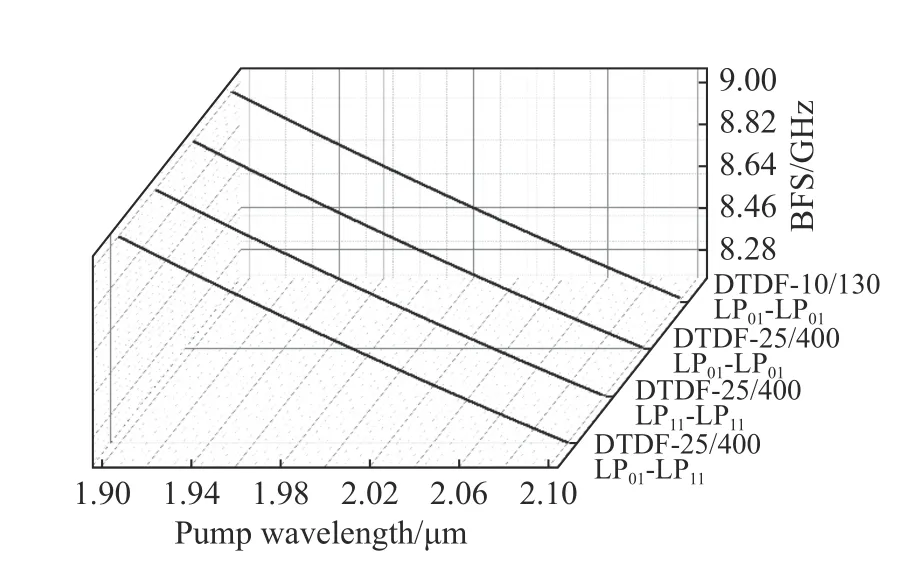
Fig.10 Schematic diagram of intra-and inter-mode Brillouin scattering of different optical wave modes in two fibers operating at 1.9~2.1 μm laser wave lengths
The Brillouin gain coefficients of LP01-LP01intra-mode Brillouin scattering in DTDF-10/130 DCTDF,LP01-LP01intra-mode,LP11-LP11intramode and LP01-LP11inter-mode Brillouin scattering in DTDF-25/400 DCTDF at 1.9~2.1 μm signal waveband are presented in Fig.11 (color online).The Brillouin gain coefficients in DTDF-10/130 DCTDF are greater than those in DTDF-25/400 DCTDF.While conducting experiments within DTDF-25/400 DCTDF,the Brillouin gain coefficient exhibited the largest value for LP01-LP01intramode Brillouin scattering,followed by LP11-LP11intra-mode Brillouin scattering,and ultimately LP01-LP11inter-mode Brillouin scattering,which is the smallest gain coefficient among the three.
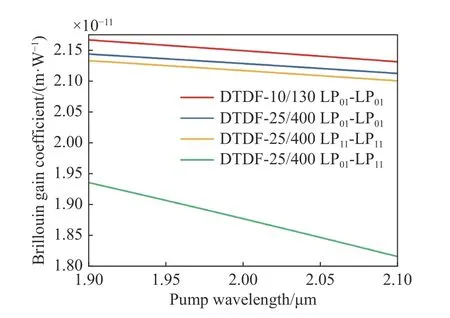
Fig.11 LP01-LP01 intra-mode Brillouin gain coefficient in DTDF-10/130 double-clad thulium-doped fiber,LP01-LP01 intra-mode,LP11-LP11 intra-mode and LP01-LP11 inter-mode Brillouin gain coefficients in DTDF-25/400 double-clad thulium-doped fiber at the 1.9~2.1 μm laser waveband
According to Fig.5,it can be observed that DTDF-10/130 DCTDF is a single-mode fiber at a laser wavelength of 2 μm,while DTDF-25/400 DCTDF is a few-mode fiber.Therefore,only intramode Brillouin scattering is present in DTDF-10/130 DCTDF and its Brillouin gain spectrum is shown in Fig.12(a).The Brillouin frequency shift is observed to be 8.595 GHz and the Brillouin gain coefficient is determined to be 2.149×10⁻¹¹m/W.In DTDF-25/400 DCTDF,both LP01and LP11modes exist,and intra-mode Brillouin scattering and intermode Brillouin scattering can exist.The Brillouin gain spectrum is shown in Fig.12(b) (color online),where the Brillouin frequency shifts and the Brillouin gain coefficients of LP01-LP01intra-mode,LP11-LP11intra-mode and LP01-LP11inter-mode Brillouin scattering are 8.583 GHz,8.577 GHz and 8.580 GHz,and 2.129×10⁻¹¹m/W,2.117×10-11m/W,and 1.8×10⁻¹¹m/W,respectively.
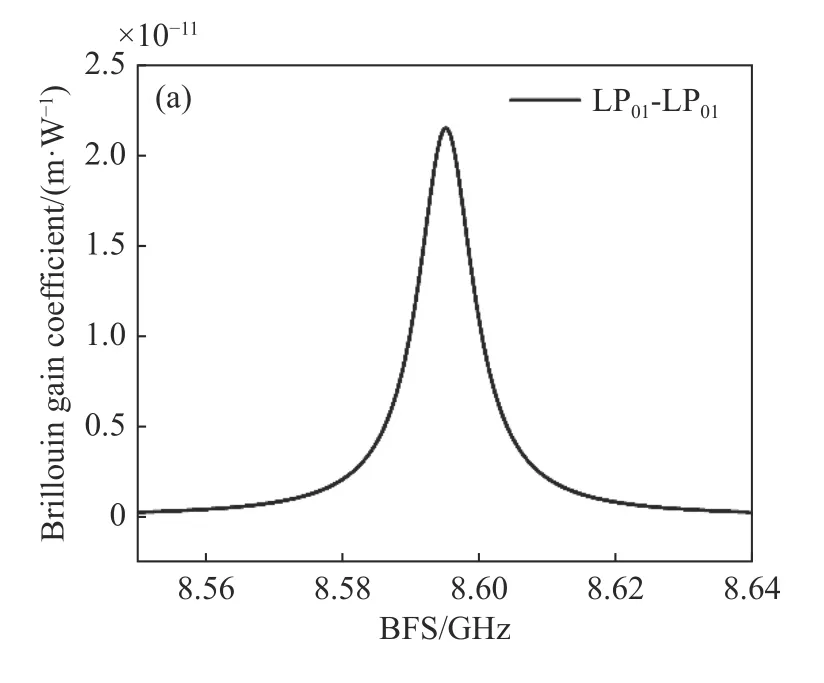
Fig.12 Brillouin gain spectra at laser wavelength of 2 μm.(a) Brillouin scattering within LP01-LP01 mode in DTDF-10/130 double-clad thulium-doped fiber;(b) Brillouin scattering within LP01-LP01 mode,LP11-LP11 mode and LP01-LP11 inter-mode in DTDF-25/400 double-clad thulium-doped fiber
3.3 Stimulated Brillouin scattering in thuliumdoped fiber amplifiers
The laser in the 2 μm band can be generated or amplified by a DCTDF,which corresponds to a thulium-doped fiber laser and an amplifier respectively.In this paper,we mainly study the SBS in DTDF-10/130 DCTDF amplifier,whose simulation parameters are shown in Table 2[33-35].
The effect of SBS on the output power of the signal wave was simulated in a DCTDF amplifier with pump wave power filling factors of 0.01,0.02 and 0.03.The seed wave was a continuous wave with a wavelength of 2 μm and a power of 0.01 W,while the pump wave was a continuous wave with a wavelength of 793 nm and a power of 100 W,respectively.
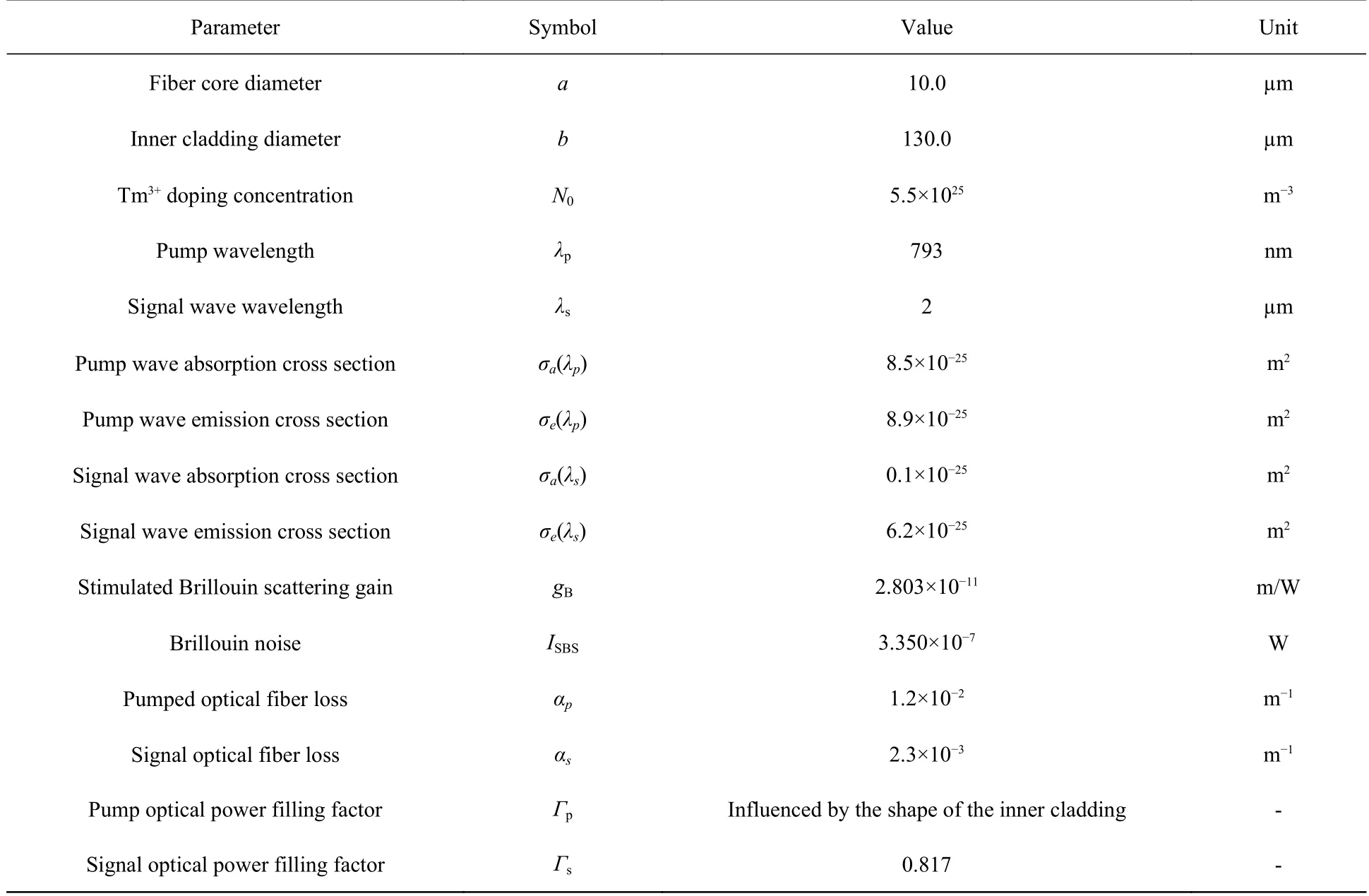
Tab.2 Simulation parameters of thulium-doped fiber amplifier
The distribution of pump wave,signal wave,and Stokes wave power along a 2.1 m DTDF-10/130 DCTDF with a pump wave power filling factor of 0.02 is shown in Fig.13 (color online).The direction of forward wave propagation is specified as the direction of increasing fiber length.The pump wave travels forward and is absorbed by the doped Tm3+in the core,resulting in a gradual decrease in intensity as fiber length increases.This process excites the Tm3+to the upper energy level of the laser.The signal wave is continuously amplified during transimission process,and when the power of signal wave reaches the SBS threshold,a portion of its energy can be converted into the backward transmitted Stokes wave by SBS.As the SBS process continues,the backward transmitted Stokes wave undergoes gradual amplification.As the transmission direction of the Stokes wave is opposite to that of the signal wave.Fig.13 illustrates a gradual decrease in the power of the former Stokes wave as the fiber length increases.To maintain optimal output power of the signal wave,suppression of SBS in thulium-doped fiber amplifiers is required.
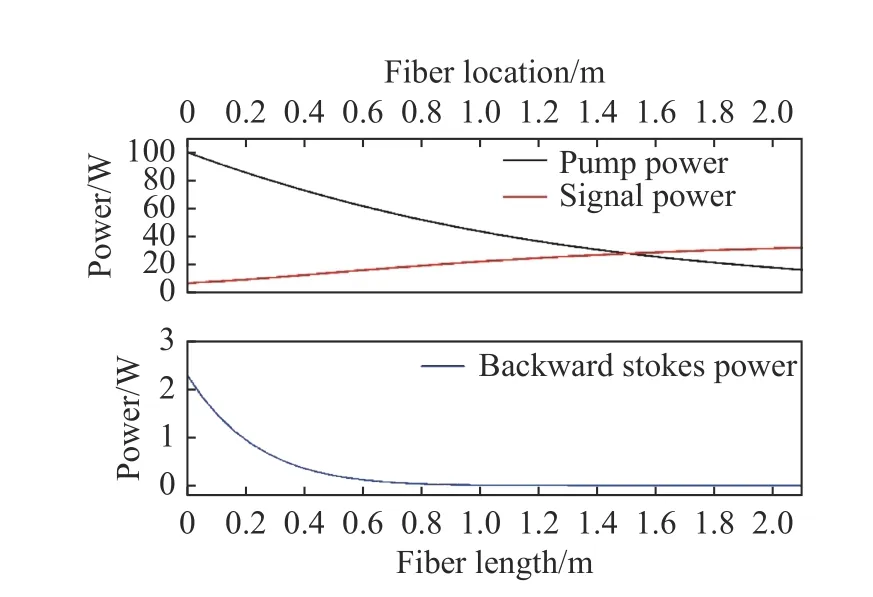
Fig.13 Distribution of pump wave power,signal wave power and Stokes wave power along the fiber
In this paper,we investigate how fiber length affects the output power of a thulium-doped fiber amplifier.First,the effect of fiber length on the pump wave absorption is studied,and the results are shown in Fig.14 (color online).It can be seen that as fiber length increases,the power of pump wave which is not absorbed by Tm3+decreases gradually.Therefore,a shorter fiber length is required to absorb the same power of pump wave for a DCTDF with a larger power filling factor.For example,when 80% of the pump wave is absorbed,the lengths of DCTDFs with pump wave power filling factors of 0.01,0.02 and 0.03 need to be approximately about 3.6 m,1.9 m and 1.3 m,respectively.
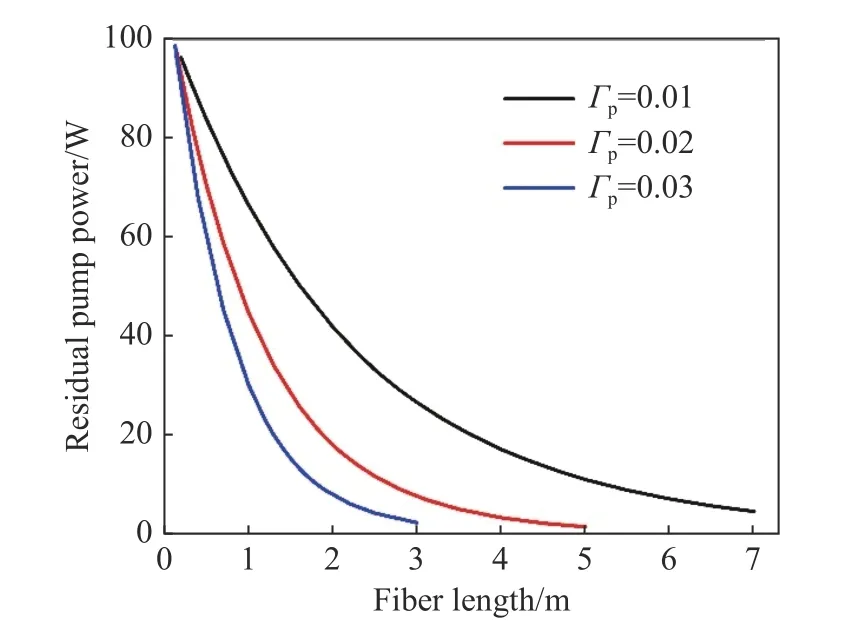
Fig.14 Residual pumping optical powers varying with fiber length at different pump optical power filling factors
As shown in Fig.15 (color online),the 2 μm laser achieves a maximum output power of 25.27 W,31.08 W and 34.06 W when the pump optical power filling factors are 0.01,0.02 and 0.03,respectively.The corresponding fiber lengths are 2.66 m,2.02 m and 1.75 m.The reverse transmitted Stokes optical power caused by SBS is 1.68 W,1.39 W and 1.14 W,respectively.The laser output power increases and then decreases as the fiber length increases,while the Stokes power for reverse transmission continues to increase,as shown in the figure 15.Therefore,effective laser amplification can be realized by selecting a shorter fiber and a DCTDF with a larger pump power filling factor as the gain medium to suppress the SBS.To this end,the pump power filling factor can be optimized by the rational design of the inner cladding structure.
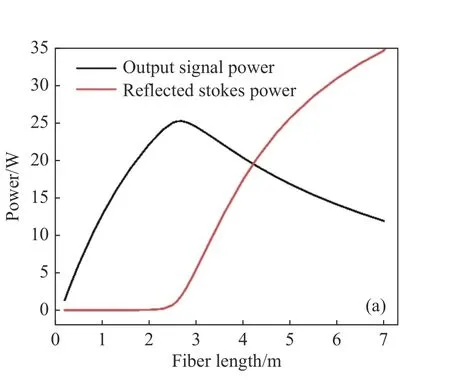
Fig.15 Variation of laser output power and Stokes optical power with fiber length when pump power filling factors are (a) 0.01,(b) 0.02,and (c) 0.03,respectively
4 Conclusion
Compared to DTDF-25/400 double-clad thulium-doped fiber,DTDF-10/130 double-clad thuliumdoped fiber can maintain single-mode transmission at 793 nm pump wavelength in the laser waveband of 1.9~2.1 μm.Only the SBS of the signal wave in the core was investigated in both fibers since the pump’s Brillouin threshold is considerably larger than that of the signal wave.The study indicates the presence of both intra-and inter-mode Brillouin scattering in DTDF-25/400 as the signal wavelength increases from 1.9 μm to 2.1 μm.On the other hand,only intra-mode Brillouin scattering is observed in DTDF-10/130.For DTDF-10/130 double-clad thuli-um-doped fiber amplifier with varying pump wavepower filling factors of 0.01,0.02 and 0.03,by us-i ng 100 W continuous wave with wavelength of 793 nm as the pump wave and 0.01 W continuous wave wavelength of 2 μm as the signal wave,the maximum output power of the signal wave is 25.27 W,31.08 W and 34.06 W,respectively.The optimal double-clad fiber lengths are 2.66 m,2.02 m and 1.75 m,respectively.The Stokes optical power generated by stimulated Brillouin scattering is 1.68 W,1.39 W and 1.14 W.The results show that using double-clad fiber with a high pump power filling factor in the thulium-doped fiber amplifier can minimize the effects of stimulated Brillouin scattering on the signal laser output power by reducing the fiber length.The numerical model presented in this paper optimizes the fiber length of the fiber amplifier.This optimization is significant in improving experimental efficiency and reducing experimental costs.

- 中國光學的其它文章
- Design of all-optical logic gate based on two-dimensional photonic crystal
- All-solid-state acousto-optic mode-locked laser operating at 660 nm
- Optical simulation design of surface mounted device beads for wide beam and high uniformity display
- 用于紫外光譜儀的探測器溫度控制系統
- TDLAS 氣體激光遙測高靈敏光電探測電路設計
- 空間目標軌道外熱流計算及輻射特性研究