人類世博物館
2024-01-27 19:40:34Cavebureau工作室菲爾艾爾斯
世界建筑 2024年1期
Cave_bureau工作室,菲爾·艾爾斯
“建筑師工作室”系列的最后一場展覽深入到地下,探訪肯尼亞廣闊的火山洞穴系統。Cave_bureau 工作室回溯了人類的起源,審視未來,同時找尋應對當今一些最緊迫挑戰的具體方案。
肯尼亞的火山洞穴承載著該國歷史和文化的獨特證據。Cave_bureau 工作室以非洲視角直面現代生活的挑戰,強調去殖民化優先于減碳,因為這些洞穴現在是地熱能的源頭,在全球綠色轉型中扮演著重要角色。
以這些洞穴為基礎,總部位于內羅畢的Cave_bureau 工作室以“人類世博物館”為題,構思了一系列裝置、影片和對景觀進行建筑干預的提案。
Cave_bureau 工作室通過對洞穴進行3D掃描,將其空間轉化為裝置和建筑。這些形成了提案的框架:以“奶牛走廊”為例,其旨在恢復馬賽人穿越內羅畢的遷徙路徑,并為洞穴周圍的野生動物和自然收集水資源。項目還探討了非洲文化博物館在 “人類世”時代可能會是什么樣子——在這個時代,人類對自然的影響已經非常明顯。
大廳中展示了一座巨大的編織雕塑,呈現了肯尼亞東部的希莫尼洞穴的全尺寸復制品。該項目與丹麥皇家建筑藝術學院建筑信息技術中心的菲爾·艾爾斯教授共同合作,將他在Kagome 編織和數字工具開發方面的研究成果應用,以實現生成復雜的幾何結構的編織圖案。□(孫斯坦 譯)
This final exhibition in the series The Architect's Studio takes a dive underground and into the extensive volcanic cave systems of Kenya.Here the design studio Cave_bureau takes a look back to the origins of humanity and examine the future,while simultaneously finding concrete solutions to some of the most pressing challenges of our time.
The volcanic caves of Kenya bear unique evidence of the country's history and heritage.From here the studio Cave_bureau confronts the challenges of modern lives from an African perspective,in which decolonisation takes precedence over decarbonisation,as the caves are now a source of geothermal energy that plays such a huge role in global green transition.
Using the caves as a basis,Nairobi-based Cave_bureau devises installations,films and proposals for architectural interventions in the landscape under the heading "The Anthropocene Museum".
Cave_bureau 3D scans the caves,before translating the shapes into installations and architecture.These form the framework for proposals: for example,"Cow Corridor",a restoration of the Masai’s migratory trails through Nairobi and a harvesting of water for wildlife and nature around the caves.All the projects also discuss what a museum of African culture might look like in the Anthropocene age -the epoch,in which the influence of humans on nature has become all too apparent.
In the Great Hall,a huge woven sculpture is presented,depicting a full-size reproduction of the Shimoni Cave in eastern Kenya.The work is a joint project with Prof.Phil Ayres from the Centre for Information Technology and Architecture (CITA) at the Royal Danish Academy -Architecture,Design,Conservation in Copenhagen,applying his research into Kagome weaving and the development of digital tools that can generate weave patterns to realise complex geometries.
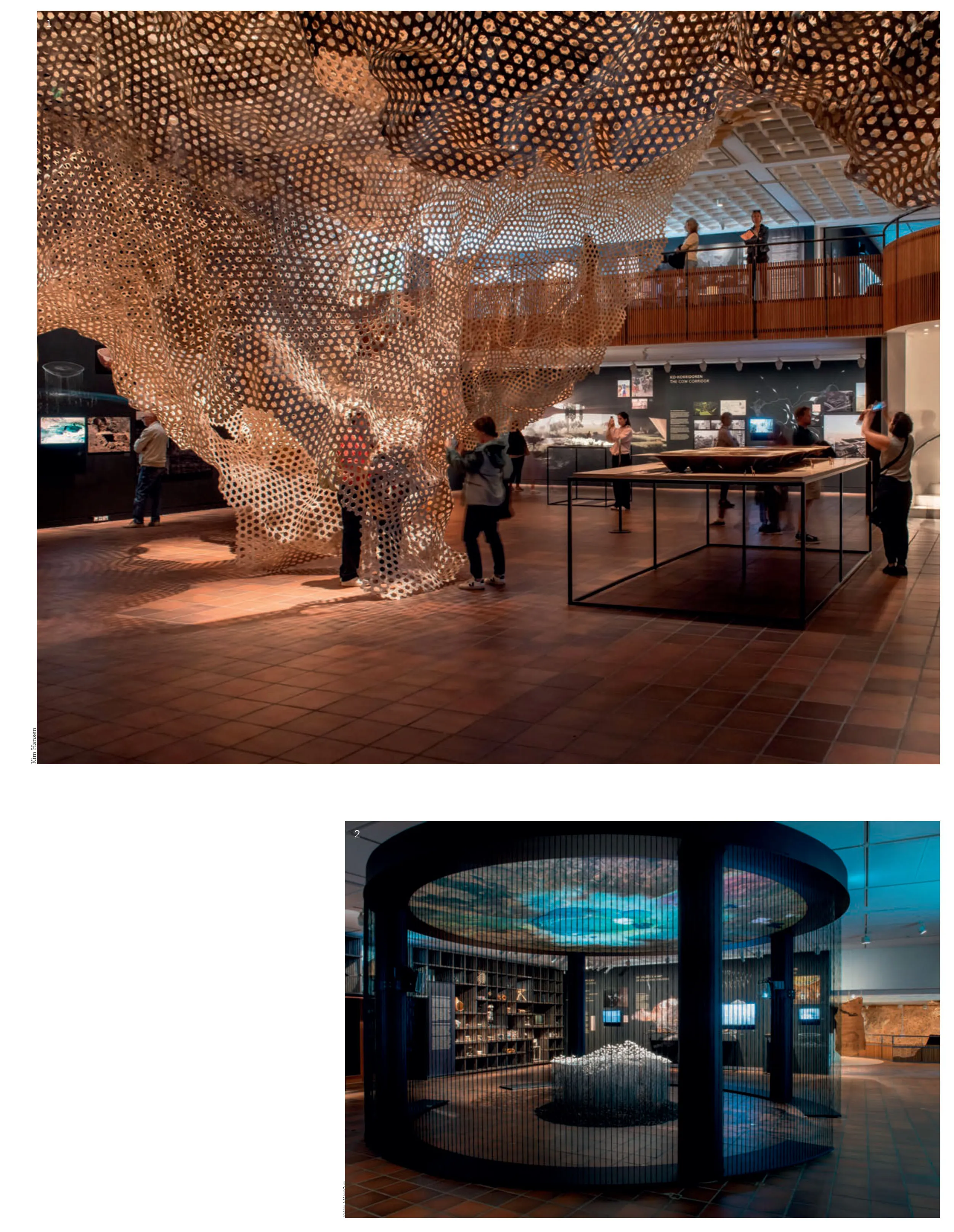
1.2 Cave_bureau和 CITA 在路易斯安那州藝術博物館舉辦的活動 Cave_bureau and CITA installment at Louisiana Art Museum
猜你喜歡
作文周刊·小學一年級版(2025年8期)2025-04-08 00:00:00
大科技·百科新說(2021年6期)2021-09-12 02:37:27
好孩子畫報(2020年5期)2020-06-27 14:08:05
小太陽畫報(2020年4期)2020-04-24 09:28:22
少兒美術(快樂歷史地理)(2019年6期)2019-10-12 08:21:30
意林·全彩Color(2019年6期)2019-07-24 08:13:50
Coco薇(2017年7期)2017-07-21 07:16:04
童話王國·原創版(2016年4期)2016-11-23 16:06:06
兒童故事畫報·智力大王(2015年11期)2016-01-27 00:55:01
奧秘(2015年2期)2015-09-10 07:22:44