英文摘要
2024-01-08 23:36:40
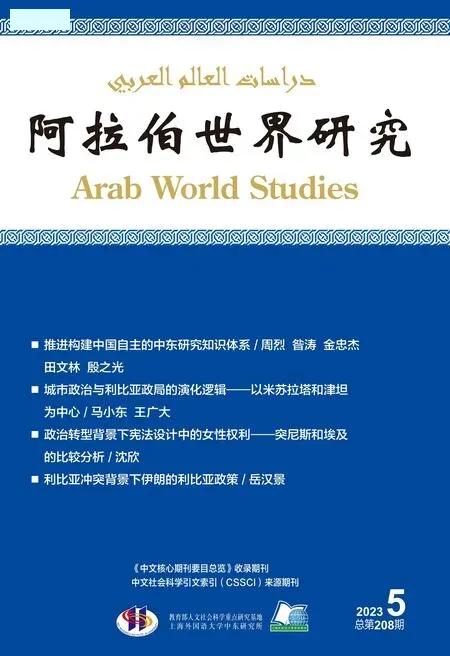
阿拉伯世界研究 2023年5期
關鍵詞:英文
3PromotingtheConstructionofChina’sIndependentKnowledgeSystemofMiddleEasternStudies
AbstractAfter President Xi Jinping made an important instruction of “building philosophy and social sciences with Chinese characteristics”, it is necessary and responsible for Chinese Middle Eastern studies scholars to pay attention to “constructing an independent discourse system of Middle Eastern Studies”. Scholars need to change the cognitive paradigm, draw inspiration from traditional culture, rely on the concept of building a Commodity with a Shared Future for Mankind, and explore routes in practice. Also, they should combine China’s contemporary economic and political practice with fine traditional Chinese culture, possessing methodological consciousness of “China as the method”. The disciplinary development of China’s Middle Eastern studies needs to combine China’s diplomacy in the new era, the strategy for invigorating China through science and education, the development of philosophy and social sciences, and the strategy for developing a quality workforce, to foster talents of Middle Eastern studies, and to contribute wisdom and strength to the major country diplomacy with Chinese characteristics and China’s cooperation with Middle Eastern countries. Facing the tasks in the new era, China urgently needs to build an independent knowledge system for country and area studies, in which it is necessary to avoid Sinocentrism while critically assimilating beneficial elements of Western research results of international and regional studies. Given this, it is meaningful only when introducing two dimensions of time and space to the political thinking of knowledge and its system. That means China’s thinking of international and regional issues is an introspection of hegemonic relations, and on this basis, theoretical and institutional thinking, around equal care, on war, peace and development.
KeyWordsCountry and Area Studies; Middle Eastern Studies; Independent Knowledge System
AuthorsZHOU Lie, Ph.D., Professor, National and Regional Research Center, Zhejiang International Studies University; Zan Tao, Ph.D., Professor, Institute for Area Studies, Peking University; JIN Zhongjie, Ph.D., Professor, School of Arabic Studies, Ningxia University; TIAN Wenlin, Ph.D., Professor, School of International Relations, Renmin University of China; YIN Zhiguang, Ph.D., Professor, School of International Relations and Public Affairs, Fudan University (in no particular order).
30UrbanPoliticsandtheEvolutionaryLogicofLibyanPoliticalDynamics:CenteredonMisrataandZintan
AbstractLibya’s central authority has declined and the country’s vertical power structure has collapsed resulting that the roles of sub-national actors have become prominent in the post-Gaddafi era. As libya is highly urbanized, compared to tribes and emerging armed groups, cities are more capable of taking over the political organization functions that embodies mainly in abstracting resources and distributing authoritative value, which traditionally undertaken by the central government. Political forces, such as Misrata and Zintan in western Libya, have had a profound impact on the political development of Libya in the post-Gaddafi era. The conceptual and organizational basis of Libyan urban politics lies in that citizens have a strong urban identity and common urban interests, and the city’s internal organizational structure is relatively clear. The power basis of urban politics lies in their unique geographical advantages and powerful armed forces, which can make them powerfully control the security order and economy within a specific “territory”. Competition and the ebb and flow of power among western cities are important factors that lead to the outbreak of the second and third civil wars in Libya, the fragmentation of state institutions. The expansion of urban power has exacerbated the fragmentation of Libyan politics and hindered the political process in the post-Gaddafi era, but at the same time, cities are also the basic elements on which national reconstruction depends on.
KeyWordsLibya; Urban Politics; Urban Identity; Misrata; Zintan
AuthorsMA Xiaodong, Ph.D. Candidate, School of International Studies, Peking University; WANG Guangda, Ph. D., Professor, Shanghai International Studies University.
48Women’sRightsintheConstitutionalDesignUndertheContextofPoliticalTransition:ComparativeAnalysisofTunisiaandEgypt
AbstractGender is a significant perspective for understanding revolutions and social movements. This paper focuses on the evident differences between Tunisia and Egypt in protecting women’s rights in the constitutional design after the Arab Spring and tries to explain from two analytical dimensions: the degree of political power compromise and the mobilization ability of women’s groups. Tunisia’s political forces reached a compromise through institutionalized party competition and a dialogue platform built by civic organizations. The constitution-making process incorporated the ideology and interests of various factions, and women’s groups conducted extensive and in-depth political mobilization. As a result, significant advances in women’s rights have been made in constitutional arrangements. However, Egypt’s religious and secular forces have more intense confrontations, and unilateral instrumental constitution-making has been implemented simultaneously as regime change. It is also difficult for women’s groups to exert positive influence due to the constraints of the opportunity structure. Therefore, the women’s rights clauses in the constitutional design are less stable and thorough. Exploring this issue is significant regarding experience accumulation and theoretical production for clarifying the complex relationship between gender, political transition, and institutional arrangements.
KeyWordsTunisia; Egypt; Social Movement; Political Transition; Constitutional Design; Women’s Rights
AuthorSHEN Xin, Ph.D. Candidate, Institute of Area Studies, Peking University.
72AnAnalysisofAlgeria’sWesternSaharaPolicyfromthePerspectiveoftheThird-PartyIntervention
AbstractWestern Sahara issue is a protracted and unresolved problem in Africa. The third-party Intervention has been a constant presence throughout the issue and is an integral part of understanding the intractability and complexity of this conflict. The existing theories still difficult to fully explain the phenomenon that third-party Intervention behaviors are often questioned. Taking Algeria’s volitional behavior in the western Sahara issue as an example and the mutual construction of behavior existence and behavior environment as a breakthrough, this paper expounds the generative mechanism of controversial intervention in global conflict affairs, so that a “Motivation-Action-Performance” evaluation model is initially formed. This not only has positive practical significance for in-depth understanding of the unresolved status quo of the Western Sahara issue and innovate conflict resolution, but also provides theoretical explanations and observation Windows for how to better promote conflict management and conflict resolution in global conflict affairs, as well as has positive enlightenment on how to more constructively participate in global security and peaceful development affairs.
KeyWordsAlgeria; Western Sahara; Global Conflict; Third-Party Intervention
AuthorLU Qiuyi, Ph.D., Assistant Researcher, Institute of African Studies, Zhejiang Normal University.
93Iran’sLibyanPolicyintheContextoftheLibyanConflict
AbstractUnder the influence of the sudden turbulence of political situation in Tunisia, civil strife occurred in Libya in early 2011, and NATO took the opportunity to carry out military intervention to support the rebel forces to overthrow the Gadhafi regime. Subsequently, the civil strife in Libya continued in a new situation, which has not yet ended. In the early days of the civil unrest in Libya, Iran’s policy towards Libya was to support anti-government protests and oppose Gaddafi’s crackdown, but also opposed NATO military intervention. The reasons include that Iran characterized the Libyan anti-government protests as an “Islamic awakening”, and there had been some new contradictions between Iran and the Gaddafi regime since the beginning of the 21st century; Iran considers NATO military intervention illegal and has consistently opposed any US intervention in the Middle East. After the fall of the Gadhafi regime, Iran adopted a policy of non-intervention in Libya. After the formation of opposing authorities in eastern and western Libya, Iran adopted a policy of overall neutrality but slightly biased towards western forces in Libya. The reason why Iran adopts the policy of non-intervention and relative neutrality is that after the fall of Gaddafii, Libya’s political development did not follow the direction expected by Iran and that Libya is not the key country of Iran’s diplomacy and that the external support of the east-west opposing forces in Libya is evenly matched and has a complex relationship with Iran.
KeyWordsLibyan Crisis; Iranian Diplomacy; Iran’s Libyan Policy
AuthorYUE Hanjing, Ph.D., Professor, School of Government Management, Shanghai University of Political Science and Law.
113TheEvolutionandProspectoftheRelationsBetweenIranandAfghanTaliban
AbstractIn the context of complex political, religious, cultural and security interests, the evolution of the relationship between Iran and the Taliban in Afghanistan has roughly gone through three stages: The first stage was the period of full-scale confrontation (1996-2001), when Iran refused to recognize the Taliban regime in Afghanistan for ideological and national interest reasons, provided military support to its rival, the Northern Alliance, and played a key role in the U.S operation to overthrow the Taliban regime in 2001; The second stage was from “covert contact” to “measured support” (2002-2020), when Iran provided limited support to the Afghan Taliban in response to the military presence of the US and its allies in Afghanistan and to curb their influence; The third stage is the period of practical cooperation (since the establishment of the new Taliban regime in 2021). Though Iran did not formally recognize the Taliban regime, both sides have been engaged in practical cooperation in various fields and bilateral relations showed good momentum. However, due to ideological and political differences, the relation between Iran and the Taliban in Afghanistan is subject to multiple uncertainties and will face a series of challenges in future development.
KeyWordsIran; Afghan Taliban; Afghanistan
AuthorsWANG Xueyu, Ph. D. Candidate, Institute of Middle Eastern Studies, Northwest University; LI Fuquan, Ph. D., Professor, Institute of Middle Eastern Studies, Northwest University.
137From“ZeroProblem”toSecuritization:TheTurkey’sForeignPolicyTowardSyriasincethe21stCentury
AbstractSince 2002, the Turkish government has formulated a new foreign strategy based on changes in domestic and foreign situations, formed a new diplomatic thinking of strategic depth doctrine, and launched a “zero problem” good-neighborly foreign policy with economic cooperation as the main axis, which temporarily resolved the Turkish cold and peaceful relations between Syria. After 2011, in order to strengthen Turkey’s influence in the Middle East, the Erdogan government chose a highly risky “regime change” policy towards Syria, which turned Turkey-Syria relations into a state of full hostility. The double deterioration of the security environment. Under such circumstances, after 2016, Turkey’s policy toward Syria was adjusted to a “securitization” agenda, returning to the traditional diplomatic strategy of safeguarding national security interests, but the security benefits did not meet reasonable expectations, and its military intervention policy in Syria fell into a dilemma. In general, Turkey’s aggressive diplomacy has brought its regional influence to a new height through multiple diplomatic tools such as military interventionism, pan-Islamism, and cultural soft power, but it has also caused a heavy social and economic burden. Relations have become tense. Under the new situation of the current wave of reconciliation in the Middle East, Turkey is pursuing détente diplomacy and implementing a “re-engagement” policy towards Syria. Calling for the normalization of relations between Turkey and Syria has become a new voice in Turkey’s domestic politics.
KeyWordsTurkey; Syria; Securitization; Foreign Policy
AuthorYANG Yulong, Ph.D., Special Associate Researcher, Institute of Studies on the Mediterranean Rim, Zhejiang International Studies University.
猜你喜歡
國際展望(2017年2期)2017-03-21 18:34:18
鄱陽湖學刊(2016年6期)2017-01-16 13:05:41
中國遠程教育(2016年6期)2016-12-07 10:07:02
財經(2016年19期)2016-08-11 08:17:03
中國遠程教育(2016年5期)2016-06-29 10:13:42
中國遠程教育(2016年2期)2016-03-21 10:31:21
中國遠程教育(2016年1期)2016-02-26 10:37:15
國際展望(2015年5期)2015-09-15 05:41:45
國際展望(2015年4期)2015-07-13 05:30:56
能源(2014年9期)2014-09-15 13:18:12