A journey through the famous Shandong county that no one seems to visit
2024-01-01 00:00:00SamDavies
漢語世界(The World of Chinese) 2024年2期


“宇宙中心”曹縣探訪實錄
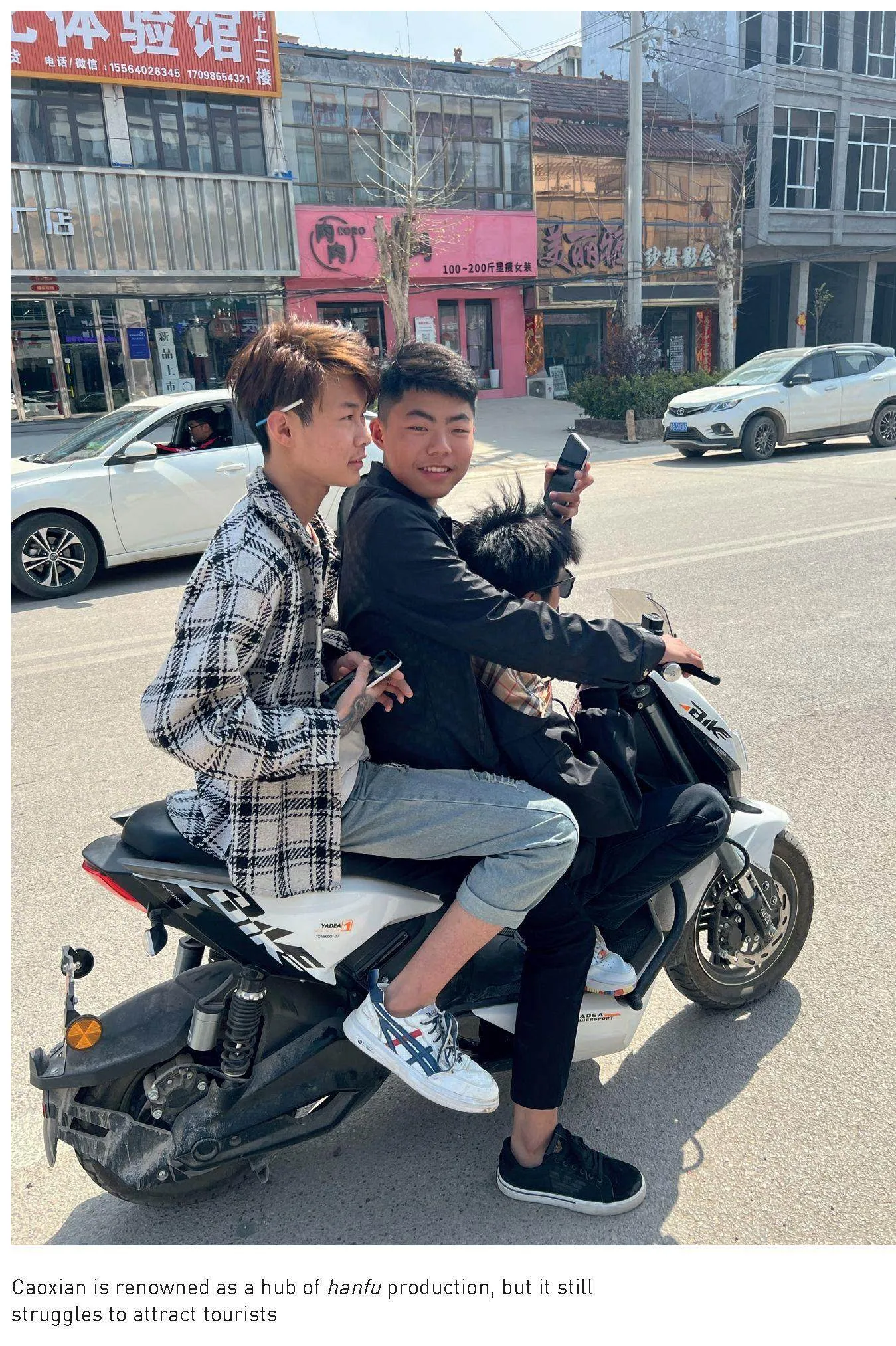
Caoxian was never meant to be famous. I realized this within hours of wandering its dusty roads, which were dotted with the shells of unfinished apartment blocks and the occasional groups of elderly locals chatting in thick accents.
In 2021, a local vlogger put the county on the map. “Shandong, Heze, Caoxian. Niubi liuliuliu. Wo de baobei,” the rotund Dashuo intoned on Douyin (China’s version of TikTok), using internet slang to express Caoxian’s awesomeness.
His love for his nowhere hometown, which sits under Heze city in the southwest of Shandong province, touched netizens’ hearts. A thousand memes bloomed. Within a few days, Douyin videos referencing Caoxian racked up 770 million views. One meme showed the whole planet revolving around the county, mimicking Beijing’s ring roads. You could be in Caoxian’s first ring or its 17th, but you were definitely in its orbit. Then it went a step further, with Caoxian labeled “Yuzhou de zhongxin (宇宙的中心)”—the center of the universe.
Naively, I had taken Caoxian’s viral fame for new-found popularity, akin to how, in 2023, Zibo, also in Shandong, transformed from an obscure city into China’s barbecue capital, attracting millions of visitors. But this April, as I stepped off the train at Caoxian during the Qingming Festival holiday, I realized I was perhaps the only tourist in town.
Center of nowhere
“This is a flourishing, livable, business-friendly city,” a deep voice narrates over a slick eight-minute introduction video on the Caoxian local government’s website. Oversaturated footage of factories and green parks follows. The narrator boasts that Caoxian is China’s largest asparagus producer and the birthplace of the Shang dynasty (1600 – 1046 BCE). But when I ask the hotel receptionist for sightseeing recommendations, she draws a blank. “Well, there’s Yinzuo Mall, and the street market,” she eventually manages.
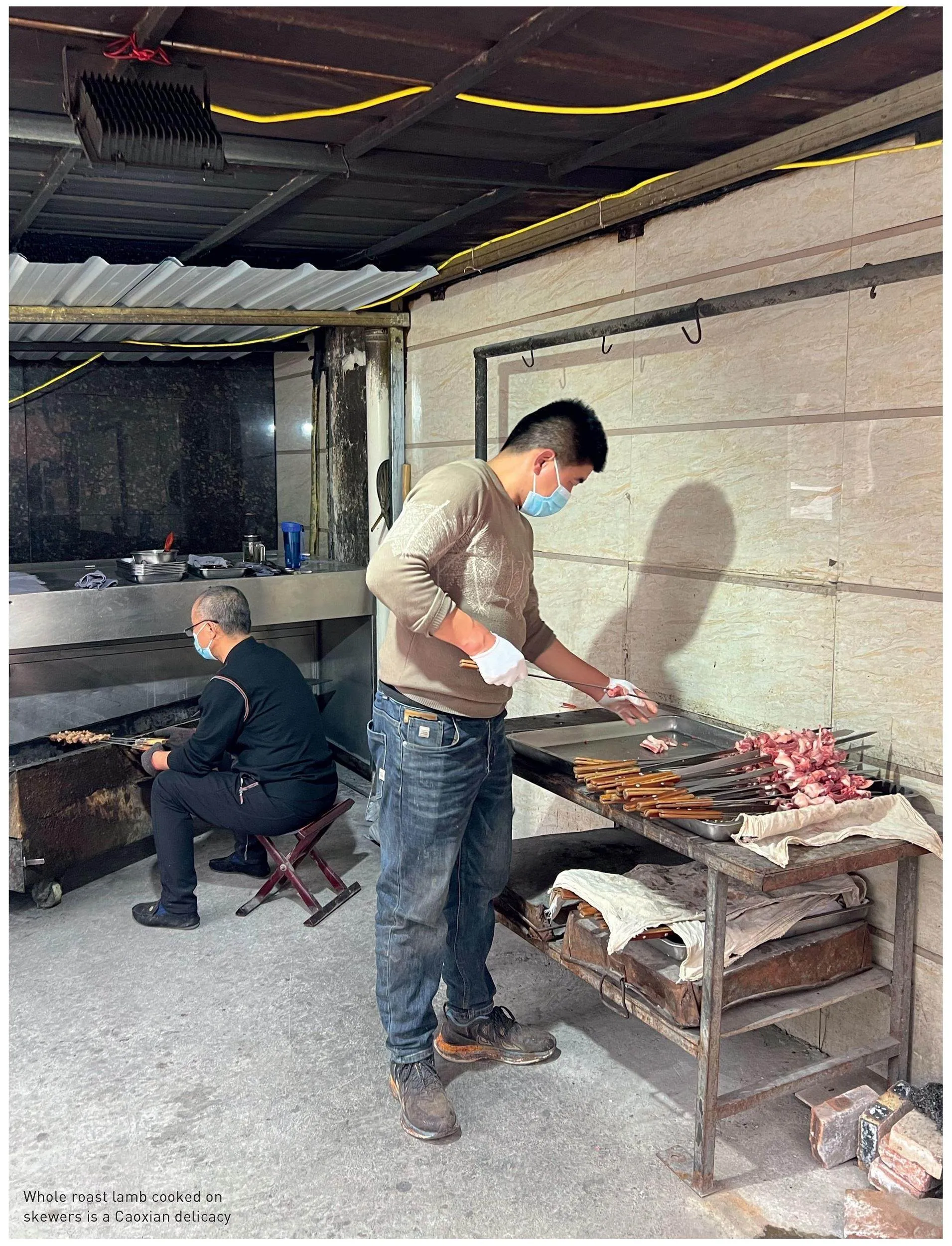
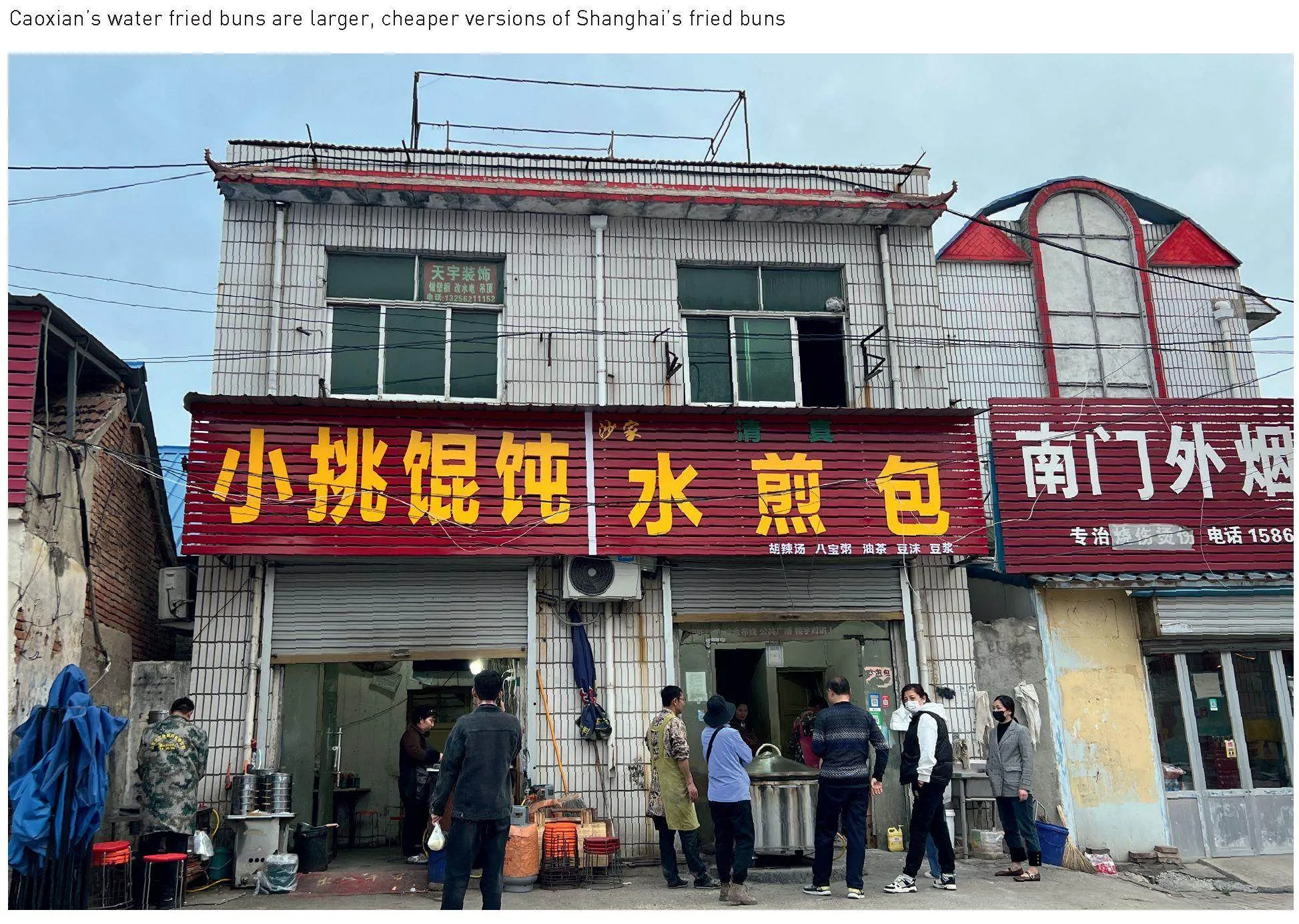
Caoxian is one of China’s most populous counties, but its 1.7 million people are spread over a large area encompassing over 20 smaller towns or townships. The old downtown area is compact, so I decide to walk there from my hotel, stopping for the local specialties small fish soup and water fried buns along the way. The soup’s unappealing gray color belies its satisfying salty flavor with tofu, seaweed, and dried fish. The hearty buns, stuffed with either pork or chives and egg, are reassuringly unrefined.
Yinzuo Mall is fronted not by historic landmarks, but by a menagerie of small-town China’s favorite budget stores: milk tea chain Mixue Bingcheng, burger joint Tastien, and coffee brand Cotti. Inside, the mall is filled with clothing brands like “Gulci” and “Lorem Ipsum” on sale for preposterously low prices: polo shirts originally 468 yuan, now 29.
I follow a wide road flanked by dozens of new apartment blocks. Some bear signs of occupancy, while cranes surround others. As I observe the construction, a middle-aged woman rides up to me on an electric scooter. “Are you viewing apartments?” she says. “Come take a look.”
Curious, I follow the agent to her company’s showroom. “Many people living in the surrounding villages and towns want to live here. The jobs and schools are better,” she says. Despite her confidence, many of the apartments seem unoccupied.
A fresh-faced realtor greets me inside the lavish showroom. He says that the apartments sell for around 4,000 yuan per square meter, down from 6,000 yuan a few months ago. That’s around one-tenth of a second-hand apartment in Beijing. If I rent out my purchase, the salesman says, I can expect 10,000 yuan. “A month?” I ask. “A year,” he says. “They’re selling quick!” There are a handful of other clients in the showroom. I tell him I’ll think about it.
I recall one of the most popular Caoxian memes: “I’d rather have a bed in Caoxian than an apartment in Beijing.” The joke seems even more farcical now that I know that I could have a 100-square-meter apartment here for the price of a shed in the capital.
Hidden heritage
I wonder about the sustainability of Caoxian’s real estate as I meander back toward the old town. I reach South Lake, a murky pool surrounded by groups of elderly men playing mahjong at wooden tables. The clack of the tiles mixes with excited screams from children on a bounce house shaped like warped versions of Ultraman and Pikachu, and punctuates music from nearby bumper car halls.
Fairground games stretch beyond the lake, flanked by bubble tea shops and food stalls. Wrinkled fortune tellers beckon at passersby. I come to a square overlooked by a monochrome building with red characters on its roof: Caoxian Theater.
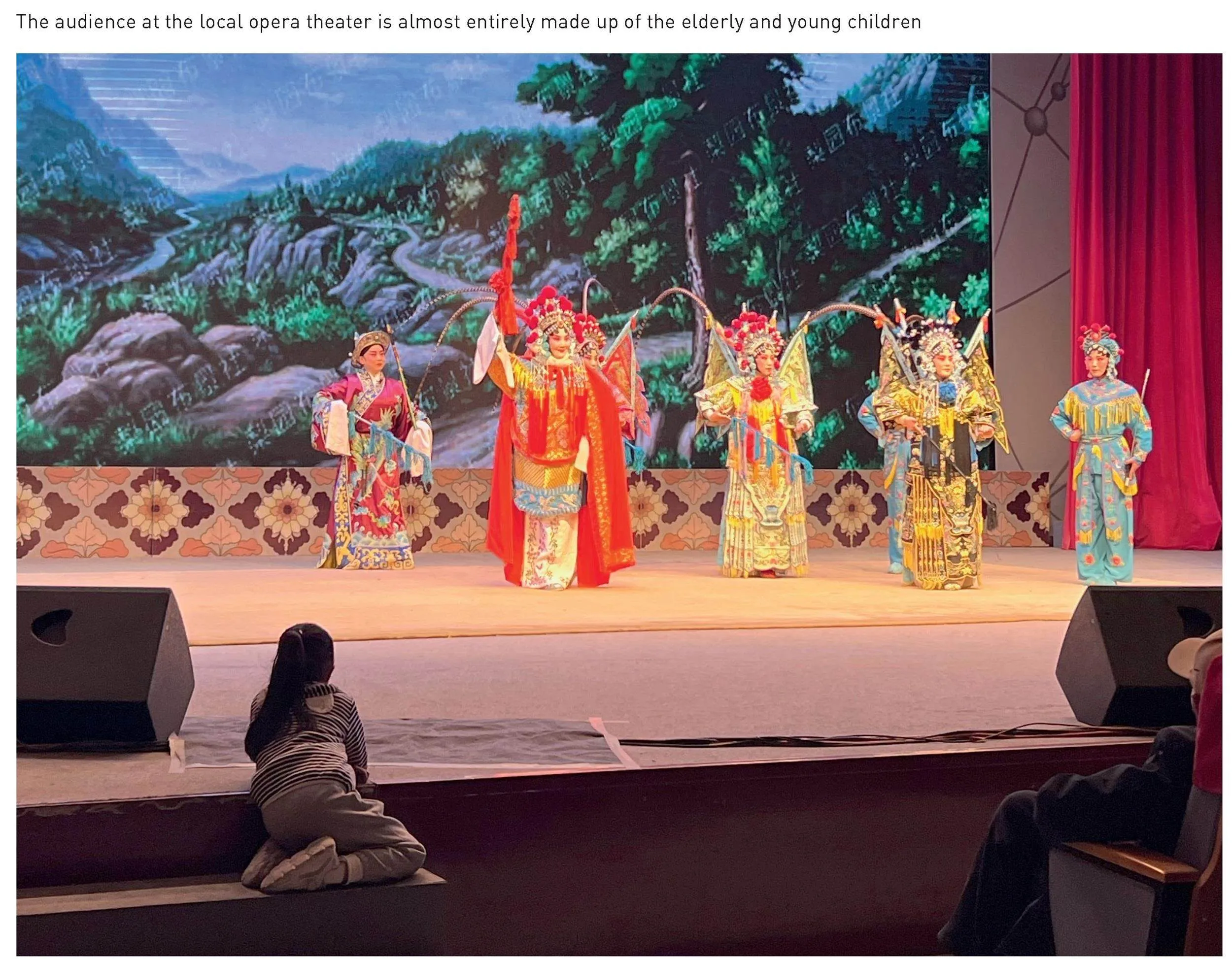
Real estate is not the only cheap product in Caoxian. The theater offers subsidized 1-yuan tickets for opera performances every Friday and Saturday evening—an effort to preserve cultural heritage. I shuffle inside with dozens of elderly locals. Cymbals clang, drums beat, and traditional erhu lilt to the actors’ rhythms. The audience applauds whenever the female lead sings a particularly long note.
After the nearly three-hour performance, I meet orchestra member and semi-retired lawyer Zhu Shilun. “Playing erhu is just a hobby, I do it for fun,” the 76-year-old says. He tells me the local government funds the troupe, with the best performers paid around 5,000 yuan per month. “The [1-yuan] tickets could hardly sustain them.”
He explains that today’s performance was a local adaptation of a Henan opera (or 豫劇). Caoxian borders Henan province, and their cultures intertwine. Even their dialects are similar. Zhu expounds further on Caoxian’s history. “This was one of the birthplaces of Chinese civilization,” he says. The county lies in the Yellow River basin, a fertile area where people settled thousands of years ago. The Cao State, a vassal of the Zhou dynasty (1046 – 256 BCE), also covered areas close to Caoxian.
Today, little hints at this illustrious history. “The tombs of Tang of Shang and Yi Yin (伊尹) are here,” Zhu says, referring to the founder of the Shang dynasty and his prime minister. “It should be better recognized…But Caoxian is poor, the government has no money to develop these places.” Most of Shandong’s wealth is concentrated in coastal regions hundreds of kilometers from Caoxian.
The Shang founder’s true burial spot is contested, and Caoxian has lost out. The local government in Bozhou, Anhui province, built a scenic park to mark their claimed site. But in Caoxian, only a small shrine marks the king’s tomb, which Zhu claims was built by local villagers. There is a remote temple for Yi Yin, but when I search for it on the popular review app Dianping, I find just one review. Three stars out of five.
Though Caoxian’s history remains underappreciated, it has at least one renowned cultural product. I seek it out the next morning.
Hanfu hotspot
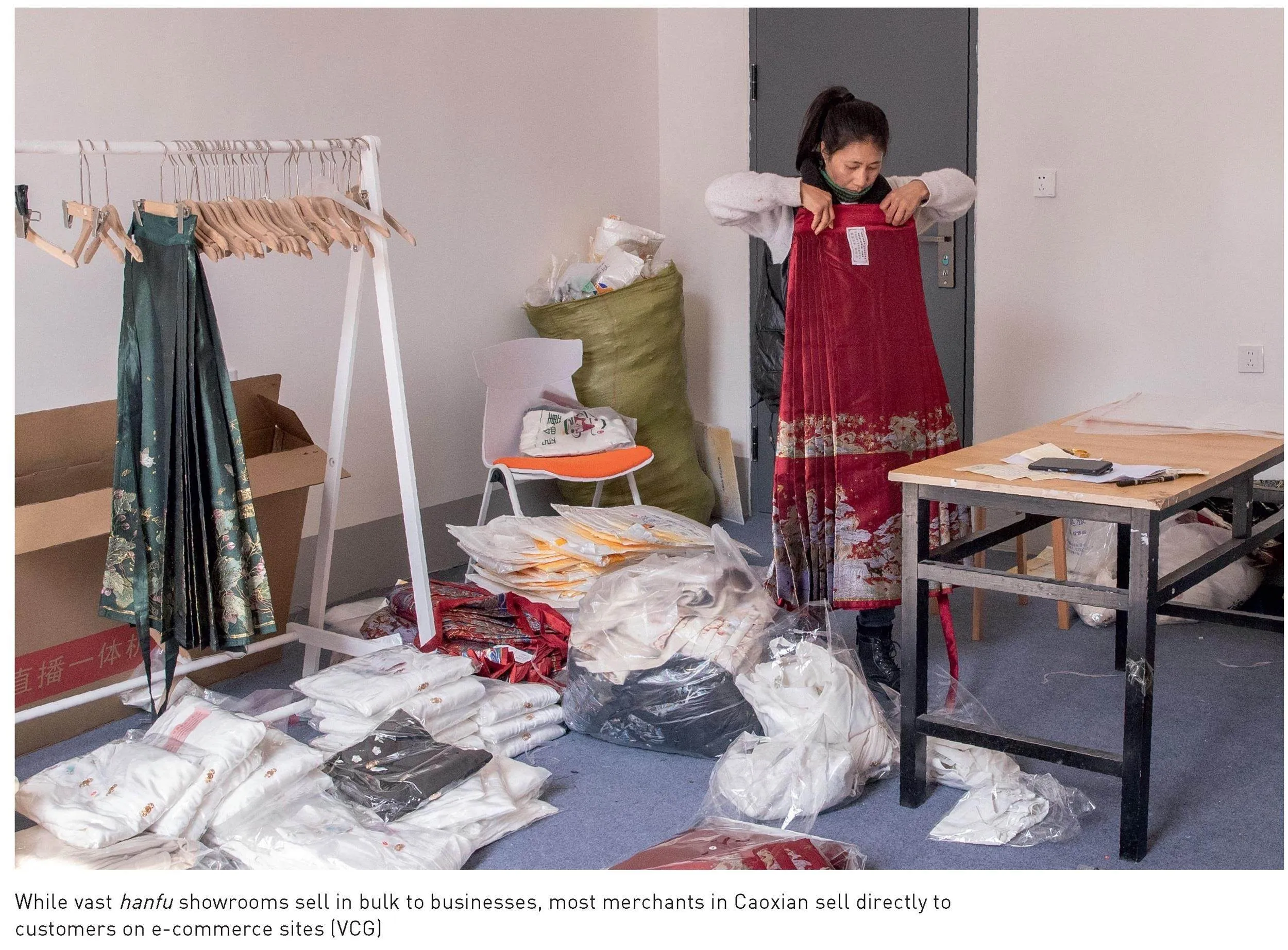
Caoxian’s viral fame brought attention to its trendiest industry: hanfu. This traditional clothing of the Han ethnic group, worn during imperial times, has become fashionable in recent years. According to official reports, Caoxian has over 2,000 hanfu-related businesses, accounting for one-third of China’s online hanfu sales.
However, Mr. Zhao, my taxi driver, plays down hanfu’s impact as he takes me to Ancailou, a township 30 kilometers from Caoxian’s center that calls itself “China’s Number One Ecommerce Hanfu Town.” “There’s no industry here. Hanfu isn’t a real industry…It’s famous, that’s all,” he says, explaining why the average disposable income in Caoxian was just over 2,000 yuan per month in 2022 (around two-thirds the Shandong average) despite its hanfu heft. The county was among China’s poorest before the rise of e-commerce. “[Caoxian is] not like where you live in Beijing. Here we have low salaries,” he adds, as we pass fields of spring onions. Zhao is an elementary school teacher and drives on his days off to make extra cash.
He’s familiar with Caoxian’s online fame but shakes his head when I ask why the virality hasn’t attracted tourists. “It was good publicity, the local government liked it. Everyone knows Caoxian [since the virality]. But there’s no tourism industry here,” he says. He claims the local government funneled money into Baliwan, a wetland park on Caoxian’s outskirts, but with little return. “There’s nothing to see there or anywhere else in Caoxian.”
Zhao drops me off at a dusty crossroads that forms Ancailou’s center. An archway overhead reads, “Hanfu Production Base.” The midday sun beats down as trikes and pickup trucks trundle by. I had expected stalls selling hanfu to a sea of tourists livestreaming their adventures in the colorful land of ancient Chinese costumes, but I quickly realized that Ancailou is a hub for producers who ship their hanfu elsewhere.
The town hosts the entire hanfu supply chain. Fabric stores sell cloth, workshops cut it, factories stitch pieces together, and vendors sell the finished products. Wholesalers run bright showrooms with neat rows of mannequins, but when I peer into a workshop, I see middle-aged workers crammed next to a noisy fabric-cutting machine. Three women sit on the floor separating colors, trimming loose threads, and bundling up finished sections.
Around a dozen hanfu shops line the street. The larger showrooms feature styles spanning almost all of imperial China, from the Qin dynasty to the Qing, most priced at around 100 yuan.
At one vast showroom, I meet Wang Lu, a young entrepreneur who spent much of last year traveling around Europe before returning to help run his family’s business. “Dusty roads with small workshops and not much going on. It feels like a village here…I bet this wasn’t exactly what you expected,” he says, when I explain I had heard that Caoxian was China’s hanfu capital.
Previously, Ancailou sold costumes for theater and screen productions. People switched to hanfu around a decade ago as the trend took off. Business is good, Wang says. His family’s firm wholesales to companies in tourist hotspots that need hundreds of outfits to rent out to photo-hungry visitors. “But the Chinese market is becoming saturated, and I’m sure there’s a market for hanfu abroad,” he says, explaining how he has tried selling internationally to customers on Instagram.
A few meters on, I enter a smaller shop in the front room of a family home. There is only one rack of hanfu besides mountains of packaged stock. The owners’ children play between the makeshift showroom and the street outside. White packages lie by the door, ready to ship to buyers on the e-commerce platform Pinduoduo. Hanfu is the backbone of Ancailou’s economy, but not all of the town’s residents benefit equally.
Central to someone
It’s the penultimate day of the holiday, and the bus from Ancailou to central Caoxian is packed with students heading to school dormitories and workers returning from relatives’ homes. We rattle along the potholed road, arriving at the town’s bus station, where motorbike taxis wait to take passengers on their final stretch.
I head back to the theater, where tonight’s performance is Shandong bangzi, an opera variety popular in southwest Shandong. This tale is a comedy where the brother of a woman betrothed to a loathsome aristocrat impersonates his sister at the wedding so she can run away. The cross-dressing brother and slapstick servants have the audience in stitches, though most of the jokes go over my head.
The next day, I again meet Zhu, the erhu player, for food. He describes how he spent 18 years in the army as a young man, traveling across the country. However, he never considered leaving Caoxian permanently: “It’s my home,” he says. “My parents were here.” Zhu shows off photos of his family home in Caoxian’s countryside. Some years ago, he added a garden and pavilion and erected a stone tablet with inscriptions from a grateful client. He had a basement built to work in the cool during summer. Zhu’s children and grandchildren also remain in Caoxian. He’s proud of his hometown.
The next morning, as I head to the train station, I look out at the dusty landscape along the edge of downtown, with towering new real estate on one side and flat farmland stretching to the horizon on the other. Despite its virality, Caoxian may never become a popular travel destination. But to Zhu at least, it really is the center of the universe.