濱海地下水含水層中微塑料運移機制及環境效應研究綜述
2023-08-24 08:19:42鄒寅俏陳廣泉于洪軍王延誠趙文卿
海洋科學 2023年6期
鄒寅俏, 陳廣泉, 于洪軍, 宋 凡, 王延誠, 趙文卿
濱海地下水含水層中微塑料運移機制及環境效應研究綜述
鄒寅俏1, 2, 陳廣泉1, 2, 于洪軍1, 2, 宋 凡3, 王延誠1, 2, 趙文卿1, 2
(1. 自然資源部 第一海洋研究所 自然資源部海岸帶科學與綜合管理重點實驗室, 山東 青島 266061; 2. 青島海洋科學與技術試點國家實驗室 海洋地質過程與環境功能實驗室, 山東 青島 266237; 3. 水利部信息中心(水利部水文水資源監測預報中心), 北京 100053)
微塑料是現代化社會經濟活動的產物, 于近海岸富集會導致海水、地下水與近岸土壤環境的污染。微塑料具有多樣化的物理化學性質, 運移機制復雜。伴隨人類活動加劇與水動力條件變化, 微塑料在濱海地區廣泛遷移并形成差異分布。微塑料能夠釋放自身有毒物質、吸附重金屬離子與有機污染物、使海岸帶區域水環境污染加劇、嚴重危害濱海地區動植物的生長發育, 威脅人類健康及濱海生態安全。因此, 探究微塑料在濱海地下水含水層中的轉運機制, 對于分析其對生態環境的潛在危害、采取有效手段應對微塑料污染具有重要意義。
濱海地下水含水層; 微塑料; 運移機制; 環境效應
微塑料是直徑小于5 mm的塑料顆粒[1], 具有尺寸小、比表面積大等物理化學性質, 能夠通過生物攝食、吸附、絡合等方式對生態環境產生嚴重威脅。2015年, 微塑料問題被列為環境與生態科學領域亟待研究的第二大科學問題[2]。在聯合國環境大會的號召之下, 中國積極致力于海洋微塑料的研究和治理。迄今, 已有30多個科研機構開展了海洋微塑料研究, 20多個國家級微塑料項目得到了國家經費支持[3]。研究區域涉及河口、海灘、海岸帶、近海、深海、極地等區域, 微塑料的研究內容涉及微塑料的理化性質[4]、分布富集[5]、遷移特征[6]、食物鏈累積[7]、分析方法學[8]、生態毒理學[9]、污染治理[10]等方面。截止到2022年7月13日, 基于Web of Science數據庫,以“microplastic”為關鍵詞搜索到的相關文獻有7 979篇, 以“marine microplastic”為關鍵詞搜索到的相關文獻有3 991篇, 并呈現出逐年遞增的趨勢, 間接表明微塑料污染所囊括的問題亟待解決。為應對微塑料污染, 2019年, 中華人民共和國國家發展和改革委員會出臺政策, 禁止在個人護理用品中添加并銷售微塑料顆粒的產品[11]。
海岸帶是海陸交互的重要區域, 在天然水利梯度下, 海底地下水排泄(submarine groundwater discharge, SGD)過程會對近岸海水環境產生影響[12-14]。而在人類活動和氣候變化的共同影響下, 也可能發生海水入侵地下水含水層的現象, 導致淡水含水層咸化。地下水與海水相互作用機制十分復雜, 近岸海水與地下水處于不斷更新的狀態, 并存在離子、有機物以及微生物的廣泛遷移[15]。微塑料作為污染物或其載體形式留存于海岸帶水域當中, 隨水動力條件變化, 在地下水與近岸海水間不斷運移, 小部分微塑料滯留于海岸帶介質空隙, 造成孔隙水污染; 部分微塑料隨水流遷移發生遠距離運輸, 或結合路徑中的離子與污染物, 發生吸附、絡合、化合等作用, 對途經水域造成不同程度的危害[16-19]。同時海岸帶水體間的相互作用能夠推動微塑料在濱海介質通道中的運移, 加快微塑料在不同水域內的更新速度, 造成不同程度的水質污染。
受海岸帶地區人類活動的影響, 微塑料在近海地區各個空間區域的分布反映出其對生態環境的潛在隱患, 微塑料污染已成為海岸帶環境保護與生態治理修復的重要問題。目前學術界對海岸帶微塑料的相關研究還處于初級階段, 未來有關微塑料的研究應致力于了解海洋微塑料的理化性質、掌握新型海洋微塑料采樣與分析處理方法、探究微塑料在海洋環境與海岸帶地下水含水層介質中的遷移規律, 對海岸帶微塑料進行綜合性分析將成為今后微塑料污染研究等方面的重要方向。本文將論述微塑料的基本物理化學特征, 探究微塑料在濱海地下水含水層中的遷移機制及其環境效應, 從而為微塑料污染預防與治理提供有力的理論依據。
1 濱海含水層微塑料來源與分布
1.1 濱海含水層微塑料來源
濱海地下水含水層中的微塑料主要來自于海洋、土壤、大氣這幾大環境領域(圖1), 根據生成條件的不同可以分為原生微塑料與次生微塑料[20, 21], 根據來源地的不同可分為陸源微塑料與海源微塑料[22]兩種。
原生微塑料是指工業生產過程中直接排放的微觀尺寸介于微塑料定義范圍之內的塑料微珠, 多生成于塑料生產階段, 且廣泛應用于陸上人類洗化用品, 包括化妝品微珠、工業清潔產品中的磨砂微珠以及工業生產的原生樹脂顆粒等[11,23]; 次生微塑料是占據主導性地位的微塑料類型[24], 主要指塑料垃圾經光化學降解、機械磨蝕及生物轉化等作用后, 聚合物發生光解、脆化并最終分解而成的微塑料, 原生微塑料受溫度、機械磨損、生物干擾、紫外線輻射、氧化作用等影響后會發生老化現象, 形成次生微塑料[25, 26]。
陸源微塑料多為陸上農業、工業、紡織業、商旅業活動殘留, 包括日化產品使用后產生的市政污水、雨雪天氣空氣中微塑料的沉降、工農業廢水直接性排放、垃圾填埋區滲濾、工業活動制造等[27-31], 其輸入到地下水含水層的過程當中可能涉及的具體途徑包括風力推動、地表水流經陸地的裹挾作用、淡水補給過程、土壤滲濾作用等; 海源微塑料多為海上漁業、養殖業、運輸業等過程所生成, 包括海產品捕撈遺留、養殖業生產、船只行駛殘留、海上作業平臺生產勘探、科研設備磨損等, 其輸入到地下水含水層的過程當中可能涉及的具體途徑包括區域性海水交換、生物攜帶、微生物運載、海水入侵、海水再循環與孔隙水交換等過程[16, 32]。
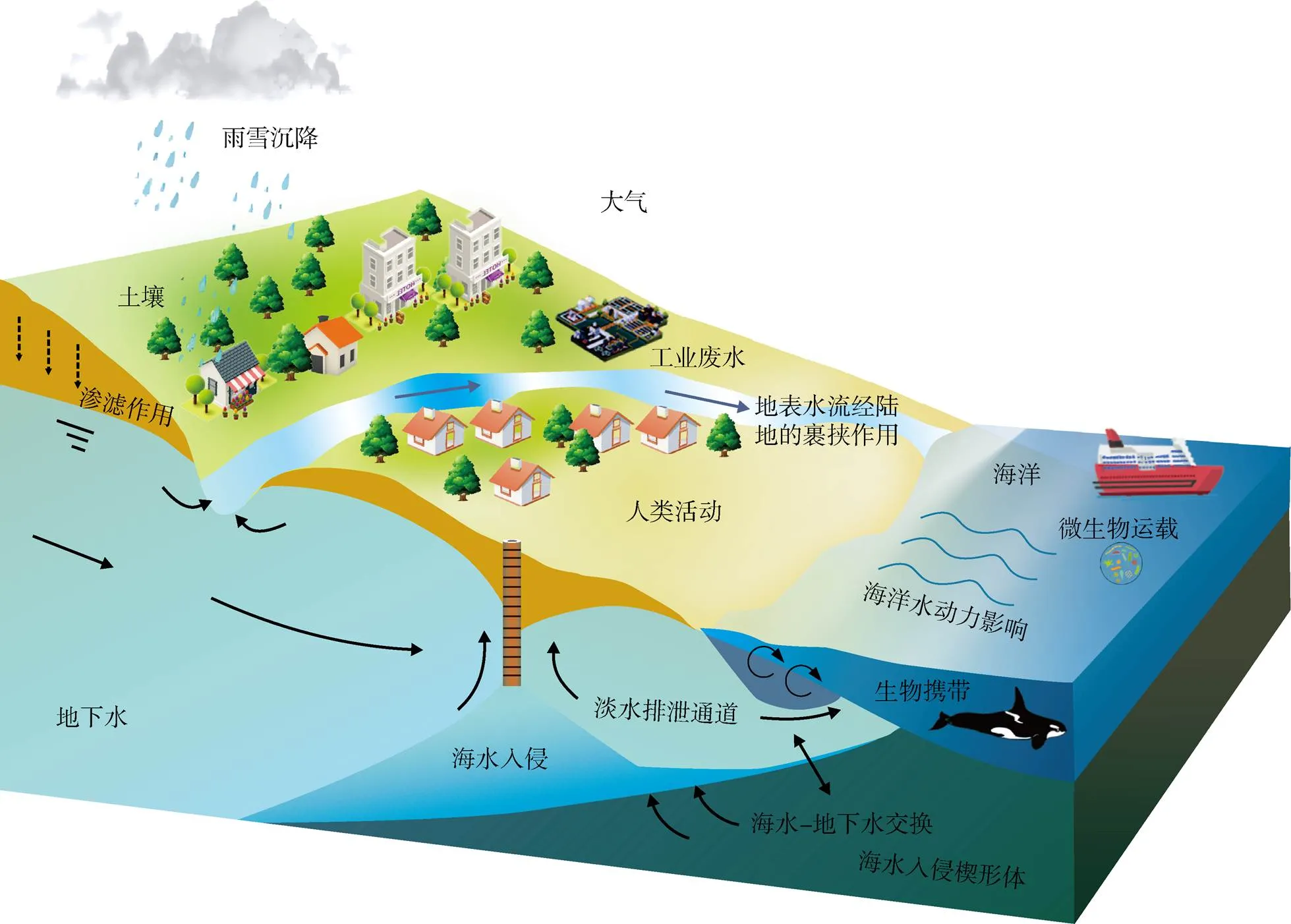
圖1 海岸帶地下水含水層中微塑料主要來源
海洋-地下水、土壤-地下水、大氣-地下水、陸表或陸表水系-地下水這4種過程是濱海含水層微塑料來源的主要動力機制。海洋系統能夠通過海底地下水排泄(Sbumarine groundwater discharge, SGD)以及海水入侵帶入微塑料[16]; 土壤中微塑料能夠借助土壤裂隙、土壤介質孔隙、生物活動或植物根系進行垂向遷移[33, 34]; 大氣中的微塑料能夠在井口處發生自然沉降或由雨雪作用被動沉降[35]; 陸表淡水水系如河流、湖泊等能夠在地下水補給過程中轉移體系內的微塑料[34, 36, 37], 并在微塑料自身性質與環境的雙重作用下形成差異性分布。
1.2 濱海含水層微塑料分布與富集
海岸帶微塑料分布范圍極廣, 從繁華喧囂的城市地區到人跡罕至的深海海溝[38], 甚至是兩極地區都存在它的蹤跡。目前研究證明, 微塑料的空間范圍分布囊括近海陸地與近岸陸域[39, 40]、河口[41]、河流[42]、湖泊[43]、海灣[44]、潮灘[45]、近海海域水域[46]、大洋和極地[47]等區域, 其遷移與分布因素受自身理化性質如粒徑、尺寸、形狀、密度、成分、聚合物類型; 水環境參數如鹽度、溫度和生物量; 氣候因素如降雨、風和湍流; 介質環境類型如空氣、沉積物、水體; 施加于微塑料的各種物理、化學、生物作用的強度等。
微塑料在海洋環境中的輸送機制有波浪、潮汐、洋流[48]、海洋生物、人工活動、海水-地下水相互作用等; 在地下水環境中的輸送機制有對流、人類活動干擾、微生物作用、地下水-海水相互作用等。
海岸帶地區微塑料受人類活動、海水水動力變化以及海水地下水相互作用的影響, 廣泛分布于河口、海灘、近海、表層海水、沉積物以及濱海地下水含水層等區域[49]。處于水體當中的微塑料能夠單獨沉降或與其他物質結合成聚集顆粒后沉降, 使海底地區成為微塑料重要的匯。一般條件下微塑料自然降解需要數百年甚至上千年, 在海水環境中微塑料吸收紫外線能力加強, 老化加速, 降解速率變緩, 使得海洋環境中的微塑料降解速率低于陸地, 加劇了近海海水中微塑料的滯留[50]。
近年來, 學術界在微塑料領域的相關研究不斷深入與發展, 地下水含水層中微塑料污染的相關科研成果也有所更新, 海岸帶地區地下水環境中微塑料的存在已經成為不爭的事實[51]。由于人類活動對塑料制品利用率的增加, 地下水含水層中微塑料污染日益加劇, 研究表明人類農業活動產生的微塑料能夠通過土壤裂隙或生物活動等過程垂向遷移進入地下水含水層[33, 34]; 沿海地區商旅類塑料垃圾碎片能夠伴隨海水-地下水相互作用過程遷移至地下水[16, 52]; 河流中攜帶的微塑料能夠在河流補給地下水的入口處向地下水含水層輸入微塑料[36, 53], 使得農業區、海岸帶地區以及河流-地下水交接口區域成為地下水含水層微塑料污染的潛在多發領域。
2 微塑料基本性質以及相關研究方法與技術
2.1 微塑料基本特性
微塑料作為一種新型污染物, 具有形狀多樣、尺寸小、密度低、表面疏水、比表面積大、吸附能力強、表面裂痕明顯、來源廣泛等物理性質; 具有性質穩定、賦存時間長、難以自然降解、表面官能團復雜、環境持久性、遷移轉化機制復雜、易于吸附有機污染物與重金屬等化學特征。不同類型的微塑料具有不同的表面電荷、官能團以及酸堿特性, 且微塑料的粒徑越小比表面積越大, 因此微米或納米級微塑料顆粒具有更高的吸附比表面積。在外部環境因素如光照、溫度、紫外線輻射等作用下微塑料會發生老化現象, 顆粒形貌改變, 表面形成新的含氧官能團, 疏水性降低, 引發更加顯著的環境效應。
物理性質方面, 微塑料分為透明色和有色顆粒兩種, 透明微塑料在海洋環境中最為常見[54], 但由于透明色與淺色微塑料色彩不夠鮮明難以辨別, 使得其數量常被低估。微塑料類型豐富且形態各異, 目前已經發現的微塑料類型包括發泡類、碎片類、纖維類、顆粒類、小球類等。海洋微塑料的形狀包括顆粒、泡沫、碎片、薄膜、纖維、球體等[55, 56], 不同形狀對應不同來源, 如顆粒和球體一般源自化妝品原料或工業原料, 碎片多為硬塑料制品破碎形成, 纖維多來源于紡織物、網、漁線和繩索, 薄膜多源自塑料袋和包裝材料等。
化學性質方面, 微塑料是由小分子單體聚合而成的高分子物質, 具有分散性、多層次性、分子量大、結構不均一等復雜的化學結構[28], 其化學組成成分主要包括: 聚乙烯(PE)、聚丙烯(PP)、聚氯乙烯(PVC)、聚苯乙烯(PS)、聚酰胺(PA)、聚酯(PEst)、聚對苯二甲酸(PET)、聚對苯二甲酸乙二醇酯(PET)、玻璃紙(CP)、聚丙烯腈(PAN)、聚乙酸乙烯酯(PVAC)和聚苯醚(PPO)等[57-59], 豐度單位一般用“個/立方米(n/m3)海水”或“個/升(n/L)海水”來表示。
微塑料具有疏水性, 表面易黏附污染物[60], 吸附過程與兩者自身性質、環境要素、兩者間相互作用密切相關。例如: 微塑料自身性質如類型、結晶度、表面形貌結構、粒徑和比表面積等; 污染物自身性質如污染物種類、電荷、絡合特性等; 粒子間相互作用力如氫鍵與范德華力、疏水作用、分配作用、污染物之間的競爭作用等; 環境因素如光照、溫度、pH、離子強度等。這些因素會造成不同種類、不同階段、不同環境條件下微塑料吸附能力的差異。
研究表明, 微塑料能夠吸附Pb2+、Cu2+、Cd2+等重金屬離子以及雙酚A、多氯聯苯、多溴聯苯醚、多環芳烴、有機氯農藥[61]、有機鹵化物、鄰苯二甲酸酯和有機磷酯類等有機化學污染物[6, 54]。有機污染物在微塑料上的吸附機理包括疏水作用、氫鍵、π-π鍵、范德華力、靜電相互作用等; 重金屬在微塑料上的吸附機理包括重金屬自身性質[62]、環境因素[63]、陽離子與微塑料表面絡合作用、帶相反電荷的分子吸引、類似帶電分子的排斥引起的靜電相互作用等, 其比表面積和疏水性也是重金屬吸附的重要因素。以上多種因素綜合作用, 共同決定微塑料在特定狀態下的吸附行為。
2.2 地下水含水層中微塑料分析方法
微塑料的研究區域涵蓋開放海域、海岸帶、海灘、土壤、河流、大氣等, 按照不同地區的區域特性, 應采取不同的采樣與處理方法[64-68], 地下水含水層中微塑料的采樣方法與開放海域類似, 分析檢測方法與常規微塑料分析方法相同。表層水樣品采樣方法以拖網法為主, 深層水樣品的采取需進行鉆孔、抽水等操作, 同時應配備具有井下采樣技術的相關儀器設備。
采樣后需對微塑料進行提取, 提取方法包括: 過濾干燥法、目檢法、密度分離法、消解法等[69, 70]。純化是能夠區分微塑料顆粒和天然顆粒的有效方法, 一般在密度分離前對樣品進行純化操作以去除微塑料表面的無機物質、有機物質、生物組織、細菌群落等雜質, 有效避免生物有機質對樣品測定結果的干擾。純化的方式分為物理分離和化學消解兩種, 具體方法包括攪拌并淡水淋洗、超聲清洗、酸性消解、堿性消解或酶消解等[2]。
分析微塑料特征的系列方法包括目視法、顯微鏡法、粒徑法、形貌法、成分法和官能團法等[71]。目視法和顯微鏡法主要對微塑料的顏色、尺寸和類型進行分析; 形貌法可觀察微塑料表面的微觀形貌如裂縫、凸起、凹陷等; 成分法主要用于確定聚合物成分; 官能團法與成分法聯合采用能夠判斷聚合物表面官能團的變化; 粒徑法通過對比不同尺寸微塑料的形態與成分特征能夠追溯微塑料的來源。
分析微塑料特征的技術方法包括微塑料物理特征的初步鑒定方法如顯微鏡觀察計數法、體視顯微鏡法(Stereomicroscope)、掃描電子顯微鏡法(SEM)等; 微塑料的定量檢測方法如傅立葉紅外光譜法(FT-IR)、拉曼光譜法及Pyr-GCMS熱解分析法等; 微塑料聚合物化學組成鑒定的儀器方法如傅里葉變換紅外吸收光譜儀(FT-IR)、拉曼光譜儀(Raman)、裂解氣相色譜-質譜連用儀(Py-GC/MS)等[49, 72, 73]。
目前分析海岸帶地區微塑料的行為變化多采用室內模擬研究, 如以固定粒徑的熒光聚苯乙烯微球作為運移微粒, 分析微塑料的老化過程、遷移規律、富集特征、吸附原理等。同時輔以不同粒徑的石英砂作為多孔介質, 垂直固定有機玻璃柱進行土柱試驗, 采用濕法填充玻璃柱的方法填充裝置, 以設定好的流速通入純水與固定濃度的微粒溶液, 以固定的時間間隔接樣, 并利用熒光分光光度計測定樣品微粒濃度。結合對流-彌散方程或溶質運移模型作為理論基礎, 利用計算機求解功能等得到不同實驗條件下的未知參數, 如水動力彌散系數、沉積系數、曲線擬合度、微粒回收率等[74, 75]。
3 微塑料在濱海地下水含水層中運移機制
微塑料在濱海地區的運移過程主要包括兩個方面, 一是陸源微塑料通過河流運輸、海底地下水排泄過程進入近海水域, 二是近海環境中的微塑料通過海水入侵方式進入濱海地下水含水層。受微塑料自身性質的影響, 其在濱海含水層多孔介質中的遷移過程中會發生吸附、絡合、聚集、沉積、團聚、滯留等現象[76]。
微塑料在濱海地下水含水層中的遷移機制十分復雜, 總體分為微塑料自身性質影響、海岸帶區域水動力及模擬條件影響、水環境因素影響3個方面。具體包括微塑料的基本性質如尺寸、形狀、電性、類型、密度、親水性、吸附能力、絡合能力等[2, 74, 77]; 區域水動力及模擬條件如波浪、潮汐、孔隙水流速、地下水-海水交換、海水再循環等[78, 79]; 水環境因素如離子強度、陽離子含量、pH值、溶解性有機物質、Fe/Al氧化物、鹽度、介質理化性質、生物活動等[75]。
3.1 微塑料的輸運過程受自身理化性質的影響
不同地區不同點位微塑料的尺寸大小存在巨大差異, 這與微塑料的風化、老化等過程有關, 其影響因素包括風和水流的強度、紫外線強度、太陽輻射時間長短、砂礫磨蝕程度等[80-82]。暴露于表層的微塑料老化后會破碎或降解成粒徑更小的微塑料顆粒甚至是納米微塑料顆粒[83], 小粒徑的微塑料顆粒在海岸帶介質中更易穿透與移動, 因此粒徑變小往往能夠使環境遷移性增強, 且粒徑越小遷移距離越遠[78], 分布范圍就越廣, 對環境的潛在威脅也就越大。
一般而言, 微塑料的粒徑越小, 越容易從小粒徑的濱海介質中穿過; 大粒徑的微塑料更傾向于發生沉降作用。微塑料顆粒的形狀會影響微塑料的遷移與堆積, 相同體積, 相同密度條件下, 顆粒越細長, 下沉速度就越快, 因此纖維狀微塑料更易發生下沉與聚集[78]。微塑料一般帶負電, 當微塑料表面的負電性較強時, 其更易與陽離子發生結合從而抑制自身的遷移, 介質表面電荷的強弱也會影響微塑料在介質表面的吸附[17]。
不同類型的微塑料理化性質有所差別, 其吸附能力不同, 絡合能力也不盡相同。密度在大多情況下會主導微塑料的沉降行為, 因此微塑料自身密度的差異以及吸附與結合后導致的密度變化均會影響微塑料在濱海含水層中的遷移[54, 77]。親水性是微塑料的基本特性之一, 它不僅能夠影響微塑料在水中的分布, 還能夠影響微塑料與含水介質或其他物質之間的相互作用。吸附作用是微塑料遷移過程中的常見行為, 它能夠吸附于介質表面, 占據其吸附位點, 同時也能與空隙中的陽離子或有機質結合, 從而滯留在介質空隙中, 降低自身遷移能力[49]。絡合作用是具有特定絡合性質的物質與微塑料之間的作用, 形成的絡合物在體積增加的情況下能夠增加微塑料遷移的難度[17]。此外, 部分離子、絡合物、有機質能夠吸附于多孔介質表面, 覆蓋微塑料的沉積位點, 使得游離微塑料增多, 促進微塑料的流動。
3.2 區域水動力及模擬條件影響
復雜的區域水動力環境對微塑料的輸運軌跡有極大的影響, 如孔隙水流速增大會使微塑料受到的流體剪應力增強, 沉積時間縮短, 沉積量降低, 從而促進遷移; 風會帶動海水波動, 從海灘進入到海水中的微塑料顆粒會隨風的波動進行水平遷移, 當風速與角度達到一定程度時, 微塑料還能夠垂直遷移甚至到達一定深度; 潮汐是周期性的海水運動, 它不僅能夠將岸灘上的微塑料裹挾入海, 還能夠促進海洋中微塑料在垂直方向上的遷移; 波浪會帶動微塑料的轉移, 推動近海微塑料穿越海岸帶介質孔隙進入地下水含水層。
地下水-海水交換過程是重要的海岸帶相互作用過程[12], 水流在濱海地下水含水層與海水中流動, 微塑料能夠跟隨水流的方向實現移動與循環。海水再循環能夠將海水與微塑料輸入到海岸帶地下水含水層中, 并通過再循環水流帶出部分微塑料, 實現微塑料的區域性轉移[16]。
海水入侵與海底地下水排泄是兩個重要的海岸帶地區海水-地下水相互作用過程[83-85]。廣義的SGD是指由陸地進入海洋的全部水體, 包括陸源地下水淡水、再循環海水以及海底孔隙水交換[86]。SGD能夠將含水層中附著的微塑料粒子釋放回海洋, 也能夠通過循環作用將海洋微塑料遷移至地下水。微塑料作為一種微型顆粒, 能夠漂浮或沉降于水域當中, 海洋中部分尺寸小于海岸帶介質的微塑料能夠透過介質, 跟隨孔隙水的流動轉移至地下水, 過程中伴隨著營養物質以及重金屬的轉移, 從而使地下水中微塑料濃度、礦物質、重金屬、鹽度等參數增加, 污染地下水水質[52]。鐳氡同位素示蹤與高密度電法原位監測是海水-地下水相互作用研究的重要技術方法, 在此基礎上利用鐳氡同位素質量平衡模型[87]以及地下水中微塑料濃度能夠計算SGD驅動的微塑料濃度通量。
受地下水超采和海平面上升的影響, 海水入侵是目前沿海地區普遍面臨的地質環境問題之一[88]。海水入侵可將不同粒徑的微塑料轉移至沿海地下水含水層, 此間還會伴隨海洋中鹽離子、營養物質、污染物以及微生物的轉移, 引發地下水咸化甚至水質惡化[52, 89]。近海海水在鹽度以及水位差異的基礎上向地下水方向涌動, 與此同時, 近海海底處于沉積狀態的微塑料受水勢影響跟隨水流方向遷移, 由于微塑料自身具有吸附性且沿途地形條件存在一定的阻礙作用, 使得微塑料遷移受阻, 最終到達地下水含水層中的僅為部分微塑料, 且大尺寸微塑料占比顯著減少。
3.3 水環境因素影響
微塑料在濱海地下水含水層中運移機制復雜, 地表微塑料顆粒向下運移需要經歷多孔介質的過濾作用, 由于介質粒徑、粗糙度、飽和度、非均質性、介質含水率等性質的不同, 使得微塑料遷移能力有所差異。濱海含水層介質具有非均質性的特點, 多孔介質向水相中釋放的陽離子濃度增加會導致離子強度增強, 削弱微塑料的輸運能力; 粗糙介質表面的沉積位點較多, 微塑料遷移能力隨介質粗糙度增加而降低; 小粒徑的介質比表面積大、沉積位點多, 孔喉較小、物理過濾作用強, 微塑料遷移能力降低。濱海含水層存在優勢流, 其較高的流量會主導微塑料遷移, 增加微塑料的遷移量。
海岸帶含水層介質的巖性多為砂質和粉砂淤泥質, 其中砂質含水層孔隙度較大, 易形成水流通道, 微塑料被優先流主導并跟隨其遷移; 偏泥質海岸介質顆粒質軟且易于聚集, 形成與土壤介質相似的垂直通道, 微塑料會通過侵蝕或壤中流等方式[90], 進一步進入到地下水和海水中。水-氣界面對微塑料的遷移也有一定的影響。土壤水中的毛細作用能夠捕獲遷移中的微塑料, 影響微塑料在孔隙中的分布。當水-氣界面的飽和度較高時, 微塑料顆粒與氣泡之間緊密相連, 微塑料難以移動, 遷移能力大大降低, 飽和度低時, 微塑料顆粒仍具有一定的活動空間, 能夠隨水流運動實現部分遷移[91]。
水環境中的各種物理化學因素通過改變微塑料自身電性或與介質之間的相互作用力影響其在濱海含水層中的遷移。如離子強度增加會壓縮微塑料與介質間雙電層, 減少靜電排斥作用, 增強微塑料的團聚作用; pH值增加能夠使官能團去質子化, 增加微塑料與介質表面的負電荷, 增強靜電排斥力, 從而降低微塑料的團聚能力; 鐵鋁氧化物的正電性會增加介質表面微塑料的沉積位點, 阻礙微塑料的遷移等[91]。
在濱海地下水含水層多孔介質中, 溶解性有機質與高價陽離子的存在對微塑料顆粒的遷移存在極大影響[17]。高價陽離子能夠吸附于微塑料及介質表面, 使表面負電荷減少, 孔隙中游離微塑料團聚增強, 減少運移; 溶解性有機質能夠覆蓋微塑料在介質表面的沉積位點, 增強微塑料及介質之間的空間阻位效應, 從而增加微塑料的流動性; 兩者并存時, 一方面溶解性有機質能夠與高價陽離子相結合, 進而吸附于介質表面; 另一方面, 溶解性有機質能夠與高價陽離子和微塑料的結合物相結合, 從而吸附于介質表面, 并占據介質孔隙的大量空間, 大大阻礙了微塑料在介質孔隙中的遷移[91]。
此外, 濱海植物根系發育會使海岸介質產生裂縫和孔洞, 成為微塑料垂直運移的有利通道; 海岸帶生存的小型動物具有捕獲、攝食、攜帶與搬運微塑料的能力[3, 91], 一般情況下微塑料附著在其表面, 小型動物活動時能夠形成洞穴, 增加微塑料遷移量[92, 93]; 小型動物的攝食行為如口器切斷、咀嚼、胃囊消化等會降低微塑料的顆粒尺寸, 使遷移能力進一步增強[94]; 微生物表面疏水性具有差異, 其胞外分泌物不同也會導致對微塑料吸附能力的變化; 微生物在吞食微塑料的同時能夠在表面提供微塑料的沉積位點, 降低微塑料的遷移能力[95]; 多孔介質表面附著的微生物能夠捕獲與吸附移動中的微塑料[91], 增加微塑料在濱海地下水含水層的滯留。
4 微塑料在濱海地下水含水層及近海的環境效應研究
微塑料對環境的危害主要表現在微塑料對濱海地下水含水層及近海環境理化性質的影響、微塑料對生物的影響以及微塑料對人類的影響[96]這3個方面。
環境中的微塑料效應主要表現在不同環境領域不同程度的微塑料污染。微塑料在完全降解之前能夠存在數百年甚至數千年[58], 引發難以估量的生態風險, 在降解過程中能夠釋放污染物, 這些污染物與各種環境介質中的化學因子發生反應會改變環境介質的理化性質如酸堿度、有機質、電導率等, 進而影響其中的微塑料分布, 造成污染程度的變化; 微塑料是重金屬的重要載體[97], 表面能夠吸附銅、鉛、鎘、鉻等重金屬[98-100], 微塑料在地下水中富集之后可能會引發地下水中重金屬離子的污染; 受長時間紫外線照射及水動力條件的影響, 潮灘上的微塑料破碎分解為更小粒徑, 實現更廣泛的遷移; 濱海濕地生態系統如河口、鹽沼、紅樹林和海草床等環境受微塑料釋放的鹵化阻燃劑等侵染后會積蓄嚴重的生態風險[101-103]; 微塑料排放后經河水流動搬運、河口灣口堆積、海流變化等過程易引發近海微塑料污染, 且污染水平受海岸帶經濟因素影響較大, 與河流輸運、人口密度、工業活動強度常呈正相關關系[104]。
此外, 微塑料能夠憑借自身復雜的吸附性能, 附著于沿途的吸附位點產生滯留現象, 或吸附周圍環境中的重金屬與污染物并共同遷移。一般情況下, 微塑料會大量吸附水環境中的非極性化合物, 老化后表面結構改變, 產生輕微毒性, 轉而吸附親水性污染物[105-106]; 離子存在形式的不同、pH值差異、離子強度高低等外界環境因素會引發微塑料和有機污染物間靜電引力的變化[107], 影響微塑料表面與污染物離子的競爭作用, 增加疏水相互作用或形成離子態的污染物; 金屬離子能夠直接吸附于微塑料表面, 占據微塑料表面的吸附位點, 影響微塑料在海岸介質中的遷移行為; 環境中微塑料、溶解性有機質和有機污染物共存時, 三者間通過充當載體、競爭吸附位點、電荷相互作用以及形成DOM-有機污染物復合物等形式產生相互作用; 多種污染物共存引發競爭作用等[108], 這些因素都會改變海岸帶地下水含水層中微塑料的吸附性能, 進而影響其遷移特征, 造成不同程度的環境威脅。
微塑料對近海海洋生物的影響主要表現在食物鏈與食物網的積累[109]。研究表明, 底棲無脊椎動物、浮游動物、濾食生物、雙殼類、海鳥、魚類、海洋哺乳動物等均存在攝食微塑料的現象[110-112]。這是因為部分微塑料顆粒的外貌特征與低營養級海洋生物相似或與浮游生物具有類似的大小和密度, 易在高營養級海洋生物區分獵物時被誤食[113], 此外, 部分有色微塑料易被以視覺效果捕食的生物誤食, 被吞食的微塑料會對生物體產生負面效應, 影響其生命活動如呼吸、攝食、消化、排泄、生殖等, 并能夠通過營養關系的遞進逐漸轉移至更高水平, 致使生物能量匱乏, 甚至引發水生動物的異常發育與死亡[77]。微塑料具有釋放自身有毒的化學物質、解吸附或浸出表面作為添加劑的重金屬與有機污染物的能力; 它還能作為海洋污染物的載體[114], 實現海洋污染物的遠距離遷移。此外, 微塑料還會阻礙近海水生植物的光合作用, 或改變植物的生物量、元素組成和根系性狀等, 且阻礙程度會隨微塑料顆粒尺寸的減小而增強[115-116]。
地下水環境的理化性質特殊, 與開放海域有所差異, 其間多為微生物活動。微塑料表面易生長生物膜[117], 易于微生物富集[101]; 能夠作為微生物載體或與其發生相互作用, 維持小型生態平衡等。微塑料與微生物之間的相互作用存在雙面性。一方面, 微塑料表面能夠為細菌、病毒等生命體提供一個良好的生存空間, 在環境條件適宜的情況下能夠形成新的生物膜, 生物膜會作用于微塑料表面, 影響微塑料對周邊化學物質的垂直運輸與吸收釋放[118]。處于懸浮狀態的微塑料能夠吸附地下水環境中的有機物與營養鹽, 甚至形成微生物群落, 或改變群落結構。另一方面, 微塑料能夠從水環境中吸附重金屬、致病菌、有機污染物等[119], 并與其發生化學作用, 形成毒性更高的二次污染物。附著病原菌的微塑料若在不經意間進入并累積過高濃度會對人體器官的運轉造成影響, 降低抵抗病菌的能力, 對人類健康造成巨大威脅[120]。
5 問題與展望
濱海含水層中的微塑料具有比表面積大、吸附性強等物理化學特征, 在海水與地下水相互作用過程中, 伴隨著復雜的水動力過程穿越濱海含水層孔隙介質, 或通過降雨滲透濱海土壤層, 引發濱海含水層中地下水污染, 當前地下水-海水相互作用過程中微塑料運移特征的相關研究仍舊處于初級階段, 部分更深層面的科學問題亟待分析。
(1) 小粒徑的微塑料顆粒具有更加復雜的物理化學特性, 易造成更高水平的污染。濱海地區地下水含水層中微塑料運移特征的關鍵科學問題應當著重于納米級微塑料的物理化學特征研究, 了解其在濱海介質間的運移行為, 對比分析大粒徑微塑料與納米級微塑料兩者間的運移特性差異, 從而拓展濱海地區微塑料的研究深度, 為進一步區分微塑料來源提供更加可靠的理論基礎。
(2) 利用合成聚苯乙烯微球模擬微塑料開展室內模擬實驗表明, 海水地下水相互作用過程是濱海含水層中微塑料的重要來源。但目前的野外現場驗證研究較少, 難以定量地解釋微觀層面微塑料顆粒的行為特征。基于鐳氡同位素示蹤和高密度電法原位監測技術的聯合應用, 在明確地下水交換通量基礎上, 耦合溶質運移模型, 可全面分析濱海地區微塑料在宏觀與微觀層面上的具體遷移途徑與地球化學相互作用過程, 有效促進微塑料相關研究水平的提升。
(3) 微塑料是具有強吸附能力且性質穩定的新型污染物質, 對各種重金屬以及有機污染物具有不同的運載能力, 能夠引發地下水污染, 積蓄嚴重的生態風險, 并通過食物鏈的傳遞效果對生物體造成巨大危害, 引發人體健康危機。未來研究應關注地下水-海水相互作用過程中微塑料遷移所引發的鏈式環境效應, 結合微塑料示蹤、水質檢測、微生物采樣、病理學統計等手段分析微塑料老化、吸附、遷移、富集等規律, 深入探討濱海地區地下水含水層中微塑料對地下水環境、微生物以及人類影響的具體表現, 明確海水-地下水相互作用水動力過程所驅動的海洋微塑料遷移過程對濱海含水層生物地球化學環境的影響。
[1] 駱永明, 施華宏, 涂晨, 等. 環境中微塑料研究進展與展望[J]. 科學通報, 2021, 66(13): 1547-1562. LUO Yongming, SHI Huahong, TU Chen, et al. Research progresses and prospects of microplastics in the environment[J]. Chinese Science Bulletin, 2021, 66(13): 1547-1562.
[2] 趙世燁. 中國部分河口微塑料的賦存特征及海洋雪中微塑料分析方法研究[D]. 上海: 華東師范大學, 2017. ZHAO Shiye. Microplastic contamination of some key estuaries in China and the approach for analyzing microplastic in marine snow[D]. Shanghai: East China Normal University, 2017.
[3] 彭谷雨. 沉積環境中的微塑料[D]. 上海: 華東師范大學, 2020. PENG Guyu. Microplastics in sedimentation environments: A comparative study in estuaries, coastal zones and the deep sea[D]. Shanghai: East China Normal University, 2020.
[4] PAN Z, GUO H G, CHEN H Z, et al. Microplastics in the Northwestern Pacific: Abundance, distribution, and characteristics[J]. Science of the Total Environment, 2019, 650: 1913-1922.
[5] ALAM F C, SEMBIRING E, MUNTALIF B S, et al. Microplastic distribution in surface water and sediment river around slum and industrial area (case study: Ciwalengke River, Majalaya district, Indonesia)[J]. Che-mosphere, 2019, 224: 637-645.
[6] LUSHER A L, O'DONNELL C, OFFICER R, et al. Microplastic interactions with North Atlantic mesopelagic fish[J]. Ices Journal of Marine Science, 2016, 73(4): 1214-1225.
[7] MERCOGLIANO R, AVIO C G, REGOLI F, et al. Occurrence of microplastics in commercial seafood under the perspective of the human food chain. A review[J]. Journal of Agricultural and Food Chemistry, 2020, 68(19): 5296-5301.
[8] LUO X, WANG Z Q, YANG L, et al. A review of analytical methods and models used in atmospheric microplastic research[J]. Science of the Total Environment, 2022, 828: 154487.
[9] AMELIA T S M, KHALIK W M A W M, ONG M C, et al. Marine microplastics as vectors of major ocean pollutants and its hazards to the marine ecosystem and humans[J]. Progress in Earth and Planetary Science, 2021, 8(1): 12.
[10] HURLEY R, WOODWARD J, ROTHWELL J J. Microplastic contamination of river beds significantly reduced by catchment-wide flooding[J]. Nature Geoscience, 2018, 11(4): 251.
[11] 朱逸寧, 徐項亮, 何一波, 等. 國內外微塑料法規現狀[J]. 中國洗滌用品工業, 2020, 233(8): 52-57. ZHU Yining, XU Xiangliang, HE Yibo, et al. Status of regulations on microplastics at home and abroad[J]. China Cleaning Industry Association, 2020, 233(8): 52-57.
[12] 李海龍, 王學靜. 海底地下水排泄研究回顧與進展[J]. 地球科學進展, 2015, 30(6): 636-646. LI Hailong, WANG Xuejing. Submarine groundwater discharge: A review[J]. Advances in Earth Science, 2015, 30(6): 636-646.
[13] 張艷. 氡同位素示蹤萊州灣海底地下水排泄[D]. 北京: 中國地質大學, 2016. ZHANG Yan. Estimation of submarine groundwater discharge into Laizhou Bay, China using222Rn[D]. Beijing: China University of Geosciences, 2016.
[14] 李開培, 郭占榮, 袁曉婕, 等. 氡和鐳同位素在沿岸海底地下水研究中的應用[J]. 勘察科學技術, 2011, 5: 30-36. LI Kaipei, GUO Zhanrong, YUAN Xiaojie, et al. Application of radon and radium isotopes in estimating submarine groundwater discharge in coastal areas[J]. Site Investigation Science and Technology, 2011, 5: 30-36.
[15] 劉花臺, 郭占榮. 海底地下水排泄的研究進展[J]. 地球科學進展, 2014, 29(7): 774-785. LIU Huatai, GUO Zhanrong. A review on submarine groundwater discharge[J]. Advances in Earth Science, 2014, 29(7): 774-785.
[16] LI M, ZHANG M Y, RONG H F, et al. Transport and deposition of plastic particles in porous media during seawater intrusion and groundwater-seawater displace-ment processes[J]. Science of the Total Environment, 2021, 781: 146752.
[17] 鄒繼穎. 微塑料對典型有機污染物和重金屬離子的吸附及機理研究[D]. 長春: 東北師范大學, 2021. ZOU Jiying. Research on sorption and mechanism of typical organic pollutants and heavy metal ions by microplastics[D]. Changchun: Northeast Normal University, 2021.
[18] GAO F L, LI J X, SUN C J, et al. Study on the capability and characteristics of heavy metals enriched on microplastics in marine environment[J]. Marine Pollution Bulletin, 2019, 144: 61-67.
[19] GAO L, FU D D, ZHAO J J, et al. Microplastics aged in various environmental media exhibited strong sorption to heavy metals in seawater[J]. Marine Pollution Bulletin, 2021, 169: 112480.
[20] EERKES-MEDRANO D, THOMPSON R C, ALDRIDGE D C. Microplastics in freshwater systems: a review of the emerging threats, identification of knowledge gaps and prioritisation of research needs[J]. Water Research, 2015, 75: 63-82.
[21] SUN Q H, LI J, WANG C, et al. Research progress on distribution, sources, identification, toxicity, and biodegradation of microplastics in the ocean, freshwater, and soil environment[J]. Frontiers of Environmental Science and Engineering, 2022, 16(1): 1.
[22] FOK L, CHEUNG P K. Hong Kong at the Pearl River Estuary: A hotspot of microplastic pollution[J]. Marine Pollution Bulletin, 2015, 99(1/2): 112-118.
[23] AKANYANGE S N, ZHANG Y, ZHAO X H, et al. A holistic assessment of microplastic ubiquitousness: Pathway for source identification in the environment[J]. Sustainable Production and Consumption, 2022, 33: 113-145.
[24] AUTA H S, EMENIKE C U, FAUZIAH S H. Distribution and importance of microplastics in the marine environment: A review of the sources, fate, effects, and potential solutions[J]. Environment International, 2017, 102: 165-176.
[25] BAO R Q, CHENG Z R, HOU Y P, et al. Secondary microplastics formation and colonized microorganisms on the surface of conventional and degradable plastic granules during long-term UV aging in various environmental media[J]. Journal of Hazardous Materials, 2022, 439: 129686.
[26] BHAGAT K, BARRIOS A C, RAJWADE K, et al. Aging of microplastics increases their adsorption affinity towards organic contaminants[J]. Chemosphere, 2022, 298: 134238.
[27] WANG C H, ZHAO J, XING B S. Environmental source, fate, and toxicity of microplastics[J]. Journal of Hazardous Materials, 2021, 407: 124357.
[28] 劉軍, 李振敏, 張君楚, 等. 微塑料污染研究進展[J]. 山東化工, 2022, 51(2): 67-70. LIU Jun, LI Zhenmin, ZHANG Junchu, et al. Research progress of microplastic pollution[J]. Shandong Chemi-cal Industry, 2022, 51(2): 67-70.
[29] ALIMI O S, BUDARZ J F, HERNANDEZ L M, et al. Microplastics and nanoplastics in aquatic environments: Aggregation, deposition, and enhanced contaminant transport[J]. Environment Science & Technology, 2018, 52(4): 1704-1724.
[30] MINTENIG S M, LODER M G J, PRIMPKE S, et al. Low numbers of microplastics detected in drinking water from ground[J]. Science of the Total Environment, 2019, 648: 631-635.
[31] MU H Y, WANG Y P, ZHANG H N, et al. High abundance of microplastics in groundwater in Jiaodong Peninsula, China[J]. Science of the Total Environment, 2022, 839: 156318.
[32] VIAROLI S, LANCIA M, RE V. Microplastics contamination of groundwater: Current evidence and future perspectives. A review[J]. Science of the Total Environment, 2022, 824: 153851.
[33] CROSSMAN J, HURLEY R R, FUTTER M, et al. Transfer and transport of microplastics from biosolids to agricultural soils and the wider environment[J]. Science of the Total Environment. 2020, 724: 138334.
[34] WU B, LI L W, ZU Y X, et al. Microplastics contamination in groundwater of a drinking-water source area, northern China[J]. Environmental Research, 2022, 214(3): 114048.
[35] ZHAO J M, RAN W, TENG J, et al. Microplastic pollution in sediments from the Bohai Sea and the Yellow Sea, China[J]. Science of the Total Environment, 2018, 640: 637-645.
[36] REN Z F, GUI X Y, XU X Y, et al. Microplastics in the soil-groundwater environment: Aging, migration, and co- transport of contaminants-A critical review[J]. Journal of Hazardous Materials, 2021, 419: 126455.
[37] BHARATH K M, NATESAN U, VAIKUNTH R, et al. Spatial distribution of microplastic concentration around landfill sites and its potential risk on groundwater[J]. Chemosphere, 2021, 277: 130263.
[38] PENG X, CHEN M, CHEN S, et al. Microplastics contaminate the deepest part of the world's ocean[J]. Geochemical Perspectives Letters, 2018, 9: 1-5.
[39] ZHOU Z Y, ZHANG P Y, ZHANG G M, et al. Vertical microplastic distribution in sediments of Fuhe River estuary to Baiyangdian Wetland in Northern China[J]. Chemosphere, 2021, 280: 130800.
[40] WANG F, LAI Z P, PENG G Y, et al. Microplastic abundance and distribution in a Central Asian desert[J]. Science of the Total Environment, 2021, 800: 149529.
[41] SHI H H, YU D L, YIN L T, et al. Source-sink process of microplastics in watershed-estuary-offshore system[J]. Journal of Cleaner Production, 2022, 338: 130612.
[42] LIU S, CHEN H, WANG J Z, et al. The distribution of microplastics in water, sediment, and fish of the Dafeng River, a remote river in China[J]. Ecotoxicology and Environmental Safety, 2021, 228: 113009.
[43] 熊雄, 吳辰熙. 湖泊——內陸水體微塑料污染的熱點區域[J]. 自然雜志, 2021, 43(4): 243-250. XIONG Xiong, WU Chenxi. Lakes—hotspots of microplastic pollution in inland water bodies[J]. Chinese Journal of Nature, 2021, 43(4): 243-250.
[44] BRONZO L, LUSHER A L, SCHOYEN M, et al. Accumulation and distribution of microplastics in coastal sediments from the inner Oslofjord, Norway[J]. Marine Pollution Bulletin, 2021, 173(B): 113076.
[45] WU F R, PENNINGS S C, TONG C F, et al. Variation in microplastics composition at small spatial and temporal scales in a tidal flat of the Yangtze Estuary, China[J]. Science of the Total Environment, 2020, 699: 134252.
[46] MANBOHI A, MEHDINIA A, RAHNAMA R, et al. Microplastic pollution in inshore and offshore surface waters of the southern Caspian Sea[J]. Chemosphere, 2021, 281: 130896.
[47] MISHRA A K, SINGH J, MISHRA P P. Microplastics in polar regions: An early warning to the world's pristine ecosystem[J]. Science of the Total Environment, 2021, 784: 147149.
[48] ONINK V, WICHMANN D, DELANDMETER P, et al. The role of ekman currents, geostrophy, and stokes drift in the accumulation of floating microplastic[J]. Journal of Geophysical Research-Oceans, 2019, 124(3): 1474- 1490.
[49] 高楠, 孔祥峰, 劉巖, 等. 儀器分析技術在海洋微塑料研究中的應用[J]. 海洋環境科學, 2019, 38(2): 178-186.GAO Nan, KONG Xiangfeng, LIU Yan, et al. Application of instrumental analysis techniques in marine microplastics research[J]. Marine Environmental Science, 2019, 38(2): 178-186.
[50] BRANDON J, GOLDSTEIN M, OHMAN M D. Long- term aging and degradation of microplastic particles: Comparing in situ oceanic and experimental weathering patterns[J]. Marine Pollution Bulletin, 2016, 110(1): 299-308.
[51] MU H Y, WANG Y P, ZHANG H N, et al. High abundance of microplastics in groundwater in Jiaodong Peninsula, China[J]. Science of the Total Environment, 2022, 839: 156318.
[52] LUO M H, ZHANG Y, LI H L, et al. Pollution assessment and sources of dissolved heavy metals in coastal water of a highly urbanized coastal area: The role of groundwater discharge[J]. Science of the Total Environment, 2022, 807(3): 151070.
[53] DRIS R, GASPERI J, SAAD M, et al. Synthetic fibers in atmospheric fallout: a source of microplastics in the environment[J]? Marine Pollution Bulletin, 2016, 104(1/2): 290-293.
[54] 陳孟玲, 高菲, 王新元, 等. 微塑料在海洋中的分布、生態效應及載體作用[J]. 海洋科學, 2021, 45(12): 125-141. CHEN Mengling, GAO Fei, WANG Xinyuan, et al. Distribution, ecological effects, and carrier function of microplastics in the marine environment[J]. Marine Sciences, 2021, 45(12): 125-141.
[55] WANG T, HU M H, SONG L L, et al. Coastal zone use influences the spatial distribution of microplastics in Hangzhou Bay, China[J]. Environmental Pollution, 2020, 266(2): 115137.
[56] HU D F, ZHANG Y X, SHEN M C. Investigation on microplastic pollution of Dongting Lake and its affiliated rivers[J]. Marine Pollution Bulletin, 2020, 160: 111555.
[57] GEYER R, JAMBECK J R, LAW K L. Production, use, and fate of all plastics ever made[J]. Science Advances, 2017, 3(7): e1700782.
[58] 孟迪. 山東半島典型近岸水域微塑料的賦存特征及源匯解析[D]. 上海: 上海海洋大學, 2022. MENG Di. Occurrence characteristics and source-sink analysis of microplastics in typical coastal waters of Shandong Peninsula[D]. Shanghai: Shanghai Ocean University, 2022.
[59] JIA Q L, DUAN Y S, HAN X L, et al. Atmospheric deposition of microplastics in the megalopolis (Shanghai) during rainy season: Characteristics, influence factors, and source[J]. Science of the Total Environment, 2022, 847: 157609.
[60] FRED-AHMADU O H, BHAGWAT G, OLUYOYE I, et al. Interaction of chemical contaminants with micro-pla-stics: Principles and perspectives[J]. Science of the Total Environment, 2020, 706: 135978.
[61] ZHANG W W, MA X D, ZHANG Z F, et al. Persistent organic pollutants carried on plastic resin pellets from two beaches in China[J]. Marine Pollution Bulletin, 2015, 99(1/2): 28-34.
[62] TURNER A, HOLMES L A. Adsorption of trace metals by microplastic pellets in fresh water[J]. Environmental Chemistry, 2015, 12(5): 600-610.
[63] YU F, YANG C F, ZHU Z L, et al. Adsorption behavior of organic pollutants and metals on micro/nanoplastics in the aquatic environment[J]. Science of the Total Environment, 2019, 694: 133643.
[64] SIMON-SANCHEZ L, GRELAUD M, FRANCI M, et al. Are research methods shaping our understanding of microplastic pollution? A literature review on the seawater and sediment bodies of the Mediterranean Sea[J]. Environmental Pollution, 2022, 292(B): 118275.
[65] YANG H R, YAN Y M, YU Y K, et al. Distribution, sources, migration, influence and analytical methods of microplastics in soil ecosystems[J]. Ecotoxicology and Environmental Safety, 2022, 243: 114009.
[66] TSERING T, SILLANPAA M, VIITALA M, et al. Variation of microplastics in the shore sediment of high-altitude lakes of the Indian Himalaya using different pretreatment methods[J]. Science of the Total Environment, 2022, 849: 157870.
[67] LUO X, WANG Z Q, YANG L, et al. A review of analytical methods and models used in atmospheric microplastic research[J]. Science of the Total Environment, 2022, 828: 154487.
[68] ZHENG Y F, LI J X, SUN C J, et al. Comparative study of three sampling methods for microplastics analysis in seawater[J]. Science of the Total Environment, 2021, 765: 144495.
[69] HIDALGO-RUZ V, GUTOW L, THOMPSON R C, et al. Microplastics in the marine environment: A review of the methods used for identification and quantification[J]. Environmental Science & Technology, 2012, 46(6): 3060-3075.
[70] KHAN N A, KHAN A H, LOPEZ-MALDONADO E A, et al. Microplastics: Occurrences, treatment methods, regulations and foreseen environmental impacts[J]. Environmental Research, 2022, 215(1): 114224.
[71] 徐湘博, 孫明星, 張林秀, 等. 土壤微塑料污染研究進展與展望[J]. 農業資源與環境學報, 2021, 38(1): 1-9. XU Xiangbo, SUN Mingxing, ZHANG Linxiu, et al. Research progress and prospect of soil microplastic pollution[J]. Journal of Agricultural Resources and Environment, 2021, 38(1): 1-9.
[72] CORAMI F, ROSSO B, MORABITO E, et al. Small microplastics (<100 μm), plasticizers and additives in seawater and sediments: Oleo-extraction, purification, quantification, and polymer characterization using Micro-FTIR[J]. Science of the Total Environment, 2021, 797: 148937.
[73] SHAN J J, ZHAO J B, ZHANG Y T, et al. Simple and rapid detection of microplastics in seawater using hyperspectral imaging technology[J]. Analytica Chimica Acta, 2019, 1050: 161-168.
[74] 張文, 董志強, 黃睿, 等. 海洋多孔介質中微塑料和富勒烯的共遷移[J]. 中國環境科學, 2019, 39(12): 5063- 5068. ZHANG Wen, DONG Zhiqiang, HUANG Rui, et al. Cotransport of microplastics and fullerene in marine porous media[J]. China Environmental Science, 2019, 39(12): 5063-5068.
[75] 趙國良, 吳域. 微塑料在豎直固定的多孔介質中遷移特性探究[J]. 環境保護前沿, 2020, 10(3): 382-387. ZHAO Guoliang, WU Yu. Study on transport mechanism of microplastics in vertically fixed porous media[J]. Advances in Environmental Protection, 2020, 10(3): 382-387.
[76] 蒲生彥, 張穎, 呂雪. 微塑料在土壤-地下水中的環境行為及其生態毒性研究進展[J]. 生態毒理學報, 2020, 15(1): 44-55. PU Shengyan, ZHANG Ying, LV Xue. Review on the environmental behavior and ecotoxicity of microplastics in soil-groundwater[J]. Asian Journal of Ecotoxicology, 2020, 15(1): 44-55.
[77] XIONG W, MEI X, MI B B, et al. Current status and cause analysis of microplastic pollution in sea areas in China[J]. China Geology, 2022, 5(1): 160-170.
[78] 王許琨, 徐艷東, 婁琦, 等. 海洋微塑料輸運過程數值模擬研究進展[J]. 海洋湖沼通報, 2021, 43(2): 74-81.WANG Xukun, XU Yandong, LOU Qi, et al. Progress in numerical simulation of marine microplastic transport[J]. Transactions of Oceanology and Limnology, 2021, 43(2): 74-81.
[79] FRIAS J P G L, LYASHEVSKA O, JOYCE H, et al. Floating microplastics in a coastal embayment: A multifaceted issue[J]. Marine Pollution Bulletin, 2020, 158: 111361.
[80] WINKLER A, SANTO N, ORTENZI M A, et al. Does mechanical stress cause microplastic release from plastic water bottles[J]. Water Research, 2019, 166: 115082.
[81] MAO R F, LANG M F, YU X Q, et al. Aging mechanism of microplastics with UV irradiation and its effects on the adsorption of heavy metals[J]. Journal of Hazardous Materials, 2020, 393: 122515.
[82] ZBYSZEWSKI M, CORCORAN P L, HOCKIN A. Comparison of the distribution and degradation of plastic debris along shorelines of the Great Lakes, North America[J]. Journal of Great Lakes Research, 2014, 40(2): 288-299.
[83] GUO X, WANG J L. The chemical behaviors of microplastics in marine environment: A review[J]. Marine Pollution Bulletin, 2019, 142: 1-14.
[84] 賈國東, 黃國倫. 海底地下水排放: 重要的海岸帶陸海相互作用過程[J]. 地學前緣, 2005, S1: 29-35. JIA Guodong, HUANG Guolun. Submarine groundwater discharge: An important landocean interaction in the coastal zone[J]. Earth Science Frontiers, 2005, S1: 29-35.
[85] BURNETT W C, BOKUNIEWICZ H, HUETTEL M, et al. Groundwater and pore water inputs to the coastal zone[J]. Biogeochemistry, 2003, 66(1/2): 3-33.
[86] BURNETT W C, DULAIOVA H, STRINGER C, et al. Submarine groundwater discharge: Its measurement and influence on the coastal zone[J]. Journal of Coastal Research, 2006, 39: 35-38.
[87] MUTHUKUMAR P, SELVAM S, BABU D S S, et al. Measurement of submarine groundwater discharge (SGD) into Tiruchendur coast at southeast India using 222Rn as a naturally occurring tracer[J]. Marine Pollution Bulletin, 2022, 174: 113233.
[88] 董凡, 張曉影, 陳廣泉等. 萊州灣南岸海水入侵特征及基于WA-NARX混合模型的動態預測[J]. 海洋學報, 2022, 44(3): 81-97. DONG Fan, ZHANG Xiaoying, CHEN Guangquan, et al. Seawater intrusion characterization and dynamics prediction based on WA-NARX hybrid model in the south of Laizhou Bay[J]. Haiyang Xuebao, 2022, 44(3): 81-97.
[89] 孫金華, 吳永祥, 林錦等. 黃渤海沿海地區海水入侵防治與地下水管理研究[J]. 中國水利, 2021, 7: 20-23. SUN Jinhua, WU Yongxiang, LIN Jin, et al. Seawater intrusion prevention and groundwater management and study in the coastal area of the Yellow Sea and the Bohai Sea[J]. China Water Resources, 2021, 7: 20-23.
[90] 余淼. 黃土區典型農林地土壤大孔隙對水分運動參數和微塑料污染的影響機制研究[D]. 楊凌: 西北農林科技大學, 2021. YU Miao. Effects of macropore on soil water movement and microplastics pollution in on Typical Farmland and Woodland in Loess Region[D]. Yangling: Northwest A&F University, 2021.
[91] 董姝楠, 夏繼紅, 王為木, 等. 土壤-地下水中微塑料遷移的影響因素及機制研究進展[J]. 農業工程學報, 2020, 36(14): 1-8. DONG Shunan, XIA Jihong, WANG Weimu, et al. Review on impact factors and mechanisms of microplastic transport in soil and groundwater[J]. Transactions of the Chinese Society of Agricultural Engineering, 2020, 36(14): 1-8.
[92] 任欣偉, 唐景春, 于宸, 等. 土壤微塑料污染及生態效應研究進展[J]. 農業環境科學學報, 2018, 37(6): 1045-1058. REN Xinwei, TANG Jingchun, YU Chen, et al. Advances in research on the ecological effects of microplastic pollution on soil ecosystems[J]. Journal of Agro-Environment Science, 2018, 37(6): 1045-1058.
[93] 劉沙沙, 付建平, 郭楚玲, 等. 微塑料的環境行為及其生態毒性研究進展[J]. 農業環境科學學報, 2019, 38(5): 957-969. LIU Shasha, FU Jianping, GUO Chuling, et al. Research progress on environmental behavior and ecological toxicity of microplastics[J]. Journal of Agro-Environment Science, 2019, 38(5): 957-969.
[94] MAASS S, DAPHI D, LEHMANN A, et al. Transport of microplastics by two collembolan species[J]. Environmental Pollution, 2017, 225: 456-459.
[95] MITZEL M R, SAND S, WHALEN J K, et al. Hydrophobicity of biofilm coatings, influences the transport dynamics of polystyrene nanoparticles in biofilm-coated sand[J]. Water Research, 2016, 92: 113-120.
[96] BRADNEY L, WIJESEKARA H, PALANSOORIYA K N, et al. Particulate plastics as a vector for toxic trace- element uptake by aquatic and terrestrial organisms and human health risk[J]. Environment International, 2019, 131: 104937.
[97] 趙偉高, 田一梅, 趙鵬, 等. 淡水環境中微塑料與重金屬的“木馬效應”研究進展[J]. 環境科學, 2023, 44(3): 1244-1257. ZHAO Weigao, TIAN Yimei, ZHAO Peng, et al. Research progress on trojan-horse effect of microplastics and heavy metals in freshwater environment[J]. Environmental Science, 2023, 44(3): 1244-1257.
[98] 李文華, 簡敏菲, 劉淑麗, 等. 鄱陽湖湖口-長江段沉積物中微塑料與重金屬污染物的賦存關系[J]. 環境科學, 2020, 41(1): 242-252. LI Wenhua, JIAN Minfei, LIU Shuli, et al. Occurrence relationship between microplastics and heavy metals pollutants in the estuarine sediments of poyang lake and the yangtze river[J]. Environmental Science, 2020, 41(1): 242-252.
[99] ZHANG S W, HAN B, SUN Y H, et al. Microplastics influence the adsorption and desorption characteristics of Cd in an agricultural soil[J]. Journal of Hazardous Materials, 2020, 388: 121775.
[100] PURWIYANTO A I S, SUTEJA Y. Concentration and adsorption of Pb and Cu in microplastics: Case study in aquatic environment[J]. Marine Pollution Bulletin, 2020, 158: 111380.
[101] LI J J, HUANG W, JIANG R J, et al. Are bacterial communities associated with microplastics influenced by marine habitats[J]. Science of the Total Environment, 2020, 733: 139400.
[102] YAO W M, DI D, WANG Z F, et al. Micro- and mac-roplastic accumulation in a newly formed Spartina alterniflora colonized estuarine saltmarsh in southeast China[J]. Marine Pollution Bulletin, 2019, 149: 110636.
[103] XIA F Y, LIU H T, ZHANG J, et al. Migration characteristics of microplastics based on source-sink investigation in a typical urban wetland[J]. Water Research, 2022, 213: 118154.
[104] HORTON A A, WALTON A, SPURGEON D J, et al. Microplastics in freshwater and terrestrial environments: Evaluating the current understanding to identify the knowledge gaps and future research priorities[J]. Science of the Total Environment, 2017, 586: 127-141.
[105] 陳蘇, 劉穎, 張曉瑩, 等. 微塑料老化行為及其對重金屬吸附影響的研究進展[J]. 生態與農村環境學報, 2023, 39(1): 12-19. CHEN Su, LIU Ying, ZHANG Xiaoying, et al. Advances in the study of aging behavior of microplastics and its effect on heavy metal adsorption[J]. Journal of Ecology and Rural Environment, 2023, 39(1): 12-19.
[106] 徐斌, 付超, 何斐, 等. 微塑料老化對其在環境中的吸附行為及光敏行為的影響[J]. 生態與農村環境學報, 2022, 38(6): 714-721. XU Bin, FU Chao, HE Fei, et al. Review on the effects of aging of microplastics on its adsorption behavior and photosensitive behavior in the environment[J]. Journal of Ecology and Rural Environment, 2022, 38(6): 714-721.
[107] XIA Y, ZHOU J J, GONG Y Y, et al. Strong influence of surfactants on virgin hydrophobic microplastics adsorbing ionic organic pollutants[J]. Environmental Pollution, 2020, 265(B): 115061.
[108] 趙美靜, 夏斌, 朱琳, 等. 微塑料與有毒污染物相互作用及聯合毒性作用研究進展[J]. 生態毒理學報, 2021, 16(5): 168-185. ZHAO Meijing, XIA Bin, ZHU Lin, et al. Research progress on interaction and joint toxicity of microplastics with toxic pollutants[J]. Asian Journal of Ecotoxicology, 2021, 16(5): 168-185.
[109] 汪新. 微塑料對海洋環境和漁業生產的影響研究現狀及防控措施[J]. 漁業研究, 2021, 43(1): 89-97. WANG Xin. Research status and prevention and control measures on the impact of microplastics on marine environment and fishery production[J]. Journal of Fisheries Research, 2021, 43(1): 89-97.
[110] XU X Y, WONG C Y, TAM N F Y, et al. Microplastics in invertebrates on soft shores in Hong Kong: Influence of habitat, taxa and feeding mode[J]. Science of the Total Environment, 2020, 715: 136999.
[111] PARKER B W, BECKINGHAM B A, INGRAM B C, et al. Microplastic and tire wear particle occurrence in fishes from an urban estuary: Influence of feeding characteristics on exposure risk[J]. Marine Pollution Bulletin, 2020, 160: 111539.
[112] GUZZETTI E, SUREDA A, TEJADA S, et al. Micro-plastic in marine organism: Environmental and toxicological effects[J]. Environmental Toxicology and Pharmacology, 2018, 64: 164-171.
[113] OUTI S, MAIJU L, RACHEL C, et al. Microplastics in marine food webs[J]. Microplastic Contamination in Aquatic Environments, 2018, (11): 339-363.
[114] 張哿, 鄒亞丹, 徐擎擎, 等. 微塑料與水中污染物的聯合作用研究進展[J]. 海洋湖沼通報, 2019, 2: 59-69. ZHANG Ge, ZOU Yadan, XU Qingqing, et al. Proceedings of joint effect of microplastics and pollutants in water[J]. Transactions of Oceanology and Limnology, 2019, 2: 59-69.
[115] YIN L S, WEN X F, HUANG D L, et al. Interactions between microplastics/nanoplastics and vascular plants[J]. Environmental Pollution, 2021, 290: 117999.
[116] LI S X, WANG P P, ZHANG C, et al. Influence of polystyrene microplastics on the growth, photosynthetic efficiency and aggregation of freshwater microalgae Chlamydomonas reinhardtii[J]. Science of the Total Environment, 2020, 714: 136767.
[117] WANG Y, ZHOU B H, CHEN H L, et al. Distribution, biological effects and biofilms of microplastics in freshwater systems - A review[J]. Chemosphere, 2022, 299: 134370.
[118] TU C, CHEN T, ZHOU Q, et al. Biofilm formation and its influences on the properties of microplastics as affected by exposure time and depth in the seawater[J]. Science of the Total Environment, 2020, 734: 139237.
[119] WANG S S, XUE N N, LI W F, et al. Selectively enrichment of antibiotics and ARGs by microplastics in river, estuary and marine waters[J]. Science of the Total Environment, 2020, 708: 134594.
[120] YANG Y, CHEN L, XUE L. Looking for a Chinese solution to global problems: The situation and countermeasures of marine plastic waste and microplastics pollution governance system in China[J]. Chinese Journal of Population Resources and Environment, 2021, 19(4): 352-357.
Review of the transport mechanism and environmental effects of microplastics in coastal aquifers
ZOU Yin-qiao1, 2, CHEN Guang-quan1, 2, YU Hong-jun1, 2, SONG Fan3, WANG Yan-cheng1, 2, ZHAO Wen-qing1, 2
(1. Key Laboratory of Coastal Science and Integrated Management, First Institute of Oceanography, Ministry of Natural Resources, Qingdao 266061, China; 2. Laboratory for Marine Geology, Pilot National Laboratory for Marine Science and Technology (Qingdao), Qingdao 266237, China; 3. Information Center (Hydrology and Water Resources Monitoring and Forecasting Center), the Ministry of Water Resources of the People’s Republic of China, Beijing 100053, China)
Microplastics can be seen in the environment together with waste products from human social and economic activities, causing pollution of seawater, groundwater, and nearshore soil when they are present in coastal zones. Due to their complicated migration mechanisms and diversified physical and chemical properties, microplastics are widely distributed in coastal areas and exhibit differentiation under the intensification of human activities and changes in hydrodynamic conditions. They can release toxic substances and adsorb heavy metal ions and organic pollutants, which induce pollution in coastal waters. Furthermore, microplastic exposure can seriously endanger the growth and development of plants and animals in coastal areas and threaten human health and coastal ecological security. Therefore, exploring their transport mechanism in coastal groundwater aquifers is crucial to examine their potential harm to ecological environments and deal with the pollution caused by them through effective approaches.
coastal groundwater aquifers; microplastics; migration mechanism; environmental effect
Sep. 21, 2022
P7
A
1000-3096(2023)6-0130-14
10.11759/hykx20220921004
2022-09-21;
2023-05-25
國家自然科學基金委員會聯合基金項目(U22A20580); 國家自然科學基金青年項目(41706067)
[National Natural Science Foundation of China-Shandong Joint Fund, No. U22A20580; National Natural Science Foundation of China, No. 41706067]
鄒寅俏(1998—), 女, 安徽淮北人, 在讀研究生, 主要從事海水與地下水相互作用研究, E-mail: yqzou@fio.org.cn; 陳廣泉(1984—), 男,通信作者, 山東青島人, 博士, 正高級工程師, 主要從事海水與地下水相互作用研究, E-mail: chenguangquan@fio.org.cn
(本文編輯: 譚雪靜)