
Gen Z Migrant Workers Are Leaving the Assembly Line
2023-06-22 14:50:17RomanKierst
漢語世界(The World of Chinese) 2023年2期
Roman Kierst

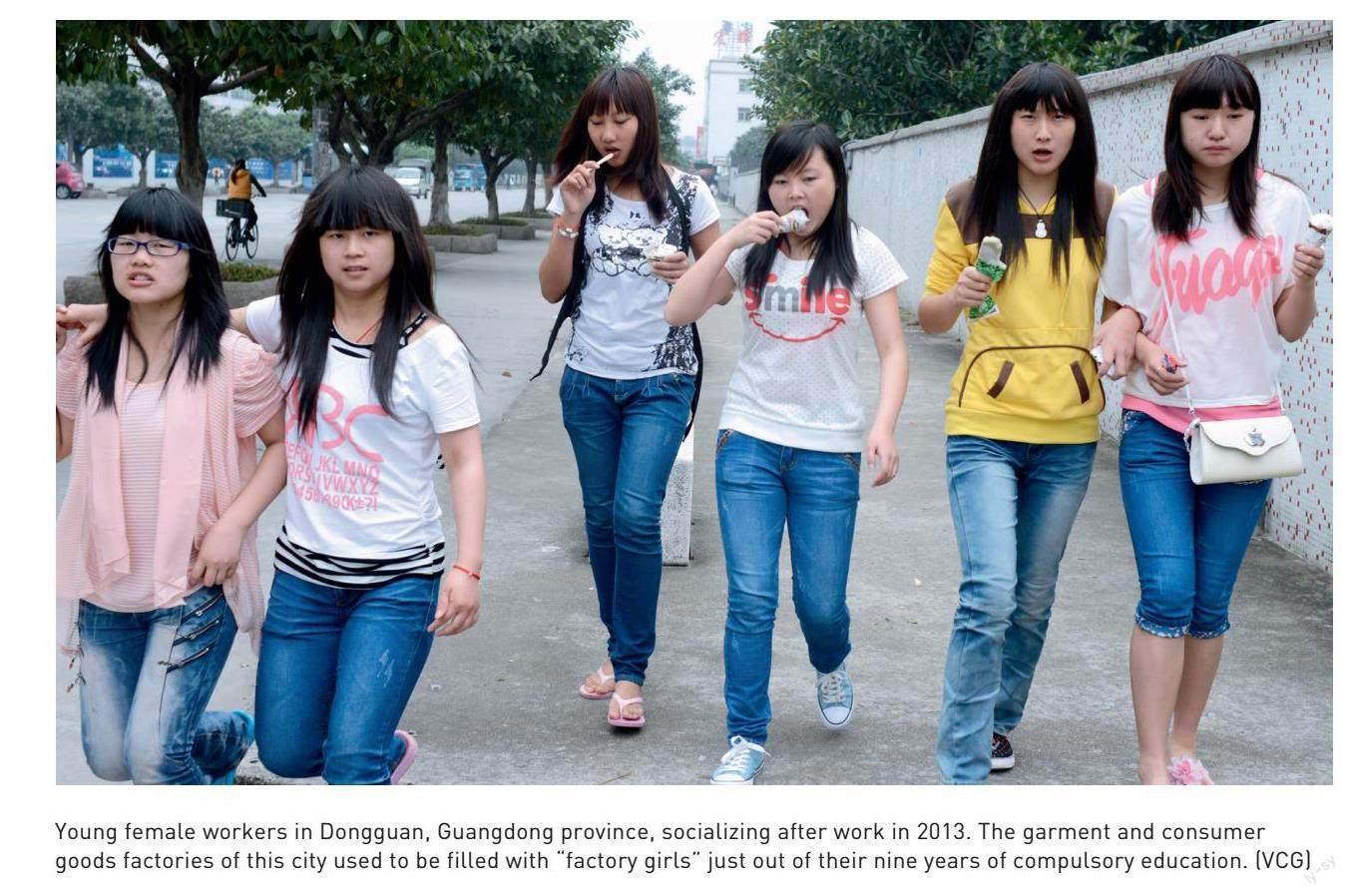

Many prefer the digital economy over factory work逃離工廠流水線的零零后
Xiao Ying is only 23 years old and already belongs to a dying breed. “A girl born in the 2000s working in a garment factory, do other people my age find this embarrassing?” the Jiangxi province native asks in the title of one of her vlogs on video streaming platform Bilibili.
The question might seem absurd to the millions of migrant workers who have filled Chinas factory assembly lines since the 1980s, leaving their hometowns in search of work and opportunity in urban areas and manufacturing hubs. But Xiao Yings generation, known in China as linglinghou (零零后) or “the post-00s”—more educated, independent, and ambitious than their parents—are different, and fewer and fewer of them are drawn to factory work now.
The regimented work of the assembly line is partly to blame. As Xiao Ying, who dropped out of middle school at 14, explains in her videos, every day at the factory is the same. She gets up shortly before 8 a.m. in her dormitory in central Jiangxis Ganzhou city. The sides of her bed frame are covered with thick blankets to create the tiniest of private spaces and shield her from the view of her coworkers who occupy other beds like this in the same room. It only takes Xiao Ying a few minutes to get to work across the street in the garment factory where she will sit at her workstation and repeat the same motion hundreds of times over the course of the next 12 hours.
By 9.30 p.m. when her workday ends, she will have sewn sleeves onto hundreds of shirts before passing them along the assembly line. Eventually, the shirts will be sold for 129 yuan on e-commerce platform Taobao. To make that amount of money, Xiao Ying has to process about 280 shirts, earning less than half a yuan per piece. “My life is the same every single day, the sewing machine never stops,” she says in one of her vlogs.
China now has nearly 4.6 million migrant workers born after 2000, according to a 2020 report by the National Bureau of Statistics. Instead of Xiao Yings humdrum routine, many prefer working in the digital platform economy and other new gig-based opportunities for the promise of more autonomy and flexibility. According to domestic media, some factories in south Chinas Pearl River Delta, the powerhouse of light manufacturing, are even reported to be struggling to staff assembly lines. Where once young people lined up out the door to apply to assemble clothing and electronics, bosses now go out on the street holding recruitment placards promising flexible hours and tasty meals.
Young and yearning for autonomy
Migrant workers have played a vital role in Chinas economic development since the 1980s, when the country began to transition away from the planned economy and encouraged the development of private enterprise and foreign trade. As factories supplying foreign markets with manufactured goods sprouted up in Chinas eastern coastal areas, workers from rural villages and poorer hinterland regions (usually central and western China) provided the cheap labor to fuel the manufacturing and construction boom. More recently, these internal migrants have also staffed the service industry, taking jobs as, for example, delivery drivers, restaurant workers, and hairdressers in big cities.
They are now demanding more from their employers. “The long working hours and strict supervision in a factory go against young peoples desire for more freedom. They have their own social circle, they are eager to socialize, and they also need to have their private space,” a consultant with Shenzhen adult education firm Sincere Education, who did not give their name, tells TWOC via an online chat, explaining why young Chinese may be less and less attracted to such work.
“This year finding workers is more difficult than last year,” one recruiter for an outdoor gear factory in Yongkang in eastern Chinas Zhejiang province told China Newsweek this February, observing a 20 percent decrease in workers under 25 compared to the previous year. The recruiter explained that their monthly salary, at around 5,000 yuan, is no longer significantly higher than in west-central China, so there are fewer people willing to migrate to Yongkang for work.
Factories have responded with creative ways of drawing people in. In Yongkang (where around half of the 1.2 million population are migrant workers who produce over 60 percent of Chinas thermos bottles, among other things), factories offered cash and other prizes for workers who returned to the factories after the Lunar New Year holiday, including a prize draw for vouchers worth 59,800 yuan to buy a Chinese-made electric car. The conditions for participating in these lotteries were lowered this year to allow fresh recruits and those not working in manufacturing to participate.
Managers have also loosened disciplinary measures like fines for showing up late or not meeting quotas. Working hours and holiday allowances may also be more generous, according to the recruiter.
For people with low education levels and limited job opportunities, the factory can still provide some freedom and independence away from their hometown and family. “Im a linglinghou and did odd jobs for four years, then I was idle at home for two to three years. Now I really want to work in a factory,” comments one young woman from northeastern Chinas Jilin province under a social media post by Sincere Education. “Where Im from Im already considered old, and if I dont leave my hometown for work now, then Ill be forced to marry and thatll be the end of my youth just like that.”
But this seems to be the exception rather than the norm, and even when factories manage to recruit linglinghou, they may not stay for long. “Their sense of self is constantly forming and growing stronger,” says the education consultant from Shenzhen.
Another recruiter from Yongkang told China Newsweek that linglinghou workers are more likely to be the only child in their family and have parents willing to help them out, and arent likely to put up with constraints. “They will quit at a moments notice.”
Out of the assembly line and into the algorithm
By comparison one of the recruiters from Yongkang observes that food delivery and package delivery are more likely to attract linglinghou workers. “There is more freedom in it compared to working in the factory. The pay is probably a little higher too.”
Xiao Liu from Shandong province is one convert. He was born in 2002 and dropped out of middle school at age 14. He began stints on different assembly lines in Yiwu city, Zhejiang, where he made things like graduation hats and candy gift boxes meant for export, then began working as a food delivery driver in Shanghai in 2020.
“I moved to Shanghai because I wanted to see more of the world, I wanted to experience new things in life.” After one and a half years of doing deliveries in Shanghai, he moved to Beijing for the same reason: “I wanted to see new things. Im still young and want to take the chance to get around a bit while I still can,” he tells TWOC during one of his breaks in Beijings busy Sanlitun area.
But for another Sanlitun delivery driver, who gave his surname as Han, it was financial pressure that got him into food delivery. Born in 2000, Han tried running his own restaurant in his hometown in Hebei province at one point after high school, but ended up losing money and defaulting on loans. Drawn by the promise of quick and easy money through ads he saw on Douyin, Chinas version of TikTok, he got into food deliveries in Beijing—where demand for drivers and pay per order is higher than elsewhere.
Han is now one of the many so-called gig couriers, working for one of the two major food delivery platforms on an order-by-order basis through his smartphone. “Last year I could make 14,000 to 15,000 yuan per month, but now its different; there arent that many orders anymore and I only make around 7,000 per month,” he tells TWOC.
Some reports suggest that in certain major Chinese cities like Beijing, the food delivery industry is reaching saturation, with too many drivers competing for orders, especially in the generally slower spring season when people start going out more and ordering in less. To make any substantial money, drivers have to accept multiple orders through their apps and string them together into quick delivery routes.
Some drivers have taken to social media to share their experiences and insights. Xiao Fei, from the outskirts of Taizhou in Zhejiang province, shares his daily life as a delivery driver on Xiaohongshu. In one video he is seen sitting on his electric scooter in Wenzhou, a port city and manufacturing hub in south Zhejiang, wearing a blue coat and helmet provided by his employer. “It was raining that day and there were lots of orders. I didnt really want to come out and deliver, but the pay-per-order is higher when its raining,” Xiao Fei, whose wife and three children remain in Taizhou while he works in Wenzhou, tells TWOC in an online chat.
The pay-per-order ranges from around 6 to 12 yuan on average, depending on the time of day, distance traveled, weather, and other factors. That day, Xiao Fei completed 10 orders in 40 minutes, making a little over 80 yuan. Xiao Ying in the garment factory would have to process 175 shirts to make the same amount of money, and with about 30 seconds per processed shirt, it would have taken her more than twice as long.
But things dont always go so smoothly. The drivers are in a constant race against time and the algorithmic systems that distribute orders, with the risk of losing their ranking in the system (leading to fewer orders being assigned to them) or even being fined if they are late. “Its impossible to not run red lights. You have to be running red lights if you want to make it in time,” says Han about his experience during peak times in Beijing.
But just as young workers are demanding more from factory jobs, and a Chinese online catchphrase alleges that “linglinghou workers are revolutionizing the workplace” in white-collar sectors, gig workers are finding their own ways to protect their interests. In a 2022 paper, Yu Zizheng, a lecturer in communications at the University of Greenwich, and his team of researchers stated that delivery workers are developing “algorithmic solidarity” to facilitate everyday resistance, for example by establishing chat groups on WeChat where they share insights like faster routes and tips on how to “game” the algorithm and manipulate the apps to their advantage.
Back in Sanlitun, the mid-afternoon lull in food orders is coming to an end, but Xiao Liu is in no hurry to rush off again on his scooter. “I dont have any big dreams…Reality will end up crushing your dreams anyway. Right now Im doing okay for myself, but later when I have to buy a house and a car in order to get married, then the pressure will be on,” he says. “Right now Im not under too much pressure, so I dont have to do my deliveries recklessly. Safety first.”
