
The Shady World of Online Reviews
2023-06-22 19:32:58紀菁菁
漢語世界(The World of Chinese) 2023年2期
紀菁菁
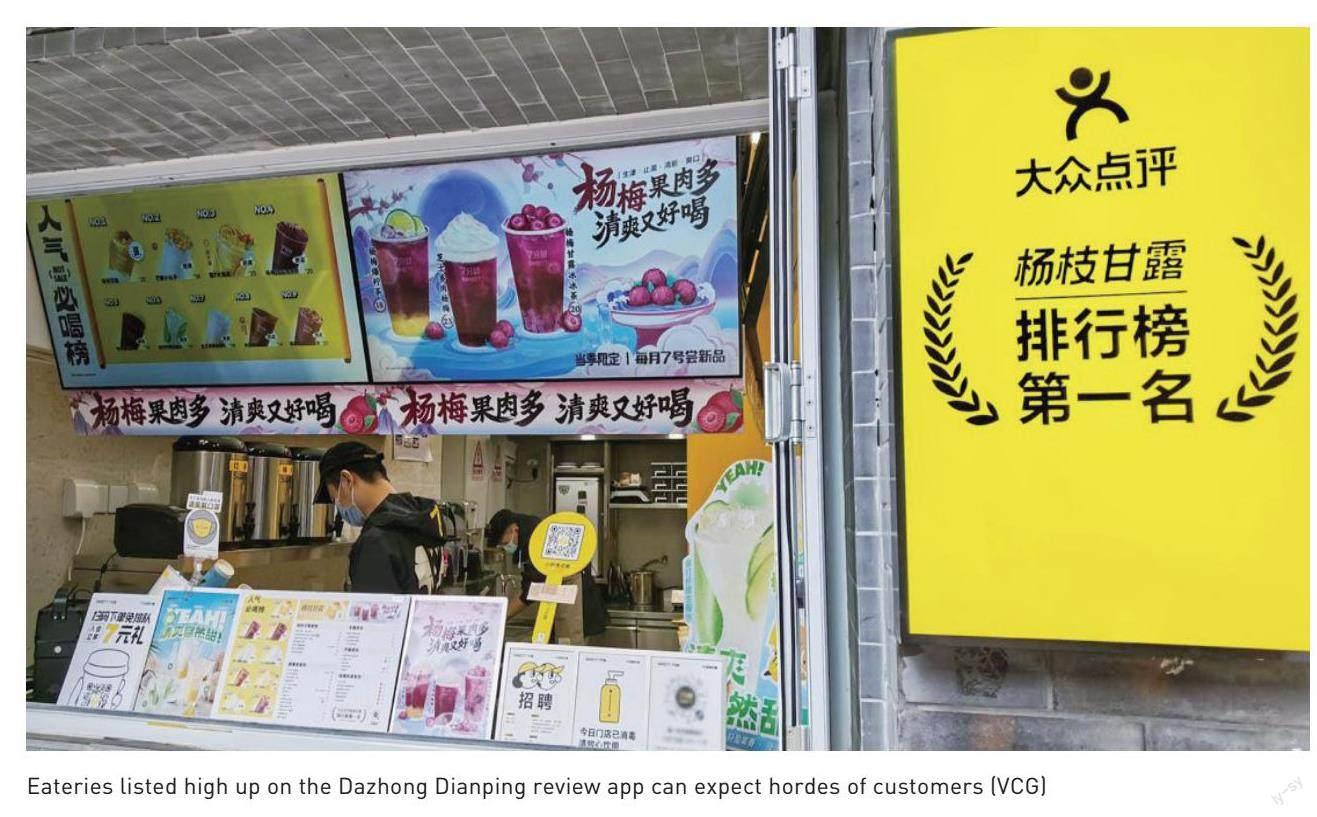

In the realm of Chinese consumer reviews, fakes lurk around every corner and a “water army” can torpedo e-commerce businesses
當“刷評”成電商潛規則
On a Sunday evening in a shopping mall in Beijing, Dazhong Dianping sinks yet another restaurants chances of gaining Chen Xins business. “I said to my boyfriend, ‘Are you sure we should eat here? Its only got 4.1 [out of 5]…with many negative reviews saying the food is poor. Maybe we should find another place,” Chen tells TWOC, indicating the unlucky Thai restaurants review score on the app.
Whenever Chen, a 29-year-old accountant, chooses a restaurant to eat at, she always checks Dazhong Dianping first. She swipes through comments and feedback from previous customers before she decides where to go. Restaurants, bars, parks, tourist sites, and all manner of entertainment venues are rated out of 5 stars according to user reviews on the app, and anything under 4.5 is likely to raise doubts in Chens mind. The platform is practically gospel to her: “Referring to these reviews can help us avoid some unpleasant experiences,” she says.
Chen, along with millions of other Chinese consumers, relies on ratings platforms like Dazhong Dianping to inform her purchasing decisions in everything from e-commerce to dining out. But she and other users are becoming increasingly wary as the growing influence of these online ratings has led to rampant review manipulation. Rather than improve their services or ensure product quality, many sellers and platforms engage in shady tactics such as offering discounts for five-star ratings, deleting bad reviews, or even employing hordes of fake reviewers to boost their scores and business, sometimes with fatal consequences for users duped into buying faulty products.
High ratings for sale
Since 2003, when Dazhong Dianping was founded as one of Chinas first online consumer review platforms, similar apps in the country have grown to have millions of users. Dazhong Dianping merged with group buying and online food delivery service Meituan in 2015; the merger has since become Chinas most popular review platform with over 290 million monthly active users. On e-commerce platform Taobao, users post 20 million reviews and comments a day.
Consumers in China seem to trust user-generated reviews more than descriptions of products and advertisements on corporate websites. According to KPMGs “Chinas Connected Consumers 2016” report, 60.8 percent of Chinese shoppers search online for reviews and recommendations before making an online purchase—a rate far higher than that of consumers in the US (39.4 percent). Chinese consumers are also more willing to voice their opinions on purchases online: Over half of Chinese online shoppers review the products they buy, compared to a global average of 30.7 percent.
Yet the authenticity of reviews is difficult to guarantee, in part because of the platforms business models. On Dazhong Dianping users can boost their ranking and earn privileges and discounts for posting “high-quality” reviews (with at least three photos and at least 100 characters in length) of products, services, and destinations. Those who reach “Level Three” or above in the apps user rankings (by posting frequent high-quality reviews) can earn free dining opportunities, discounts on Meituans shared bikes, and even 50 percent discounts on group-buying promotions through Meituans other platforms.
The platform also charges restaurants a commission from revenue generated through Meituans group buying function. Businesses can pay to boost their establishment up the search list for keywords, and buy targeted advertisements and other promotional opportunities on the platform.
Apart from paying review platforms, businesses sometimes resort to other dubious tactics to gain a five-star rating. On Taobao, sellers have offered cash back and discounts for positive reviews since at least 2013, when China National Radio reported merchants offered customers between 1 to 10 yuan for five-star ratings which would increase their stores credibility and prominence on the platform.
The practice continues unabated. “I have been contacted several times by merchants who told me I can become their VIP customer, but it turned out that they just wanted to encourage me to post positive reviews in return for money,” says Wu Fan, an online shopping enthusiast from Shanghai. Wu says many Taobao sellers include “discount coupons” with products she buys, offering the customer cash back for a five-star review.
Wu reported these Taobao sellers to the platform, but found that the cash-for-review practice was not listed among the wrongdoings that one can select in the online complaint form, so she could only cite the incident under “harassment.” “If the platform doesnt clearly designate these violations as items to be reported, its hard for consumers to believe that they will combat the violations thoroughly,” she says.
Reviewers going pro
Some businesses go further than bribing customers for reviews, and instead employ fake reviewers—sometimes on an industrial scale. The “water army (水軍),” as these groups of fake social media users have come to be known, have existed for years and, for just a few hundred yuan in some instances, can boost products or sink competitors by flooding their listings with reviews and ratings from fake profiles.
Some news reports have revealed that fake reviewers, listed as “store improvers,” can be hired on Xianyu, a secondhand marketplace linked to Taobao, and other crowdsourcing platforms to achieve tens of thousands of positive reviews or “likes” on posts. In March this year, undercover filming by CCTV revealed the operations of one such click farm: thousands of mobile phones lined up in an office and controlled via a computer so that they swipe through and leave “likes” on clients livestreams to boost them up platforms rankings and attract customers for their products. “You can buy 100,000 likes for 18 yuan, and 30 comments for 30 yuan,” one manager at the click farm told the undercover journalists, explaining that the practice is already an “open secret” in the livestreaming industry.
Last July, newspaper Legal Daily reported that a Nanjing information technology company acting as the sales agent for a skin tightening beauty device hired water armies to defame its Guangdong competitor on several online platforms at least six times. The hired shills spread false information about the competing beauty device, including that it causes skin allergies and even contains harmful metals. This apparently led to losses of 1.8 million yuan for its competitor, who reported the Nanjing company to the police.
Authorities have attempted to crack down on water army practices—the click farm exposed by CCTV was shut down, while 4,000 suspects were arrested from 2019 to 2022 as part of a “Clean Up the Internet” campaign led by the Ministry of Public Security, according to Global Times. Taobao also explicitly forbade the practice of cash for good reviews in December 2021. However, product recommendations and reviews are evolving in ways that make it even more difficult to prove illegality. On lifestyle app Xiaohongshu (RED), around 200 million monthly active users (including professional vloggers, influencers, and regular users) search for products, review purchases, and make recommendations, and there is little way for the platform to tell whether they are paid to do so.
Chen browses Xiaohongshu about a dozen times a day, finding new products to buy and restaurants to visit, but she now complains that the line between advertisements or sponsored product recommendations and non-sponsored ones is becoming increasingly blurry. Xiaohongshu bloggers often disguise commercial advertisements or sponsored content as if they were regular, personal posts, she says. “Its very unpleasant when I have to try to distinguish whether a post that intrigues me on the platform is an advertisement or not.”
Though sponsored content is supposed to be clearly labeled on the platform, brands know that the label puts off many consumers, so they may collaborate with influencers clandestinely to promote their products. Lizhi News reported in 2021 that groups and individuals offer to ghostwrite and share Xiaohongshu posts for as little as 4 yuan.
Chen shares that she bought a lipstick after reading a post with more than 7,000 “likes” about its beautiful color and its moisturizing performance, only to find it had a bland color and gave her chapped lips when she used it. Searching for more reviews of the product online, she found many other users who experienced the same lackluster outcome. Chen now believes the post recommending the lipstick may have been an unlabeled sponsored ad. In 2021, the platform suspended 29 brands accounts on the grounds that they had been involved in false marketing by recruiting water armies to like their posts, post reviews under their posts, or write posts recommending their products or services.
Fake reviews, real consequences
Dubious reviews and rankings can have fatal consequences. In 2016, 21-year-old cancer patient Wei Zexi died after undertaking experimental treatment at a hospital in Beijing that appeared high up in the search results of the Baidu search engine. The hospital had paid Baidu to become a top result, but was not qualified to treat Weis illness.
The tragedy stirred public wrath over online advertising and the credibility of online recommendations. Authorities implemented new regulations soon after which limited the number of sponsored results on search engine pages and made advertisements more distinguishable from organic results by highlighting commercial content in blue and adding a “commercial promotion” tag to such results.
This tragedy and other issues since then have combined to greatly undermine public trust in online reviews and rankings. According to a survey covering 22,765 respondents from different provinces and municipalities in China by the China Consumers Association in 2022, consumers are increasingly concerned about online reviews. Respondents are still enthusiastic to post online reviews after consumption, but have become more trusting of negative and neutral reviews than positive ones.
Regulators have attempted to put a stop to many of the practices that consumers are unsatisfied with. The 2017 amended Anti-Unfair Competition Law says businesses cannot produce false or misleading commercial material about the sales of their goods, or use user reviews to deceive and mislead consumers. An amended e-commerce law from 2019 stipulates that online retailers must not deceive or mislead consumers with fictitious transactions or fabricated reviews.
But reviews can make or break a business, and so obtaining positive ones, no matter how dubiously, remains a priority for retailers. “Bad reviews are a disaster for a newly founded store, whose [trust] rating [on the site] will go down rapidly. Then the platform will limit their traffic, which means the store gets little exposure,” says a Taobao merchant based in Zhejiang province, who did not wish to be named. “The competition among established stores for positive reviews is fiercer, especially because they want a higher ranking on the platform and have more money to buy good reviews.”
After 10 years selling clothing on Taobao, the merchant has achieved a rating of 4.7 out of 5 but feels constant pressure to stay at that level or improve. The seller tells TWOC they have never used fake reviews to boost their rating, but would consider it if the stores score fell below 4.5.
With manipulated ratings unlikely to go away soon, users are mainly left to fend for themselves. Savvy shoppers employ techniques to detect potentially fake reviews. “I am used to spotting product comments and images that look very similar, which are most probably the work of the water army,” says Wu Fan. Wu and other users also suggest checking the reviewers profile and previous posts to see their other review activity, and looking for reviews that contain specific information that couldnt easily be copy and pasted.
Even so, Wu says shes still been tricked by fake recommendations, and less experienced users will struggle even more: “My parents are in their 60s and find it very hard to distinguish real reviews from fake ones, which worries me a lot,” she says.
“Fake online reviews wont disappear overnight,” says Wu. “I dont know how to improve my ability to identify fake ones. Maybe I just have to get scammed a few more times.”
