基于炎癥營養參數的評分系統預測胃上部癌新輔助化療效果的研究
2023-04-29 18:03:53朱紅蘋劉睿清張憲祥張茂申王東升盧云
精準醫學雜志 2023年5期
朱紅蘋 劉睿清 張憲祥 張茂申 王東升 盧云

[摘要] 目的 探討局部進展期胃上部癌患者新輔助化療(NACT)前后炎癥營養指標與NACT療效的關系,并建立臨床預測模型。方法 選取2013年4月—2022年1月于我院胃腸外科接受NACT的胃上部癌患者117例,根據化療結果分為有效組與無效組,收集患者的年齡、性別、吸煙史、飲酒史、首發癥狀、腫瘤部位、腫瘤分化程度、腫瘤臨床分期、腫瘤病理類型、NACT前1周內及NACT后1周內的血常規結果等臨床資料,經單因素及多因素分析后篩選出影響NACT療效的因素,進一步構建列線圖模型并驗證該模型的性能。結果 多因素分析結果顯示,患者NACT前后的血漿中性粒細胞與淋巴細胞比值(NLR)差值(△NLR)(OR=2.043,95%CI=1.334~3.127,P<0.05)、血漿血小板與淋巴細胞比值(PLR)差值(△PLR)(OR=1.007,95%CI=1.000~1.014,P<0.05)、血清白蛋白(Alb)差值(△Alb)(OR=0.936,95%CI=0.878~0.997,P<0.05)以及T分期(OR=4.044,95%CI=1.128~14.501,P<0.05)均為影響NACT療效的獨立危險因素。基于多因素分析結果構建胃上部癌NACT療效列線圖預測模型,該模型受試者特征曲線下面積為0.877,繪制的校準曲線及臨床決策曲線顯示校準度較好且與實際結果較一致。結論 胃上部癌患者△NLR、△PLR、△Alb及T分期為影響NACT療效的獨立危險因素,胃上部癌NACT療效預測模型具有良好的預測性能和臨床應用價值。
[關鍵詞] 胃腫瘤;慢性病指標;營養評價;化學療法,腫瘤,局部灌注;危險因素;回歸分析
[中圖分類號] R735.2
[文獻標志碼] A
VALUE OF A SCORING SYSTEM BASED ON INFLAMMATORY AND NUTRITIONAL INDICATORS IN PREDICTING THE EFFICACY OF NEOADJUVANT CHEMOTHERAPY FOR UPPER GASTRIC CANCER \? ZHU Hongping, LIU Ruiqing, ZHANG Xianxiang, ZHANG Maoshen, WANG Dongsheng, LU Yun? (Gastrointestinal Surgery, The Affiliated Hospital of Qingdao University, Qingdao 266555, China)
[ABSTRACT] Objective To investigate the association of inflammatory and nutritional indicators with the efficacy of neoadjuvant chemotherapy (NACT) in patients with upper gastric cancer before and after NACT, and to establish a clinical predictive model. Methods A total of 117 patients with upper gastric cancer who underwent NACT in Department of Gastroenterology in our hospital from April 2013 to January 2022 were enrolled, and according to the efficacy of chemotherapy, they were divided into effective group and ineffective group. Related clinical data were collected, such as age, sex, smoking history, drinking history, initial symptoms, tumor location, degree of tumor differentiation, tumor stage, tumor pathological type, and routine blood test results within one week before NACT and within one week after NACT. Univariate and multivariate analyses were performed to identify the influencing factors for the efficacy of NACT, and then a nomogram model was established and validated. ResultsThe multivariate analysis showed that the difference in plasma neutrophil-to-lymphocyte ratio before and after NACT (△NLR) (OR=2.043,95%CI=1.334-3.127,P<0.05), the difference in plasma platelet-to-lymphocyte ratio before and after NACT (△PLR) (OR=1.007,95%CI=1.000-1.014,P<0.05), the difference in serum albumin before and after NACT (△Alb) (OR=0.936,95%CI=0.878-0.997,P<0.05), and T stage (OR=4.044,95%CI=1.128-14.501,P<0.05) were independent risk factors for the efficacy of NACT. A nomogram predictive model for the efficacy of NACT in upper gastric cancer was constructed based on the results of the multivariate analysis, with an area under the ROC curve of 0.877, and the calibration curve and the clinical decision curve showed that the model had good calibration and consistency with the actual results. Conclusion △NLR, △PLR, △Alb, and T stage are independent independent risk factors for the efficacy of NACT in patients with upper gastric can-cer, and the predictive model for the efficacy of NACT for upper gastric cancer has good predictive performance and clinical application value.
[KEY WORDS] Stomach neoplasms; Chronic disease indicators; Nutrition assessment; Chemotherapy, cancer, regional perfusion; Risk factors; Regression analysis
胃癌屬于全球人群中第5大常見和第3高病死率的腫瘤[1],近年來胃上部癌發病率呈上升趨勢[2]。既往研究表明新輔助化療(NACT)可提高腫瘤根治性切除率并改善患者預后[3-4]。目前歐洲腫瘤內科學會(ESMO)指南[5]、美國國立綜合癌癥網絡(NCCN)指南[6]及我國2018版《胃癌診療規范》[7]均推薦局部進展期胃癌患者采用NACT治療。
既往研究表明,中性粒細胞與淋巴細胞比值(NLR)、血小板與淋巴細胞比值(PLR)、淋巴細胞與單核細胞比值(LMR)、系統免疫炎癥指數(SII)及血清白蛋白(Alb)等炎癥營養指標均可作為評估胃癌患者預后的標志物[8-10]。炎癥反應可通過多種機制導致腫瘤生長、侵襲和轉移[11],患者營養不良可導致腫瘤進展。既往研究顯示,炎癥營養指標與腫瘤患者營養不良相關[12]。有研究表明第三腰椎(L3)水平橫斷面機體組成成分面積能夠反映全身營養狀況[13]。本研究通過探討炎癥營養指標及其NACT前后差值與NACT療效的關系,構建相關指標預測胃上部癌NACT效果的臨床模型,旨在為醫務工作者采取相關治療措施時提供一定參考。現將結果報告如下。
1 資料和方法
1.1 一般資料
選取2013年4月—2022年1月于我院胃腸外科接受NACT的胃癌患者。患者納入標準:①年齡18~75歲者;②經胃鏡活檢病理檢查證實為胃上部癌者;③接受NACT治療者;④NACT前腫瘤臨床分期≥cT2或有淋巴結轉移者;⑤影像學檢查未見腫瘤遠處轉移者;⑥機體其他器官功能正常者;⑦用胃癌一線化療藥物(主要包括氟尿嘧啶類、鉑類與紫杉醇類)治療者。排除標準:①NACT療程<2周期者;②行NACT后未手術者;③具有血液系統疾病及其他有血常規異常的疾病者。
收集患者的年齡、性別、吸煙史、飲酒史、首發癥狀、腫瘤部位、腫瘤分化程度、腫瘤臨床分期、腫瘤病理類型以及NACT前1周內、NACT后1周內血常規指標,計算患者NACT前后NLR、PLR、LMR、SII、Alb。獲取患者NACT前1個月內以及手術前最后一次CT平掃的L3橫斷面單幅圖像,通過sliceOmatic圖像分析軟件計算該層面機體組成成分面積(皮下脂肪、內臟脂肪及肌肉組織面積)[14],并計算NACT前后患者L3水平橫斷面機體組成成分面積的差值。由兩位放射科專家通過CT平掃對比患者NACT前后胃上部胃壁厚度的變化,按照實體瘤的療效評價標準[15]對胃上部癌NACT療效進行準確評估,評估結果分為完全緩解(CR)、部分緩解(PR)、疾病穩定(SD)和疾病進展(PD),根據NACT治療結果將患者分為有效組(CR、PR者)和無效組(SD、PD者)。
1.2 統計學分析
采用SPSS 26.0統計學軟件進行統計分析,服從正態分布的計量資料以x?±s表示,組間比較采用t檢驗;計數資料以例(率)表示,組間比較采用χ2檢驗。采用多因素logistic回歸模型分析NACT療效的影響因素。使用R語言建立預測NACT療效的列線圖預測模型,并對模型效能進行評價。以P<0.05為有統計學差異。
2 結果
2.1 兩組患者一般資料比較
本研究共納入患者117例,其中男性患者89例,女性患者28例,60歲及以上患者76例。有效組、無效組患者腫瘤T分期及分化程度差異有顯著性(χ2=9.584、6.764,P<0.05)。見表1。
2.2 兩組患者的炎癥及營養指標比較
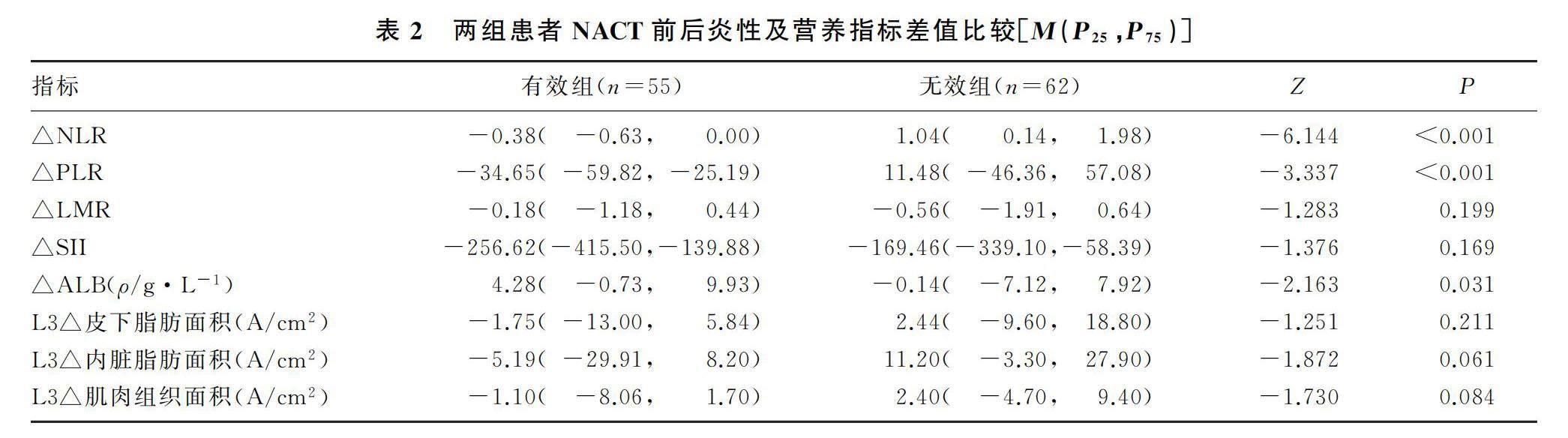
兩組患者的NACT前后NLR差值(△NLR)、PLR差值(△PLR)以及Alb差值(△Alb)相比較,差異均具有統計學意義(t=-3.781~2.496,P<0.05)。見表2。
2.3 影響NACT療效的多因素logistic回歸分析
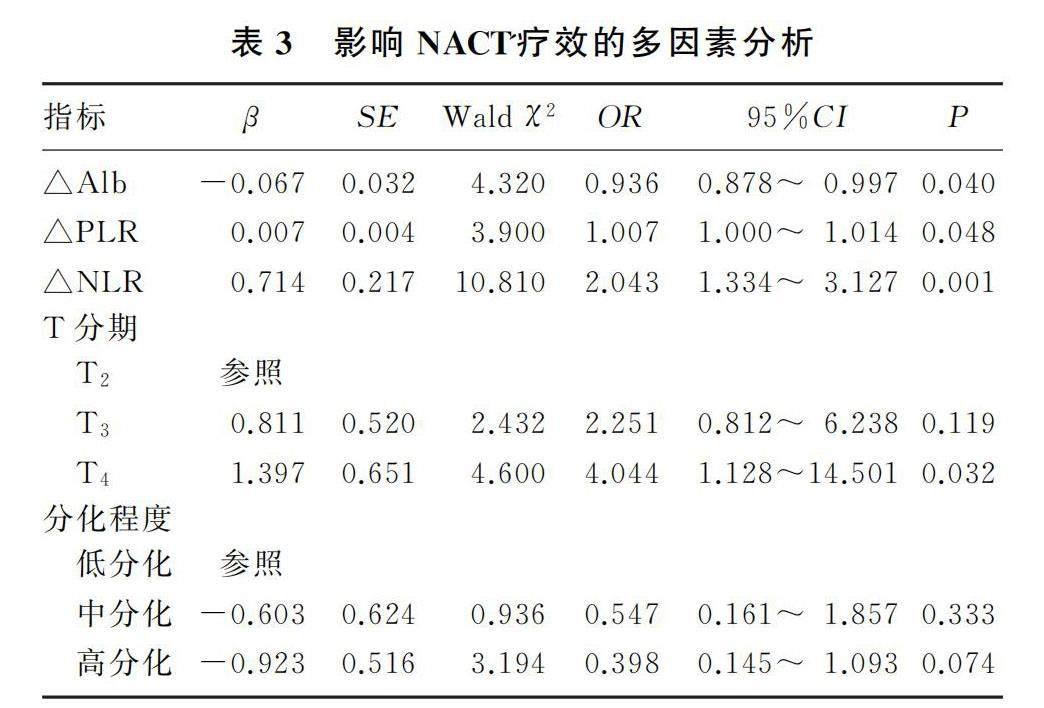
將t檢驗及χ2檢驗中P<0.05的影響因素納入多因素logistic回歸模型,分析結果顯示T分期、△NLR、△PLR和△Alb為影響NACT療效的獨立危險因素(P<0.05)。見表3。
2.4 列線圖預測模型的構建
基于多因素logistic回歸分析結果構建預測NACT療效的列線圖模型(圖1A);繪制列線圖預測模型的受試者特征(ROC)曲線(圖B),計算曲線下面積(AUC)為0.877,95%CI=0.812~0.941。采用Bootstrap自抽樣法對上述模型進行內部驗證,重復抽樣1 000次,計算C-index值為0.856,表示該模型具有良好的預測價值。繪制校準曲線及臨床決策曲線結果顯示,該模型校準度較好,模型和實際結果具有較好的一致性,并且具有明顯正向凈收益,在預測胃上部癌NACT療效方面具有較好臨床實用性(圖1C、D)。
3 討論
近年來,全球胃上部癌發病率逐漸增高,針對胃上部癌的治療方案也逐漸個體化以及精準化。目前NACT方案已經成為局部進展期胃癌的首選治療方案[5-6],且據以往研究,針對胃上部癌的NACT治療具有良好效果[16]。隨著NACT的推廣,對其療效的預測已經成為研究熱點。一項研究表明NLR、PLR可以作為NACT療效的獨立預測指標[17],但也有部分學者認為NLR和PLR對腫瘤預后預測并無意義[18]。因此,雖然關于NACT療效判斷的研究較多,但評判標準仍存在爭議。本研究綜合多數研究中納入的指標對NACT療效預測進行探討,以期得出更準確結果。
炎癥反應可導致腫瘤的發生發展,機體炎癥反應可引起外周血中性粒細胞、淋巴細胞等血細胞數量異常,并通過相關途徑導致腫瘤進展[6]。外周血NLR和PLR作為系統炎性反應指標,已被證實與多種腫瘤的發生發展有關系[19]。因此本研究通過NACT前后NLR、LMR、SII和PLR等炎癥指標變化預測NACT療效具有可行性。機體營養不良易致腫瘤進展,較差的營養狀態可加劇腫瘤細胞增殖和腫瘤微環境形成,最終致腫瘤發展及轉移。血清Alb及CT平掃L3水平橫斷面機體組成成分可反映患者機體營養狀態[14],故本研究亦將上述兩者作為反映患者NACT前后營養狀況的研究指標。
本研究NACT有效組的患者NACT后NLR、PLR、LMR和SII明顯降低,反映出淋巴細胞數量的增加可能是由于NACT誘導致炎癥下調的原因。與炎癥標志物相反,NACT后Alb升高,反映患者營養狀態得以改善。經研究發現,NACT前低血小板與中性粒細胞比值以及高淋巴細胞與白細胞比值都屬于NACT療效的獨立危險因素[20]。有研究顯示,NACT后NLR與淋巴細胞計數減少為化療效果的獨立危險因素[21]。此外腫瘤細胞可誘導血小板活化并聚集,使PLR升高,導致腫瘤進展。
ISHIBASHI等[21]研究顯示NACT前NLR升高為食管癌預后的獨立危險因素,KIM等[22]研究結果表明NACT前NLR升高為胃癌患者預后的獨立危險因素,MUNGAN等[23]的研究結果則顯示NACT前較高PLR和NLR與胃癌患者不良預后有關。本研究兩組患者的T分期、△NLR、△PLR以及△Alb表現出顯著性差異,且T分期、△NLR、△PLR和△Alb為胃上部癌NACT療效的獨立危險因素。另外,本研究關注NACT前后相關炎癥營養指標的差值因素,并發現相關炎癥營養指標差值對胃上部癌NACT療效具有預測價值,故該模型具有一定創新性。
本研究構建的預測NACT療效的列線圖模型以國人臨床數據為基礎,因此更適用于我國的胃癌NACT患者,此外既往研究中多以單一因素為基點討論胃癌NACT療效的影響因素,本研究系統討論了多個臨床指標,依據每個參數的權重和重要性構建了列線圖預測模型,且血常規結果、Alb水平、腫瘤分化程度、腫瘤臨床分期等皆為臨床工作中易于獲取的實用性指標,因此本研究構建的列線圖預測模型具有一定的實用性。本研究也存在不足之處,如樣本量偏少,且為回顧性研究,未進行外部驗證。上述不足需在后期研究中進行完善。
綜上所述,T分期、△NLR、△PLR和△Alb為胃上部癌NACT療效的獨立危險因素,基于以上因素構建的臨床預測模型則可以準確地判斷胃上部癌NACT臨床效果。
作者聲明:所有作者均參與了研究設計、論文的寫作和修改。所有作者均閱讀并同意發表該論文,且均聲明不存在利益沖突。
[參考文獻]
[1]BRAY F, FERLAY J, SOERJOMATARAM I, et al. Global cancer statistics 2018:GLOBOCAN estimates of incidence and mortality worldwide for 36 cancers in 185 countries[J]. CA A Cancer J Clin, 2018,68(6):394-424.
[2]LI P, JING J, LI R, et al. Upper gastrointestinal cancer in China: Spatial epidemiologic evidence from screening areas[J]. Cancer Prev Res (Phila), 2020,13(11):935-946.
[3]KUMAR CG P, MUDULY D, IMADUDDIN M, et al. P-282 Factors predicting response to neoadjuvant chemotherapy in gastric cancer[J]. Ann Oncol, 2021,32:S193.
[4]ZHU Z, GONG Y B, XU H M. Neoadjuvant therapy strategies for advanced gastric cancer:Current innovations and future challenges[J]. Chronic Dis Transl Med, 2020(3):147-157.
[5]SMYTH E C, VERHEIJ M, ALLUM W, et al. Gastric can-cer: ESMO Clinical Practice Guidelines for diagnosis, treatment and follow-up[J]. Ann Oncol, 2016,27(suppl 5):v38-v49.
[6]AJANI J A, D'AMICO T A, ALMHANNA K, et al. Gastric cancer, version 3.2016, NCCN clinical practice guidelines in onco-logy[J]. J Natl Compr Canc Netw, 2016,14(10):1286-1312.
[7]陳俊良,王風華. 2021版CSCO胃癌診療指南轉移性胃癌更新解讀[J]. 中國腫瘤臨床, 2022,49(7):325-330.
[8]ZHANG L X, WEI Z J, XU A M, et al. Can the neutrophil-lymphocyte ratio and platelet-lymphocyte ratio be beneficial in predicting lymph node metastasis and promising prognostic markers of gastric cancer patients? Tumor maker retrospective study[J]. Int J Surg, 2018,56:320-327.
[9]LI K J, XIA X F, SU M, et al. Predictive value of lymphocyte-to-monocyte ratio (LMR) and neutrophil-to-lymphocyte ratio (NLR) in patients with oesophageal cancer undergoing concurrent chemoradiotherapy[J]. BMC Cancer, 2019,19(1):1004.
[10]CHEN G J, WUXIAO Z J, LIANG Y, et al. Inflammation-based Glasgow prognostic score as an independent prognostic factor in patients with angioimmunoblastic T-cell lymphoma[J]. Chin Med J (Engl), 2021,134(5):579-581.
[11]SINGH N, BABY D, RAJGURU J P, et al. Inflammation and cancer[J]. Ann Afr Med, 2019,18(3):121-126.
[12]AKBOGA S A, GOKCE A, HATIPOGLU M, et al. The relationship between mortality and inflammatory markers and the systemic immune inflammatory index in patients in the intensive care unit with a pneumothorax as a complication of COVID-19 disease[J]. Ir J Med Sci, 2022,191(4):1931-1936.
[13]UOJIMA H, CHUMA M, TANAKA Y, et al. Skeletal muscle mass influences tolerability and prognosis in hepatocellular carcinoma patients treated with lenvatinib[J]. Liver Cancer, 2020,9(2):193-206.
[14]LINDQVIST C, BRISMAR T B, MAJEED A, et al. Assessment of muscle mass depletion in chronic liver disease: Dua-l-energy X-ray absorptiometry compared with computed tomography[J]. Nutrition, 2019,61:93-98.
[15]楊學寧,吳一龍. 實體瘤治療療效評價標準:RECIST[J]. 循證醫學, 2004,4(2):85-90,111.
[16]RAHMAN S, THOMAS B, MAYNARD N, et al. Impact of postoperative chemotherapy on survival for oesophagogastric adenocarcinoma after preoperative chemotherapy and surgery[J]. Br J Surg, 2022,109(2):227-236.
[17]TANG C, CHENG X, YU S, et al. Platelet-to-lymphocyte ratio and lymphocyte-to-white blood cell ratio predict the efficacy of neoadjuvant chemotherapy and the prognosis of locally advanced gastric cancer patients treated with the oxaliplatin and capecitabine regimen[J]. Onco Targets Ther, 2018,11:7061-7075.
[18]LOCOCO F, CHIAPPETTA M, EVANGELISTA J, et al. Role of peripheral blood markers for detecting response and predicting prognosis in patients with non-small-cell lung cancer undergoing neoadjuvant therapy and surgery[J]. Lung, 2022,200(3):393-400.
[19]HU Y P, WANG S M, DING N H, et al. Platelet/lymphocyte ratio is superior to neutrophil/lymphocyte ratio as a predictor of chemotherapy response and disease-free survival in luminal B-like (HER2-) breast cancer[J]. Clin Breast Cancer, 2020,20(4):e403-e409.
[20]TEZOL O, BOZLU G, SAGCAN F, et al. Value of neutrophil-to-lymphocyte ratio, monocyte-to-lymphocyte ratio, platelet-to-lymphocyte ratio and red blood cell distribution width in distinguishing between reactive lymphadenopathy and lymphoma in children[J]. Bratisl Lek Listy, 2020,121(4):287-292.
[21]ISHIBASHI Y, TSUJIMOTO H, HIRAKI S, et al. Predictive value of immuno-inflammatory and nutritional measures modulated by neoadjuvant chemotherapy on the response of neoadjuvant chemotherapy and long-term outcomes in patients with esophageal cancer[J]. Oncol Lett, 2020,19(1):487-497.
[22]KIM M R, KIM A S, CHOI H I, et al. Inflammatory markers for predicting overall survival in gastric cancer patients: A systematic review and meta-analysis[J]. PLoS One, 2020,15(7):e0236445.
[23]MUNGAN I, DICLE ? B, BEKTA? ?, et al. Correction to: Does the preoperative platelet-tolymphocyte ratio and neutrophil-to-lymphocyte ratio predict morbidity after gastrectomy for gastric cancer?[J]. Mil Med Res, 2020,7(1):12.
(本文編輯 范睿心 厲建強)
猜你喜歡
童話王國·奇妙邏輯推理(2024年5期)2024-06-19 16:03:38
中學生數理化·七年級數學人教版(2020年10期)2020-11-26 08:24:50
中華養生保健(2020年1期)2020-11-16 00:47:38
數學物理學報(2020年2期)2020-06-02 11:29:24
中國中醫急癥(2019年10期)2019-05-21 07:20:30
中國醫藥指南(2017年3期)2017-11-13 02:57:31
光學精密工程(2016年6期)2016-11-07 09:07:19
中國衛生標準管理(2015年3期)2016-01-14 03:41:46
醫學研究雜志(2015年9期)2015-07-01 17:28:27
中國當代醫藥(2015年20期)2015-03-01 02:04:29