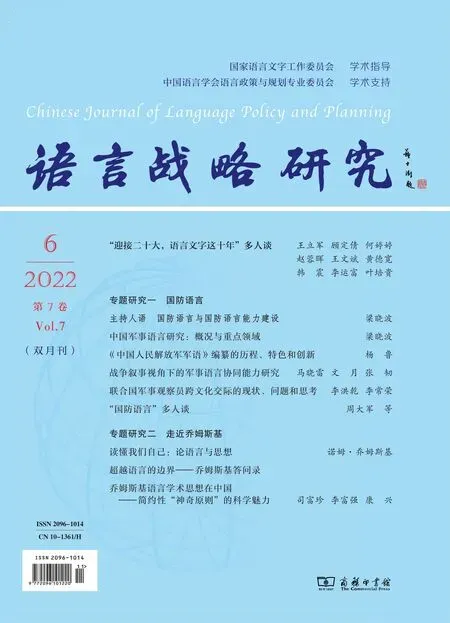
讀懂我們自己:論語言與思想*
2023-01-25 02:18:38諾姆喬姆斯基司富珍趙欣宇
語言戰略研究 2022年6期
〔美〕諾姆·喬姆斯基司富珍,時 仲,趙欣宇(譯)
(1.麻省理工學院 語言學系 美國 波士頓 MA02139;2.亞利桑那大學 語言學系美國 圖森 AZ85721;3.北京語言大學 語言學系 北京 100083)
提 要 德爾斐神諭諭示我們要“認識自己”,這首先要重視我們作為同一物種的共同屬性。語言與思想是將人類與其他物種區分開來的兩個重要屬性,而語言與思想具有等同關系:語言是生成思想的系統,思想則是由語言所生成的,它們為人類所共有,并且在重要的方面為人類所獨有。回顧思想史和科學史上關于語言和思想的生成性、普遍性及創造性本質的認識,可以洞察科學家始終堅守著揭示復雜表象的簡約性“神奇原則”。在此背景下,為了解決“人類語言的成就如何成為可能”這一“伽利略謎題”,可以引入關于語言研究的“強式最簡主義”思路和關于詞語指涉事物的“言語行為”觀。當然,語言與思想并非人類的唯一特征。認識自己,關乎我們當前面臨并且亟待化解的生存危機,關乎人類的未來。
一、引言:德爾斐神諭的啟示
我們最好從頭(即2500年前那個最早有詳細記載的時期)說起:相傳,德爾斐①古希臘重鎮,阿波羅神廟所在地。——譯者注在那時頒布了一道神諭,它定義了我們這個物種的主要任務——認識自己。
這個由兩個詞組成的格言警句“認識自己”可以從幾個不同的方面得到解釋。綜合我們目前所知以及我們認識中最重要的方面來看,最合理的便是按照集體義來解釋這一神諭:它是一則給我們人類集體的緊急忠告,敦促大家嘗試去解讀自身:讀懂我們人類到底是何種生物。
而我們實際上是些奇異的動物,既是進化史上的驕傲,也是地球的禍害。想弄明白其中原因并非易事。但我們必須及時搞明白它,這樣才有可能避禍就福。
人類出現的時間非常晚,大約在二三十萬年前,在進化史上這不過是一眨眼的時間,因此我們之間差異非常有限,這一點也就毫不奇怪了。但是,人們總是覺得這些微小的差異至關重要,而對于共同之處則不把它們當回事。要讀懂我們自己,正確的立場剛好相反:最為重要、最能揭示真相的恰好是我們之間的共同之處,它將我們與地球上所有其他的生命徹底區分開來。而我們之間的差異則只是表面現象。
這一點不僅在純粹智力的層面上是成立的,而且從人類生活的角度看也是如此。放眼整個人類歷史,我們正處于一個獨特的時刻,要求我們必須迅速、果斷地做出決定,否則人類社會是否還能以任何一種有組織的形式維持下去都會是個問題,這一點已經不是什么新聞了。當下危機交匯,關乎人類存亡。所有這些都是人類作為集體所共同面對的問題,不分你我。我們要么共同來回答這些問題,要么就什么都解決不了——這樣的話人類實驗將以不光彩的結局宣告結束。我后面還會就這個問題說幾句。
所以我們有足夠的理由將神諭所給予的忠告按集體義來釋解:“我們到底是一群怎樣的生物?”哪些是為人類所共有,而生命世界里的其他物種,包括那些屬于人類近親屬的高等類人猿,卻都不具有的物種屬性?這就是被古人類學家稱為“人類的能力”的屬性。
在研究這個問題時,我想我們找到了符合這一嚴格標準的兩個顯著屬性:語言和思想(至少是那些我們可以把握和學習的“思想”)。正是語言和思想使得人類能夠去發布關于神諭的公告,去反思其意義,去為那些我們心智中被喚醒的問題尋找答案。而在人類最平凡的日常生活經歷中,語言與思想也發揮著同樣的作用。這些都為人類所共有,并且在重要的方面為人類所獨有。
二、語言與思想研究中的“神奇原則”
如果研究表明語言和思想這兩個具有區別性意義的屬性實質上定義了我們這一物種,那么接下來的問題就是,它們之間有著怎樣的關系。對此最簡單的回答就是等同關系。語言是生成思想的系統,而思想是由語言所生成的。
而實際上這也正是在神諭發布的同時就給出的答案。在古印度,有一位著名的梵語學者巴特哈里,他是印度偉大的語法傳統和哲學傳統的奠基人之一。在他的概念里,“語言不是意義的載體或思想的傳遞者”,而是它的生成原則:“思想錨定語言,語言錨定思想……使用語言就是在思想,思想則通過語言而‘振蕩’。”
類似的觀點在思想史上不斷回蕩。16世紀時西班牙醫學哲學家胡安·瓦爾特就強調人類理解力中那個為人類所獨有的特性,他稱之為“生成品質”:這是一種我們在正常生活中一直使用的能力,我們用語言建構新思想,并且還用語言去理解他人的思想。這為不久之后發生的第一次認知革命奠定了基礎。瓦爾特還發現了另外一種更高形式的才智,這種才智使得某一些人得以創造具有真正智力水平和審美價值的作品,而其他像我們這樣缺乏這種天賦的人,則至少可以享受它、欣賞它,有時候還可以繼承它并發揚光大。這是我們物種的另外一種屬性,它可能是由語言-思想的復合體派生而來的。
瓦爾特也堅持關于語言結構普遍性的觀點,認為大腦是認知功能的物質場所,同時他還堅持認為這些認知功能具有天賦性。隨著對人類理解力這一生成品質認識的加深,這些思想復活了,它們是在人們對久已被遺忘的歷史一無所知的情況下復活的,是在1950年代被稱作“認知革命”的運動中復活的,是在與當時盛極一時的結構主義-行為主義教條的斷然決裂中復活的。
這些思想曾經繁榮于17世紀科學革命期間,并為現代科學奠定了基礎。而那次革命的核心部分則是,科學家們都愿意沉迷于對簡單的事情的思考,雖然一般人常常認為這些事是理所當然的。為什么石頭會向地球落下,而蒸汽則會離開地面向上升騰?為什么我們會把某些視覺呈現的東西看成三角形?伽利略和他同時代的人們不滿足于用“神秘思想”去解釋世界上發生的事情。他們希望將注意力集中在簡單的現象上,并為它們尋求解釋。這種研究思路如同孩子不斷地追問為什么。這一立場此后一直推動著人類理解向前發展。
伽利略認為自然是簡單的,而科學家的任務則是揭示自然的這一簡單性。對伽利略來說,這是一種指導研究工作的理想。在隨后的若干年里,人們發現這一點在許多領域都是正確的,它也因此成為一種堅定信念——即阿爾伯特·愛因斯坦所說的“神奇原則”(Miracle Creed),用他的話說就是“一條屢試屢驗到令人驚訝程度的神奇原則”。
語言也沒有逃過現代科學奠基者們的法眼。伽利略及其同時代人曾表達過他們對一個非凡事實的敬畏和好奇:只需要幾個符號,我們每個人就都可以在我們的頭腦里建構出無限的思想來,還可以在對方不進入我們大腦的情況下把我們思維中最為內在的部分傳達給他們。對笛卡爾來說,語言通常所具有的創造性使用的特點是他所說的第二物質(即思維,res cogitans)的基礎,它將語言與思想聯系起來,是一種獨屬于人類的物質。伽利略認為,字母表是人類最令人嘆為觀止的發明,因為它捕獲到了語言的這一奇跡。
幾個世紀后,現代邏輯和邏輯哲學的奠基人戈特洛布·弗雷格也回應了伽利略發出的這一驚嘆。弗雷格發現:“語言的成就令人驚訝。它用幾個音節表達了無數的思想,甚至對于一種人類首次掌握的思想來說,它也為之提供外衣,這樣,對它一無所知的其他人也能夠認識它。”
這些偉大的思想家對人類語言如此驚嘆是完全在理的,正如他們一直堅持對那些看似平淡無奇、不言而喻的事情保持疑問一樣。仔細觀察就會發現,這些事情看似平淡無奇、不言而喻,實際卻并非如此。
三、語言與思想的“伽利略謎題”
關于語言和思想的這一洞察引出了一個我們稱之為“伽利略謎題”的問題:人類語言的這一成就何以成為可能?在我看來,這個伽利略謎題似乎清楚地抓住了在探究語言和思想的本質(它事實上是人類獨特的本質)方面所面臨的主要任務。
正是這一伽利略謎題催生了普遍唯理語法的豐富傳統。說它“普遍”,是因為它尋求人類語言的普遍原則;稱之曰“唯理”,是因為它試圖超越描寫的局限,而去尋求解釋。在這一傳統中,人們始終普遍認為語言與思想緊緊地捆綁在一起。19世紀時的語言學家威廉·德懷特·惠特尼曾用一句簡單的話表達了這種共識,即語言是有聲的思想——盡管我們現在認識到聲音并非占據那么獨一無二的地位;其他感官模式也可以起到同樣的作用。偉大的人文主義者、現代研究型大學的創始人威廉·馮·洪堡特進一步將語言與思想等同起來,把語言描述為“一種生成活動”,并對如下事實進行了深入思索,即,語言的這種生成活動可以“將有限手段無限地使用”,而這正是伽利略謎題的一個基本特征。
洪堡特對伽利略謎題的表述揭示了以往整個研究傳統中的一個嚴重缺憾,即,未能考慮到亞里士多德對擁有知識和使用知識(用當代的話來說就是對語言能力和語言運用)所做的關鍵區分:以往的傳統一直專注于使用知識的方面,更具體地說,就是專注于言語產出中的知識使用問題,卻很少提及語言感知問題,然而語言感知是現代心理語言學的首要關注點。而感知和產出都可以觸及人們內在擁有的知識。
那時還沒有合適的工具用來清楚地制定和實施如下基本任務:揭示所擁有的知識體系,這個知識體系用現代技術性的說法來表達就是內在語言或I-語言。
上述這一缺憾被阿蘭·圖靈以及20世紀早期其他一些偉大的數學家所創造的現代計算理論彌補了。他們重塑了這一傳統。這些工具使人們得以重新認識曾被遺忘的亞里士多德對擁有知識和使用知識所做的區分,也第一次使得人們對“擁有的知識”展開認真研究成為可能。同時,他們也使得“一個有限的機制是如何產生無限的輸出結果的”這一問題變得清晰起來。當然他們也并沒有完全解決洪堡特關于言語產出的困惑,但它使我們有可能開辟出可行的研究領域來,即研究人們所擁有的知識的生成問題:手段有限,但范圍卻無限。而語言的產出,就像其他創造性活動一樣,無論在任何基本意義上都無法探究,它如同簡單自發行為一般難解。
語言的生成和產出之間的區別是一個根本性的問題,但恰恰也是經常被誤解的問題。語言生成性劃定了語言的地盤,它包括了語言所建構的所有思想,無窮無盡。而語言產出則是使用這些語言所建構的思想的一種活動,并且這些活動通常是以人們還不理解的創新性和創造性方式進行。用笛卡爾的術語來說,我們對語言的使用是適應環境的,而非由環境引起的。我們被引導并傾向于以某種方式說話,但卻并不是被強迫這么做。而瓦爾特意義上的更高形式的創造力則更為神秘。
上面提到的這種計算理論作為新工具,使我們首次有可能發展出一種關于語言的解釋性理論,這種語言可以產生無限的、由層級結構所構成的表達,而這些結構則用來建構思想,并且可以通過感官運動媒介(通常是聲音)來得到外化——這一點可以稱作語言的基本屬性。
這項事業一經著手便暴露出了問題。當時占統治地位的結構主義-行為主義理論所達成的共識中并沒有什么真正的不解之謎,似乎所有根本的東西都已知曉;各種分析程序可用于任何材料的語料庫,從而產出結構描述。正如美國著名語言學家雷納德·布龍菲爾德所提出的那個廣為接受的理論教條:語言習得被理解成僅僅是訓練和習慣的問題。
而當尋求解釋的努力一旦開始,就發現實際上幾乎什么都不知道。幾乎每一句話都會帶來新的困惑。而且,在他們關于研究程序的時間表里也找不到任何構成最佳解釋理論應該有的基本要素;而在其他科學分支中,重要的理論要素是一定會列入工作程序的時間表里的。尋找最佳理論是一項創造性的活動,這種努力無法通過算法來實現。
四、關于語言的強式最簡主義解釋方案
對于語言來說,解釋必須從兩個層面進行。關于某一種語言的生成語法應該是一種試圖解釋該語言屬性的理論,而語言的屬性即指語言使用者所擁有的知識。在更深層次上,關于人類所共享的語言官能的理論關注的是使語言習得成為可能的先天因素,這些先天因素將人類與所有其他有機體區別開來。用現代術語來說就叫做“普遍語法”(universal grammar,UG),這是一個由傳統術語改編而來并融入新的理論框架中的概念。
UG似乎有著相互矛盾的若干目標,它必須滿足至少3個方面的條件:
(i)首先,UG必須足夠豐富,以克服刺激的貧乏性(poverty of stimulus,POS)問題:事實上,所獲得的知識明顯遠遠超出能夠接觸到的可用證據的范圍。這是有時被稱作為“柏拉圖問題”的一個特例。正如伯特蘭·羅素所言,我們為什么能在證據如此少的情況下懂得這么多?
(ii)同時,UG又必須足夠簡單,它是在人類進化所提供的種種條件下進化而來的——這點有時被稱作“達爾文問題”。
(iii)UG對于所有可能的語言一定是相同的,它是一種固定不變的人類物種屬性。這一點是必然的,因為事實上不存在只針對特定語言的生物適應機制。
只有把研究重點限制在可以同時滿足可學性、進化性和普遍性的共同機制上,我們才能對某些語言現象提供真正的解釋,盡管這三者之間看起來存在矛盾。也正是調和相互沖突的需求這一目標在推動著理論探求的發展進程。
早在生成語法初期,這些問題就已經顯現。而現在我們才知道,問題的嚴重性遠超我們當時的預期。
就進化性而言,有關基因的研究表明,人類在出現后不久就開始分化。語言官能是先天存在的,就目前所知,人類之間并無區別。此外,也沒有充分的證據支持符號的使用存在于智人(現代人類)出現之前。這些事實說明,語言與現代人類幾乎同時出現。如果這一結論正確,我們就會認為語言的基本結構應該是相當簡單的。這是人類始祖大腦內部曾經發生的某種相對來說小型的線路重組的結果,它一經發生,至今未曾改變。因此,這與可學性之間的明顯矛盾變得更加尖銳。
語言習得領域的研究進一步加劇了這一困境。研究表明,兩三歲的孩子已經大致掌握了其語言的基本特性,包括一些顯著特征。此外,對兒童實際獲得的數據的統計學研究表明,孩子所獲得的相關證據非常稀少。這些發現似乎要求UG必須非常豐富,以解決稀少的可用數據和獲得的豐富知識之間的巨大差距帶來的問題。然而,進化條件則又要求UG是非常有限的。再加上其后還有數量上顯然無窮無盡的變體問題。
在過去的一些年里,最簡方案讓我們看到解決這一糾結困境的希望。想了解它是如何做到這一點的,我們可以來看一下結構依存性這一語言的最基本的也是最費解的普遍屬性。
先來想一想下面這個簡單句的特性。實驗結果表明,兩歲的孩子就已經能夠掌握它:
(1)The boy and the girlarein the room.
這里用的是“arein the room”,而不是“isin the room”。
這一現象讓人困惑。要確定一致性問題,兒童依靠的并不是鄰接原則這一最簡單的計算規則,相反,他本能地依賴于某種他從未聽到過的規則:他依賴的是其大腦創造的結構。接著,孩子依據這個抽象結構的本質為句子指派復數形式。
這個問題很容易得到延伸。請看以下句子:
(2) a.The friend of my brotherswashappy.
b.The friends of my brotherwerehappy.
在決定是使用was還是were時,我們忽略線性上的鄰接關系,只關注那個由名詞短語做主語的結構。不僅如此,還必須更進一步去尋找這個名詞短語中的中心成分friend/friends,即那個線性距離上更遠一些的名詞。結果證明這一計算過程并非微不足道,它遠比線性鄰接規則復雜,但更加簡單的線性鄰接規則卻被本能地忽略了。
接下來,讓我們更進一步。“The mechanic who fixed the car carefully packed his tools”是一個有歧義的句子:可以解讀為“fixed the car carefully”(小心地修理汽車)或者“carefully packed his tools”(小心地打包工具)。現在,把副詞carefully(小心地)放在前面:“Carefully, the mechanic who fixed the car packed his tools”這個句子的含義就變得明確了,意為他小心地打包了工具。副詞carefully需要尋找一個動詞,但它卻不能使用最簡單的計算過程:選擇線性距離最近的動詞。UG迫使我們忽略簡單的計算,而選擇線性距離更遠的動詞——當我們按照大腦告訴我們的正確方式指派結構時,我們就會發現這恰好是結構上距離最近的動詞。
毋庸置疑,這些都不可能是后天學到的。
神經語言學中有證據支持這一觀點。實驗表明,如果向被試展示根據真實語言建模的人造語言,大腦中語言區的反應是正常的;但是,如果人造語言使用線性順序等非常簡單的規則,這時大腦中出現的擴散性活動則表明,大腦將這種人造語言視作謎題進行處理,此時語言區就不會被激活。
因此,我們就會產生一個嚴重的困惑:嬰兒明明聽到的是線性順序,但卻將其盡數忽略,而只關注他從未聽到的那些由大腦所構建的抽象結構。而且,這一點適用于所有語言中的所有結構。
那么,看來唯一合理的答案就是,線性順序對正在習得構建思想系統的孩子來說還沒有什么用。但如果是這樣,為什么語音上還需要線性化呢?原因顯而易見。發音系統無法產出結構,所以外化程序就必須把線性順序強加于生成思想的內在系統上,而實際上內在系統其實并非是按線性順序排列的。手語在線條性上就不那么嚴格,因為運用手語時在視覺空間中有更多的選擇。
用于外化的感覺-運動系統(Sensory-Motor System)與語言無關;它們早在語言出現之前就存在了,而且從那時起就沒有改變過。真正的語言是產生思想的內部系統I-語言,它對于個體來說是內在的,在大腦中編碼為遞歸的生成程序。
我們現在面臨的問題是,為什么嬰兒聽到的是線性順序,卻本能地將其百分之百地忽略,而只關注他從未聽到的、由大腦構建的抽象結構。
我們近期發現,對此有一個直截了當的答案。那就是,要滿足“基本屬性”就需要一個計算程序。而最簡單的程序則是二分的固定形式,它在最近的研究中被稱作“合并”(Merge)。如果遞歸生成是基于“合并”程序,那么結構依存性就是強制性的,因此也就不存在線性順序,這一點很容易證明。在這方面,語言符合那個“神奇原則”,即去尋找最簡單的解決方案。
這會產生多方面的影響。其中影響之一是,某些思想在言語中變得難以表達,有時即使非常簡單的思想也可能如此。為了說明這一點,讓我們把注意力從合取式并列結構轉到析取式結構上來。比如“Either John or Maryisin the room”以及“Either the girls or the boysarein the room”這兩個句子。我們來看看,這個結構如果是“Either the girls or John [is] in the room”或“Either the girls or John [are] in the room”情況會是怎樣的呢?這時你會發現這兩種結構都不可能。句子想要表達的思想很清楚,而如果數的一致關系是基于線性上的鄰接關系,那表達應該不會存在問題。但考慮到結構依存性,這個思想內容就無法用最簡單的方式表達出來了,因為在這個析取結構中存在著內部沖突。
這只是最佳設計和溝通效用之間存在沖突的眾多例子之一,還有許多例子問題更加嚴重,而解決這些問題的方式卻總是相同的:那就是,總是犧牲溝通效用。打個比方,大自然母親在構建語言時關心的是最佳設計,而不是如何使用這個系統。所以如果語言有時功能缺失,那也只能由它去了。
值得注意的是,這是物種進化的普遍方式。我們可以區分一般進化演變的3個階段。第一個階段是革新階段。某些基因發生了破裂,有可能是基因突變或者基因轉移,或者個別細菌意外吞食某種微生物從而變成真核細胞,也就是復雜生命的基礎形態。所以是基因破裂帶來了新生事物。接下來就到了第二個階段,即重構階段:大自然以最簡約的方式重新設計出一套滿足自然法則的新系統。這些在達西·湯普森關于萬物生長法則以及阿蘭·圖靈關于自然法則下斑圖①即圖靈斑圖,指自然界中所呈現的不斷重復、周期性排列的圖案,如獵豹的斑點、斑馬的條紋、貝殼的紋路。——譯者注形成機制的經典著作中曾有過深入的探討。這同樣也是“神奇原則”的再現。進化的第三個也是最后一個階段是篩選階段:自然選擇使得物種的多樣性有所減少,那些適應性更強的生物種類生存了下來。由上一個進化階段所產生的最簡策略或許會存在功能缺失之處,但大自然對此并不介意。在重構的過程中,大自然尋求的是最佳設計,而無法顧及它有哪些可能的功用。
語言似乎也符合這種一般的進化模式。可以設想一種與之相仿的進化情景:大腦中的某個部位發生了線路重組,它帶來了遞歸生成的普遍屬性。隨后大自然依照通常的做法,運用自然法則(具體到這里的討論就是計算效率原則,因為我們正在討論計算系統的問題)去尋求一種最簡操作。結果是,大自然尋求到的是一種基于合并的系統,它滿足語言的基本屬性的需要。緊接著就出現了語言最深層次、同時也是最讓人感到意外的一個屬性——結構依存性,同時也帶來了一系列后果。這些內容又經由普遍語法進行編碼加工。正因如此,嬰兒會本能地忽略掉耳朵里聽到的一切,而只在意自己大腦中創造出來的抽象結構,并最終把它充實為思想。
據此,我們可以為普遍語法所面臨的難題設想一種解決方案:在研究思想生成的核心系統時,可以暫且將多樣性條件②即前文提到的“普遍性條件”,普遍性與多樣性實際上是一個問題的兩個方面。——譯者注(條件iii)擱置一旁。語言的多樣性可能很大程度上是在詞匯的邊緣層面以及語言外化層面產生的;或許有朝一日,我們能夠獲知,事實上多樣性全部都是在這些層面產生的。而在我看來,目前的研究正朝著這個趨勢發展,這也將會是一個自然而然的結論。而刺激貧乏性之于核心系統來說則非常嚴苛、無法跨越,就像上面談到的結構依存的情況那樣。此外,感覺-運動和I-語言的關系也引出了很多認知方面的問題,這些問題可以通過多種方式解決。如果結論表明語言的復雜性、易變性以及多樣性的核心原因即在于此,那應該也就并不奇怪了。這些想法如果沒錯,那么所有這些語言的復雜性、易變性和多樣性問題就都只是些表面現象罷了。
倘若如此,至少對于I-語言來說,難題就被大大簡化了,只要滿足進化性條件(條件ii)就足夠了。只要I-語言的結構由最簡操作生成而來,問題便迎刃而解。這也是強式最簡主義(Strong Minimalist Thesis,SMT)為語言理論設立的首要目標。其假設內容是,語言在構建思想的核心屬性方面,與大自然的其余組成部分一樣,同樣符合“神奇原則”。
上述觀察結論印證了一種傳統觀念,即語言從本質上講是一個關于思想的系統。而那個關于語言根本上是一個可能從動物交際演化而來的交際系統的現代教條看來是站不住腳的。
再回到進化的情景上來。進化史的第三個階段,即篩選階段,其實目前的研究顯然還從未觸及。不過,看起來篩選的結果是語言之間似乎沒有什么差異,這一點應該是對的。之所以沒有差異,或許是因為進化時間還太短,抑或是因為整個系統結合得太過緊密而無法分開,因此篩選的結果是要么全有、要么全無,這很有趣。這點得到越來越多復雜案例的印證。
五、關于詞語指涉事物的“言語行為”說
與其繼續討論更多關于可信性解釋的案例,接下來不如換個話題,探討思想是如何在頭腦中豐盈起來的。
I-語言是一個計算系統。任何一個這樣的計算系統都會有原始元素(即用于計算的原子成分)以及用于生成新元素的計算程序。
對語言來說,這些原始元素就是最小的“有意義的”成分,在類似英語這樣的分析性語言中通常就是單詞。所以我們才會看到《詞語和對象》(W.V.蒯因)或《詞語和事物》(羅杰·布朗)這類標題的書籍。而對于一般意義的語言來說,原始元素并不是單詞。甚至如果我們仔細觀察,會發現英語同樣如此,不過這里暫且不做詳細討論。
這些書名反映出一種主流觀點,即詞語指涉世界上的事物,且詞語與外部事物通過指稱關系建立聯系。對于科學界來說,建立這樣一種對應關系是一種規范做法。當科學家們談到“鈾”或“基因”時,他們希望確實存在這些東西。動物的交際系統看上去也遵守這些條件,它們發出的信號(例如猴子的叫聲)和某種物理上可識別的事件之間存在一一對應的關系。但很多證據表明,指稱說在人類語言中并不成立。我們的確會使用詞語來指代某些事物,但那體現的是一種行為,也就是英國哲學家約翰·奧斯汀所說的言語行為。而如果我們仔細研究詞語的含義,就會對詞-物對應的觀點產生質疑。
哲學文獻中常常以一個假定的邏輯專名(logically proper name)為例,比如“倫敦”。倫敦曾被一場大火燒毀,而后又在泰晤士河上游50英里處重建,所用的材料和設計風格與此前截然不同。但我仍然完全可以說,我打算再去參觀一次倫敦。沒有人相信有現實世界中的某個實體具有這樣的屬性。實際上,“倫敦”并不是一個專有名詞,而只是一個城市的名稱。“城市”作為一種心理概念則具備更為豐富、復雜的屬性,在使用“倫敦”一詞進行指代性的言語行為時,這些屬性就會被傳遞下去。
上述觀察結論可以擴展到全部詞匯,這與亞里士多德所持觀點相仿。他在討論“房子”一詞時觀察到,房子其實是一種物質和形式的混合體。物質部分即物理學家可以辨別的東西,如磚頭、木材等。其形式則是一種精神層面的構造:設計上的規劃構思、建筑師的意圖想法、特色的功能用途等等。某個物體可能看起來和我的房子一模一樣,但它實際上是個圖書館,或者車庫,又或是巨人的鎮紙,而這些屬性都無法通過物理手段檢測到。
在亞里士多德之前,希臘哲學家赫拉克利特也表達過類似的觀點。他問道,如果一條河流的物質成分發生改變,我們又如何能夠兩次踏進同一條河流?這是一個很深奧的問題。但稍加思考就會發現:從上文提到的“言語行為”的角度看,如果河流的物質變化較為猛烈,那么它指的仍然是同一條河流;反而是,如果只發生細小輕微的變化,它就不能稱作河流,而可能是水道,或者是表面硬化的什么東西,甚至可能是公路。其他用來指代事物的最簡單的詞匯道理也是如此。
語言和思想的這些特征又引出了新的難題,即,上述這些知識都必須不假學習便可知曉,并且還應當在最根本的方面具備跨語言的共性。語言習得研究表明,在這些知識的習得過程中呈現給習得者的外部材料少之又少,這意味著,習得過程主要依靠的是一套豐富的天賦而來的結構。而學習的過程顯然就是把語言相對表面的那些屬性設置好的過程。而在動物符號系統中,并不存在非常相似的概念。當然也沒有任何關于它們這方面發展的記錄。
出于以上原因,人類概念的起源似乎是一個無望破解的神秘謎題,它深埋在智人的史前時代。但仔細想想又不是這樣。作為計算的原子成分,這些豐富繁多而又錯綜復雜的概念,假如游離于那個能夠產生進入推理、思考和其他心理行為的復雜表達的、生成思想的語言系統之外,它們將百無一用。倘若概念先于語言出現,它們將被視為無用的廢物而被棄置。因此,一個合理假設是:語言表達的遞歸生成能力出現后,取代了原始人類用于表達基本概念的詞匯;后來,隨著生成語言和思想的組合可能性的出現,具有獨特人類特征的概念才正式登場。具體過程我們無從知曉,但至少可以就這個問題展開探索。
強式最簡主義在這里再次發揮作用。當某種進化創新出現時,大自然會尋求最簡約的方式來進行適應。參與進來的因素越簡單,所產生的系統就越精細。介入的因素過多,后果可能就會變得混亂不堪。可以想象,概念作為人類思想的獨特資源,強式最簡主義的簡約性和嚴律性在其發展過程中起到了舉足輕重的作用。人類在數萬年的歷史上形成了豐富而有創造力的生活以及復雜多樣的社會秩序,隨著這些更多地為人們所了解,也會有更多新穎、有益的見解進入人們的視野。而這將是舉世歡欣之事。
六、余論:認識自己與人類未來
沿著上述路徑,我們或許能夠真正洞察到語言和思想的本質,也就是人類能力的最根本特征。當然,這不是我們唯一的特征。環顧四周就會發覺,作為一種出現在地球上沒多久的奇異生物,人類的身上還具備其他一些引人注目的特征,在一開始我就提到過。它們關乎我們當前面臨并且亟待化解的生存危機。
77年前的1945年8月6日①1945年8月6日,美軍向日本廣島投擲了原子彈,核武器首次被用于人類戰爭。——譯者注,這一議題以一種激烈的形式清晰地呈現在世人面前。自那一天起,我們認識到人類的智慧已經達到了可以摧毀全世界的程度——實際那時還未達到,但那時顯然就很清楚地表明,對人類的科學技術來說用不了多久就可以做到這點。后來事實上確實也僅在1952年便達到了這個水平:那一年,美國第一枚熱核武器爆炸,沒過多久,蘇聯也同樣做到了。
這引出了一個關于人性的深刻問題:我們的道德能力是否足以駕馭我們的毀滅能力?從隨后幾年的觀察來看,情況并不樂觀,在核武器之外的方面同樣如此。1945年時的人們還未察覺到,地球正在進入一個新的地質年代,即人類世,一個人類活動對環境造成嚴重影響的時代。這些影響已經危及我們這些有組織的人類的生存命運,更不用提那些正在被我們肆意毀掉的大量物種了。
地質學的國際權威組織將人類世的開始時間界定在第二次世界大戰后。自那時起,人類對地球的破壞急劇升級,現在情況已經達到了不可逆轉、一觸即發的地步。
隨著時間的推移,這一問題變得愈加凸顯和尖銳。人類所掌握的破壞能力和控制破壞沖動的道德能力之間存在著一定的差距。問題是,這個差距能被消除嗎?我們很快就會發現,如果選錯了答案,其他的事情就都不重要了。
1.Introduction: Enlightenment from the Delphic Oracle
A good place to begin is at the beginning, 2500 years ago, about as far back as detailed records go.That is when the Delphic Oracle issued a pronouncement defining our primary task: Know Thyself.
A two-word aphorism can be interpreted in many ways.Given what we know today, and what should be uppermost in our minds, a reasonable way to interpret the Oracle is in collective terms: as urgent advice to try to understand what kind of creatures we humans are.
And we are indeed strange beasts, at once the pride of evolutionary history and the scourge of the earth.It’s a challenge to find out how this could be.And an imperative to find out in time so that we can fend off the worst and aspire to the best.
Humans appeared very recently, some 2-300,000 years ago, a blink of an eye in evolutionary time.Not surprisingly, there is very limited diversity among us.The slight differences are what matter for life; the commonalities we take for granted.For understanding ourselves, the proper stance is the exact opposite: What is deeply important and most revealing is what is common to us, what distinguishes humans so radically from all other life on earth.Variation is superficial.
That much is true on pure intellectual grounds, but also in its import for human life.It is not news that we are at a unique moment in human history, a moment when decisions have to be made, quickly and decisively, as to whether human society will persist in any organized form.We are living at a moment of confluence of severe crises, existential ones.All are collective, with no boundaries.We will answer them together, or not at all, in which case the human experiment will come to an inglorious end.I’ll return at the end to a few words on that.
For good reasons, then, we should interpret the advice of the Oracle collectively: What Kind of Creatures are We? What are the species properties that are common to humans apart from severe pathology, and are without significant analogue elsewhere in the living world, even among our closest relatives the higher apes? These are the properties that paleoanthropologists call “the human capacity”.
When we inquire into this question, I think we find two striking properties that satisfy this austere criterion:language and thought—at leastthoughtin any sense that we can grasp and can study.It is language and thought that enable humans to issue the proclamation of the Oracle, to reflect on its meaning, to seek to find answers to the questions it awakens in our minds.And the same is true of the most mundane experiences of ordinary human life,all common to humans and in important ways distinctive to the human species.
2.“Miracle Creed” in the study of language and thought
If inquiry reveals two distinct properties that virtually define the species, the next question is what relation holds between them.The simplest answer would be the relation of identity.Language is a system for generating thought,and thought is what is generated by language.
That in fact is the answer that was given at about the same time as the pronouncement of the Oracle: in classical India by a famous Sanskrit scholar, Bhartrhari, one of the founders of the great tradition of Indian grammar and philosophy.In his conception, “language is not the vehicle of meaning or the conveyor of thought” but rather its generative principle: “thought anchors language and language anchors thought… using language is thinking, and thought ‘vibrates’ through language.”
Similar ideas resonate through intellectual history.The 16th century Spanish physician-philosopher Juan Huarte set the stage for the first cognitive revolution that followed shortly after by emphasizing what he called “the generative quality” of human understanding, unique to humans: the capacity that we constantly exercise in normal life in using language to construct new thoughts and to interpret those of others.Huarte also identified a still higher form of intelligence that enables some to create work of true intellectual and aesthetic value—while the rest of us,lacking this talent, are at least able to enjoy and appreciate it, sometimes to carry it forward, another species property that probably derives from the language-thought complex.
Huarte also insisted upon the universality of language structure, on the brain as the material site for cognitive functions, and on the innateness of these functions.Along with the generative quality of human understanding,these ideas have been revived, without any awareness of the long-forgotten history, in what is called “the cognitive revolution” of the 1950s, in a sharp break from then-prevailing structuralist-behaviorist doctrines.
These ideas flourished during the 17th century scientific revolution, which laid the basis for modern science.A core part of the revolution was the willingness to be puzzled about simple things, ordinarily just taken for granted.Why do rocks fall the earth while steam rises? Why do we see a certain visual presentation as a triangle.Galileo and his contemporaries were not satisfied with the “occult ideas” that were invoked to account for what happens in the world, and wanted to focus attention on simple phenomena and find explanations for them.Much as children do with their incessant why-questions.That’s the stance that has always driven understanding forward.
Galileo held that nature is simple and it is the task of the scientist to demonstrate that.For Galileo, it was an ideal to guide research.In the centuries that followed it has been found to be true in so many domains that it has become a firm belief—what Albert Einstein called a “miracle creed”.In his words, “a miracle creed which has been borne out to an amazing extent by the development of science”.
Language did not escape the attention of the founders of modern science.Galileo and his contemporaries expressed their awe and wonder about a truly remarkable fact: with a few symbols, each of us can construct infinitely many thoughts in our minds, and can convey to others with no access to our minds their most innermost workings.For Descartes, the normal creative use of language, employing this capacity, was a foundation for his postulating a second substance,res cogitans, relating language and thought, a substance unique to humans.Galileo himself regarded the alphabet as the most spectacular of human inventions because it captured this marvel.
Galileo’s amazement was echoed centuries later by Gottlob Frege, the founder of modern logic and logical philosophy.Frege found “astonishing what language accomplishes.With a few syllables it expresses a countless number of thoughts, and even for a thought grasped for the first time by a human it provides a clothing in which it can be recognized by another to whom it is entirely new.”
The amazement of these great thinkers is entirely warranted.As is their insistence on puzzlement over what seems commonplace and self-evident.It rarely is, when we look closely.
3.“The Galilean Challenge”
The insight about language and thought poses what we may call “the Galilean challenge”: How is this achievement possible? The challenge seems to me to capture lucidly the major task faced by the inquiry into the nature of language and thought, in fact into the unique nature of the human species.
The Galilean challenge initiated the rich tradition of General and Rational grammar, general because it sought universal principles underlying human languages, rational because it sought to go beyond description to explanation.Throughout, language was generally regarded as closely bound to thought.The common understanding was captured simply in the phrase of the 19th century linguist William Dwight Whitney that language is audible thought—though we now recognize that sound does not have that unique status; other sensory modalities will do.The great humanist and founder of the modern research university Wilhelm von Humboldt, went further.He identified language with thought.He characterized language as “a generative activity” and he pondered the fact that somehow this activity “makes infinite use of finite means”—a basic feature of the Galilean challenge.
Humboldt’s formulation of the Galilean challenge brings to light a serious gap in the entire tradition.It failed to accommodate Aristotle’s crucial distinction betweenpossession of knowledgeanduse of knowledge; in contemporary terms, between competence and performance.The tradition kept to use of knowledge, more specifically, use of knowledge in production of speech.Little was said about perception of language, a prime concern of modern psycholinguistics.Both perception and production access the knowledge that is internally possessed.
Appropriate means were not available to formulate clearly and pursue the fundamental task: to unearth the system of knowledge possessed, the internal language, I-language in modern technical usage.
This gap was overcome by the modern theory of computation created by Alan Turing and other great early 20th century mathematicians and adopted in the modern reshaping of the tradition.These tools made it possible to resurrect Aristotle’s forgotten distinction between possession and use of knowledge and to launch serious study of possession of knowledge for the first time.They also made it clear how a finite mechanism can have infinite output.That does not entirely resolve Humboldt’s puzzle about production, but it makes it possible to carve out the domain of feasible inquiry: the study of generation of the knowledge possessed, with finite means and infinite scope.Production of language, like other creative activity, is beyond reach of inquiry in any fundamental sense, as is even simple voluntary action.
The distinction between generation and production of language is fundamental, and commonly misunderstood.Generation lays out the terrain: here are the linguistically-formulated thoughts, the whole infinite range of them.Production is an activity that makes use of these thoughts, commonly in innovative and creative ways that are not understood.In Cartesian terms, our use of language is appropriate to circumstances but not caused by them.We are incited and inclined to speak in certain ways, but not compelled.And Huarte’s higher form of creativity is still more mysterious.
The new tools of the theory of computation made it possible for the first time to develop explanatory theories of a language that yield an infinite array of hierarchically structured expressions that constitute thought, and can be externalized in some sensory-motor medium, usually sound—what we can call the Basic Property of Language.
As soon as this enterprise was undertaken, problems arose.The reigning structuralist-behaviorist consensus had no real puzzles.Everything essential was known; procedures of analysis could be applied to any corpus of materials, yielding a structural description.Acquisition of language was understood to be just a matter of training and habit, as the leading American linguist, Leonard Bloom field, formulated widely accepted doctrine.
As soon as the search for explanation began, it turned out that almost nothing was known.Virtually every sentence poses new puzzles.Furthermore, the elements that were postulated in the best explanatory theories could not possibly be found by a schedule of procedures, just as in every other branch of science.Search for the best theory is a creative activity.There are no algorithms for such endeavors.
4.The Strong Minimalist Thesis
Explanation in the language case has to proceed at two levels.A generative grammar of a language is a theory that seeks to account for its properties, the knowledge possessed by the language user.At a deeper level, the theory of the shared language faculty is concerned with the innate factors that make language acquisition possible—factors that distinguish humans from all other organisms.In modern terms, it’s calleduniversal grammar, UG, adapting a traditional term to a new framework.
UG has goals that appear contradictory.It must meet at least three conditions:
(i) UG must be rich enough to overcome the problem of poverty of stimulus (POS), the fact that what is acquired demonstrably lies far beyond the evidence available.This is a special case of what is sometimes called“Plato’s problem”; as formulated by Bertrand Russell, how can we know so much with so little evidence?
(ii) UG must be simple enough to have evolved under the conditions of human evolution—sometimes called“Darwin’s problem”.
(iii) UG must be the same for all possible languages, a fixed human species property.It’s necessary given the fact that there is no biological adaptation to specific languages.
We achieve a genuine explanation of some linguistic phenomenon only if it keeps to mechanisms that satisfy the joint conditions of learnability, evolvability, and universality, which appear to be at odds.The course of theoretical inquiry has been driven by the goal of reconciling these conflicting requirements.
These problems were evident at the outset of the generative enterprise.We now know that they are considerably more severe than was then envisioned.
With regard to evolvability, genetic studies have shown that humans began to separate not long after their appearance.There are no known differences in Language Faculty, which must have already been in place.Furthermore, there is no meaningful evidence of symbolic activity prior to emergence of Homo sapiens (modern humans).These facts suggest that language emerged pretty much along with modern humans.If so, we would expect that the basic structure of language should be quite simple, the result of some relatively small rewiring of the brain that took place once and has not changed in the brief period since.The apparent contradiction with learnability therefore becomes even sharper.
Research on language acquisition has extended the dilemma further.It has shown that a child of two or three years old has largely mastered basic properties of its language, including some remarkable ones.Furthermore,statistical study of the data actually available to a child shows that relevant evidence is very sparse.These discoveries seem to require that UG must be very rich in order to overcome the enormous gap between data available and knowledge attained, while the evolvability condition demands that UG be very restricted.And the problem of apparently endless variation lurks in the background.
In the past few years, some hope has emerged to resolve this tangle of dilemmas, within the so-called minimalist program.We can see how by looking at a fundamental and quite puzzling universal property of language:structure-dependence.
Consider the properties of this simple sentence, mastered by two-year-old children as experiment has shown:
(1) The boy and the girlarein the room.
Not “isin the room”.
That raises puzzles.To determine agreement, the child does not use the simplest computational rule,adjacency.Instead, the child reflexively relies on something it never hears: the structure its mind creates.The child then assigns plurality by virtue of the nature of this abstract structure.
The problem quickly extends.Let me take the sentences below as example:
(2) a.The friend of my brotherswashappy.
b.The friends of my brotherwerehappy.
To decide whether to usewasorwere, we ignore linear adjacency and attend only to the structure, the Noun Phrase subject.But we have to go beyond to find the central element of the Noun Phrase,friend/friends, the more remote Noun.That turns out to be a non-trivial computation, far more complex than linear adjacency, which is reflexively ignored.
Let’s take it a step further.Consider the sentence “The mechanic who fixed the car carefully packed his tools”.It is ambiguous,“fixed the car carefully” or “carefully packed his tools”.Now put the adverb “carefully” in the front:“Carefully, the mechanic who fixed the car packed his tools?” It is now unambiguous.It means that he carefully packed his tools.The adverbcarefullyseeks a verb, but it cannot use the simplest computation: pick the linearly closest verb.UG forces us to ignore that simple computation and to select the more remote verb—which happens to be the structurally closest verb as we see when we assign the structure in what our minds tell us is the correct way.
It goes without saying that none of this can possibly be learned.
There is supporting neurolinguistic evidence.Experimental work shows that if subjects are presented with invented languages modelled on actual ones, the language areas of the brain react normally; but if the invented languages use very simple rules involving linear order, there is diffuse activity in the brain, indicating that it is being treated as a puzzle, not activating the language areas.
We therefore have a serious puzzle.The infant ignores 100% of what it hears—linear order—and attends only to what it never hears, abstract structures that its mind constructs.Furthermore, this is true for all constructions in all languages.
The only plausible answer is that linear order is simply not available to the child who is acquiring a system that constructs thoughts.Why then does speech require linearization? The reason is obvious.The articulatory system cannot produce structures, so the externalization process must impose linear order on an internal system of generation of thought, which is unordered.Sign language is less strictly linear because of wider options available in visual space.
The sensory-motor systems used for externalization have nothing to do with language; they were in place long before language emerged, and have not changed since.True language is the internal system that generates thought,the I-language—internal to an individual, coded as a recursive generative procedure in the brain.
We now face the question why the infant reflexively ignores 100% of what it hears—linear order—and attends only to what it never hears—abstract structures constructed by the mind.
We’ve recently discovered that there is a straightforward answer.Satisfaction of the Basic Property requires a computational procedure.The simplest procedure is binary set-formation, called “Merge” in recent work.It is easy to show that if recursive generation is based on Merge, then structure-dependence is imposed and there is no linear order.In this respect, language conforms to the miracle creed, and seeks the simplest solution.
There are many consequences.One consequence is that certain thoughts become inexpressible in speech, even very simple ones.To illustrate, let’s shift from conjunction to disjunction.Take the sentences “Either John or Maryisin the room” and “Either the girls or the boysarein the room”.How about “Either the girls or John [is or are] in the room”? Neither is possible.The thought is clear, and if number agreement were based on adjacency it could be easily expressed.But with structure-dependence, the thought is inexpressible in the simplest way, because of the internal conflict within the disjunction.
This is one of many examples of conflict between optimal design and utility for communication.There are many others that are far more serious than this one.They are always resolved the same way: communicative efficiency is always sacrificed.To put it metaphorically, when Mother Nature was constructing language, she was concerned with optimal design, not how the system might be used.If it turns out to be dysfunctional, so be it.
It’s worth noting that that’s how evolution works quite generally.We can distinguish three stages in normal evolutionary change.The first stage is innovative.Some disruption takes place, maybe mutation or gene transfer or a bacterium accidentally swallowing some microorganism, leading to eukaryotic cells, the basis for complex life.The disruption introduces something new.Then comes the second stage, reconstruction: nature re-designs the new system in the simplest way, satisfying natural law.These are matters discussed in depth in classic work of D’Arcy Thompson on laws of growth and by Alan Turing on creation of patterns by physical law.It is the miracle creed once again.The final, third stage of evolution is winnowing: natural selection reduces the variety to the better adapted.The simplest solution produced at the second stage might turn out to be dysfunctional, but nature doesn’t care.In reconstruction, nature seeks optimal design.It has no way to consider possible functions.
Language seems to fit the normal pattern.We can envision an evolutionary scenario that looks something like this.Some small rewiring of the brain yielded the general property of recursive generation.Nature then took the usual course of seeking the simplest such operation, relying on natural law (in this case, principles of computational efficiency, since we are dealing with a computational system).The result is a system based on Merge, which satisfies the Basic Property.The deepest and most surprising property of language, structure-dependence follows at once, with its ramified consequences.UG encodes the outcome.The infant therefore reflexively ignores everything it hears and attends only to the abstract structures its mind creates, fleshed out as thoughts.
In these terms, we can envision a resolution of the conundrum facing UG: the diversity condition (iii) can be put to the side in the study of the core system of generation of thought.The variety of languages might be localized largely in peripheral aspects of lexicon and in externalization; perhaps completely localized there, we might someday learn.Research seems to me to be tending in that direction, and it would be a natural outcome.The poverty of stimulus (POS) conditions on the core system are severe, sometimes clearly insurmountable, as in the case of structure-dependence.Furthermore, the Sensory-motor (SM)/I-language relation poses a cognitive problem that can be solved in many ways.It would not be surprising to find that it is the locus of the complexity and mutability of language along with their variety of languages—all superficial if these ideas are on the right track.
If so, at least for I-language, the conundrum is largely reduced to satisfying the evolvability condition(ii).That problem will be overcome to the extent that the structures of I-language are generated by the simplest operations.TheStrong Minimalist Thesis(SMT) sets this outcome as a prime goal of the theory of language.The assumption again is that language conforms to the miracle creed along with the rest of nature in its core property of construction of thought.
These observations reinforce the traditional view that language is essentially a system of thought.The modern doctrine that language is basically a system of communication that may have evolved from animal communication that seems quite untenable.
Returning to the evolutionary scenario, the third stage, the winnowing stage apparently has never been reached, though it seems to be no diversity.Possibly that’s true, because the time has been so short, more interestingly, because the system is so tightly integrated that it’s either all or none.That seems to be increasingly what we find when we investigate more complex cases.
5.Words and objects: A “Speech Act” perspective
Instead of going on to further cases of genuine explanation, let’s turn to how thoughts are fleshed out.
I-language is a computational system.Any such system has primitive elements—atoms of computation—and computational procedures to form new elements.
For language, the primitives are the minimum “meaning-bearing” elements.In an analytic language like English, these are often words, so you have major books with titles likeWords and Objects(W.V.Quine) orWords and Things(Roger Brown).For language generally,wordis not the right concept, even for English if we look closely,but let’s keep to that.
The titles of the books reflect the standard view that words are linked to mind-external objects by the relation of reference: words refer to things in the world.For the sciences, establishing such a relation is a norm.When scientists speak of Uranium or genes, they hope there are such things.It also seems that animal communication systems observe these conditions, with a 1-1 relation between the signals, say a monkey call, and some physically identifiable event.But there is very strong evidence that human language does not observe the referential doctrine.We of course do use words to refer.That is an action, what the British philosopher John Austin called a speech act.When we look closely at the meanings of words, it is hard to sustain the idea that there is a word-object relation.
Take a standard example in the philosophical literature, a supposedly, logically proper name, likeLondon.I can perfectly well say that I’m going to visit London again after it was destroyed by fire and rebuilt 50 miles up the Thames with different materials and design.No one believes that there is a real-world entity with such properties as these.The wordLondonis not a proper name, it’s a city name, and our mental conceptcityhas rich and complex properties, carried over when we use the wordLondonin the speech act of referring.
The observation generalizes to the whole vocabulary.The basic point was recognized by Aristotle.Aristotle discussed the wordhouse.He observes that house is an amalgam of matter and form.The material part is what a physicist could identify: bricks, timber, and so on.The form is a mental construction: the design, the intention of the architect, the characteristic use, and so on.Something could look exactly like where I live but not be a house,could be a library, could be a garage, could be a paperweight for a giant.These are not properties determined,detectable by physical examination.
Even earlier, a similar point was made by the Greek philosopher Heraclitus when he asked how we can cross the same river twice, though its material component has changed.It’s a deep question.A little thought shows that under radical material changes it remains the same river, while under slight changes it might not be a river at all,could be a canal, or with a hardened surface, could even be a highway.That turns out to be true of even the simplest words that we use to refer.
These features of language and thought raise new conundrums.All of this must be known without learning, and correspondingly seems to be shared cross-linguistically in fundamental respects.Studies of language and language acquisition have shown that these items are acquired on very few presentations, implying that they are based on rich innate structure.Learning is apparently a matter of settling relatively superficial properties.There are no significant analogues to such concepts in animal symbolic systems.Of course, we have no record of their development.
For these reasons, the origin of human concepts has seemed a hopeless mystery, buried deep in the pre-history of homo sapiens.But on reflection, that seems most unlikely.The rich and intricate concepts that are the atoms of computation would have no function outside of a system of generation of thought that yields complex expressions that can enter into reasoning, reflection, and other mental acts.If they had emerged before language, they would have been useless waste and would have been discarded.So, it is reasonable to suppose that when the capacity emerged for recursive generation of thought, it appropriated a lexicon of very elementary concepts available to proto-humans; and only later, as the combinatorial possibilities of generating language and thought became available,concepts of the distinctive human character appeared—how, we can only guess, but at least it might be possible to explore the question.
Here again the role of the Strong Minimalist Thesis (SMT) might appear.When some innovation appears,nature seeks the simplest way to accommodate it.The simpler the factors that do so, the more refined will be the system that is produced.With many factors intervening the result is likely to be chaotic.It is not too much of a stretch of the imagination to think that the simplicity and discipline of the Strong Minimalist Thesis had a significant role in the development of these unique conceptual resources of human thought.As more is being learned about the rich, inventive, creative lives and complex social orders of the tens of thousands of years of human history that are now becoming accessible to inquiry, new and helpful insights into these questions might be coming into view.It will be exciting cross-world.
6.Concluding remarks: Understanding ourselves and the shared future of human being
Following these paths, we may hope to gain real insight into the nature of language and thought, fundamental features of the human capacity.Fundamental, but of course not all inclusive.When we look around us, we see other striking features of this strange creature that recently appeared on earth, those features I alluded to at the outset,having to do with the existential crises that we face and must overcome soon.
The issue arose with dramatic clarity 77 years ago, on Aug.6th, 1945.On that day, we learned that human intelligence had reached the level where it had found ways to destroy us all—actually not quite yet, but it was clear that science would soon reach that point.And it did, in 1952, when the US exploded a thermonuclear weapon, soon followed by the Soviet Union.
That raised a profound question about human nature: can our moral capacity rise to the level where it will control our capacity to destroy? The record of the years that follow is not encouraging, not just with regard to nuclear weapons.It was not known in 1945, but the world was entering into a new geological epoch, the Anthropocene, an epoch in which human activity has a grave impact on the environment, so serious that it imperils the survival of organized human life on earth, not to speak of the vast number of species that we are wantonly destroying.
The World Geological Organization has dated the onset of the Anthropocene to the period after World War II,when the destruction sharply escalated—By now, it has reached the level where irreversible tipping points are in sight.
The question has only become more stark over the years.There is a gap between the human capacity to destroy and human moral capacity to control their impulse.Can that gap be overcome? We will soon find out, and if it’s the wrong answer, nothing else is gonna matter.
猜你喜歡
華人時刊(2022年7期)2022-06-05 07:33:26
大科技·百科新說(2021年6期)2021-09-12 02:37:27
當代陜西(2021年13期)2021-08-06 09:24:34
好孩子畫報(2020年5期)2020-06-27 14:08:05
文苑(2020年4期)2020-05-30 12:35:30
意林·全彩Color(2019年6期)2019-07-24 08:13:50
人大建設(2019年4期)2019-07-13 05:43:08
當代陜西(2019年12期)2019-07-12 09:11:50
小學生作文(中高年級適用)(2018年3期)2018-04-18 01:24:47
華北電力大學學報(社會科學版)(2016年4期)2016-12-01 03:59:30